
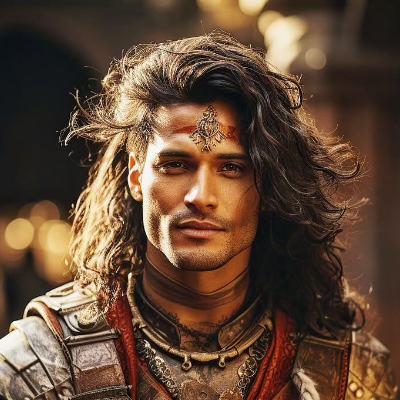
About
Shankha — Prince of Matsya and Son of Virata
Shankha · Sankha · Son of Virata · Prince of Matsya
Shankha was a prince of the Matsya kingdom, identified in certain recensions of the Mahabharata as a son of King Virata, ruler of Matsya, and his chief queen Sudeshna, who was the daughter of Kekaya, a Suta chieftain of the Kekaya country of northwestern Bharatavarsha, and of Malavi, a woman associated with the Malava country of central Bharatavarsha. He was thus the brother of Uttara Kumara, the prince of Matsya who served as Arjuna's charioteer during the Kaurava cattle raid on the kingdom, and of Uttaraa, the princess of Matsya who became the wife of Abhimanyu and the mother of Parikshit, the last Kuru king recorded in the Mahabharata. Shankha is mentioned in the Mahabharata as having been killed in the Kurukshetra war. His presence in the text is limited and his profile within the primary sources is among the briefest of the named Matsya royal figures. The textual tradition is not uniform regarding his identity, and his mention is absent from some recensions while present in others.
✦ The Name
The name Shankha is a Sanskrit word meaning conch shell, the same term applied to the sacred conch instruments blown by warriors at the commencement of battle in the epic tradition. The name is common in the broader Mahabharata world — most famously, the conch of Arjuna was named Devadatta, and the Bhagavata Purana and other texts use shankha as a name and epithet for various figures and objects of sacred significance. As a personal name for this prince of Matsya, it carries no elaborated symbolic significance within the text itself; it functions purely as an identifying designation.
✦ Lineage
- Father: Virata — king of the Matsya kingdom, a ruler of the lunar dynasty; hosted the five Pandava brothers and Draupadi during their thirteenth year of incognito exile; fought on the side of the Pandavas in the Kurukshetra war and was killed during the conflict
- Mother: Sudeshna — daughter of Kekaya the Suta chieftain and of Malavi; chief queen of Virata; sister of Kichaka, the commander-in-chief of the Matsya armies who was killed by Bhima, the second of the five Pandava brothers, during the Pandavas' year of concealment at Virata's court
- Brother: Uttara Kumara — prince of Matsya; served as charioteer to Arjuna during the Kaurava cattle raid on Matsya; participated in the Kurukshetra war and was killed on the first day of battle by Shalya, king of Madra
- Sister: Uttaraa — princess of Matsya; became the wife of Abhimanyu, son of the Pandava Arjuna and his wife Subhadra, who was the sister of Krishna; mother of Parikshit, who inherited the Kuru throne after the Kurukshetra war as the last surviving heir of the Pandava line
- Maternal uncle: Kichaka — commander-in-chief of Virata's armies; the dominant military power in the Matsya court during his lifetime; killed by Bhima during the year the Pandavas spent in disguise at Virata's court after his assault upon Draupadi, the wife of the five Pandava brothers
- Maternal uncles: The Upakichakas — the brothers of Kichaka and Sudeshna who served in the Matsya military establishment; killed by Bhima at the cremation ground after they attempted to burn Draupadi alive with Kichaka's corpse
✦ Death in the Kurukshetra War
The Mahabharata records that Shankha was killed in the Kurukshetra war fighting on the side of the Pandavas alongside his father Virata and his brother Uttara Kumara. The text identifies Drona — the preeminent teacher of martial arts of the Kuru period, who served as a commander of the Kaurava forces — as the warrior who killed Shankha. Beyond this single fact, no further detail of his conduct in the war, the day on which he fell, or the circumstances of the encounter with Drona is preserved in the surviving primary sources.
✦ Textual Variants and Inconsistencies
Shankha's presence in the Mahabharata is not uniform across all recensions of the text. He is mentioned in certain versions as a son of Virata alongside Uttara Kumara, but his name is absent or differently handled in other portions of the manuscript tradition. The critical edition of the Mahabharata prepared at the Bhandarkar Oriental Research Institute reflects this inconsistency. Unlike Uttara Kumara, whose role in the charioteer episode of the Virata Parva gives him a sustained and clearly defined narrative presence, Shankha appears only in the context of the Kurukshetra war and only as a name attached to the fact of his death. Some secondary sources treat him as a confirmed son of Virata while others note the uncertainty of his textual status. The profile is accordingly brief, and no expansion beyond what the attested portions of the primary text directly state is possible without departing from the evidence.
✦ Connection to the Wider Genealogy
As a son of Virata and Sudeshna, Shankha was a grandson of Kekaya the Suta chieftain and of Malavi, and a nephew of Kichaka and the Upakichakas. His death in the Kurukshetra war without recorded issue, together with the deaths of his brother Uttara Kumara and his father Virata in the same conflict, left the male line of the Matsya royal family through Virata and Sudeshna extinguished within that generation. The continuation of all genealogical significance from this branch of the Matsya house passed through Uttaraa and her son Parikshit, who carried the combined Matsya and Kuru-Pandava lineage into the post-war era. Shankha himself left no recorded descendants and no continuing line within any surviving primary source.
✦ References
- Mahabharata, Drona Parva (Book 7): Primary source for the death of Shankha; records his killing by Drona during the Kurukshetra war while fighting on the side of the Pandava coalition.
- Mahabharata, Bhishma Parva (Book 6): Lists the Matsya forces under Virata among the commanders and contingents of the Pandava army at the outset of the Kurukshetra war; supplies the broader context for Shankha's participation in the conflict.
- Mahabharata, Stri Parva (Book 11): Records lamentation over warriors killed in the war including members of the Matsya royal family; contributes context for the scale of loss suffered by Virata's house in the conflict.
- Vettam Mani, Puranic Encyclopaedia (1975): Entry on Shankha identifies him as a son of Virata killed in the Kurukshetra war and notes the limited textual basis for his profile; synthesises the available Mahabharata material without contributing independent primary source detail beyond what the epic itself supplies.