
About
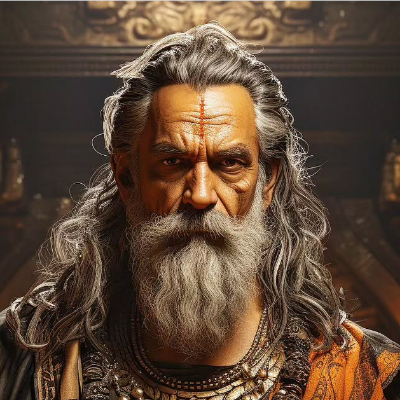
Suvarnavarman — King of Kashi, Son of Sarvaga, Father of Vapushtama, Contemporary of the Chandogya Upanishad
Suvarnavarman · Suvarṇavarman · Suvarnasena · Suvarnavarma · Subarnavarma · Kashi-raja · Sarvaga-putra · Bhima-prapautra · Vapushtama-pita · Janamejaya-shvaशura
Suvarnavarman — also written Suvarnasena, Suvarnavarma, and Subarnavarma across different primary and secondary sources — is the king of Kashi (the ancient kingdom centred on present-day Varanasi); the son of Sarvaga, who ruled Kashi after the Kurukshetra War and was the son of the Pandava Bhima and his wife Balandhara; the great-grandson of Bhima through the Kashi royal line; the father of Vapushtama, who married the Kuru king Janamejaya and bore him the sons Shatanika and Sankukarna; and thus the father-in-law of Janamejaya himself. His existence is confirmed in the primary Mahabharata text (Adi Parva, Chapter 44 in the Adi Parva 44 source and Chapter 95 in the genealogical summary) under the form Suvarnavarman — where the text records that Janamejaya's ministers approached him, the king of Kashi, to give his daughter Vapushtama in marriage to the young Kuru king. He is the king who examined Janamejaya's qualities according to dharma, found him worthy, and gave his daughter with all ordained rites. Beyond these canonical facts, the IndiaForums source adds a remarkable detail: Suvarnavarman administered the three kingdoms of Kashi, Mithila (Videha), and Kosala — the arrangement inherited from his father Sarvaga — and appointed the priest Jatukarna for all three kingdoms. In doing so he rejected Svetaketu — the celebrated philosopher who appears in the Chandogya Upanishad in the famous dialogue with King Pravahana Jaivali — who had sought one of the three priestly positions. This reference places Suvarnavarman as a contemporary of the Chandogya Upanishad's philosophical narratives, connecting the Kashi royal genealogy to one of the foundational texts of the Upanishadic tradition.
✦ The Name — Variants and Their Sources
The Sanskrit name Suvarnavarman is a compound of suvarna (golden, of good colour, gold itself — from su meaning good or excellent and varna meaning colour or quality) and varman (armour, shield, protection — a suffix common in royal and Kshatriya names meaning protector). The compound means he whose armour is golden, the golden-armoured one, the one protected by gold. As a royal name it records the king's prestige and martial dignity — the golden armour being both a literal royal attribute and a symbolic statement of his quality. The variant Suvarnasena — used in the Glorious Hinduism source — replaces varman with sena (army) giving he of the golden army, the one with a golden force. The variant Suvarnavarma and Subarnavarma — used in the Wikipedia characters list and the Bharatpedia source — are phonetic simplifications of the same primary name. All four variants refer without ambiguity to the same king of Kashi, son of Sarvaga, father of Vapushtama. The form Suvarnavarman has the strongest primary textual authority, being used in the Mahabharata text as cited by the Adi Parva 44 source (drawing from Bibek Debroy's unabridged translation of the Critical Edition text from the Bhandarkar Oriental Research Institute).
✦ Lineage
- Father: Sarvaga — the only surviving son of Bhima and his wife Balandhara; who ruled Kashi, Mithila, and Kosala after the Kurukshetra War;
- Paternal grandfather: Balandhara — princess of Kashi; the wife of Bhima through whose marriage the Kashi-Pandava family connection was established
- Paternal great-grandfather: Bhima — the second Pandava; son of Pandu and Kunti, who invoked the wind god Vayu to father him; making Suvarnavarman the great-great-grandson of Bhima through the Kashi line
- Priestly appointment: Jatukarna — appointed as royal priest for all three kingdoms of Kashi, Mithila, and Kosala under Suvarnavarman's administration; an unusual triple appointment reflecting the consolidated administration his father Sarvaga had established and that Suvarnavarman maintained
- Rejected candidate: Svetaketu — the celebrated Brahmin philosopher, grandson of the sage Uddalaka Aruni, who appears in the Chandogya Upanishad (6.1–16) in the famous Tat Tvam Asi discourse with his father Uddalaka; and again in the dialogue with King Pravahana Jaivali of the Panchalas (Chandogya Upanishad 5.3–10) — Svetaketu had sought one of the three priestly positions in Suvarnavarman's three kingdoms and was rejected in favour of Jatukarna; this makes Suvarnavarman a figure precisely contemporary with the Chandogya Upanishad's principal philosophical dialogues
- Daughter: Vapushtama — the most beautiful one; whose name records her outstanding physical grace; who married the Kuru king Janamejaya; who bore him Shatanika (the successor of Janamejaya; whose son was Ashvamedhadatta; whose line continued as the Kuru-Vatsa dynasty through Nicaksha to Kaushambi) and Sankukarna (mentioned only in the Mahabharata's Adi Parva and in the Harivamsa; absent from the major Puranas)
- Son-in-law: Janamejaya — the great Kuru king; great-grandson of Arjuna; who performed the Sarpa Satra (the snake sacrifice) at which the entire Mahabharata was first narrated by Vaishampayana to the assembled sages
- Grandsons: Shatanika — king of Hastinapura after Janamejaya; and Sankukarna — second son of Janamejaya and Vapushtama
✦ The Marriage Arrangement — Wisdom and Due Inquiry
The Mahabharata's Adi Parva records the circumstances of the marriage with a detail that reflects well on Suvarnavarman's character as a king. When Janamejaya was still a young boy newly installed on the Kuru throne after his father Parikshit's sudden death from Takshaka's bite, the ministers of Hastinapura recognised that the kingdom needed stability. They journeyed to Kashi and approached Suvarnavarman to propose a match between his daughter Vapushtama and the young king. Suvarnavarman did not accept the proposal immediately or unconditionally. The Mahabharata text records specifically that the king of Kashi, after due inquiries, bestowed his daughter on Janamejaya with all ordained rites. The phrase after due inquiries — present in both the Adi Parva 44 source's translation and in the mahabharata-stories blogspot retelling — is the tradition's record that Suvarnavarman performed his dharmic duty as a father: he examined the quality of the prospective groom, verified his lineage and character, and only then agreed. The approval was given not to the ministers' request but to the young king himself on his own merits — the king of Kashi judged Janamejaya worthy and gave his daughter accordingly. The choice was wise on both sides. Janamejaya received a queen of impeccable lineage — Pandava-descended through Bhima's Kashi line — whose connection to the Kuru household was already established through two generations of family alliance. Suvarnavarman secured his family's permanent connection to the main Kuru throne at Hastinapura, ensuring that the grandchildren of his daughter would rule the Kuru dynasty. Through Vapushtama's marriage his family moved from the orbit of the Kashi kingdom — important and ancient, but not the primary locus of Vedic political authority — into the direct centre of the Kuru succession. His grandsons Shatanika and Sankukarna were simultaneously Kashi royalty through him and Kuru royalty through Janamejaya.
✦ The Chandogya Upanishad Connection — A King Contemporary with Philosophy
The most historically resonant detail associated with Suvarnavarman is his rejection of Svetaketu as a candidate for royal priesthood. The Chandogya Upanishad — one of the oldest and most philosophically important of the major Upanishads, belonging to the Sama Veda — preserves two episodes involving Svetaketu that are among the most celebrated in the entire Upanishadic corpus. In the first (Chandogya Upanishad 6.1–16) his father Uddalaka Aruni teaches him the nature of ultimate reality through the famous Tat Tvam Asi discourse — that art thou, the foundational statement of Advaita Vedanta. In the second (Chandogya Upanishad 5.3–10) Svetaketu goes to the court of King Pravahana Jaivali of the Panchalas and is asked five questions about the nature of the soul, death, rebirth, and release, which he cannot answer — questions that his father Uddalaka also fails to answer, leading Uddalaka to acknowledge that the doctrine of the five fires and two paths belongs to a Kshatriya tradition that Brahmins had not previously known. The IndiaForums source's reference places Suvarnavarman as a king who administered three kingdoms — Kashi, Mithila, and Kosala — in the same region and period as these Chandogya Upanishad dialogues, who appointed Jatukarna as his priest, and who rejected Svetaketu when Svetaketu sought one of the three priestly positions. If this identification is accurate — and the IndiaForums source presents it as a well-researched genealogical conclusion drawing from the Chandogya Upanishad's own internal references — then Suvarnavarman is the king at whose court the famous philosopher Svetaketu was turned away, who then went to seek the knowledge he lacked from King Pravahana Jaivali of the Panchalas. The theological consequence of that rejection — a Brahmin philosopher going to a king to learn what his own lineage had not taught him — was the Chandogya Upanishad's most celebrated philosophical teaching. The king who made it necessary, however indirectly, was the great-great-grandson of Bhima.
✦ Historical and Dynastic Significance
Suvarnavarman's reign represents the third generation of the post-Kurukshetra Kashi succession — Sarvaga, Suvarnavarman, and then the line continued until Kashi became absorbed into the Vatsa kingdom under later Kuru-Vatsa administrative reorganisation. His administration of three kingdoms simultaneously — Kashi, Mithila, and Kosala — reflects a period in the post-war political settlement in which the Pandava-connected Kashi royal house had temporarily consolidated regional authority across the eastern Gangetic plain in the absence of viable heirs in the neighbouring kingdoms. The kingdoms were not conquered but administered as a regent for kingdoms whose own successions were in flux. His daughter's marriage to Janamejaya and the sons she bore him were the mechanism through which the Kashi-Pandava branch reintegrated into the Kuru main line — the administrative consolidation of three kingdoms reducing to Kashi alone in the next generation, but the bloodline continuing powerfully through the queens of Hastinapura.
✦ References
- Mahabharata (Adi Parva, Chapter 44 / Astika Parva; and Chapter 95 of the genealogical summary) — the primary canonical source: the ministers of Janamejaya approaching Suvarnavarman the king of Kashi; Suvarnavarman's examination of Janamejaya after due inquiries; the giving of Vapushtama with all ordained rites; the birth of the two sons Shatanika and Sankukarna; the form Suvarnavarman confirmed in the Bibek Debroy translation of the Bhandarkar Oriental Research Institute Critical Edition
- Chandogya Upanishad (5.3–10 — the Pravahana Jaivali dialogue; 6.1–16 — the Tat Tvam Asi discourse) — the Upanishadic text that records the activities of Svetaketu in the same political and geographic context; the connection to Suvarnavarman's rejection of Svetaketu as a priestly candidate and the Chandogya's broader narrative of knowledge passing from Kshatriya kings to Brahmin seekers in this period
- Glorious Hinduism — Kasi Kingdom — the Suvarnasena form of the name; the full Kashi succession from Sarvaga through Suvarnasena to Vapushtama; the marriage to Janamejaya; Shatanika and Sankukarna as sons
- Wikipedia — List of characters in the Mahabharata; Bharatpedia — List of characters in the Mahabharata — the Subarnavarma form; Vapushtama as his daughter; the Kashi succession confirmed
- Mahabharata Stories Blogspot — Janamejaya Plans the Serpent Sacrifice; Abhinav Agarwal — Mahabharata Adi Parva Astika Parva; Adi Parva 44 (earth-history.com) — three independent summaries of the primary text passage recording Suvarnavarman's role in the marriage arrangement; the due inquiries detail confirmed in all three
- IndiaForums — Upapandavas (Sons and Daughters of the Five Brothers) — the crucial additional detail: Suvarnavarman administering three kingdoms — Kashi, Mithila, and Kosala; appointing Jatukarna as his priest; rejecting Svetaketu who sought one of the three positions; the genealogical research connecting Suvarnavarman's court to the Chandogya Upanishad's philosophical context
- Wisdomlib — Vapushtama; HinduPad — Vapusthama Wife of Janamejaya; Glorious Hinduism — The Ultimate Mahabharata Family Tree: modern summaries drawing from the above primary sources