
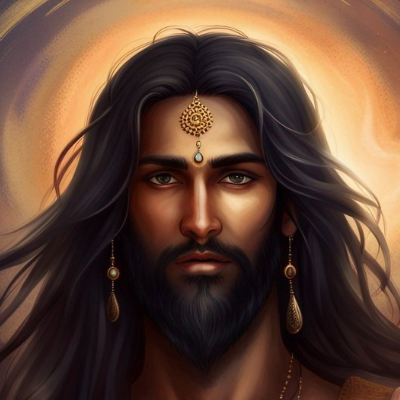
About
Vasudeva — Prince of the Vrishni Clan, Father of Krishna and Balarama
Vasudeva · Anakadundubhi · Shuraseni · Devakiputra-pita · Kundadhara · Kashyapa (prior life) · son of Shurasena
Vasudeva is a king of the Vrishni branch of the Yadava lineage and one of the most extensively documented figures in the Hindu Puranic and epic tradition. He is the son of Shurasena — ruler of the Surasena janapada with its capital at Mathura, and a descendant of Vrishni I, the eponymous founder of the Vrishni clan — and of Marisha, Shurasena's principal queen. Vasudeva is primarily known as the father of Krishna, the divine hero and avatar of Vishnu who stands at the centre of the Mahabharata, the Harivamsa, and the Bhagavata Purana, and of Balarama, Krishna's elder brother and a figure of immense strength celebrated across the same texts. He is also the brother of Pritha — given in adoption to King Kuntibhoja and thereafter known as Kunti — who became the mother of the three elder Pandava heroes Yudhishthira, Bhima, and Arjuna, thereby making Vasudeva the maternal uncle of the Pandavas. His life is shaped by a divine prophecy, a long imprisonment, and his central role in the circumstances surrounding Krishna's birth and early survival. He appears extensively in the Mahabharata, the Harivamsa, the Bhagavata Purana, the Vishnu Purana, the Matsya Purana, the Vayu Purana, and the Brahma Purana.
✦ The Name
The name Vasudeva is a Sanskrit compound of vasu and deva. Vasu carries multiple meanings — wealth, goodness, a class of eight divine beings associated with elemental forces — while deva means god or divine being. The compound may be rendered as "god of wealth," "the divine Vasu," or "he whose nature is divine goodness." It is a name of prestige within the Kshatriya tradition and also one that carries theological resonance, since his son Krishna is himself referred to as Vasudeva — meaning "son of Vasudeva" — across the Mahabharata and the Bhagavata Purana. The distinction between Vasudeva the father and Vasudeva as a name of Krishna is a persistent source of ambiguity in secondary discussions of the texts, though the primary sources are internally consistent in context.
The epithet Anakadundubhi — one of his most widely used alternative names — is explained in the primary sources as referring to the celestial kettledrums that sounded at the moment of his birth, heralding the arrival of a figure of cosmic significance. Anaka refers to a type of drum and dundubhi to a large kettledrum; the compound thus identifies him as "he at whose birth the divine drums resounded." The Harivamsa and Bhagavata Purana both record this explanation. The patronymic Shuraseni identifies him as the son of Shurasena, and Devakiputra-pita — "father of Devaki's son" — is a relational epithet used in some passages to identify him through his most celebrated son.
✦ Lineage
- Paternal great-grandfather: Vrishni I, eponymous founder of the Vrishni clan, a king of the Yadava lineage; husband of Gandhari and Madri
- Paternal great-grandmother: Madri, younger wife of Vrishni I, mother of the Madri-born branch including Yudhajit, Devamidhusha, and Anamitra
- Paternal grandfather: Devamidhusha (also Devamidha), son of Vrishni I and Madri, recorded in the Harivamsa, Vayu Purana, and Matsya Purana as Shurasena's direct progenitor
- Father: Shurasena, son of Devamidhusha, ruler of the Surasena janapada with its capital at Mathura, a senior king of the Vrishni-Yadava confederation
- Mother: Marisha, principal queen of Shurasena, identified in the Harivamsa as the mother of Vasudeva and his siblings
- Full brothers: Devabhaga, Devasravas, Anadhrishti, Kanavaka, Vatsaka, Grihajit, Shyama, and Shamika — all sons of Shurasena recorded in the Harivamsa and Vishnu Purana
- Full sister: Pritha (Kunti), eldest child of Shurasena, given in adoption to his childless cousin Kuntibhoja; she became the wife of King Pandu of the Kuru line and mother of Yudhishthira, Bhima, and Arjuna
- Additional sisters: Shrutadevi, Shrutakirti, Shrutashrava, and Rajadhidevi — daughters of Shurasena recorded in the Harivamsa
The Fourteen Wives of Vasudeva — as enumerated in the Harivamsa Purana, Harivamsa Parva, Chapter 35, and corroborated in the Brahma Purana:
The Harivamsa Purana, in its thirty-fifth chapter of the Harivamsa Parva, provides the most comprehensive enumeration of Vasudeva's household, naming fourteen women in his inner household and assigning them ranked positions. Seven of these fourteen are daughters of Devaka — a Yadava chief of the Bhoja clan and uncle of Kamsa — who were given collectively to Vasudeva in a marital alliance. The remaining wives came from other lineages or, in two cases at the end of the list, occupied the status of attendant-consorts within the household. The Bhagavata Purana (Canto 9, Chapter 24) and Vishnu Purana (Book 4, Chapter 15) record the seven daughters of Devaka independently, and the Matsya Purana corroborates the same tradition. What follows is the full household as the primary sources establish it.
First wife — Rohini:
- Background: Daughter of Bahlika, a senior Yadava-affiliated elder; she resided in Gokula under the protection of Nanda the cowherd chief during Vasudeva's imprisonment in Mathura
- Sons by Vasudeva: Balarama (born from the embryo transferred from Devaki's womb by divine intervention, carried by Rohini to term and born as her son; also known as Sankarshana, Halayudha, and Rohini's son), Sarana, Shatha, Durdama, Subhra, Bhadra, Durmada, and Nanda (not to be confused with Nanda the cowherd chief of Gokula)
- Daughters by Vasudeva: Subhadra, who became the wife of the Pandava hero Arjuna and mother of Abhimanyu — though some recensions of the Harivamsa and Bhagavata Purana attribute Subhadra to Devaki rather than Rohini; this variant is noted in the Textual Variants section
Second wife — Madira (also Indira in Sanskrit recensions):
- Background: An early consort of the Yadava household; her precise lineage is not consistently specified across all recensions
- Principal son by Vasudeva: Nanda; the Harivamsa also records a fuller list of sons attributed to this household in genealogical chapters separate from Chapter 35, including Nabhava, Subhanu, Svabhanu, Bhanumana, Chandrabhanu, Brihadbhanu, Atibhanu, Shribhanu, and Pratibhanu — whether all of these belong to Madira or are distributed across multiple wives differs between the Chapter 35 enumeration and the extended genealogical passages
Third wife — Vaishakhi:
- Background: An early consort of the Yadava household recorded in Harivamsa Chapter 35; her lineage and any children are not enumerated in the primary sources currently available
Fourth wife — Bhadra:
- Background: A noble Yadava clan princess recorded in Harivamsa Chapter 35
- Sons by Vasudeva: The Harivamsa records sons including Asanga (not to be confused with Asanga son of Satyaki in the Shini-Vrishni branch), Shalya (not to be confused with the Madra king of the same name), Vipulashringa, Kavi, Shanku, and Vipula in its extended genealogical passages, though the precise attribution of these sons to Bhadra specifically versus other wives requires care across recensions
Fifth wife — Sunamni (also Sunama):
- Background: Recorded in Harivamsa Chapter 35 and Brahma Purana
- Sons by Vasudeva: Vrikadeva and Gada; Gada is the better-attested of the two, appearing as a named Vrishni warrior in the Mahabharata and Harivamsa narrative sections
Sixth through twelfth wives — the seven daughters of Devaka:
Devaka, a Yadava chief of the Bhoja clan and the paternal uncle of Kamsa, had seven daughters whom he gave collectively in marriage to Vasudeva as part of a dynastic and political alliance within the Yadava confederation. The Bhagavata Purana (9.24.23), Vishnu Purana (Book 4, Chapter 15), and Matsya Purana enumerate all seven daughters; the Harivamsa Chapter 35 lists six of them by name within its ranked sequence, with Dhritadeva — the eldest — appearing to be absorbed into or substituted by another name in certain manuscript recensions, as discussed in the Textual Variants section. The seven daughters of Devaka, from eldest to youngest, are as follows.
- Dhritadeva (eldest daughter of Devaka): Recorded in the Bhagavata Purana (9.24.23) and Vishnu Purana (Book 4, Chapter 15) as the eldest of Devaka's seven daughters given to Vasudeva; her son by Vasudeva is named Viprishtha (also given as Viprstha in some recensions); she is absent from or displaced by another name in the Harivamsa Chapter 35 sequence, representing a genuine inter-textual inconsistency
- Shantideva (daughter of Devaka): Recorded in Harivamsa Chapter 35 and Brahma Purana; her sons by Vasudeva include Bhoja and Vijaya
- Upadevi (daughter of Devaka): Recorded in Harivamsa Chapter 35 and Brahma Purana; children not individually enumerated in the primary sources currently available
- Shrideva (daughter of Devaka): Recorded in Harivamsa Chapter 35 and Brahma Purana; children not individually enumerated in the primary sources currently available
- Devarakshita (daughter of Devaka): Recorded in Harivamsa Chapter 35 and Brahma Purana; her son by Vasudeva is named Upasangavara
- Sahadeva (daughter of Devaka): Recorded in Harivamsa Chapter 35 and Brahma Purana as the first of Devaka's daughters wedded to Vasudeva in the context of the alliance against Kamsa's growing power; children not individually enumerated in the primary sources currently available
- Devaki (youngest daughter of Devaka): The most celebrated of Vasudeva's wives and the mother of Krishna; her sons and the events surrounding their births are the central narrative of Vasudeva's life and are treated in full in the narrative sections of this profile
Children of Devaki by Vasudeva:
- Kirtiman: first son, surrendered to Kamsa and slain immediately after birth
- Sushena: second son, surrendered to Kamsa and slain
- Udayin (Bhadrasena in some recensions): third son, surrendered to Kamsa and slain
- Bhadrasena (Rijudasa in the Bhagavata Purana): fourth son, surrendered to Kamsa and slain; the Harivamsa and Bhagavata Purana differ on the names of the third and fourth sons — both accounts are recorded in the Textual Variants section
- Anjana (Sanjaya in some recensions): fifth son, surrendered to Kamsa and slain
- Kshatravridha (Devarakshita or Paribarha in some recensions): sixth son, surrendered to Kamsa and slain
- Balarama: seventh conception of Devaki; the embryo was transferred by divine intervention from Devaki's womb to the womb of Rohini in Gokula to protect him from Kamsa; born as Rohini's son and known as Sankarshana, Halayudha, and Balarama
- Krishna: eighth child of Devaki and the avatar of Vishnu; born in Kamsa's prison at Mathura and immediately carried by Vasudeva across the Yamuna to Gokula; the central figure of the Mahabharata, Harivamsa, and Bhagavata Purana
- Subhadra: daughter of Vasudeva; the principal tradition of the Harivamsa and Bhagavata Purana gives her as Devaki's daughter; some recensions give her as Rohini's daughter — both positions are noted in the Textual Variants section; she became the wife of the Pandava hero Arjuna and the mother of Abhimanyu
Thirteenth wife — Sutanu:
- Background: Described in the Harivamsa as an attendant who rose to the status of a wife within Vasudeva's household; some recensions of the Bhagavata Purana identify her instead as a princess of Kashi (Varanasi); the two traditions on her background represent a genuine inter-textual variant
- Son by Vasudeva: Paundraka; this Paundraka is to be distinguished with care from Paundraka Vasudeva — the king of the Pundra kingdom who appears in the Mahabharata and Bhagavata Purana claiming to be the true Vasudeva and demanding that Krishna relinquish that title; whether the two figures are related or identical is not resolved in the primary sources
Fourteenth wife — Badarva (also Yadavi in select Brahma Purana manuscripts):
- Background: Listed in Harivamsa Chapter 35 as the fourteenth member of Vasudeva's household; her status, like Sutanu's, is that of an attendant-consort rather than a royal wife; children not enumerated in the primary sources currently available
Vrikadevi — position in the household:
- Background: Documented in the Harivamsa as a royal princess — identified in some sources as a princess of the Trigarta kingdom, and in alternative traditions as one of the daughters of Devaka; if the latter, she would form part of the seven-daughters group, but the primary sources do not resolve this identification consistently
- Son by Vasudeva: Agavaha (also spelled Avagaha in some recensions); the Harivamsa's extended genealogical passages had earlier been cited with a different set of sons (Kaushalya, Kesari, Arka) attributed to this household in some secondary compilations — the Harivamsa Chapter 35 tradition giving Agavaha is treated as the primary-source attested position, and the discrepancy is noted in the Textual Variants section
✦ The Previous Life: Kashyapa and Aditi
The Bhagavata Purana presents a theological framework in which Vasudeva and Devaki are not merely human parents of Krishna but are the reincarnations of cosmic figures from an earlier age. In this account, preserved in Canto 10, Vasudeva was in a previous life the great progenitor-sage Kashyapa — one of the primordial Prajapatis and the father of the Adityas, Danavas, and many other classes of beings in the cosmological tradition — and Devaki was Aditi, the mother of the gods and Kashyapa's wife. In that earlier existence, Vishnu had been born to them as Vamana, the dwarf avatar, to restore cosmic order usurped by the Asura king Bali. Aditi had undertaken severe austerities to obtain Vishnu as her son again, and Vishnu had granted the boon that he would be born to them once more. The Bhagavata Purana presents Vasudeva and Devaki's births in the Vrishni lineage as the fulfilment of that ancient boon, with Krishna's birth as its culmination. This prior-life framework is specific to the Bhagavata Purana's theological elaboration and is not uniformly presented across all primary sources, though the Harivamsa and Vishnu Purana also contain elements connecting Vasudeva to cosmic significance.
✦ The Prophecy and the Marriage to Devaki
The central narrative of Vasudeva's life is set in motion at his wedding to Devaki, daughter of Devaka of the Bhoja-Yadava line. The wedding was celebrated with great ceremony, and Devaki's cousin Kamsa — son of Ugrasena, the king of Mathura, and a figure of growing and tyrannical ambition within the Yadava confederation — drove the wedding chariot himself as a mark of honour to his cousin. As the wedding procession moved through the city, a divine voice spoke from the sky, addressed directly to Kamsa, and declared that the eighth child born to the woman he was driving in the chariot would be his destroyer.
Kamsa, hearing this prophecy, immediately seized Devaki by the hair and drew his sword to kill her. Vasudeva intervened, and in a celebrated passage preserved across the Harivamsa, Bhagavata Purana, and Vishnu Purana, he reasoned with Kamsa calmly and offered him a solemn pledge: he would surrender every child born to Devaki into Kamsa's hands. Kamsa accepted this pledge and released Devaki, but he then imprisoned both Vasudeva and Devaki to ensure complete control over their offspring. From this point forward, the lives of Vasudeva and Devaki were spent in captivity in Mathura under Kamsa's direct supervision.
✦ The Imprisonment and the Slaying of the Six Sons
Vasudeva honoured his pledge with unfailing consistency. As each of Devaki's children was born in the prison, he carried the newborn to Kamsa, who killed each child in turn. The Harivamsa and Bhagavata Purana name the six sons who were surrendered and slain — though the two texts give slightly different names for some of them, as noted in the Variants section below. The grief of Vasudeva and Devaki through these successive losses is described in the primary sources with considerable pathos, particularly in the Bhagavata Purana's tenth canto, which frames their endurance as a form of devotional suffering that prepared the conditions for Krishna's divine birth.
The Bhagavata Purana adds a further cosmological layer to this account, stating that the six slain sons were not ordinary beings but were the six sons of the divine figure Marichi who had been cursed by the sage Brahma — or in another version by the sage Hiranyakashipu — and were expiating that curse through their brief lives and deaths as Devaki's children at the hands of Kamsa. This framework is specific to the Bhagavata's theological elaboration and is not the primary narrative focus of the Harivamsa's account of the same events.
✦ The Transfer of Balarama
When Devaki conceived for the seventh time, the divine plan to protect this child took the form of a miraculous embryo transfer. The Bhagavata Purana records that Vishnu, or in some accounts the goddess Yogamaya acting on Vishnu's command, caused the embryo to be drawn from Devaki's womb and placed in the womb of Rohini — Vasudeva's other wife, who was residing safely in Gokula, the cowherd settlement, under the protection of Nanda, the chief of the cowherds and Vasudeva's close friend. The transfer was accompanied by the impression that Devaki had suffered a miscarriage. The child born to Rohini from this transferred embryo was Balarama, also called Sankarshana from the act of being drawn across from one womb to another. Balarama is thus simultaneously the seventh child of Devaki by conception and the son of Rohini by birth, and both identities are preserved consistently across the primary sources that record this event.
✦ The Birth of Krishna and the Night Crossing
The birth of Devaki's eighth child — Krishna — is described across the Harivamsa, Bhagavata Purana, and Vishnu Purana as a moment of cosmic significance attended by celestial signs. The birth occurred at midnight, on the eighth day of the dark fortnight of the month of Bhadrapada, in the prison at Mathura. The Bhagavata Purana records that Vishnu himself appeared to Vasudeva and Devaki in his four-armed divine form at the moment of birth before taking the form of a human infant, and instructed Vasudeva to carry him immediately to Gokula and exchange him with the newborn daughter of Nanda the cowherd chief and his wife Yashoda.
What followed is one of the most celebrated episodes in the entire Puranic tradition. Vasudeva took the infant Krishna, placed him in a basket, and left the prison — the chains on his feet having fallen away, the locked doors having opened, and the guards having fallen into a supernatural sleep. He crossed the Yamuna River on foot in the middle of the night, carrying the infant above his head. The Bhagavata Purana records that the Yamuna's waters, though swollen with monsoon floods, parted or subsided to allow Vasudeva safe passage, and that the great serpent Shesha spread his hoods over Vasudeva and the child as a canopy against the rain. Vasudeva reached Gokula, exchanged Krishna for the newborn daughter of Yashoda — who lay in a state of post-delivery unconsciousness — and returned to the prison with the infant girl. The doors closed, the chains reformed, and by the time the guards woke and summoned Kamsa, only a girl child was present. Kamsa seized the child to kill her, but she slipped from his hands, rose into the sky in her divine form, laughed at him, and declared that his destroyer was already born and beyond his reach. This episode is recorded with substantial narrative detail in the Bhagavata Purana's tenth canto and in the Harivamsa, and with somewhat greater compression in the Vishnu Purana.
✦ Release from Prison and Reunion with Krishna
Vasudeva and Devaki remained imprisoned in Mathura throughout Krishna's childhood in Gokula and adolescence in Vrindavana. Their release came only when Krishna, having grown to young manhood, returned to Mathura with Balarama, killed Kamsa in the wrestling arena, and freed his parents from their long captivity. The reunion of Vasudeva and Devaki with Krishna — whom they had not seen since the night of his birth — is described with emotional weight in the Bhagavata Purana and Harivamsa. Vasudeva formally acknowledged Krishna as his son, and the family was reunited in the restored Mathura under the reinstated kingship of Ugrasena, Kamsa's father, whom Krishna and Balarama placed back on the throne.
Following the liberation of Mathura, Vasudeva performed the sacred thread ceremony and formal education rites for Krishna and Balarama, who were sent to the hermitage of the sage Sandipani at Avantipura for their formal training. The Bhagavata Purana and Harivamsa both record Vasudeva's performance of various religious rites and his resumed role as a senior Vrishni elder after his release.
✦ Role in the Kurukshetra War Period
Vasudeva is present as a senior elder of the Vrishni clan throughout the Mahabharata's narrative of the events leading to and following the Kurukshetra war. He participates in the assembly at Dvaraka where the Pandava and Kaurava factions both seek Yadava military support. He is present at major dynastic events including the marriage of Subhadra to Arjuna — which the Harivamsa records was arranged with Vasudeva's knowledge and Krishna's connivance, though the manner of the arrangement is described differently in different recensions. He performs sacrificial rites, presides over clan gatherings, and is consistently depicted as a figure of dignity and religious authority within the Vrishni confederation, even as his son Krishna's role as the central figure of the war grows ever more dominant in the narrative.
✦ Death and the Prabhasa Catastrophe
The Mausala Parva of the Mahabharata and the Harivamsa record the destruction of the Yadava clan at Prabhasa — the sacred bathing site on the western coast near Dvaraka — as the culminating catastrophe of the post-war period. The Yadavas, afflicted by a curse arising from an act of mockery directed at the sages Vishvamitra, Kanva, and Narada, fell into a catastrophic internecine conflict in which they destroyed one another with clubs fashioned from the reeds growing at Prabhasa. Krishna's son Pradyumna, his grandson Aniruddha, the warrior Satyaki, and vast numbers of the Vrishni and Andhaka clans perished in this massacre.
Vasudeva, already aged at this point, survived the initial carnage but did not long outlive it. The Mausala Parva records that after the destruction at Prabhasa, Vasudeva withdrew from the scene of slaughter, sat in a state of meditative grief, and died — in some accounts through yogic withdrawal, in others simply through the weight of age and sorrow at the destruction of his clan and the departure of Krishna. His death preceded or closely followed Krishna's own departure from the world, and the two events are presented in the primary sources as part of the same great closure of the Dvapara age.
✦ Theological and Philosophical Significance
In the theological framework of the Bhagavata Purana, Vasudeva's significance extends beyond his role as Krishna's biological father. He and Devaki are presented as the foremost devotees of Vishnu, whose patient endurance of imprisonment, grief, and surrender of their children is itself a form of the highest bhakti — devotional submission to the divine will. The Bhagavata frames their suffering not as misfortune but as divinely ordained preparation, the necessary context within which the avatar could take birth in the world. Vasudeva's act of carrying the infant Krishna across the Yamuna is treated in this tradition as one of the great acts of sacred service in all of cosmological history — a mortal carrying the divine across the waters of the world.
The identification of Vasudeva with the cosmic sage Kashyapa in the prior-life framework further elevates his theological status, connecting him to the primordial creative order of the universe and situating Krishna's birth within a pattern of divine descent that spans multiple cosmic ages. This framework is most fully developed in the Bhagavata Purana and represents that text's specific theological interpretation of the genealogical and narrative material shared across the wider primary-source tradition.
✦ Textual Variants and Inconsistencies
Several genuine inter-textual inconsistencies exist across the primary sources and are noted here without adjudication.
The most significant structural inconsistency concerns the enumeration of Devaka's daughters. The Bhagavata Purana (9.24.23), Vishnu Purana (Book 4, Chapter 15), and Matsya Purana consistently name seven daughters of Devaka given to Vasudeva, placing Dhritadeva as the eldest. The Harivamsa Chapter 35's ranked list of fourteen wives, however, names only six of Devaka's daughters explicitly, with Dhritadeva absent from the sequence. The position she would occupy in the Harivamsa list appears to be filled by either Vrikadevi or Sunamni depending on the recension consulted. This is a manuscript-level variance between primary sources of comparable standing, and cannot be resolved by adjudication in either direction.
The names of the six sons of Devaki slain by Kamsa differ between the Harivamsa and the Bhagavata Purana. The Harivamsa gives them as Kirtiman, Sushena, Udayin, Bhadrasena, Anjana, and Kshatravridha. The Bhagavata Purana gives a partially overlapping but distinct list in one passage, naming Smara, Udgitha, Parishvanga, Patanga, Kshudrabhrit, and Ghrini, while elsewhere identifying these sons with six cursed sons of the divine Marichi expiating their curse through brief mortal lives. Both accounts have standing in the tradition as primary sources.
The parentage of Subhadra is a second area of variant. The principal tradition of the Harivamsa and Bhagavata Purana identifies her as the daughter of Vasudeva and Devaki, making her the full sister of Krishna and Balarama. Some passages in the Harivamsa and certain recensions describe her as a daughter of Rohini, which would make her Balarama's full sister by the same mother but Krishna's half-sister. The majority tradition gives her as Devaki's daughter.
The sons attributed to Vrikadevi show a discrepancy between the Harivamsa Chapter 35 tradition, which gives Agavaha as her son, and certain secondary genealogical compilations that list Kaushalya, Kesari, and Arka under this household. The Chapter 35 primary-source reading is adopted here, and the secondary compilation list is noted as unverified against a specific primary verse.
The background of Sutanu presents a further variant. The Harivamsa describes her as an attendant-consort who rose to wifely status within the household. Certain recensions of the Bhagavata Purana identify her as a princess of Kashi. The two characterisations are not easily reconciled and represent a genuine divergence between primary source traditions on the same figure.
The identity of Paundraka — son of Vasudeva and Sutanu — in relation to Paundraka Vasudeva, the king of the Pundra kingdom who challenged Krishna's identity as the true Vasudeva in the Mahabharata and Bhagavata Purana, is left unresolved by the primary sources. Regional traditions link the two figures but no primary Puranic verse establishes the connection definitively.
The manner of Vasudeva's death is treated differently across sources. The Mausala Parva gives a compressed account of his end following the Prabhasa catastrophe. The Bhagavata Purana elaborates on his death as a conscious yogic departure consistent with that text's theological framing of his life as devotional service. The Harivamsa falls between the two in its level of elaboration.
✦ Connection to the Wider Genealogy
Vasudeva occupies the fourth generation of the Vrishni dynastic line in the majority primary-source tradition. His full patrilineal sequence runs: Vrishni I → Devamidhusha → Shurasena → Vasudeva → Krishna (and Balarama). Through his sister Pritha-Kunti, his line also intersects with the Kuru dynastic tree at the generation of the Pandavas. Through his daughter Subhadra's marriage to Arjuna, the Vrishni and Kuru lines are joined a second time in the following generation, producing Abhimanyu — the son of Arjuna and Subhadra — whose son Parikshit became the king of Hastinapura after the Kurukshetra war, carrying the combined blood of the Vrishni and Kuru lines into the post-war period and the opening of the Kali age.
✦ References
Primary Sources
- Harivamsa Purana, Harivamsa Parva, Chapter 35: The principal source for the complete enumeration of Vasudeva's fourteen wives, their ranked order, and the attribution of children to specific households; the foundational text for the full household record.
- Harivamsa Purana, Harivamsa Parva, Chapters 34, 47–52 and related narrative chapters: Source for the extended genealogical lists of Vasudeva's children across households, the events of his imprisonment, Krishna's birth and transfer, and his role as a Vrishni elder.
- Bhagavata Purana, Canto 9, Chapter 24, verse 23: Names all seven daughters of Devaka given to Vasudeva, including Dhritadeva as the eldest; corroborates the seven-daughters tradition and records Viprishtha as Dhritadeva's son.
- Bhagavata Purana, Canto 10, Chapters 1–4 and related passages: The principal theological source for the prior-life framework, the prophecy episode, the birth and transfer of Krishna, and the identification of the six slain sons with cursed cosmic beings.
- Vishnu Purana, Book 4, Chapter 15: Records the seven daughters of Devaka given to Vasudeva and corroborates Dhritadeva's position as the eldest; provides the genealogical sequence for the Vrishni succession.
- Matsya Purana, Chapter 45: Corroborates the seven-daughters-of-Devaka tradition and places Vasudeva within the Devamidhusha-Shurasena line.
- Brahma Purana, Chapter 112, verse 35: Corroborates the Harivamsa Chapter 35 enumeration of Vasudeva's wives and their ranked positions.
- Mahabharata, Adi Parva: Records Vasudeva's family background, his relationship to the Pandavas through Kunti, and the adoption of Pritha by Kuntibhoja.
- Mahabharata, Mausala Parva: Records the destruction of the Yadavas at Prabhasa and Vasudeva's death in its aftermath.
- Vayu Purana, Chapter 96: Corroborates the Vrishni genealogical sequence and Vasudeva's placement within the Madri-born branch of the clan.
Secondary and Reference Works
- Wisdomlib.org, Harivamsa Purana (Dutt translation), Chapter 35: Used for verification of the fourteen-wife enumeration and the ranked household list.
- Harivamsam.arasan.info, Harivamsa Parva Sections 35 and 37: Used for verification of wife rankings, background details for Vrikadevi and Sutanu, and the quoted passage establishing their distinct positions in the household list.
- Wikipedia, article on Vasudeva: Consulted as a secondary orientation resource; individual claims verified against primary sources before inclusion.
- Puranic Encyclopaedia (Vettam Mani): Consulted as a secondary reference for cross-checking the enumeration of Vasudeva's children and the identification of variant names across recensions.