
About
Rohini — Daughter of Bahlika, First Wife of Vasudeva, Mother of Balarama
Rohini · Pauravi · Rohini Devi
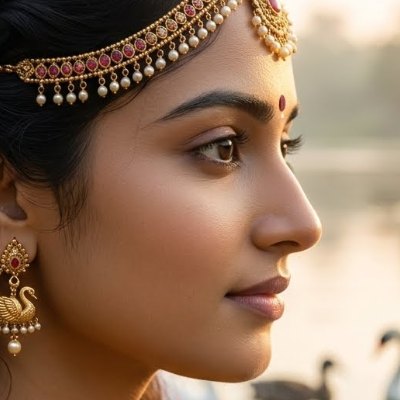
Rohini is a princess of the Kuru lineage, daughter of Bahlika — the eldest son of King Pratipa of Hastinapura and elder brother of Shantanu — and the first and principal wife of Vasudeva, the Yadava chieftain who is the father of Krishna. She is identified across the Mahabharata, the Harivamsha, and the Bhagavata and Vishnu Puranas as the surrogate mother of Balarama, Krishna's elder brother and an avatar of the cosmic serpent Adishesha, whose embryo was transferred from the womb of Devaki into Rohini's womb by the power of Yogamaya on the instruction of Vishnu. She is also the biological mother of Subhadra — the sister of Krishna and Balarama who became the wife of Arjuna and the mother of Abhimanyu — as well as of several other sons by Vasudeva. During the period of Vasudeva's imprisonment by Kamsa, Rohini lived under the protection of Nanda, the cowherd chief of Gokula, and it was in that household that she gave birth to Balarama and participated in the upbringing of Krishna. Her connection to the Kuru royal house through her father Bahlika makes her a figure standing at the genealogical intersection of the Kuru and Yadava dynasties.
✦ The Name
The name Rohini derives from the Sanskrit root ruh, to rise or to ascend, and is the feminine form of Rohana, meaning one who ascends or the ascending one. The name is shared by the bright red star Rohini — the fourth lunar mansion in the Vedic nakshatra system, identified with the star Aldebaran in Taurus — and by the moon-god Chandra's favourite wife, also called Rohini, who gives her name to that asterism. The name thus carries associations of luminosity, auspiciousness, and celestial favour. The designation Pauravi, by which Rohini is also known in some sources, is a gotra-derived title meaning one of the Puru lineage — appropriate since Bahlika, her father, was a prince of the Kuru-Paurava house, itself a branch of the Lunar dynasty founded by Puru. The relationship between Rohini and Pauravi as names for one or two persons is a textual variant discussed below.
✦ Lineage
- Father: Bahlika — eldest son of King Pratipa of Hastinapura and elder brother of King Shantanu; he had left Hastinapura to rule the kingdom of Bahlika in the northwest, and fought on the Kaurava side in the Kurukshetra war; he was killed by Bhima on the fourteenth day of battle.
- Brother: Somadatta — son of Bahlika, a Kaurava ally who fought and died at Kurukshetra; his sons Bhuri, Bhurishravas, and Shala also fought for the Kauravas.
- Paternal grandfather: Pratipa — king of Hastinapura, son of Dilipa in the Puranic genealogy; father of Devapi, Bahlika, and Shantanu.
- Husband: Vasudeva — son of Shurasena of the Yadava clan; chieftain of the Vrishnis; father of Krishna and Balarama; a member of the Chandravamsha through the Yadu branch.
- Co-wives (principal): Devaki — daughter of Devaka of the Mathura Yadava line, imprisoned with Vasudeva by Kamsa; biological mother of Balarama and Krishna; Pauravi — identified in some sources as a second daughter of Bahlika and a separate wife of Vasudeva, distinct from Rohini; see the Variants section below.
- Son (surrogate): Balarama — originally the seventh embryo of Devaki and Vasudeva; transferred into Rohini's womb by divine power; born and raised by Rohini in Gokula; elder brother of Krishna; incarnation of Adishesha; also called Sankarshana, Halayudha, and Balabhadra.
- Daughter: Subhadra — born of Vasudeva and Rohini; sister of Balarama and half-sister of Krishna; later wife of Arjuna, the third Pandava; mother of the hero Abhimanyu. The Harivamsha identifies her birth name as Chitra, with Subhadra as the name by which she became widely known.
- Sons (biological, by Vasudeva, per Harivamsha): Sarana, Shatha, Durdhama, Damana, Shvabhra, Pindaraka, and Ushinara — named in the Harivamsha's chapter on Vasudeva's family; these sons are Yadava princes of the Vrishni clan through their father.
✦ The Transfer of Balarama's Embryo
The account of Rohini's role in Balarama's birth is given most fully in the tenth book of the Bhagavata Purana. When Vasudeva and Devaki were imprisoned in Mathura by Kamsa — who had received the divine prophecy that Devaki's eighth son would kill him — Kamsa killed each of Devaki's children at birth. When Devaki conceived her seventh child — who was in reality an amsha, a portion, of Vishnu himself, destined to be born as Balarama — Vishnu directed his power Yogamaya to act. Yogamaya transferred the embryo from Devaki's womb into the womb of Rohini, who was at that time living under the protection of Nanda, the cowherd chief of Gokula, in the village of Vrindavana. Devaki was understood to have miscarried, and the child was born to Rohini in Gokula at an auspicious hour. Because the child was drawn out of — or transferred from — one womb into another, he received the name Sankarshana, the one who was drawn across; he was also called Balarama for his supreme strength and Balabhadra.
Rohini thus became Balarama's physical mother in every practical sense — she carried him through the latter portion of pregnancy, gave birth to him, nursed him, and raised him in Gokula alongside Krishna, who was brought to Nanda's household shortly after his own birth and raised as the son of Yashoda. The Bhagavata Purana presents Rohini as deeply involved in the childhood of both boys — she is the older maternal figure present in Nanda's household, while Yashoda is Krishna's foster-mother. The two women together provide the nurturing household context within which both divine children spend their early years.
✦ Rohini in Gokula
The Harivamsha records that Vasudeva, after the murder of several of his and Devaki's early children, sent Rohini secretly to Nanda's household in Gokula so that she and any child she might bear would be safe from Kamsa's reach. Rohini lived there through the years of imprisonment, raising Balarama in Gokula and later Vrindavana alongside Krishna. The Bhagavata Purana and the Harivamsha both present this period as one of maternal devotion and practical guardianship: Rohini oversaw the household, participated in the cowherd community's life, and ensured the safety and upbringing of the two boys who would later return to Mathura, kill Kamsa, and restore the city to its former governance.
✦ Rohini's Genealogical Significance
Rohini's position as a daughter of Bahlika makes her a member of the Kuru royal house — she is a great-granddaughter of Pratipa, and thus a near kinswoman of Bhishma, who was Pratipa's son by Sunanda. Through her marriage to Vasudeva she became part of the Yadava Vrishni clan. Her son Balarama thus carries Kuru blood on his mother's side and Yadava blood on his father's, a genealogical fusion that places him at the convergence of the two great dynasties at the centre of the Mahabharata narrative. Her daughter Subhadra similarly carries Kuru blood through Rohini and Yadava blood through Vasudeva; by marrying Arjuna, Subhadra further entwines these lineages, and their son Abhimanyu — grandson of both Vasudeva and Kunti's son Arjuna — becomes one of the Mahabharata war's most celebrated figures.
✦ Textual Variants: Rohini and Pauravi
The relationship between Rohini and Pauravi as names or as distinct persons is handled differently across the primary sources, and the discrepancy is significant enough to require explicit notice. The Harivamsha describes Rohini as a Pauravi — meaning one of the Puru lineage — treating Pauravi as a gotra designation attached to Rohini rather than as a separate name. The Wikipedia article on Bahlika, drawing on the Harivamsha, states that Bahlika had a daughter called Pauravi who was also known as Rohini, presenting the two names as belonging to the same person. The Bhagavata Purana, in its list of Vasudeva's wives, names both Pauravi and Rohini as separate entries, suggesting they are two distinct women. H. H. Wilson's commentary on the Vishnu Purana notes explicitly that the Vayu Purana treats Pauravi as a title for a second Rohini distinct from the first — the mother of Balarama — and that the Vayu Purana identifies this second Rohini-Pauravi also as a daughter of Bahlika, making two daughters of Bahlika among Vasudeva's wives. The Vishnu Purana's own text and the Brahma Purana list only one Rohini, not distinguishing Pauravi. This inconsistency across sources — whether Pauravi is a gotra title for the Rohini who is Balarama's mother, or a separate wife who is also a daughter of Bahlika — is not resolved within the primary texts themselves and must be acknowledged as an unresolved variant.
A further variant concerns Balarama's maternity. The Harivamsha, in its chapter on Vasudeva's family, appears to present Balarama simply as Rohini's natural-born eldest son without the embryo-transfer narrative, calling him Vasudeva's first son by Rohini. The Bhagavata Purana's fuller account of the transfer from Devaki's womb is the version most widely known in the tradition, but the Harivamsha's simpler account — in which Rohini is straightforwardly the biological mother — represents a distinct earlier strand that does not incorporate the miraculous transfer mechanism.
✦ References
- Harivamsha, Adi Parva, chapter 35 (Vasudeva's Family): Names Rohini as first wife of Vasudeva, of Puru lineage; lists her sons including Sarana, Shatha, Durdhama, Damana, Shvabhra, Pindaraka, and Ushinara, and her daughter Chitra identified as Subhadra; presents Balarama as her son without the embryo-transfer account.
- Bhagavata Purana, Skandha X, chapters 1–2: The primary source for the embryo-transfer narrative; Vishnu directs Yogamaya to move Devaki's seventh embryo into Rohini's womb; Rohini living at Nanda's household in Gokula; Balarama born as Sankarshana.
- Vishnu Purana, Book IV, chapter 15 (Wilson edition with footnotes): Lists Rohini among Vasudeva's wives; Wilson's footnote 439.1 explicitly distinguishes Pauravi as a possible title for a second Rohini, also daughter of Bahlika according to the Vayu Purana, and notes the variation across the Bhagavata, Brahma Purana, and Harivamsha enumerations.
- Mahabharata, Adi Parva: Identifies Bahlika as son of Pratipa and elder brother of Shantanu; the genealogical context within which Rohini's paternal lineage is situated.
- Mahabharata, Mausala Parva: Records that after the death of Vasudeva, Rohini entered his funeral pyre — an attestation of her role as his principal wife and of her end.
- Vettam Mani, Puranic Encyclopaedia (1975), s.v. "Rohini": Secondary reference consolidating attestations of Rohini wife of Vasudeva across the Mahabharata, Harivamsha, and Puranic sources.