
About
Devaki — Youngest Daughter of Devaka, Mother of Krishna
Devaki · Devakī · Daivaki · Vasudeva-patni · Krishna-mata · Aditi (prior life) · youngest daughter of Devaka
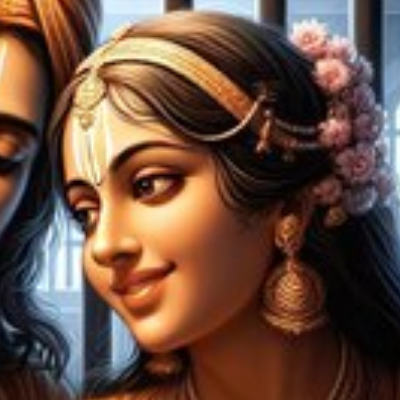
Devaki is the youngest of the seven daughters of Devaka, a chief of the Kukura branch of the Yadava confederation and the paternal uncle of Kamsa, the king of Mathura. She is the wife of Vasudeva, son of Shurasena of the Vrishni clan, and the mother of Krishna — the divine hero, avatar of Vishnu, and central figure of the Mahabharata, the Harivamsa, and the Bhagavata Purana — as well as of Balarama by embryo transfer to Rohini, and of Subhadra in the principal textual tradition. Her life is defined by the prophecy that her eighth child would destroy Kamsa, her cousin, and by the years of imprisonment she shared with Vasudeva in Mathura while Kamsa slew their first six sons one by one. She is among the most extensively documented women in the entire Puranic and epic tradition, appearing prominently in the Mahabharata, the Harivamsa, the Bhagavata Purana, the Vishnu Purana, the Matsya Purana, the Vayu Purana, and the Brahma Purana. In the theological framework of the Bhagavata Purana she is identified with the cosmic goddess Aditi, mother of the gods, who in a previous life had obtained from Vishnu the boon that he would be born to her again — a boon fulfilled in the present life through Krishna's birth to Devaki.
✦ The Name
The name Devaki is derived from devaka, meaning "of or belonging to Devaka" or "divine little one," with the feminine suffix giving it the sense of "daughter of Devaka" or "the divine girl." The patronymic origin of the name — identifying her directly through her father — is consistent with Vedic and Puranic naming conventions for women of royal lineage. The variant Daivaki, used in some passages of the Mahabharata and Harivamsa, is a further derivation from the same root, carrying the same meaning of descent from Devaka. The epithet Vasudeva-patni identifies her as the wife of Vasudeva, and Krishna-mata — mother of Krishna — is the relational designation by which she is most frequently identified in devotional and theological contexts across the tradition.
In the Bhagavata Purana's prior-life theological framework, she is identified with Aditi, the primordial mother of the Adityas and wife of the sage Kashyapa — himself identified in that framework with Vasudeva in his prior life. This identification connects her name and identity to the deepest cosmological layer of the Puranic tradition.
✦ Lineage
- Father: Devaka, chief of the Kukura branch of the Yadava confederation, paternal uncle of Kamsa the king of Mathura; he gave all seven of his daughters to Vasudeva in a single dynastic alliance
- Sisters: Dhritadeva the eldest, Shantideva, Upadevi, Shrideva, Devarakshita, and Sahadeva — all wives of Vasudeva by the same alliance
- Cousin: Kamsa, son of Ugrasena, king of Mathura; the primary antagonist of her life who imprisoned her and Vasudeva and slew six of her sons
- Husband: Vasudeva, son of Shurasena of the Vrishni clan, ruler of the Surasena janapada
- Son: Kirtiman, first son by Vasudeva, surrendered to Kamsa and slain at birth
- Son: Sushena, second son, surrendered to Kamsa and slain
- Son: Udayin (Bhadrasena in some recensions), third son, surrendered to Kamsa and slain
- Son: Bhadrasena (Rijudasa in the Bhagavata Purana), fourth son, surrendered to Kamsa and slain; the Harivamsa and Bhagavata Purana give differing names for the third and fourth sons — this inconsistency is noted in the Variants section
- Son: Anjana (Sanjaya in some recensions), fifth son, surrendered to Kamsa and slain
- Son: Kshatravridha (Devarakshita or Paribarha in some recensions), sixth son, surrendered to Kamsa and slain
- Son: Balarama, seventh conception; the embryo was transferred by divine intervention from Devaki's womb to the womb of Rohini in Gokula; born as Rohini's son and known as Sankarshana, Halayudha, and Balarama; simultaneously Devaki's seventh conceived child and Rohini's birthed son
- Son: Krishna, eighth child of Devaki and the avatar of Vishnu; the central figure of the Mahabharata, Harivamsa, and Bhagavata Purana; born in Kamsa's prison at Mathura and immediately carried by Vasudeva across the Yamuna to Gokula
- Daughter: Subhadra, attributed to Devaki in the principal tradition of the Harivamsa and Bhagavata Purana; she became the wife of the Pandava hero Arjuna and the mother of Abhimanyu; some recensions give her as Rohini's daughter — this variant is noted below
✦ The Prior Life: Aditi and Kashyapa
The Bhagavata Purana presents Devaki's birth and life within a cosmological framework of prior existences. In this account, Devaki was in a previous cosmic age the goddess Aditi — the primordial mother of the divine Adityas and wife of the great progenitor-sage Kashyapa, who is in turn identified with Vasudeva in his prior life. In that earlier existence, Aditi had performed severe austerities and received from Vishnu the boon that he would be born to her as her son once more, as he had previously been born as Vamana the dwarf avatar to restore cosmic order from the Asura king Bali. The Bhagavata Purana presents Devaki's birth in the Kukura-Yadava line and her union with Vasudeva as the fulfilment of this ancient cosmic promise, with Krishna's birth as its culmination. This prior-life framework is the Bhagavata Purana's specific theological interpretation and is not uniformly elaborated across all primary sources, though the Harivamsa and Vishnu Purana also reflect the understanding that Devaki's role as Krishna's mother carried cosmic significance beyond ordinary human parenthood.
✦ The Wedding and the Prophecy
Devaki's marriage to Vasudeva was celebrated with great ceremony and was attended by her cousin Kamsa, who drove the wedding chariot himself as a mark of honour. As the wedding procession moved through Mathura, a divine voice sounded from the sky and addressed Kamsa directly, declaring that the eighth child to be born to the woman in the chariot he was driving would be his destroyer. The Harivamsa, Bhagavata Purana, and Vishnu Purana all record this episode, which stands as the originating moment of the central conflict of Devaki's life. It was at this precise moment — at her own wedding, in the hour of her marriage — that Devaki became the figure around whose womb the fate of Mathura and of the divine avatar's entry into the world would turn.
Kamsa immediately seized Devaki to kill her upon hearing the prophecy. Vasudeva intervened with calm reasoning and offered Kamsa a solemn pledge to surrender every child born to Devaki into his hands. Kamsa accepted and released Devaki, but imprisoned both her and Vasudeva in Mathura to ensure direct control over their offspring. From this day forward, Devaki's life was lived within the walls of Kamsa's prison.
✦ The Imprisonment and the Loss of Six Sons
The years of Devaki's imprisonment form one of the most sustained narratives of maternal grief and endurance in the Puranic tradition. As each of her children was born in the prison, Vasudeva honoured his pledge and carried the newborn to Kamsa, who killed each child immediately. Six sons were lost in this manner. The primary sources describe Devaki's anguish at each successive loss and her powerlessness to intervene — bound by the logic of Vasudeva's pledge and by the physical reality of their imprisonment. The Bhagavata Purana in particular gives extensive attention to her emotional state through these losses, framing her suffering as a form of supreme devotional endurance — the bearing of grief in the service of a divine purpose she could not yet fully comprehend.
The Bhagavata Purana adds a further theological dimension by identifying the six slain sons not as ordinary infants but as divine beings expiating a cosmic curse through their brief mortal lives and deaths. In one passage they are called the six sons of the divine Marichi who had been cursed to be born in demonic circumstances and slain; in another passage the Bhagavata names them differently from the Harivamsa's account. Both sets of names have standing in the primary sources and are recorded in the Variants section.
✦ The Transfer of Balarama
When Devaki conceived for the seventh time, the divine plan to protect this child operated through a miracle recorded in the Bhagavata Purana and Harivamsa. The goddess Yogamaya, acting on Vishnu's instruction, caused the embryo to be drawn from Devaki's womb and transferred to the womb of Rohini — Vasudeva's wife residing safely in Gokula — where it grew to term and was born as Balarama, also called Sankarshana from the act of being drawn across. Devaki experienced this as a miscarriage and the impression was given to Kamsa and his guards that she had lost the child. Balarama is therefore simultaneously the seventh conception of Devaki and the son born to Rohini, and both dimensions of his identity are preserved across the primary sources. The transfer protected the child from Kamsa's reach and set the conditions for his eventual role as Krishna's elder brother and companion.
✦ The Birth of Krishna
The birth of Devaki's eighth child — Krishna — is described across the Harivamsa, Bhagavata Purana, and Vishnu Purana as a moment of cosmic convergence. The birth occurred at midnight on the eighth day of the dark fortnight of the month of Bhadrapada, within the prison at Mathura. Celestial signs attended the birth — planets moved into auspicious alignments, divine flowers fell, winds carried fragrant breaths, and the atmosphere of the prison was transformed. The Bhagavata Purana records that at the moment of birth, Vishnu appeared to Devaki and Vasudeva in his four-armed divine form, radiant and fully armed, before taking the form of a human infant at Vasudeva's request, so that the child could be carried safely to Gokula without attracting divine attention.
The Bhagavata Purana presents Devaki's experience of this moment as one of simultaneous wonder and fear — wonder at the divine manifestation of Vishnu before her, and fear that if Kamsa discovered the child before Vasudeva could act, all would be lost. She implored Vasudeva to conceal the child's divine nature and carry him immediately to safety. Vasudeva took the infant Krishna, placed him in a basket, and departed the prison — chains falling from his feet, doors opening supernaturally, guards falling into enchanted sleep — and crossed the flooded Yamuna to Gokula, where he exchanged the infant with the newborn daughter of Nanda the cowherd chief and his wife Yashoda, returning to the prison with the girl child before dawn.
Devaki thus gave birth to the avatar of Vishnu within a prison cell, at midnight, in the presence only of her husband — and then surrendered the child immediately to the darkness and the flood-swollen river, trusting in the divine plan she had been given. This act of surrender, following the loss of six sons and the apparent miscarriage of the seventh, is presented across the primary sources as the culminating moment of her extraordinary endurance.
✦ The Aftermath and Kamsa's Discovery
When the guards woke and found a girl child in the prison, Kamsa was summoned and seized the infant to dash her against the stone floor. But the child slipped from his hands, rose into the sky in her divine form — identified in the Bhagavata Purana and Harivamsa as the goddess Yogamaya or a form of the goddess Durga or Vindhyavasini — laughed at Kamsa, declared that his destroyer was already born and safe beyond his reach, and disappeared. Kamsa, shaken but unable to identify or locate Krishna, unleashed a series of measures against infants in the region — sending demons to Gokula to kill the child — all of which failed, as Krishna destroyed each demon sent against him during his childhood in Gokula.
Devaki and Vasudeva remained imprisoned throughout Krishna's childhood. They were aware that their son lived but could not see him or communicate with him during the years he grew up among the cowherds of Gokula and Vrindavana.
✦ Release and Reunion
Devaki and Vasudeva were freed from their long imprisonment only when Krishna, having grown to young manhood, returned to Mathura with Balarama and killed Kamsa in the arena during the wrestling festival to which Kamsa had summoned them. After Kamsa's death, Krishna and Balarama went directly to their parents' prison, broke open the doors, and approached Devaki and Vasudeva with the reverence of sons. The Bhagavata Purana records that Devaki embraced Krishna with overwhelming emotion — she had not held him since the moment of his birth — and that her grief and joy and the long years of separation and loss all converged in that reunion. The text describes her maternal feeling overflowing and she wept, holding both Krishna and Balarama, unable to speak.
Following the liberation of Mathura, Devaki resumed her place as the senior queen of Vasudeva's household. Krishna and Balarama were formally acknowledged as her sons in the restored Mathura under the reinstated kingship of Ugrasena. The Bhagavata Purana records that Devaki subsequently asked Krishna to restore the six sons who had been slain by Kamsa, and that Krishna, by his divine power, brought them back from the realm of the dead so that Devaki could see them once more before they departed to their celestial destinations. This episode, in which Devaki is granted a final sight of her lost sons, is presented in the Bhagavata Purana as a supreme act of divine compassion toward a mother whose suffering had been without parallel in the tradition.
✦ Later Life and Death
After her release, Devaki lived in Mathura and later in Dvaraka, the great city built by Krishna on the western coast. The Harivamsa and Bhagavata Purana record her presence as a senior figure in the Vrishni household through the years of Krishna's reign. She is present at major events in the dynastic life of the Vrishni clan and is treated with the highest reverence as the mother of Krishna. The Mausala Parva of the Mahabharata records the destruction of the Yadavas at Prabhasa and the submersion of Dvaraka. Devaki's fate in the immediate aftermath of these events is treated with varying degrees of elaboration across the sources. Some passages indicate that she performed sati — entering the funeral pyre — following Vasudeva's death, an account recorded in the Mahabharata's Mausala Parva in the context of the deaths of Vasudeva's wives. This account is presented as one version of her end within the primary sources and is not the only manner in which her death is described across all recensions.
✦ Theological Significance
In the theology of the Bhagavata Purana and the Vaishnava tradition more broadly, Devaki occupies a position of extraordinary sanctity as the mother through whom the supreme deity took human birth. The prior-life identification with Aditi situates her within the cosmic genealogy of divine motherhood — she is the mother of Vishnu's avatar not accidentally but as the fulfilment of a boon that spans cosmic ages. Her endurance of imprisonment, the loss of six sons, and the surrender of the seventh and eighth children into the divine plan are read in this tradition as forms of the highest devotional patience — a bhakti expressed not through ecstasy but through the bearing of loss in service to a purpose greater than herself.
The Harivamsa's account, while less theologically elaborated than the Bhagavata Purana's, nonetheless presents Devaki as a figure of profound human dignity whose suffering is proportionate to the magnitude of what she carried — not metaphorically, but literally, within her body. The tradition's reverence for Devaki is inseparable from its reverence for Krishna; she is the ground of his entry into the world, and that ground was prepared through decades of grief endured without surrender.
✦ Textual Variants and Inconsistencies
The names of the six sons of Devaki slain by Kamsa differ between the Harivamsa and the Bhagavata Purana. The Harivamsa gives them as Kirtiman, Sushena, Udayin, Bhadrasena, Anjana, and Kshatravridha. The Bhagavata Purana gives a partially overlapping but distinct set of names in one passage — Smara, Udgitha, Parishvanga, Patanga, Kshudrabhrit, and Ghrini — while in another passage of the same text it identifies the six sons with six cursed sons of the divine Marichi. Both accounts have standing as primary sources and cannot be adjudicated between.
The parentage of Subhadra is a second area of variant. The principal tradition of the Harivamsa and Bhagavata Purana gives Subhadra as the daughter of Vasudeva and Devaki, making her the full sister of Krishna and Balarama. Some passages in the Harivamsa and certain recensions describe her as the daughter of Rohini — Vasudeva's first wife — which would make her Balarama's full sister by the same mother but Krishna's half-sister only. The majority primary-source tradition gives her as Devaki's daughter.
The identity of the divine girl child born to Yashoda and exchanged with Krishna on the night of his birth varies across texts. The Bhagavata Purana identifies her as Yogamaya, a divine power of Vishnu who took birth in Gokula for the purpose of this exchange. The Harivamsa and other texts identify her as a form of the goddess Durga or Vindhyavasini. These are consistent in their basic structure — a divine feminine figure took the place of Krishna in Gokula — while diverging on her precise identity and subsequent mythology.
✦ Connection to the Wider Genealogy
Devaki stands at the intersection of the Kukura and Vrishni branches of the Yadava confederation. Through her father Devaka she belongs to the Kukura line; through her husband Vasudeva and her son Krishna she is the central figure of the Vrishni dynastic climax. Her son Krishna's descendants — Pradyumna, Aniruddha, and the further Vrishni line — all trace their maternal descent through her. Through her daughter Subhadra's marriage to Arjuna, Devaki is also the maternal grandmother of Abhimanyu, whose son Parikshit became king of Hastinapura after the Kurukshetra war, carrying the combined blood of the Vrishni and Kuru lines into the opening of the Kali age. The genealogical reach of Devaki's household thus extends across the entirety of the late Puranic dynastic tradition.
✦ References
Primary Sources
- Harivamsa Purana, Harivamsa Parva, Chapters 35, 47–52 and related narrative chapters: Records Devaki's placement among Vasudeva's wives, the names of her six slain sons, the embryo transfer of Balarama, Krishna's birth, and her role as a Vrishni household figure.
- Bhagavata Purana, Canto 9, Chapter 24, verse 23: Names Devaki as the youngest of Devaka's seven daughters given to Vasudeva.
- Bhagavata Purana, Canto 10, Chapters 1–4 and related passages: The principal theological source for the prior-life Aditi framework, the prophecy, the imprisonment, the embryo transfer, the birth of Krishna, the exchange at Gokula, the reunion after Kamsa's death, and the restoration of the six slain sons.
- Vishnu Purana, Book 5: Records the Devaki-Vasudeva narrative including the imprisonment, the birth of Krishna, and the Kamsa episode; corroborates the seven-daughters tradition.
- Mahabharata, Adi Parva: Records Devaki's family background and her role as Vasudeva's wife within the broader genealogical context.
- Mahabharata, Mausala Parva: Records the destruction of the Yadavas at Prabhasa and the deaths of Vasudeva's wives including Devaki.
- Matsya Purana: Corroborates the seven-daughters-of-Devaka tradition and Devaki's placement within it.
- Brahma Purana, Chapter 112, verse 35: Corroborates the household enumeration placing Devaki among Vasudeva's wives.
Secondary and Reference Works
- Wisdomlib.org, Harivamsa Purana (Dutt translation), Chapters 35 and related sections: Used for verification of Devaki's placement in the household enumeration and the narrative chapters relating to Krishna's birth.
- Vaniquotes.org, Bhagavata Purana Canto 10: Used for verse-level verification of the Bhagavata's account of the six slain sons, Krishna's birth episode, the prior-life Aditi-Kashyapa framework, and the restoration of the six sons.
- Harivamsam.arasan.info, Harivamsa Parva Sections 35 and related: Used for cross-verification of the wife sequence and narrative details.
- Puranic Encyclopaedia (Vettam Mani): Consulted as a secondary reference for cross-checking names, variants, and genealogical details across recensions.