
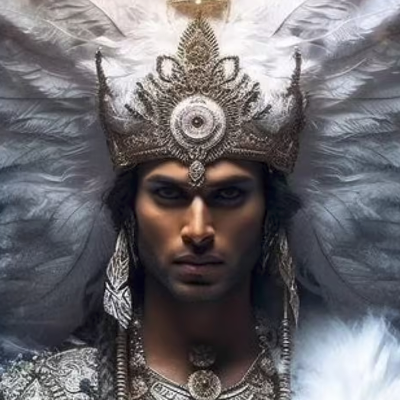
About
Paundraka — The False Vasudeva, King of Pundra and Kashi
Paundraka · Paundraka Vasudeva · Poundra · Paundraka Vāsudeva
Paundraka is a king who appears in the Bhagavata Purana and the Mahabharata as one of the adversaries of Krishna — the eighth avatara of Vishnu and supreme deity of the Vaishnava tradition — and is notable in the Puranic canon as a figure who falsely claimed to be Vasudeva, one of the principal names of Vishnu-Krishna, and demanded that Krishna renounce his divine identity, symbols, and weapons in favour of this claim. Paundraka is identified in the primary texts as a king of the Pundra people — a people associated with a region in the northeastern part of the Indian subcontinent, broadly corresponding to parts of modern Bengal and Bihar — who also held sovereignty over the city of Kashi, the sacred city on the Ganga also known as Varanasi, through an alliance with its king. His claim to be the true Vasudeva — the true descent of the supreme divine — led directly to a military confrontation with Krishna, his defeat, and his death. The subsequent events involving the king of Kashi's attempt to avenge Paundraka's death produced one of the more dramatic episodes associated with Krishna's use of his divine weapon the Sudarshana Chakra. Paundraka's narrative appears principally in the Bhagavata Purana's tenth Canto and in the Mahabharata's Sabha Parva, with additional references in the Vishnu Purana and the Harivamsa.
✦ The Name
Paundraka derives from Pundra — the name of the people or region over whom he ruled — with the suffix indicating belonging to or originating from that people or territory. The name thus identifies him primarily through his ethnic or geographical identity as a king of the Pundras rather than through any personal characteristic. The compound Paundraka Vasudeva — the Vasudeva of Pundra, or the Pundra king who claims to be Vasudeva — is the designation that most precisely captures his significance in the tradition, combining his regional identity with the false divine title he appropriated. Vasudeva as a name of Krishna derives from his being the son of Vasudeva — the Yadava chief who is his father — and is also used as a theological name identifying Krishna with the supreme divine principle. It is this name, with all its theological weight, that Paundraka falsely claimed as his own.
✦ Lineage
- Father: Vasudeva of Pundra — identified in some accounts as the king of the Pundra people from whom Paundraka inherited his kingdom. The Bhagavata Purana does not elaborate on the paternal lineage beyond identifying Paundraka's royal and regional background.
- Ally: The king of Kashi — whose personal name in the primary texts is not consistently given but who is identified as the ruler of the city of Kashi on the Ganga, a powerful king and close ally of Paundraka who supported his claim and whose own fate became entangled with Paundraka's destruction.
- Son: Sudakshina — the son of the king of Kashi, not of Paundraka himself, who nonetheless plays a significant role in the events following Paundraka's death, as described in the narrative episodes below. Some readings of the text associate Sudakshina with the Kashi royal house rather than with Paundraka's own lineage, and this is the more textually consistent interpretation.
✦ The False Claim to Divine Identity
The Bhagavata Purana's tenth Canto narrates that Paundraka had become convinced — either through self-delusion or through the flattery of foolish advisers, as the text presents it — that he himself was the true Vasudeva, the genuine descent of the supreme divine into the world, and that Krishna of Dwaraka was a pretender who had appropriated the symbols and name of the divine without legitimate claim. Acting upon this conviction, Paundraka assumed the external marks of Krishna — carrying a replica discus, a conch, a mace, and a lotus; wearing the characteristic garland of forest flowers known as the Vanamala; marking his body with the Shrivatsa mark — the auspicious mark on Vishnu's chest — and adopting the Kaustubha gem or its imitation as an ornament. He dressed himself in yellow garments in imitation of Krishna's characteristic dress, and rode upon Garuda — or a representation of Garuda, the divine eagle who is Vishnu's vehicle — as his emblem.
Having thus arrayed himself, Paundraka sent a messenger to Dwaraka — the island city ruled by Krishna — bearing a formal declaration addressed to Krishna. The Bhagavata Purana summarises the content of this declaration: Paundraka asserted that he was the one true Vasudeva who had descended into the world out of compassion for living beings, that Krishna had falsely assumed the name and symbols of Vasudeva, and that Krishna must therefore relinquish those symbols — the conch, the discus, the mace, the lotus, the garland, and the name Vasudeva — and either surrender himself to Paundraka or prepare to fight. The declaration was delivered in the court of Dwaraka before the assembled Yadavas and Krishna himself.
The Bhagavata Purana records that Krishna laughed upon hearing this message — the laughter of the assembly accompanying his own — and sent back word to Paundraka that he would indeed deliver to him the symbols Paundraka had demanded, but by means of his weapons in battle.
✦ The Battle and Death of Paundraka
Krishna marched against Paundraka, who came out to meet him supported by the army of his ally the king of Kashi. The Bhagavata Purana's account of the battle is relatively brief. Paundraka appeared on the battlefield arrayed in his imitation of Krishna's divine form — with the replica weapons, the imitation ornaments, and the external marks he had assumed — and the text notes with deliberate irony that he resembled a stage actor costumed to play the role of Vishnu, the comparison pointing to the fundamental inauthenticity of his claim.
Krishna engaged Paundraka in battle and, having defeated him in combat, severed his head with the Sudarshana Chakra — the spinning discus weapon that is one of the defining attributes of Vishnu and which Paundraka had imitated in his false persona. The Bhagavata Purana records that Paundraka, having spent so much time and effort meditating upon Krishna's form and dwelling upon his image — even if in a spirit of enmity and imitation rather than devotion — attained at the moment of death a liberation of a particular kind, described in the text as the result of his constant mental fixation upon Krishna's form. This is consistent with a theological principle articulated in the Bhagavata Purana that intense mental focus upon Krishna, even in a spirit of opposition, can produce a form of liberation, because the mind so fixed has in a fundamental sense made Krishna its constant object. The text presents this outcome with a degree of theological complexity — Paundraka's liberation is real but it arises from an ironic form of involuntary devotion rather than from genuine understanding or surrender.
✦ The Revenge of Kashi and the Sudarshana Chakra Episode
The death of Paundraka did not end the episode. The king of Kashi, who had been Paundraka's principal ally and whose forces had also been defeated in the battle, was himself killed by Krishna in the same engagement — the Bhagavata Purana states that Krishna cut off the Kashi king's head with the Sudarshana Chakra and had the head catapulted into the city of Kashi itself, where it fell in the midst of the city to the horror of the population and the royal family.
The son of the king of Kashi — named Sudakshina in the Bhagavata Purana — was devastated by his father's death and determined to avenge it. Sudakshina undertook a ritual of black magic — described in the text as an abhichara yajna, a sacrificial rite performed with malevolent intent — to summon a supernatural destructive force against Krishna. Through this rite he summoned a being of fire described as Krishnashiras — a being with a blazing head, produced from the sacrificial fire through the power of the destructive ritual, and sent it toward Dwaraka to destroy Krishna.
The Bhagavata Purana narrates that the fiery being approached Dwaraka and began to burn the city. Krishna, apprised of this, deployed the Sudarshana Chakra against the supernatural fire. The Sudarshana Chakra — described in the tradition as an entity of divine intelligence and power rather than merely an inert weapon — pursued the fiery being, destroyed it, and then turned upon its creator, Sudakshina, pursuing him back to Kashi. Sudakshina fled to the temples and sacred sites of Kashi seeking refuge, but the Sudarshana Chakra, described as incapable of being obstructed by any means once deployed by Vishnu, burned Kashi itself — destroying its buildings and sacred structures — before completing its circuit and returning to Krishna. The burning of Kashi by the Sudarshana Chakra, sent in response to the malevolent ritual of Sudakshina, is the culminating event of the Paundraka episode in the Bhagavata Purana, and represents one of the most dramatic deployments of the Sudarshana Chakra in the entire Krishna narrative.
✦ The Mahabharata Account
The Mahabharata's Sabha Parva — the Book of the Assembly Hall — contains a reference to Paundraka in the context of the digvijaya, the conquest of the directions undertaken by the Pandava Bhima and others to establish the sovereignty of Yudhishthira before the Rajasuya sacrifice. In this context Paundraka is listed among the kings who were brought under the authority of the Pandavas or who submitted to their sovereignty. The Sabha Parva reference identifies Paundraka as a king of considerable power in the eastern regions and as the ruler associated with the Pundra people, consistent with the Bhagavata Purana's identification of him. The Mahabharata does not narrate the full episode of the false Vasudeva claim and the subsequent battle with Krishna in the detail provided by the Bhagavata Purana, but its reference to Paundraka as a significant eastern king confirms his standing in the epic's geographical and political framework.
The Harivamsa, the appendix to the Mahabharata that deals extensively with the life of Krishna, also contains material relating to Paundraka consistent with the Bhagavata Purana's account, though the Bhagavata Purana provides the most fully developed version of the narrative.
✦ Textual Variants and Inconsistencies
The primary textual inconsistency in Paundraka's narrative concerns the precise identity and name of the king of Kashi who was his ally. The Bhagavata Purana does not give the Kashi king's personal name consistently in all recensions, referring to him primarily through his title and his city. The Harivamsa and other texts provide variant details on the Kashi alliance without achieving full consistency across all sources.
The precise nature of Paundraka's liberation at the moment of his death is also handled with some variation in theological emphasis across commentarial traditions. The Bhagavata Purana's own text is clear that Paundraka attained a form of liberation through his constant mental absorption in Krishna's form, but the commentators of different Vaishnava schools interpret the quality and completeness of this liberation differently — some treating it as full liberation into Vishnu's realm and others treating it as a lesser form of release. The text itself leaves the precise nature of the liberation somewhat open.
The episode of the burning of Kashi by the Sudarshana Chakra presents an obvious theological tension — Kashi is one of the most sacred cities in the Hindu tradition, identified as the city of Shiva himself, and the burning of Kashi by Vishnu's weapon sits uncomfortably within traditions that hold the city to be eternally inviolable and under Shiva's special protection. This tension is not explicitly addressed in the Bhagavata Purana's account of the episode, and different commentators have handled it in different ways, some treating the burning as limited to specific structures rather than the city as a whole.
✦ Theological Significance
Paundraka's narrative serves several theological functions within the Bhagavata Purana's framework. At the most immediate level it is a narrative demonstration of the futility of false claims to divine identity — Paundraka's imitation of Krishna's form, weapons, and name is presented as inherently absurd, a pretension that cannot survive contact with the genuine article. The irony of his appearing on the battlefield costumed as an actor playing Vishnu while facing the actual Vishnu is a pointed theological statement about the difference between external imitation and genuine divine nature.
At a deeper level, the episode illustrates the Bhagavata Purana's consistent theological position that Krishna — as the supreme divine — is the ultimate object of all consciousness, and that intense mental fixation upon him, regardless of the quality or motivation of that fixation, constitutes a form of relationship with the divine that carries soteriological consequences. Paundraka's obsessive imitation of Krishna, sustained over a long period, is treated as a form of inverted or unwitting devotion that ultimately produces liberation despite the complete absence of genuine understanding or surrender. This principle — that even hostile or distorted fixation upon Krishna can lead to liberation — is developed across several other narratives in the Bhagavata Purana as well, and the Paundraka episode is one of its clearest expressions.
✦ Connection to the Wider Genealogy
Paundraka connects to the wider Itihasa-Puranic genealogical tree primarily through his political relationships rather than through any deep lineage connections to the major Puranic dynasties. He is a king of the Pundra people — a regional group in the eastern part of the subcontinent — and his alliance with the king of Kashi draws the sacred city and its royal house into his narrative. His adversarial relationship with Krishna places him within the large category of kings and demons who come into conflict with Krishna during the period of Krishna's life at Dwaraka, a period in which numerous rulers across the subcontinent were defeated or brought into submission as part of the establishment of Yadava and Pandava sovereignty that the Puranic and epic texts present as the political context of Krishna's earthly life. The Pundra people as a group appear in other Puranic and epic contexts as an eastern people within the geographical framework of the tradition, but Paundraka himself is the only member of their royal line who receives significant individual treatment in the primary texts.
✦ References
- Primary Sources:
- Bhagavata Purana, Canto 10, Chapters 66 and 67 — the principal and most fully developed source for the Paundraka narrative; contains the account of the false Vasudeva claim, the message to Krishna, the battle and death of Paundraka, the killing of the Kashi king, the abhichara yajna of Sudakshina, the deployment of the Sudarshana Chakra, and the burning of Kashi.
- Mahabharata, Sabha Parva — references Paundraka as a king of the Pundra people and a significant eastern ruler in the context of the Pandava digvijaya; does not narrate the full false Vasudeva episode but confirms Paundraka's political standing and regional identity.
- Harivamsa — contains material on Paundraka consistent with the Bhagavata Purana account; contributes variant details to the textual tradition of the episode.
- Vishnu Purana — references the Paundraka episode within its broader treatment of Krishna's life and adversaries.
- Secondary Sources:
- Vettam Mani, Puranic Encyclopaedia (Motilal Banarsidass, 1975) — provides a consolidated entry on Paundraka with cross-references to the relevant Puranic and epic passages and a summary of the principal narrative.
- Wisdomlib (wisdomlib.org) — provides indexed references to Paundraka across multiple Puranic texts with verse-level citations useful for cross-referencing the accounts of the false Vasudeva episode and the Sudarshana Chakra narrative.