
About
Krishna — Svayam Bhagavan, Purna Avatar of Vishnu, Axis of the Dvapara Yuga
Krishna · Vasudeva · Govinda · Gopala · Madhava · Keshava · Janardana · Damodara · Murari · Dvarakadheesh · Parthasarathi · Jagadguru · Yogeshvara · Hrishikesha · Achyuta · Hari · Shyamsundar · Nandanandana · Giridhara · Devakisuta · Purushottama · Narayana · Ranchhor · Banke Bihari · Kunjbihari · Laddu Gopal
Krishna is the most widely worshipped deity in Hinduism and the central figure of the Dvapara Yuga — the cosmic age whose end his life marked and whose transition to the Kali Yuga his departure inaugurated. He is worshipped as the eighth avatar of Vishnu and simultaneously as Svayam Bhagavan — God Himself — the supreme, complete, original form of the divine, possessing all sixteen divine attributes (kalas) in their fullness. The Bhagavata Purana declares him the source from which all other avatars of Vishnu arise. He is the central figure of the Mahabharata, the Bhagavad Gita, the Bhagavata Purana (Canto 10 being devoted entirely to his life), the Harivamsa, the Vishnu Purana (Book 5), the Brahma Vaivarta Purana, and the Brahma Purana. The Bhagavad Gita (10.26) records Krishna's own declaration: among divine sages he is Narada; among the Maruts he is Marichi; among mountains he is Meru; among bodies of water he is the ocean; among sacrifices he is japa; among weapons he is the thunderbolt. He is god of protection, compassion, tenderness, and love. He is the greatest yogi. His name krishna in Sanskrit means dark or black — referring both to his complexion and to the infinite depth of his nature, like a dark rain cloud or the unfathomable ocean.
✦ The Name and Its Meanings
The Sanskrit word Krishna carries the primary meaning of black or dark — a reference to his complexion, described across the texts as dark as a rain cloud, luminous as a sapphire, or the blue-black of the deep sky. The Mahabharata Wiki records that his skin was specifically dark, the source of his name. A secondary etymological tradition derives his name from the Sanskrit root krish — to attract — yielding the meaning he who attracts all, which is reflected in his popular epithet Akarshanaprabhu (the lord who attracts). His most important patronymic is Vasudeva — son of Vasudeva — and Devakisuta — son of Devaki. Nandanandana reflects his foster parentage — beloved son of Nanda. Govinda and Gopala connect him to the cowherd life — protector of cows and their herder. Parthasarathi is his role at Kurukshetra — charioteer of Partha (Arjuna). Dvarakadheesh — lord of Dvaraka — reflects his years as a sovereign. Yogeshvara — the master of yoga — is his supreme designation. Ranchhor — he who left the battlefield — is a name unique to the Gujarat tradition, reflecting his deliberate strategic withdrawal from Mathura before Jarasandha and Kalayavana, celebrated rather than reproached as the highest act of renunciation.
✦ The Divine Identity — Avatar or Svayam Bhagavan
The tradition holds two positions simultaneously on Krishna's divine status. The classical Puranic position identifies him as the eighth avatar of Vishnu — Vishnu descended to earth in human form to destroy the demonic and restore dharma. The Bhagavata Purana and the Brahma Vaivarta Purana go further, identifying him as Svayam Bhagavan — not merely an incarnation of Vishnu but the supreme original source from which Vishnu himself is an expansion. In Krishnaism, this second understanding is primary: Krishna is Para-Brahman — the absolute supreme being — who creates, maintains, and dissolves the universe and who descended as a human for divine play. The Bhagavata Purana declares that all avatars are expansions of Krishna, not the reverse. The Mahabharata's Shanti Parva and Sabha Parva affirm his supreme identity through multiple Puranic declarations of other figures — Vyasa, Narada, Bhishma, and Sahadeva — recognising him as the universal god. The World History Encyclopedia describes him as simultaneously within the universe and beyond it, and as the universe itself.
The cosmic origin of Krishna is described in the Mahabharata (World History Encyclopedia) as follows: Vishnu pulled two hairs from his own head — one white and one black. The white hair was planted in the womb of Rohini, wife of Vasudeva, and became Balarama. The black hair was planted in the womb of Devaki and became Krishna. Both brothers are thus direct descents of Vishnu's own being, not mere spiritual infusions into a human vessel.
✦ Lineage and Immediate Family
- Cosmic lineage: Avatar of Vishnu; born as eighth son of Vasudeva of the Vrishni clan of the Yadavas, and Devaki, daughter of Devaka of the Andhaka branch — themselves incarnations of the sage Kashyapa and his wife Aditi, cursed by Varuna (or Brahma) to take human birth for delaying the return of his divine cow after a yajna
- Biological father: Vasudeva (also called Anakadundubhi — named for the drums that sounded at his birth), king of the Vrishnis, son of Shurasena; sister of Vasudeva was Kunti, mother of the Pandavas — making Krishna their maternal cousin
- Biological mother: Devaki — described as an incarnation of Aditi, mother goddess; cousin of Kamsa, the tyrant king of Mathura
- Foster father: Nanda — chieftain of the cowherds of Gokul, stepbrother or cousin of Vasudeva per the Harivamsa; his name means joy personified
- Foster mother: Yashoda — wife of Nanda; her name means giver of fame; the woman who raised the god as her own child without knowing his divine identity
- Elder brother: Balarama — born to Rohini (another wife of Vasudeva) after being transferred from Devaki's womb by divine will; an avatar of Shesha Naga, the cosmic serpent; Krishna's inseparable companion throughout life
- Sister: Subhadra — daughter of Vasudeva and Rohini; who later married Arjuna and became mother of Abhimanyu
- Friend and cousin: Uddhava — son of Devabhaga (Vasudeva's brother), described as closely resembling Krishna in appearance; his most trusted advisor and confidant in Dvaraka
- Paternal aunts: Kunti (mother of the Pandavas), Shrutasravas (mother of Shishupala), Shrutadeva (mother of Dantavaktra), Shrutakirti (wife of a Kekaya king), Rajadhidevi (wife of the Avanti king)
- Previous birth connection: Krishna and Arjuna were the sages Nara and Narayana in a previous cosmic life — the inseparable pair of divine wisdom and devotion
✦ The Prophecy and Birth in Prison
Kamsa — the son of Ugrasena, king of Mathura — had usurped the throne from his own father and ruled as a tyrant. He was the cousin of Devaki. On the day of Devaki and Vasudeva's wedding, as Kamsa drove their chariot to Mathura, a celestial voice (akashvani) declared that Devaki's eighth child would be his death. Enraged, Kamsa rose to kill Devaki immediately, but Vasudeva interceded and promised to deliver every child to him. Kamsa imprisoned both Devaki and Vasudeva and killed their first six sons at birth. The seventh — Balarama — was divinely transferred to the womb of Rohini before birth, apparently miscarried. The eighth — Krishna — was born at midnight on the eighth day of the dark fortnight of the month of Bhadra, in the Rohini Nakshatra. At the moment of birth, the prison lit up with divine light; Devaki and Vasudeva beheld a four-armed divine form before Krishna's divine radiance subsided into that of an infant. He instructed Vasudeva to carry him across the Yamuna to the home of Nanda and Yashoda in Gokul, exchange him with their newborn daughter, and return. Vasudeva carried him across the flooding Yamuna — miraculously parted as Krishna's feet touched the water — while the prison guards slept under divine enchantment. He placed the baby with Yashoda and returned with her newborn daughter. When Kamsa stormed in and seized the girl, she transformed into an eight-armed goddess and declared that his destroyer had already been born elsewhere — then vanished.
✦ Childhood in Gokul and Vrindavan — The Lila Period
Krishna was raised in Gokul and then in Vrindavan — the forest community of cowherds and milkmaids on the banks of the Yamuna. He was adored as a playful, mischievous, extraordinarily beautiful child who stole butter from his mother's pots, charmed his community, and revealed his divine nature through an almost continuous series of miracles and demon-slayings. His childhood years are described in the Bhagavata Purana (Canto 10) and the Harivamsa with lavish detail and are the source of the tradition of Bal Lila — the divine sport of God in the form of a child.
The demons sent by Kamsa to kill the infant Krishna — and their fates — form the central narrative of the Gokul years. Putana — a demoness sent by Kamsa in the form of a beautiful woman with poison on her breast — came to nurse the seven-day-old infant. Krishna sucked out both her milk and her life force, killing her while simultaneously liberating her, for she was granted heaven as a foster mother of the divine child. Shakatasura — a ghost demon who had taken shelter in a handcart — was destroyed when the infant Krishna, lying under the cart, kicked it with his tiny foot and shattered it. Trinavarta — a whirlwind demon — swept the baby into the sky intending to dash him to earth, but the infant made himself as heavy as a mountain; the demon's neck snapped and he fell dead. Vatsasura — who appeared in the form of a calf to blend into Krishna's herd — was seized by his hind legs and hurled against a tree, dying on impact. Bakasura — a great stork demon, Kamsa's ally and brother of Putana and Aghasura — swallowed Krishna, felt him burn in his throat like fire, disgorged him, then attacked with his beak; Krishna split the beak in two as a child splits a blade of grass. Aghasura — younger brother of Putana and Bakasura, a gigantic serpent-demon eight miles long — lay on a road with his mouth open like a mountain cavern; Krishna's cowherd friends entered unknowingly, then Krishna entered, expanded his body inside the demon until it suffocated, and led all his friends to safety. Dhenukasura — a donkey-demon guarding a Talavana orchard — was killed by Balarama, who flung him into a palm tree. Pralambhasura — who disguised himself as a cowherd in a game — was killed by Balarama when he tried to abduct him. Arishtasura — a gigantic bull demon — charged the village; Krishna caught his horns, wrestled him, broke his horns, and killed him. Keshi — a great horse demon sent by Kamsa — charged with his enormous hooves; Krishna thrust his arm into the demon's mouth and expanded it until the demon suffocated. Vyomasura — a bat-demon — kidnapped Krishna's friends and sealed them in a cave; Krishna tracked him, seized him, and choked him to death.
Among the most celebrated non-demonic episodes of the childhood years: Kaliya — a great venomous serpent living in the Yamuna whose poison boiled the river and killed all it touched — was subdued by Krishna, who leaped from a Kadamba tree into the water, wrestled the serpent, danced on its multiple hoods until Kaliya surrendered and vomited blood, then, at the plea of Kaliya's wives, spared him and directed him to leave the Yamuna and return to the island of Ramanaka (held in some traditions to be Fiji). Govardhan Hill — the episode for which the epithet Giridhara (holder of the mountain) was earned: when Krishna persuaded the cowherds to stop the annual worship of Indra and worship Govardhan Hill instead, the offended Indra sent seven days of torrential flooding upon Vrindavan; Krishna lifted the entire Govardhan Hill on his little finger and held it as an umbrella above the entire community for seven days until Indra accepted defeat and surrendered. The twin Arjuna trees — two great trees in which the sons of Kubera, Nalakuvara and Manigriva, had been frozen by Narada's curse for their arrogance; Krishna as an infant, tied to a stone by Yashoda as punishment for stealing butter, crawled between the two trees and uprooted them with the stone, releasing the two princes from the curse. The forest fire — on multiple occasions when the Yamuna forest caught fire, Krishna swallowed the entire fire to protect his friends and the cattle.
✦ Radha and the Gopis — The Madhurya Lila
As a youth, Krishna became the most celebrated lover in all of sacred literature. The sound of his flute — the Venu — drew the gopis (the wives and daughters of the cowherds) from their homes irresistibly, even from sleep, even against their own will, to dance with him in the moonlit forests of Vrindavan on the banks of the Yamuna. His relationship with the gopis is understood across the devotional tradition as the supreme symbol of the soul's relationship with God — the irresistible pull of the divine lover toward whom the individual soul rushes, abandoning all worldly attachment. The Rasa Lila — the circular cosmic dance in which Krishna simultaneously appeared beside every gopi, multiplying himself so that each believed she alone danced with him — is the supreme expression of this tradition.
His supreme consort is Radha — celebrated as the highest devotee and the very power of Krishna's love. Radha does not appear by name in the Mahabharata or the Bhagavata Purana's core text (though she is referenced indirectly) but is elaborated in the Brahma Vaivarta Purana, the Gita Govinda of Jayadeva, and across the Bhakti tradition. She is considered an incarnation of Lakshmi and the most intimate expression of the soul's love for the divine. Their relationship is described as eternal — transcending marriage and conventional human categories. The World History Encyclopedia notes that some sources claim they were married in secret. Krishna knew Radha only until around age ten per some Puranic accounts — he departed for Mathura and never returned to Vrindavan.
✦ Education at Sandipani's Ashrama
After the death of Kamsa (described below), Vasudeva sent Krishna and Balarama — along with their close friend Sudama — to the ashrama of the sage Sandipani in Ujjain for formal education. Sandipani educated them in the four Vedas and their six supplementary branches (the Vedangas), the Upanishads, archery, the science of weapons, mantras, Dharmashastra, Nyaya (logic), Rajaneeti (political science), astronomy, the Gandharva Veda (music and performing arts), mathematics, medicine, the art of elephant and horse training, and drawing. Krishna is recorded as having mastered 64 vidyas (sciences) and 16 skills in 64 days — the equivalent of what other students spent years learning — by virtue of his perfect memory and divine nature. For his Gurudakshina (preceptor's fee), Sandipani requested the return of his son who had drowned in the ocean at Prabhasa. Krishna and Balarama descended to the ocean, slew the sea-demon Panchajana who had swallowed the boy, retrieved the Panchajanya conch from within the demon, and descended further to Naraka to demand the boy from Yama. Yama restored the boy to life. Sandipani gave Krishna the name Jagat Guru — teacher of the world.
✦ Return to Mathura — The Killing of Kamsa
Kamsa summoned Krishna and Balarama to Mathura under the pretext of a great wrestling festival. On the way into the city, Krishna disarmed and killed a mad elephant named Kuvalayapeeda that Kamsa had positioned at the gate. In the arena, the two brothers defeated and killed the royal wrestlers Chanura and Mustika. Then Krishna leaped up to the royal box, seized Kamsa by the hair, and hurled him from his throne to the wrestling ground, killing him. He freed his parents Vasudeva and Devaki from their long imprisonment, restored Ugrasena — Kamsa's own father — to the throne, and became a leading prince of the Yadava court.
✦ Jarasandha and the Wars for Mathura
Kamsa had been the son-in-law of Jarasandha — the immensely powerful king of Magadha, whose army numbered twenty-three akshauhini divisions. Infuriated by Kamsa's death, Jarasandha vowed revenge. He attacked Mathura seventeen times with enormous armies — each time Krishna and Balarama destroyed his forces but deliberately spared Jarasandha himself, knowing that he served as a magnet drawing demons from across the world to be destroyed in one place rather than requiring Krishna to pursue them individually. During the eighteenth attack, Jarasandha allied with Kalayavana — a Yavana king with a boon from Shiva making him unconquerable in battle — who attacked with thirty million soldiers. Unable to fight both simultaneously and protect his people, Krishna made the decisive choice to build a new city. He commissioned Vishvakarma — the divine architect — to construct a magnificent coastal fortified city on twelve yojanas of ocean reclaimed by the sea at Krishna's request. This city was Dvaraka, completed overnight, and Krishna transported the entire population of Mathura there safely. Jarasandha, pursuing Krishna and Balarama into an eighty-mile mountain, set it ablaze — but the two brothers leaped from the summit over the flames and walked to Dvaraka unhurt. Jarasandha believed them dead and returned home. For Kalayavana, Krishna lured him into the cave where the ancient Treta Yuga king Muchukunda — who had served the gods in their wars with the asuras and was granted the boon of a long slumber, with any who disturbed his sleep being instantly incinerated by his gaze — lay sleeping. When Kalayavana kicked the sleeping form mistaking it for Krishna, Muchukunda's gaze burnt him to ash.
✦ The Khandava Fire — Weapons from Varuna
The fire god Agni, suffering from indigestion, wished to consume the Khandava Forest, which was protected by Indra. He approached Krishna and Arjuna to aid him. Varuna — the god of the seas and cosmic waters — gave Krishna the Sudarshana Chakra (divine discus) and the Kaumodaki (his divine mace), and gave Arjuna the bow Gandiva and an inexhaustible quiver of arrows. Together Krishna and Arjuna kept Indra at bay while Agni consumed the forest — the destruction of the Khandava Forest making way for the Pandavas to build their kingdom of Indraprastha.
✦ Wives — The Ashtabharya and the 16,108
The Bhagavata Purana records eight principal queen-consorts — the Ashtabharya — in this order: Rukmini (daughter of King Bhishmaka of Vidarbha, incarnation of Lakshmi, and his most beloved queen — married by elopement at her own request when she secretly sent a letter declaring her love to Krishna and asking him to take her away before her forced marriage to Shishupala); Satyabhama (daughter of Satrajit, the possessor of the Syamantaka jewel); Jambavati (daughter of Jambavan, the immortal bear-king of the Ramayana — married after their twenty-eight day battle over the Syamantaka jewel); Kalindi (the goddess of the Yamuna river, who undertook penance desiring Krishna as husband); Mitravinda (daughter of the Avanti king, cousin of Krishna — married at her svayamvara after Krishna defeated the assembled kings); Nagnajiti (also called Satya — daughter of King Nagnajit of Kosala, married after Krishna alone tamed seven bulls that no other king could subdue); Bhadra (a cousin of Krishna, married with her brothers' permission); Lakshmana (also called Madra — married at her svayamvara after Krishna defeated the rival suitors including Duryodhana and Jarasandha's allies). In addition, after defeating and killing Narakasura (Bhaumasura) — who had seized the earrings of Aditi and imprisoned 16,100 princesses — Krishna married all 16,100 liberated women, granting each a palace and expanding himself into as many forms as there were wives to give each equal companionship. Thus the total wives of Krishna are described as 16,108.
✦ Children
The Bhagavata Purana records that Krishna had ten sons from each of his eight principal queens — eighty sons in total — and one daughter Charumati from Rukmini. From Rukmini: Pradyumna (eldest and most celebrated; an avatar of Kamadeva; later the father of Aniruddha); Charudeshna, Sudeshna, Charudeha, Sucharu, Charugupta, Bhadracharu, Charuchandra, Vicharu, Charu, and daughter Charumati. From Jambavati: Samba (the eldest, for whom Krishna performed six months of penance to Shiva — described separately below), Sumitra, Purujit, Satyajit, Sahasrajit, Vijaya, Chitraketu, Vasuman, Dravida, and Kratu. From Satyabhama: Bhanu (eldest), Subhanu, Svarbhanu, Prabhanu, Bhanuman, Chandrabhanu, Brihadbhanu, Atibhanu, Shribhanu, and Pratibhanu. The other principal queens bore similarly named sons. Total sons from all sixteen thousand queens are described as 180,000.
✦ Narakasura — The Battle with Satyabhama
Narakasura (Bhaumasura) — son of Bhumi Devi (Earth goddess) — had become a threat to both earth and heaven. He had stolen the earrings of Aditi, mother of the gods, and captured 16,100 women. Indra appealed to Krishna. Krishna rode to battle with Satyabhama. The tradition records that Satyabhama herself slew Narakasura — fulfilling a boon he had received that only his own mother (the Earth-goddess, whose form Satyabhama represented) could end his life. The defeat of Narakasura is the mythological origin of Diwali — the festival of lights celebrated on the day Krishna returned from the battle. After his return, Krishna and Satyabhama proceeded to Indra's heaven, where Krishna retrieved Aditi's earrings. Satyabhama admired the Parijata tree (the divine wish-fulfilling tree of the gods). Though Indra was reluctant, Krishna uprooted the tree and carried it back to Dvaraka, where it grew in Satyabhama's garden.
✦ Banasura and the Battle with Shiva
Banasura — a thousand-armed son of King Bali and a devotee of Shiva, who had Shiva's boon to guard his city — captured Aniruddha (Krishna's grandson, son of Pradyumna) after Aniruddha entered his city at night to meet Banasura's daughter Usha, who had fallen in love with him in a dream. Krishna, Balarama, and Pradyumna attacked Banasura's city to free Aniruddha. Shiva himself came to Banasura's defense. The battle between Krishna and Shiva is one of the most celebrated episodes in the tradition — the two supreme divine forces in apparent opposition. Ultimately, Shiva acknowledged Krishna's supremacy and stepped aside. Krishna cut off all of Banasura's thousand arms except two, sparing his life because of his descent from the illustrious devotee Prahlada and Shiva's intercession.
✦ Paundraka — The False Vasudeva
Paundraka Vasudeva — king of Kashi — had deluded himself into believing he was the real Vishnu-Vasudeva and sent a messenger to Krishna demanding he give up his conch, disc, garland, and name. Krishna went to battle, killed Paundraka with the Sudarshana Chakra, and sent the chakra on to destroy the king of Kashi who had supported him.
✦ Shishupala — The Death at the Rajasuya
Shishupala — the son of Vasudeva's sister Shrutasravas, king of Chedi, and one of the rebirths of Jaya (the Vaikuntha gatekeeper) — had abused and insulted Krishna a hundred times at the Rajasuya Yajna of Yudhishthira. Krishna had promised Shishupala's mother to forgive one hundred offences. When the hundredth was reached, Krishna released his Sudarshana Chakra and severed Shishupala's head in front of the assembled kings. His soul merged into Krishna — the liberation of the enemy who had hated the divine.
✦ Jarasandha — Death at the Rajasuya
When Yudhishthira prepared the Rajasuya Yajna, Narada advised that Jarasandha — who held eighty-six kings captive in his prison intended for a mass human sacrifice — must first be defeated. Krishna, Bhima, and Arjuna went to Magadha disguised as Brahmins. Jarasandha chose Bhima for single combat. Their mace battle lasted twenty-seven days. At the critical moment, Krishna signalled to Bhima with a subtle gesture — tearing a leaf down the middle — indicating how to defeat Jarasandha: by tearing his body apart, since Jarasandha had been born as two halves joined by a demoness named Jara. Bhima tore Jarasandha's body in two, separating the halves and throwing them in opposite directions so they could not rejoin. The eighty-six captive kings were freed.
✦ Role in the Mahabharata — Statesman, Diplomat, and Strategist
Krishna's relationship with the Pandavas began through his cousin bond with Arjuna and deepened through decades of affection and shared purposes. He assisted Arjuna in his marriage to Subhadra — his own sister — becoming his brother-in-law. He helped the Pandavas build Indraprastha by securing divine assistance. He supported them through the forest exile with counsel. He was present at Draupadi's swayamvara. When the dice game ruined the Pandavas and Draupadi was humiliated in the Kaurava court, Krishna was absent — but appeared in a miraculous apparition to provide Draupadi with an endless sari that Duhshasana could not remove.
At the end of the Pandavas' exile, Krishna went to the Kaurava court as a peace ambassador on behalf of the Pandavas — the Shanti Parva peace mission. He proposed that the Pandavas would accept just five villages — one for each brother — to avoid war. Duryodhana refused, declaring he would not give land enough to fit a needle. When Duryodhana devised a plan to arrest Krishna during the peace mission, Krishna revealed his Vishvarupa — his cosmic universal form encompassing all creation — to the assembly. Bhishma, Drona, and the sages present recognised his divine nature and bowed. Duryodhana remained defiant.
Before Kurukshetra, both Duryodhana and Arjuna came to Krishna to seek his aid. Duryodhana arrived first and found Krishna asleep; he sat at his head. Arjuna arrived after and sat at his feet. When Krishna awoke, he saw Arjuna first. He offered a choice: himself unarmed on one side, his Narayani army (the Yadava forces) on the other. Duryodhana chose the army; Arjuna chose Krishna. Krishna served as Arjuna's charioteer — his Parthasarathi — throughout the eighteen-day war.
✦ The Bhagavad Gita — The Teaching at Kurukshetra
On the first morning of the Kurukshetra war, Krishna drove Arjuna's chariot between the two armies. Seeing his grandfather Bhishma, his teacher Drona, his cousins, friends, and kinsmen arrayed for battle, Arjuna was overwhelmed by grief and moral paralysis. He laid down his bow and told Krishna he could not fight. The Bhagavad Gita — the Song of God, a text of 700 verses in 18 chapters — is Krishna's response. He taught Arjuna the nature of the eternal soul (atman) and its distinction from the perishable body; the nature of death as transition rather than extinction; the doctrine of nishkama karma (action without attachment to its fruits); the three paths of yoga (jnana yoga — the path of knowledge, bhakti yoga — the path of devotion, karma yoga — the path of selfless action); the nature of the three gunas and their role in binding or liberating; the imperishable Brahman; and ultimately, complete surrender to the divine as the highest path. In Chapter 10 he declared the divine vibhutis — his manifestations in all great things in creation. In Chapter 11 he revealed the Vishvarupa — his infinite cosmic form encompassing all beings, all time, all creation and destruction simultaneously — granting Arjuna divine sight to behold it. Arjuna, unable to bear its immensity, begged him to return to his human form. He did so. Thus convinced and transformed, Arjuna resumed his bow.
Krishna also revealed the Vishvarupa a second time during his peace mission to the Kaurava court — before the assembled kings of both sides — as the form in which he made his identity clear to those with eyes to recognise it.
✦ During the Kurukshetra War — As Charioteer and Strategist
Krishna vowed not to bear arms in the Kurukshetra war — a vow he kept throughout the eighteen days, though he broke it once in a moment of divine anger when he picked up a chariot wheel to charge at Bhishma after Bhishma, in a fierce advance, was close to destroying Arjuna. Bhishma welcomed him, saying he would be honoured to be killed by Krishna himself. Arjuna restrained Krishna; Krishna put down the wheel. As charioteer and strategist, his role was decisive: he managed the tactical direction of the Pandava forces; he advised on when and how to use weapons and on the ethical dimensions of every contested decision (such as the killing of Drona through the false report of Ashvatthama's death, which Krishna alone authorised as necessary). After the war, he supported Yudhishthira through his devastating guilt and grief over the carnage, and instructed him in his duties as king through the extended teachings of the Shanti Parva and Anushasana Parva. He concealed the Pandavas from Ashvatthama during his night raid on their camp.
✦ Gandhari's Curse and the Foreknowledge of Destruction
On the night before Duryodhana's death, Krishna visited Gandhari to offer condolences. Gandhari — whose a hundred sons had all been killed — accused him of allowing the war to proceed when he could have stopped it. She cursed Krishna that his Yadava clan would destroy itself in fratricidal strife, just as her family had been destroyed. The Mahabharata and Mausala Parva record that Krishna accepted the curse and said tathastu — so be it — knowing it was both just and already determined. He felt that the Yadavas had grown arrogant and adharmic and that their destruction was necessary. A curse from Sage Durvasa — also recorded in one tradition — added the condition that he would die at the hands of a hunter.
✦ The Samba Curse and the Seeds of Destruction
Years after the Kurukshetra war, the Yadava youth — arrogant and dissolute in prosperity — played a prank on a group of visiting sages. Samba, Krishna's son by Jambavati, was dressed as a pregnant woman. His friends asked the sages mockingly to predict the gender of the child. The enraged sages — Vishvamitra, Durvasa, Vasishtha, Narada, and others — declared that Samba would produce an iron pestle that would destroy the entire Yadava race. Samba produced the pestle. Alarmed, Ugrasena and Krishna ordered it ground to powder and cast into the sea, and wine banned in the kingdom. A single fragment that could not be ground was also cast into the sea. The iron powder washed ashore and grew as sharp reeds on the beach at Prabhasa. The fragment was swallowed by a fish and retrieved in its stomach by the hunter Jara, who fashioned it into an arrowhead.
✦ The Mausala Parva — The End of the Yadavas and Dvaraka
Thirty-six years after Kurukshetra, dark omens filled Dvaraka — comets, earthquakes, blood rain, deformed births among cattle, the disappearance of the Sudarshana Chakra, the Panchajanya conch, Krishna's chariot, and Balarama's plough. Krishna led the Yadavas on a pilgrimage to Prabhasa Tirtha (near modern Veraval, Gujarat). There, drunk on wine, old rivalries exploded — Satyaki taunted Kritavarma for killing sleeping warriors; Kritavarma mocked Satyaki in return; Pradyumna joined against Kritavarma. In the fracas, Satyaki beheaded Kritavarma. Chaos spread. The Yadavas seized the sharp reeds growing from the iron powder on the shore and began killing each other. The most powerful Yadava warriors — Pradyumna, Satyaki, Kritavarma, Samba, and thousands of others — were all slain. Krishna tried to stop the massacre but could not. Only Krishna, Balarama, and the charioteer Daruka survived. Balarama, grieving, sat by the seashore in deep meditation — in some accounts a great white serpent (Shesha Naga) emerged from his mouth, signifying his divine essence's return to the spiritual plane. Krishna returned to Dvaraka, consoled his father Vasudeva, and returned to the forest.
✦ The Departure — Jara's Arrow and the Return to Vaikuntha
Having understood that his divine mission was complete, Krishna sat under a peepal tree at the edge of the forest near Prabhasa in deep yogic meditation — his left foot resting over his right knee, the sole of his foot moving slightly. The hunter Jara — whose name means old age — was tracking deer nearby. Mistaking the moving sole of Krishna's foot for a deer's ear, he shot an arrow tipped with the fragment of the iron pestle from Samba's curse. The arrow pierced Krishna's heel. Realising his mistake, Jara fell at Krishna's feet in terror. Krishna smiled, forgave him, and told him: Do not fear. This was destined. In another birth, I slew you as Vali. Now the debt is repaid. He instructed Jara to depart. The Bhagavata Purana records that an aerial vehicle arrived for Jara, who departed to the spiritual world. Krishna, restraining his senses completely, entered the highest state of yoga. Brahma, Shiva, the Prajapatis, the sages, the gods, the Gandharvas, the Siddhas, and all celestial beings arrived at Prabhasa in aerial vehicles, showering flowers, chanting his glories. Krishna closed his lotus eyes, fixed his mind within himself, and departed from his mortal body to his transcendent abode. The Bhagavata Purana (Book 11, Chapter 31) records that he returned to Vaikuntha directly through his yogic concentration. The Bhagavata Purana, Vishnu Purana, and Brahma Purana all state that the day Krishna left the earth was the day the Dvapara Yuga ended and the Kali Yuga began. Seven days after his departure, Dvaraka was swallowed by the sea.
The pilgrimage site of Bhalka (also called Dehotsarga — the place where he gave up his body) in Veraval, Gujarat marks the place of his death and is the most sacred site of his final departure. The tradition holds that his heart was taken and enshrined at the Jagannath Temple in Puri. After Krishna's death, Arjuna came to Dvaraka, escorted the surviving women and Krishna's grandson Vajra (son of Aniruddha) to Indraprastha, and ensured the continuation of Krishna's lineage. Rukmini, Jambavati, and the other principal queens entered Krishna's funeral pyre. The remaining queens of the 16,100 were settled across the country by Arjuna.
✦ Iconography
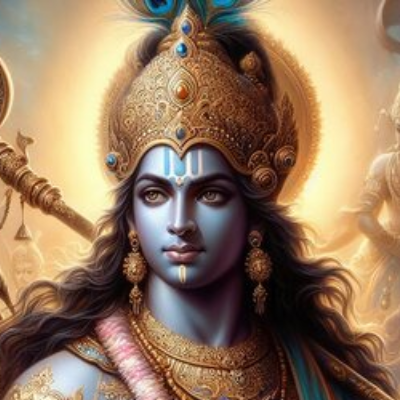
Krishna's iconography across the tradition reflects the multiple roles and periods of his life. He is depicted in several canonical forms: as Bal Krishna — the infant or toddler crawling on hands and knees, a ball of butter in his hand; as the young Venu Gopala — the flute-playing cowherd youth with a peacock feather in his crown, standing in the characteristic tribhanga (three-part curve) posture, surrounded by gopis and cows; as Parthasarathi — the charioteer of Kurukshetra; and as the fully divine Chaturbhuja form — four-armed, holding the four principal attributes of Vishnu: the Sudarshana Chakra (divine discus), the Panchajanya (conch), the Kaumodaki (mace), and the Padma (lotus) or Sharnga bow. His complexion is dark blue — the colour of the deep sky or of sapphire — or occasionally described as dark as a monsoon cloud. He wears a yellow silk dhoti (pitambara), a flower garland, and a peacock feather in his crown. His vehicle is Garuda — the great eagle. His chariot is drawn by four horses — Shaibya (green), Sugriva (red), Meghapushpa (dark), and Balahaka (white) — driven by his charioteer Daruka. He carries the Sudarshana Chakra on his right index finger; the Panchajanya conch in his upper left hand; the Kaumodaki mace in his lower right or left hand; and holds a lotus. His sword is Nandaka; his bow is Sharnga.
✦ Sacred Sites
The principal sacred sites associated with Krishna's life form a circuit of pilgrimage across India. Mathura — his birthplace; Vrindavan — the forest of his childhood and youth; Barsana — home of Radha; Govardhan Hill — the mountain he lifted; Gokul — where Nanda and Yashoda raised him; Kurukshetra — where the Bhagavad Gita was revealed; Dvaraka — his capital, now partly submerged; Bhalka Tirtha near Veraval — the site of his departure; Puri — where the Jagannath tradition preserves his heart; and Ujjain — where he studied at Sandipani's ashrama.
✦ Texts Attributed to or Founded by Krishna
- Bhagavad Gita — the supreme philosophical and devotional text of Hinduism, spoken by Krishna to Arjuna on the first day of Kurukshetra; embedded in the Bhishma Parva of the Mahabharata
- Uddhava Gita (also called Hamsa Gita or Bhagavata Purana Canto 11) — Krishna's final teachings to Uddhava before his departure, considered by many traditions equal in depth to the Bhagavad Gita
- Anu Gita — a recapitulation of the Bhagavad Gita's teachings given by Krishna to Arjuna after the war, when Arjuna said he had forgotten much of what was said
- Narada Pancharatra (Satvata Tantra) — the body of Vaishnava doctrine said to have been originally taught by Vishnu-Krishna to the four Kumaras and transmitted through Narada
- Four Vaishnava Sampradayas — all four authorised lines of Vaishnava tradition (Sri, Brahma, Rudra, Kumara) ultimately converge in Krishna as their supreme object of devotion
✦ Festival
Janmashtami — the birth of Krishna — is celebrated on the eighth day (ashtami) of the dark fortnight (krishna paksha) of the month of Bhadra, falling in late August or early September of the Gregorian calendar. It is one of the most widely observed festivals in Hinduism, celebrated with midnight worship, fasting, and devotional singing. Dahi Handi — the smashing of a suspended pot of curd — recreates his childhood butter-stealing. Diwali commemorates his killing of Narakasura and return with the Parijata tree. Holi is associated with his play with the gopis and the killing of the demoness Pootana (Putana). The Rasa Panchami festival celebrates the Rasa Lila.
✦ Krishna in Other Traditions
In Jainism, Krishna is listed among the sixty-three Shalakapurushas — notable figures — as a Vasudeva in the cosmic triad with Balarama (Baladeva) and Jarasandha (Prati-Vasudeva). The Jain versions follow the general outline but are polemically critical of Krishna and diverge significantly in detail — in these accounts Krishna loses battles, his gopis and Yadavas die in a fire created by an ascetic, and after Jara's arrow he is said to go to the third hell of Jain cosmology, while Balarama goes to the sixth heaven. In Buddhism, the Jataka tales include Krishna legends, the Vidhurapandita Jataka mentioning Madhura (Mathura). These inclusions indicate that Krishna's theological identity was established and significant in the religious landscape observed by non-Hindu traditions well before the common era.
✦ References
- Rigveda — earliest Vedic references to Vasudeva and Baladeva as objects of worship; Sudarshana Chakra referenced as Vishnu's symbol; Panchajanya referenced through the Samudra Manthana in Skanda Purana
- Chandogya Upanishad — reference to Krishna Devakiputra as a disciple who received teaching on Brahman
- Mahabharata (Vyasa) — Adi Parva: birth and childhood; Sabha Parva: the Rajasuya; Shishupala's death; Jarasandha's death; Udyoga Parva: peace mission; Vishvarupa at Kaurava court; Bhishma Parva: the Bhagavad Gita (18 chapters, 700 verses); Kurukshetra war narrative; Shanti Parva and Anushasana Parva: teachings to Yudhishthira; Mausala Parva: the end of the Yadavas, Balarama's departure, Jara's arrow, Krishna's death, Dvaraka's submersion
- Harivamsa (appendix to Mahabharata) — the most complete early account of Krishna's childhood, youth, and demon-slayings; Vrindavan lila; Govardhan episode; Rukmini's marriage; Dvaraka construction
- Bhagavata Purana — Canto 10: the supreme and most complete account of Krishna's life from conception to death; Canto 11 (Uddhava Gita): the final teachings before his departure and the departure itself; Canto 1: the occasion of the Bhagavatam's composition at Narada's instruction to Vyasa
- Vishnu Purana (Book 5) — a parallel complete account of Krishna's life; the Syamantaka jewel episode
- Brahma Vaivarta Purana — detailed treatment of Radha; Krishna as Svayam Bhagavan; his divine identity
- Brahma Purana — the Mathura and Dvaraka lilas; Rukmini's marriage; Narakasura; Banasura and the battle with Shiva; Paundraka
- Bhagavad Gita — 18 chapters, 700 verses; the supreme philosophical text of Hinduism
- Uddhava Gita (Bhagavata Purana, Canto 11, Chapters 7–29) — Krishna's final teachings
- Gita Govinda (Jayadeva, 12th century CE) — the supreme poetic treatment of the Radha-Krishna relationship
- Wikipedia — Krishna; Wikipedia — Krishna in the Mahabharata; Wikipedia — Mausala Parva; Wikipedia — Bhalka; Wikipedia — Vasudeva; Wikipedia — Devaki; Britannica — Krishna; World History Encyclopedia — Krishna; Mahabharata Wiki — Krishna; ISKCON Bangalore — Demons Killed by Krishna: modern summaries drawing from the above primary sources