
About
Rukmini — Princess of Vidarbha, Chief Consort of Krishna, and Incarnation of Lakshmi
Rukmini · Rukminidevi · Vaidarbhi · Bhaishmaki · Krishnapriya · Trivakra · Lakshmipriya · Queen of Dvaraka
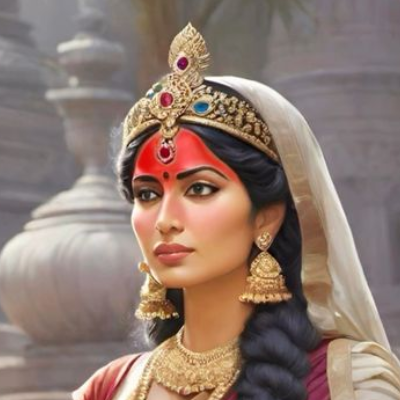
Rukmini is the youngest child and only daughter of Bhishmaka, king of Vidarbha — a kingdom in the Deccan region of the Indian subcontinent with its capital at Kundina — and his queen Shuddhamati. She is identified across the Bhagavata Purana, the Vishnu Purana, the Harivamsa, the Padma Purana, and the Skanda Purana as an incarnation of the goddess Lakshmi, the eternal consort of Vishnu, taking human birth in order to unite with Krishna, the eighth avatar of Vishnu, in his earthly sojourn. She becomes Krishna's principal wife and the queen of his city of Dvaraka on the western coast, and is accorded the status of his foremost consort — Patni Pradhana — above his other wives in the Puranic hierarchy. Her narrative encompasses her birth, her devotion to Krishna prior to any meeting, her famous letter, her elopement, her life at Dvaraka, her children, her theological debates with Krishna recorded in the Bhagavata Purana, and her death alongside him. She is among the most fully drawn female figures in the Puranic corpus, with a presence that extends from the genealogical and martial episodes of the Krishna cycle into philosophical dialogue, domestic narrative, and eschatological conclusion.
✦ The Names and Epithets
The name Rukmini follows the gold-root naming convention of the Vidarbha royal house, combining the Sanskrit root rukma — meaning gold or golden radiance — with the feminine suffix, yielding the sense of the golden one or she who is adorned with gold. It shares its root with the names of all her brothers: Rukmi, Rukmaratha, Rukmabahu, Rukmakesha, and Rukmanetra. The epithet Vaidarbhi is a matronymic-style patronymic derived from her kingdom of origin, Vidarbha, and means simply the one from Vidarbha or the Vidarbha princess. Bhaishmaki is her patronymic proper, meaning daughter of Bhishmaka. Krishnapriya, meaning the beloved of Krishna, reflects her primary theological identity. In certain regional and devotional traditions she is also identified by epithets that align her directly with Lakshmi, the goddess of fortune and the eternal consort of Vishnu, of whom she is understood to be a complete and full incarnation rather than a partial manifestation.
✦ Lineage
- Father — Bhishmaka: King of Vidarbha and head of the Bhoja dynasty, a branch of the wider Yadava lineage. Described in the Puranic texts as a pious ruler who held Krishna in personal esteem, though he allowed his eldest son Rukmi's political will to direct the official arrangements for Rukmini's marriage.
- Mother — Shuddhamati: Queen of Vidarbha, also rendered Sudhimati in some recensions. She is named as the mother of all six of Bhishmaka's children but is not assigned individual narrative in the primary sources.
- Elder brother — Rukmi: The eldest son and crown prince of Vidarbha. An accomplished warrior and a firm opponent of Krishna, Rukmi pressed for Rukmini's marriage to Shishupala, king of Chedi, and pursued Krishna after the elopement, only to be defeated, humiliated, and spared at Rukmini's own tearful intercession. He spent the remainder of his life in self-imposed exile at his founded city of Bhojakata and was eventually killed by Balarama during a dice game.
- Elder brothers — Rukmaratha, Rukmabahu, Rukmakesha, Rukmanetra: The four remaining brothers of Rukmini, younger than Rukmi and older than Rukmini, named in the Puranic genealogical lists without individual narrative development.
- Consort — Krishna: The eighth avatar of Vishnu, prince of the Vrishni branch of the Yadava lineage, and king of Dvaraka. Identified in the Bhagavata Purana and the Vishnu Purana as Vishnu himself incarnate. Krishna abducted Rukmini from her wedding procession at Kundina and made her his chief wife at Dvaraka.
- Son — Pradyumna: The firstborn son of Rukmini and Krishna, identified in certain Puranic texts as an incarnation of Kama, the god of love. Pradyumna was abducted as an infant by the demon Shambara and later returned after killing him. He married Mayavati — who is identified as a prior incarnation of Rati, the consort of Kama — and also married Rukmavati, the daughter of Rukmini's elder brother Rukmi, thereby connecting the estranged families. Pradyumna later fathered Aniruddha, a grandson of Krishna.
- Sons — Charudeshna, Sudeshna, Charudeha, Sushena, Charusena, Bhadracharu, Charuchandra, Vicharu, and Charu: Eight further sons of Rukmini and Krishna, named in the Bhagavata Purana's enumeration of Krishna's progeny by his various wives. These sons are listed in the genealogical passages but do not receive individual narrative development in the primary texts.
- Daughter — Charumati: A daughter of Rukmini and Krishna, named in the Bhagavata Purana. She is given in marriage to Bali, son of Kritavarma, a Yadava chief and a figure of significance in the late portions of the Mahabharata and the Bhagavata Purana.
✦ Birth and the Celestial Proclamation
The Skanda Purana preserves a tradition — not found in the same form in the Bhagavata Purana or the Vishnu Purana — according to which at the time of Rukmini's birth an incorporeal celestial voice, an akashavani, proclaimed to Bhishmaka that the child born to him was destined to be wed to a four-armed being, a description understood as pointing to Vishnu or his avatar Krishna. This divine proclamation is presented in the Skanda Purana as the foundation of Bhishmaka's inner conviction regarding his daughter's rightful husband, placing a sacred injunction over her from the moment of her birth. The Bhagavata Purana does not include this birth episode; its account of Rukmini's devotion to Krishna is explained instead through her having heard of his virtues and qualities from sages, brahmins, and others who spoke of him, which kindled her single-minded love.
✦ Rukmini's Devotion and the Letter to Krishna
The Bhagavata Purana's account, which is the most detailed in the textual tradition, describes Rukmini as having heard extensive descriptions of Krishna's beauty, character, and divine nature from those who visited Kundina, and as having resolved, from that hearing alone and prior to any direct encounter with him, that she would accept no husband other than Krishna. The text presents this resolve not as ordinary romantic attachment but as the recognition by Lakshmi's incarnation of her eternal lord. Rukmini is depicted as a woman of both profound inner conviction and practical initiative: unwilling to submit to the marriage her brother Rukmi was arranging with Shishupala, king of Chedi, and unable to override the political machinery of the royal household from within, she devised a means of communication with Krishna.
She entrusted a brahmin — named Sunanda in some recensions of the Bhagavata Purana — with a letter addressed to Krishna. This letter, paraphrased across the tenth book of the Bhagavata Purana, declared her love, described her situation, identified the threat of the impending marriage to Shishupala, and implored Krishna to come to Kundina and carry her away before the ceremony could be completed. She also indicated a practical means by which this could be accomplished without scandal: she would need to visit the temple of the goddess — identified in most recensions as the Ambika or Gauri temple on the outskirts of Kundina — on the day before the wedding, as was customary for a bride. This procession would take her outside the palace and provide the opportunity for Krishna to seize her. She also conveyed in the letter that if he did not come, she intended to end her life rather than be given to another. The brahmin carried the letter to Dvaraka and delivered it to Krishna, who received it and departed immediately for Kundina.
✦ The Elopement from Kundina
Krishna arrived at Kundina accompanied by his elder brother Balarama and a Yadava military force. The city was filled with the assembled allies of Rukmi — among them Shishupala, Jarasandha of Magadha, Shalva, Paundraka Vasudeva, and Dantavakra — who had gathered for the marriage festival. The Bhagavata Purana describes Bhishmaka welcoming Krishna with great personal reverence and hospitality upon his arrival, even as the official preparations for Rukmini's wedding to Shishupala continued around him.
On the day before the appointed wedding, Rukmini proceeded from the palace in the customary bridal procession toward the goddess temple. The Bhagavata Purana describes her at this moment in terms that the text frames as a vision of divine beauty and composed dignity — a woman moving through a charged public moment with complete inner stillness, her gaze searching the crowd for the one she had summoned. As she emerged from the temple after her worship, Krishna drove his chariot forward, took her hand, and lifted her into the chariot, departing swiftly. This act is categorised in the dharmashastra tradition as a rakshasa form of marriage — the seizure of a bride by a warrior — which the texts present as a lawful mode of marriage for Kshatriyas.
The assembled kings gave immediate chase. Balarama and the Yadava army engaged and repelled the forces of Shishupala, Jarasandha, and their allies. Rukmi alone refused to abandon his pursuit; he pressed forward and challenged Krishna directly in single combat, was defeated comprehensively, and was subjected by Krishna to public humiliation — the shaving of portions of his head and beard, a mark of disgrace for a Kshatriya. Rukmini, learning of her brother's defeat and disfigurement, wept before Krishna and interceded for Rukmi's life, which Krishna granted. Rukmi, unable to return to Kundina without having avenged his defeat, vowed lifelong exile and founded the city of Bhojakata.
✦ Marriage and Status at Dvaraka
The formal marriage of Rukmini and Krishna was celebrated at Dvaraka following her elopement. The Bhagavata Purana and the Vishnu Purana both establish Rukmini as the foremost among Krishna's wives — he is said in these texts to have married eight principal queens, referred to collectively as the Ashtabharya or the eight principal consorts, of whom Rukmini is always named first. The other seven are Satyabhama, Jambavati, Kalindi, Mitravinda, Nagnajiti, Bhadra, and Lakshmana. Beyond the eight principal queens, the Bhagavata Purana also records that Krishna married sixteen thousand one hundred women whom he had liberated from the captivity of the demon Narakasura — an episode discussed separately below — but Rukmini's pre-eminence among all of these is consistently maintained in the text.
The Bhagavata Purana describes Rukmini as presiding over a grand palace at Dvaraka befitting her status. Her household is depicted as a model of queenly order and personal devotion: she is shown attending to Krishna, fanning him, managing her domestic responsibilities, and simultaneously maintaining the inner orientation of a devotee who understands the full divine identity of the one she serves as husband. This dual consciousness — of wife and devotee, of woman and goddess — is a recurring theological point in the Puranic presentation of their relationship.
✦ The Birth and Abduction of Pradyumna
The Bhagavata Purana records that the firstborn son of Rukmini and Krishna was Pradyumna, identified in certain texts as an incarnation of Kama, the god of love, who had been reduced to a bodiless state by the fire of Shiva's third eye for having disturbed Shiva's meditation. Shortly after his birth, the infant Pradyumna was abducted by the demon Shambara, who had received a prophecy that this child would be the cause of his death. Shambara threw the infant into the sea. A large fish swallowed the child; the fish was subsequently caught by fishermen and brought to Shambara's own kitchen, where it was cut open. Inside was found the living infant. A woman in Shambara's household named Mayavati — identified in the Bhagavata Purana as a prior incarnation of Rati, the consort of Kama — was assigned to raise the child. She was later informed by the sage Narada of the child's true divine identity and of her own prior identity as his eternal consort.
Pradyumna grew to manhood in Shambara's household, mastered all the arts of illusion that Mayavati taught him, and eventually killed Shambara in combat. He then returned to Dvaraka with Mayavati. His arrival with a woman caused initial consternation among the women of the palace, who — not recognising him — mistook him for Krishna himself on account of his resemblance to his father. Rukmini, experiencing a sudden surge of maternal emotion she could not immediately explain, wept upon seeing him. It was the sage Narada who arrived and revealed to Rukmini that the young man before her was her own long-lost son Pradyumna, returned from captivity. The Bhagavata Purana describes the reunion of Rukmini and Pradyumna as one of great joy, and frames the entire episode as the restoration of Kama to his consort Rati and of a son to his mother, both in a single moment.
✦ The Parijata Episode and the Rivalry with Satyabhama
The Bhagavata Purana and the Harivamsa both record an episode in which Krishna brought the Parijata tree — a divine flowering tree from the heavenly realm of Indra — to Dvaraka. The occasion arose when the sage Narada brought a single Parijata flower to Dvaraka and gave it to Krishna, who gave it to Rukmini. Satyabhama, another of Krishna's principal wives — the daughter of the Yadava chief Satrajit and a woman of spirited and forthright temperament — was displeased that the flower had not been given to her. She used her influence with Krishna to press him to bring the entire Parijata tree from Indra's heaven and plant it in her garden. Krishna accordingly went to Indra's realm, and after a conflict with Indra — who resisted the removal of the tree — brought the Parijata to Dvaraka and planted it in Satyabhama's garden.
The episode is significant for what it reveals about Rukmini's character in the Puranic presentation. Unlike Satyabhama, who pressed her claim openly and with considerable persistence, Rukmini made no competing demand for the tree. The Bhagavata Purana presents her composure and absence of rivalry as consistent with her identity as Lakshmi incarnate — a goddess who does not contend for outward tokens because her position is understood to be constitutionally secure. Several later commentators within the Vaishnava tradition have interpreted the contrast between the two queens in this episode as illustrative of two modes of devotion: Satyabhama's ardent and passionate attachment on one hand, and Rukmini's serene and unwavering confidence on the other.
✦ The Liberation of Narakasura and the Sixteen Thousand Queens
The Bhagavata Purana records that Krishna, accompanied by Satyabhama rather than Rukmini in the narrative of this particular episode, killed the demon Narakasura — also called Bhaumasura — who had abducted and imprisoned sixteen thousand one hundred women of royal lineage, holding them in his fortress. After Narakasura's death, Krishna liberated all the captive women and, since their abduction had rendered them without prospect of marriage in the social conventions of the age, married all of them simultaneously by divine power, manifesting a separate form for each. These women are enumerated in the Bhagavata Purana among Krishna's wives but are distinguished from his eight principal consorts, of whom Rukmini remains the foremost. Rukmini's status and position are not altered by this episode; the Bhagavata Purana's narrative structure consistently preserves her precedence.
✦ The Dice Game at Bhojakata and the Death of Rukmi
A generation after Rukmini's elopement, her son Pradyumna married Rukmavati, the daughter of Rukmi — Rukmini's own elder brother who had spent his life in exile at Bhojakata after his defeat and humiliation. The marriage between Pradyumna and Rukmavati thus brought the estranged families formally together, though without dissolving the underlying tensions. Following the wedding celebrations at Bhojakata, a dice game was arranged among the assembled kings. Rukmi challenged Balarama — Krishna's elder brother, a man of extraordinary physical strength and well-known irascibility — to a game of dice. The game ended in a dispute over its outcome; Rukmi and his allies, including the king of Kalinga, mocked Balarama openly over his losses. Balarama, his anger beyond containment, struck Rukmi dead.
The Bhagavata Purana states with notable directness that Krishna neither prevented the killing nor approved of it — he remained silent, unwilling to reproach his own elder brother Balarama yet equally unable to endorse the killing of his wife's brother. Rukmini is described as being overcome with grief at the death of Rukmi, even though their relationship had been defined throughout her life by his opposition to her deepest desire and his role in her near-forced marriage to another. The Bhagavata Purana's depiction of her grief is treated not as contradiction but as the natural complexity of sibling bonds that persist across personal and political ruptures.
✦ The Philosophical Dialogue with Krishna
One of the most distinctive episodes involving Rukmini in the Bhagavata Purana is a philosophical exchange between her and Krishna recorded in the tenth book. Krishna approaches Rukmini in a playful and testing spirit, and appears to question whether she acted wisely in choosing him — a man of uncertain social standing in the perception of worldly kings, one who had abandoned his ancestral city of Mathura and founded a new one on the sea, and who had powerful enemies. He suggests that men of greater worldly stature and security had been available to her, and raises the possibility that she might have done better. The passage is understood by the Puranic tradition not as a genuine expression of doubt on Krishna's part but as a divine game — a testing of Rukmini and an opportunity for her to articulate her understanding of who and what Krishna truly is.
Rukmini's response, as paraphrased across the tenth book, is the most extended direct speech attributed to her in the entire corpus. She addresses Krishna's apparent self-deprecation with steady clarity, identifying him as the supreme being whose true nature is beyond the comprehension of those who evaluate him by worldly measures. She rejects the premise that any of the kings offered as alternatives could compare to him, and asserts that her choice was not made in ignorance of his circumstances but precisely because of her understanding of his nature. The exchange concludes in reconciliation and tenderness, with the playfulness of Krishna's opening gambit resolving into an affirmation of their union. This passage is significant in the Vaishnava theological tradition as an instance of Rukmini functioning not merely as a devoted wife but as a theologian in her own right, articulating the doctrine of Krishna's supremacy from within the context of domestic life.
✦ The Durvasa Episode
The Bhagavata Purana records an episode in which the sage Durvasa — renowned throughout the epic and Puranic literature for his extreme austerity and his equally extreme readiness to curse those who displease him — visited Dvaraka and was received as a guest by Krishna and Rukmini. After the meal, Durvasa expressed a wish to be taken to his hermitage, and Krishna undertook to carry him there personally, drawing the carriage himself while Rukmini pulled alongside. During the journey, Rukmini experienced intense thirst. She drew water from the earth — by certain accounts, by means of a small miracle — and drank without first offering water to Durvasa. The sage, perceiving this as a breach of hospitality and protocol, was angered and threatened a curse. Rukmini's composure in the face of Durvasa's wrath, and the resolution of the episode through Krishna's intercession, are the substance of the narrative. The episode is presented as an illustration of the challenges of maintaining perfect dharmic conduct even for those of the highest birth and devotion, and as a demonstration of Krishna's protective role toward his wife.
✦ Rukmini and the Ashvamedha
Certain recensions of the Harivamsa and related Puranic material refer to Rukmini's presence at significant royal ceremonies performed at Dvaraka, including her role as the chief queen in sacrificial and ceremonial contexts that required the participation of the principal consort. Her status as Patni Pradhana — the foremost wife — meant that in any ritual context requiring the queen's formal participation, Rukmini occupied that position. However, the specific details of her role in any individual ceremony are not elaborated at length in the primary texts; her ceremonial function is implied by her queenly status rather than narrated in dedicated episodes.
✦ Death and Departure
The Bhagavata Purana's eleventh book narrates the destruction of the Yadava clan at Prabhasa — the consequence of a curse laid by the sages Vishvamitra, Kanva, and Narada upon the Yadava youth who had mocked them — and the subsequent departure of Krishna from the mortal world. Following the catastrophic internecine violence among the Yadavas at Prabhasa and the death of Balarama, Krishna withdrew to the forest, where he was struck by the arrow of a hunter named Jara and left his mortal body. The Bhagavata Purana states that Rukmini, along with several of the other principal queens of Krishna — including Satyabhama, Jambavati, and others — chose not to survive the death of their husband. Some entered fire; others are described as having given up their bodies through yogic means or through grief. Rukmini is specifically named among those who entered the funeral fire, an act that the text frames as the voluntary departure of Lakshmi from her earthly sojourn at the conclusion of the avatar's mission.
✦ Textual Variants and Inconsistencies
The name of the brahmin messenger who carried Rukmini's letter to Krishna varies across recensions of the Bhagavata Purana. The name Sunanda appears in certain manuscripts; others do not specify the brahmin's name. This is a minor variant of no consequence to the substance of the episode but is noted for completeness.
The precise temple at which Rukmini was to offer worship before her wedding — and from the precincts of which Krishna seized her — is identified in most recensions of the Bhagavata Purana as the temple of Ambika, a form of the goddess Parvati or Durga. Certain other recensions and secondary texts identify the deity as Gauri. These are variant names for closely related goddess forms, and the difference does not substantially alter the narrative; it is nonetheless a point of variation in the manuscript tradition.
The birth episode involving the celestial proclamation — the akashavani at Rukmini's birth instructing Bhishmaka to wed her to a four-armed being — is attested in the Skanda Purana but not in the Bhagavata Purana's account of the same events. The two texts are not contradictory so much as differently emphasised; the Skanda Purana supplies a divine sanction at birth while the Bhagavata Purana explains Rukmini's devotion through hearing rather than through a natal proclamation. Both accounts are recorded here as representing distinct but not mutually exclusive narrative traditions.
The number of children attributed to Rukmini and Krishna shows minor variation across texts. The Bhagavata Purana names ten sons — Pradyumna and nine others — and one daughter, Charumati. Some Puranic genealogical lists show slight differences in the names of the nine sons other than Pradyumna. The enumeration given in the lineage section of this profile follows the Bhagavata Purana as the primary source.
✦ Theological and Philosophical Significance
Rukmini's identification as Lakshmi incarnate is not incidental to her narrative but foundational to it. The Bhagavata Purana frames the entire arc of her story — from her devotion prior to meeting Krishna, through her bold act of self-directed correspondence, to her elopement, her domestic life, her philosophical exchange with Krishna, and her final departure — as the earthly re-enactment of the eternal union between Vishnu and Lakshmi. Her agency in the elopement, which is remarkable in the context of the narrative traditions of the period, is presented not as rebellion but as the inevitability of a cosmic reunion asserting itself through a woman of exceptional inner clarity.
Within the Vaishnava devotional traditions, particularly those of the Sri Vaishnava school associated with Ramanuja and the Pancharatra tradition, Rukmini's role as the mediating presence of Lakshmi — who intercedes with Vishnu on behalf of devotees and who embodies divine grace — is of major theological importance. She is understood not merely as the wife of the avatar but as the essential companion principle of divinity itself, without whom the avatar's earthly sojourn would be incomplete. Her capacity to function simultaneously as devoted wife, wise queen, grieving sister, articulate theologian, and departing goddess at the close of the avatar's mission gives her a theological range that few figures in the Puranic corpus match.
✦ Iconography and Worship
Rukmini is worshipped as a goddess in her own right across a wide range of Vaishnava temples, most prominently at the Dwarkadhish temple complex in Dwarka, Gujarat, where a separate shrine dedicated to her stands apart from the main Krishna sanctuary — a feature that is itself the subject of a well-known devotional legend explaining the separation of their shrines. In iconographic tradition she is typically depicted as a queen of golden complexion, richly adorned, seated or standing beside Krishna. In certain regional traditions of Maharashtra and the Deccan — the geographical area of ancient Vidarbha — she is worshipped as Rukmini Vitthal alongside the form of Krishna known as Vitthal or Vithoba at Pandharpur, where she is among the most actively venerated deities. In this tradition her shrine at Pandharpur is distinct from the main Vitthal temple, and she is worshipped with a full ceremonial calendar of her own.
✦ Connection to the Wider Genealogy
Through her father Bhishmaka, Rukmini belongs to the Bhoja branch of the Yadava lineage. Through her marriage to Krishna, who belongs to the Vrishni branch of the same Yadava descent group, she becomes the connecting figure between two branches of a shared ancestral line. Her son Pradyumna's marriage to Rukmavati — daughter of Rukmini's own brother Rukmi — closes this genealogical circle further within a single generation, uniting the estranged Vidarbha and Dvaraka lines through the children of both the separated siblings. Pradyumna and Rukmavati's son Aniruddha — a grandson of Krishna and through Rukmavati also a great-grandson of Bhishmaka — married Usha, the daughter of the demon king Bana, an episode narrated at length in the Bhagavata Purana. Rukmini thus stands at the generative centre of one of the most genealogically intricate kinship clusters in the entire Puranic tradition.
✦ References
Primary Sources
- Bhagavata Purana, Skandha 10, Chapters 52–54: The fullest and most authoritative account of Rukmini's devotion to Krishna, her letter, the elopement from Kundina, Rukmi's defeat, and the formal marriage at Dvaraka; also the primary source for her identification as Lakshmi incarnate.
- Bhagavata Purana, Skandha 10, Chapters 55–56: Narrates the birth of Pradyumna, his abduction by Shambara, his return to Dvaraka with Mayavati, and Rukmini's reunion with her son.
- Bhagavata Purana, Skandha 10, Chapter 60: Records the philosophical dialogue between Krishna and Rukmini in which she articulates her understanding of his divine nature in response to his testing questions.
- Bhagavata Purana, Skandha 10, Chapter 61: Enumerates the children of Krishna's principal wives, listing Rukmini's ten sons and daughter Charumati, and narrates the dice game at Bhojakata and Rukmi's death at Balarama's hands.
- Bhagavata Purana, Skandha 10, Chapters 59 and 67–68: Contains the Narakasura episode and the Parijata tree episode, establishing context for the wider domestic and cosmological dimensions of life at Dvaraka.
- Bhagavata Purana, Skandha 11: Narrates the destruction of the Yadava clan at Prabhasa, the death of Krishna, and the departure of his principal queens including Rukmini.
- Vishnu Purana, Book 5: Provides a parallel account of the elopement and of Rukmini's status as Krishna's foremost wife, with genealogical enumeration of their children.
- Harivamsa, Vishnu Parva: Contains a version of the elopement narrative, the Bhojakata dice game and Rukmi's death, and additional material on Rukmini's ceremonial and domestic role at Dvaraka.
- Skanda Purana: Preserves the tradition of the celestial proclamation at Rukmini's birth instructing Bhishmaka to wed her to a four-armed being, a detail specific to this text.
- Padma Purana: Contributes to the tradition of Rukmini's identification as Lakshmi incarnate and her theological significance within the wider Vaishnava framework.
- Mahabharata, Sabha Parva and Drona Parva: Contains incidental references to Rukmini in the context of the Yadava genealogy and the broader narrative of the Kurukshetra war, within which Krishna and his household are embedded.
Modern Reference Works
- Mani, Vettam — Puranic Encyclopaedia (1975): Provides a consolidated narrative and genealogical summary of Rukmini drawing on the primary Puranic sources, with cross-references to the major episodes across multiple texts.
- Wisdomlib.org — definition and concept entries for Rukmini: Aggregates references to Rukmini across multiple Puranic texts and is useful for cross-checking the range of her appearances, variant name forms, and episodic details.
- Matchett, Freda — Krishna: Lord or Avatara? (2001): Provides scholarly analysis of the Bhagavata Purana's presentation of Krishna's relationships with his wives, including the theological framing of Rukmini as Lakshmi incarnate and the significance of the philosophical dialogue in Chapter 60.
- Wikipedia — articles on Rukmini and Ashtabharya: Offers a general narrative synthesis and orientation to the primary source chapters; used here only as a secondary reference, with all factual claims verified against primary texts.