
About
Bhishmaka — King of Vidarbha and Father of Rukmini
Bhishmaka · Hiranyaroman · Raja of Kundina · Bhoja king
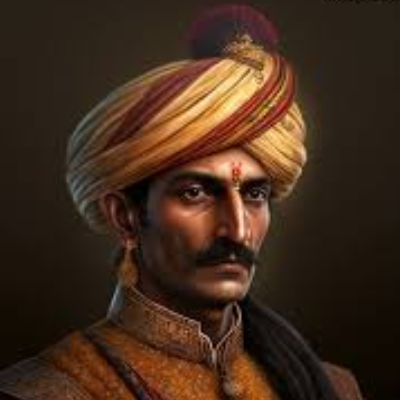
Bhishmaka is the king of Vidarbha, a realm in the Deccan region of the Indian subcontinent, with his capital established at the city of Kundina. He belongs to the Bhoja lineage, one of the ancient Kshatriya clans. He is most prominently known in the Puranic and epic traditions as the father of Rukmini — who is identified in the Bhagavata Purana and other texts as an incarnation of the goddess Lakshmi and who becomes the principal consort of Krishna, the eighth avatar of Vishnu. Bhishmaka appears as a named king in the Mahabharata, the Bhagavata Purana, the Vishnu Purana, the Harivamsa, and the Skanda Purana, each contributing distinct details about his character, his household, and the circumstances surrounding Rukmini's marriage.
✦ The Name
The name Bhishmaka is Sanskrit in origin and carries the sense of one who is formidable or awe-inspiring, related to the root that also underlies the name of the great warrior Bhishma of the Kuru line. The alternate name or epithet Hiranyaroman is a compound of hiranya, meaning gold, and roman, meaning bodily hair or down, yielding the meaning "one with golden hair" or "golden-haired." This epithet appears in certain Puranic passages as an identifying descriptive for the king. In the genealogical and narrative sections of the texts, he is typically identified simply by his primary name Bhishmaka, or by his title as king of Vidarbha.
✦ Lineage
- Dynasty: Bhoja, a branch of the wider Yadava clan grouping; Bhishmaka is identified as the head of the Bhoja rulers of Vidarbha.
- Consort: Shuddhamati (also rendered in some recensions as Sudhimati), queen of Vidarbha and mother of his children.
- Son — Rukmi: The eldest child, crown prince of Vidarbha, a powerful warrior and an opponent of Krishna. Rukmi's political ambitions and personal enmity toward Krishna drive much of the conflict in the Rukmini narrative.
- Son — Rukmaratha: Second son of Bhishmaka, named in the Puranic lists of Bhishmaka's male progeny.
- Son — Rukmabahu: Third son, named in the same genealogical lists.
- Son — Rukmakesha: Fourth son of Bhishmaka.
- Son — Rukmanetra: Fifth son of Bhishmaka.
- Daughter — Rukmini: The youngest child of Bhishmaka and Shuddhamati, described in the Bhagavata Purana as supremely beautiful and devoted to Krishna. She is identified as an incarnation of the goddess Lakshmi, the consort of Vishnu, and becomes the foremost among Krishna's wives after her elopement with him.
✦ Bhishmaka as an Ally of Jarasandha
In the Sabha Parva of the Mahabharata, during the account of the digvijaya (conquest of the directions) undertaken by the Pandava prince Sahadeva, Bhishmaka is named among the kings of the southern regions who were brought under the suzerainty of the Pandavas. The text indicates that Bhishmaka, as king of Vidarbha, had previously aligned himself with Jarasandha, the powerful king of Magadha who was an adversary of both the Pandavas and Krishna. Following Sahadeva's southern campaign, Bhishmaka is included among the defeated kings who submitted to Pandava authority. This episode establishes Bhishmaka as a politically significant regional ruler whose alliances had wider consequences in the epic's geopolitical landscape.
✦ The Celestial Proclamation at Rukmini's Birth
The Skanda Purana preserves a tradition, not found uniformly across all texts, in which at the time of Rukmini's birth an incorporeal or celestial voice — an akashavani — declared to Bhishmaka that his daughter was destined to be wed to a four-armed being, a description understood as a reference to Vishnu or his avatar Krishna. This divine pronouncement placed a sacred injunction upon Bhishmaka regarding his daughter's marriage and is presented in the Skanda Purana as the basis for his own inner conviction that Rukmini belonged with Krishna. The episode explains the moral and spiritual dimension of Bhishmaka's conflict: he had received divine guidance pointing toward one outcome while his son Rukmi relentlessly pressed for another.
✦ The Marriage Conflict and Rukmini's Elopement
The central episode involving Bhishmaka is narrated at length in the tenth book of the Bhagavata Purana and in the Vishnu Purana, with a parallel account in the Harivamsa. According to these sources, Rukmini, having heard of Krishna's virtues, resolved to marry him and no other. Her eldest brother Rukmi, however, harboured deep hostility toward Krishna and had allied himself politically with Shishupala, the king of Chedi and a rival of Krishna. Rukmi arranged and pressed for Rukmini's betrothal to Shishupala, and the formal marriage preparations were set in motion according to Rukmi's insistence.
Bhishmaka's position in this conflict is portrayed with nuance in the Harivamsa and the Bhagavata Purana. While the king officially allowed the preparations for Rukmini's marriage to Shishupala to proceed — a concession attributed to his inability or unwillingness to override his powerful eldest son — he himself held Krishna in profound esteem and welcomed Krishna and his elder brother Balarama when they arrived at Kundina during the marriage festival. The Bhagavata Purana describes Bhishmaka honouring Krishna with great respect and courtesy upon his arrival, indicating the king's personal reverence even amid the political pressure.
Rukmini, unwilling to submit to the arranged marriage, had already dispatched a messenger — a brahmin named Sunanda in some recensions — bearing a letter to Krishna in which she declared her love and implored him to carry her away before the wedding could take place. Acting on this appeal, Krishna abducted Rukmini from a procession near a temple — the Ambika or Gauri temple in most recensions — in an act understood in the texts as a rakshasa form of marriage, sanctioned for Kshatriya warriors. Balarama and the Yadava forces supported Krishna and repelled the armies of Shishupala, Jarasandha, and Rukmi who gave chase. Rukmi alone pursued them relentlessly but was defeated and humiliated by Krishna, who spared his life at Rukmini's tearful entreaty. After this, Bhishmaka accepted the union as divinely ordained and the texts present no further opposition from him to the marriage.
✦ Textual Variants and Inconsistencies
The name of Bhishmaka's consort varies across the textual tradition. The Bhagavata Purana and certain Puranic genealogies refer to her as Shuddhamati, while other recensions and secondary sources render the name as Sudhimati. These are likely variant spellings of the same figure rather than references to two distinct women, but the inconsistency exists in the manuscript tradition and is noted here for accuracy.
The alternate name Hiranyaroman, applied to Bhishmaka in certain Puranic passages, is not consistently used across all texts. The Mahabharata and the Bhagavata Purana primarily employ the name Bhishmaka; Hiranyaroman appears in more limited contexts and may represent a regional or recension-specific tradition rather than a universally attested epithet.
The celestial voice episode at Rukmini's birth, as recorded in the Skanda Purana, does not appear in the same form in the Bhagavata Purana's account of the Rukmini episode. The Bhagavata Purana explains Bhishmaka's apparent acquiescence primarily through the political dominance of Rukmi rather than through explicit divine instruction given at birth. These two explanatory frameworks — divine command versus political coercion — represent distinct narrative emphases across the textual corpus rather than contradictory facts, but the reader should note that the Skanda Purana's akashavani tradition is particular to that text.
✦ Character and Theological Significance
In the Puranic construction of the Rukmini narrative, Bhishmaka serves as a figure of genuine piety and moral conflict. Unlike Rukmi, who is portrayed as wilfully opposed to Krishna on grounds of pride and political rivalry, Bhishmaka is consistently depicted as a man of personal devotion who is caught between paternal authority over a headstrong eldest son and his own spiritual inclinations. The Harivamsa in particular draws attention to this interior conflict. His hospitality toward Krishna during the marriage preparations — even while those preparations officially served a rival groom — is presented in the texts as an act of sincere veneration rather than political calculation.
Within the broader theological framework of the Bhagavata Purana, the entire episode of Rukmini's elopement is understood as the fulfilment of a cosmic union between Vishnu and Lakshmi in their earthly forms. Bhishmaka, as the earthly father of Lakshmi's incarnation, occupies a position analogous to that of Janaka of Mithila — the father of Sita, who is herself identified as Lakshmi's incarnation — in the Ramayana tradition. In both cases, the mortal father is the custodian of a goddess in human form, and the narrative arc moves toward the reunion of that goddess with her divine consort.
✦ Connection to the Wider Genealogy
Bhishmaka belongs to the Bhoja branch of the Yadava lineage, a broad kinship network of clans descended from the ancient king Yadu. His kingdom of Vidarbha places him within the political geography of the Deccan, distinct from the main Yadava settlements of Mathura and Dvaraka. Through his daughter Rukmini's marriage to Krishna — who is himself a prince of the Vrishni branch of the same Yadava lineage — Bhishmaka becomes a grandfather, through the Puranic tradition, of Pradyumna, the son born of Rukmini and Krishna, who is identified in certain texts as an incarnation of the god of love, Kama. Through Pradyumna the line continues to Aniruddha, a grandson of Krishna, whose own story is prominent in the later books of the Bhagavata Purana. Bhishmaka's eldest son Rukmi, despite his enmity with Krishna, later becomes the maternal grandfather of Aniruddha's wife Rochana or Subhadra in some recensions, weaving the families further together across a generation of reconciliation.
✦ References
Primary Sources
- Mahabharata, Sabha Parva: Names Bhishmaka among the kings of the south defeated by Sahadeva during the Pandava digvijaya campaign, identifying him as a former ally of Jarasandha.
- Bhagavata Purana, Skandha 10 (Chapters 52–54): The primary and most detailed account of Rukmini's love for Krishna, her letter to him, her elopement, and Bhishmaka's role as her father who honours Krishna during the marriage preparations.
- Vishnu Purana, Book 5: Narrates the Rukmini episode with reference to Bhishmaka as king of Vidarbha and father of Rukmini and Rukmi.
- Harivamsa (Vishnu Parva): Provides a parallel account of the elopement and gives particular attention to Bhishmaka's moral conflict between devotion to Krishna and deference to his son Rukmi's demands.
- Skanda Purana: Preserves the tradition of the celestial voice at Rukmini's birth instructing Bhishmaka to wed her to a four-armed being, a detail not uniformly found in other primary texts.
Modern Reference Works
- Mani, Vettam — Puranic Encyclopaedia (1975): Provides a consolidated summary of Bhishmaka's lineage, his five sons and daughter Rukmini, and the key episodes drawn from the Puranic sources.
- Wisdomlib.org — definition and concept entries for Bhishmaka: Aggregates references to Bhishmaka across multiple Puranic texts, useful for cross-checking the range of his appearances and the variant name Hiranyaroman.
- Wikipedia — articles on Bhishmaka and Rukmini: Provides a general narrative synthesis and points toward primary source chapters; used here only as a secondary orientation aid, with all factual claims verified against primary texts.