
About
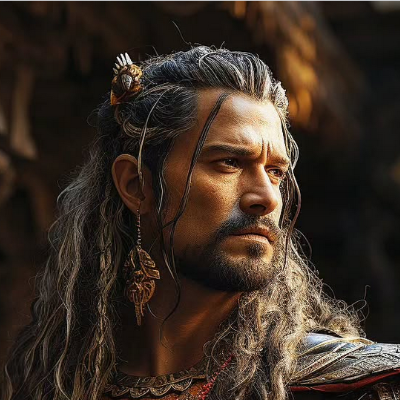
Rukmi — Crown Prince of Vidarbha and Adversary of Krishna
Rukmi · Rukmin · Prince of Kundina · Bhoja Kshatriya
Rukmi is the eldest son of Bhishmaka, king of Vidarbha — a kingdom in the Deccan region of the Indian subcontinent with its capital at Kundina — and his queen Shuddhamati. He is the elder brother of Rukmini, who is identified in the Bhagavata Purana and the Vishnu Purana as an incarnation of the goddess Lakshmi and who becomes the principal consort of Krishna, the eighth avatar of Vishnu. Rukmi is one of the most complex secondary figures in the Krishna cycle of the Puranic tradition: a warrior of genuine prowess and a prince of deep political conviction whose implacable enmity toward Krishna drives the central conflict of his sister's marriage narrative, yet who is also woven back into the Yadava kinship network through his descendants in the following generation. He appears prominently in the Bhagavata Purana, the Vishnu Purana, the Harivamsa, and the Mahabharata, with certain details varying across these sources.
✦ The Name
The name Rukmi is derived from the Sanskrit root associated with gold or radiance — the same root that underlies the name Rukmini, his sister, and the names of his four brothers: Rukmaratha, Rukmabahu, Rukmakesha, and Rukmanetra. The gold-root naming convention applied to all of Bhishmaka's children suggests a dynastic or ceremonial tradition within the Vidarbha royal house. Rukmi's own name therefore carries the sense of the golden or the radiant one, though the texts do not elaborate on this etymology in their narratives. The name is found in both the nominative form Rukmi and in the adjectival form Rukmin in different passages of the Puranic literature.
✦ Lineage
- Father — Bhishmaka: King of Vidarbha and head of the Bhoja dynasty, a branch of the wider Yadava lineage. Bhishmaka is described across the Puranic texts as a pious and personally devout ruler who held Krishna in high regard, placing him in direct temperamental opposition to his eldest son.
- Mother — Shuddhamati: Queen of Vidarbha, also rendered Sudhimati in some recensions. She is the mother of all of Bhishmaka's children.
- Brothers — Rukmaratha, Rukmabahu, Rukmakesha, Rukmanetra: Four younger brothers of Rukmi, named in the Puranic genealogical lists of Bhishmaka's male progeny. They do not receive individual narrative development in the primary texts.
- Sister — Rukmini: The youngest child of Bhishmaka, supremely devoted to Krishna and identified in the Bhagavata Purana as an incarnation of the goddess Lakshmi. Her desire to marry Krishna and Rukmi's insistence on wedding her to Shishupala of Chedi form the central axis of Rukmi's story.
- Daughter — Rukmavati (in some recensions Rochana): A daughter of Rukmi, given in marriage to Pradyumna, the son of Krishna and Rukmini. This union, narrated in the Bhagavata Purana, represents a significant reconciliation between the two families across one generation, though the texts note the irony that Rukmi's own grandchild would be born of this line.
- Son — Rukmaratha (the younger): A son of Rukmi, named in the Bhagavata Purana in the context of the dice-game episode at Bhojakata, where he is killed by Balarama. This figure shares his name with Rukmi's younger brother but is a distinct person — a member of the next generation.
✦ Rukmi's Enmity Toward Krishna
The nature and origin of Rukmi's hostility toward Krishna are rooted in political allegiance and personal pride rather than in any single precipitating event narrated in the texts. Rukmi had aligned himself firmly with Jarasandha, the powerful king of Magadha who was the principal political opponent of Krishna and the Yadava confederacy, and with Shishupala, the king of Chedi, who bore his own deep and explicitly narrated enmity toward Krishna — an enmity the Bhagavata Purana traces to a previous life. Rukmi's insistence on betrothing Rukmini to Shishupala was thus simultaneously a personal political decision and an expression of the anti-Krishna alliance he had joined. The Harivamsa presents Rukmi's opposition as hardened by pride: he was a warrior confident in his own strength and contemptuous of Krishna's claim to his sister's hand. The Bhagavata Purana does not attribute the enmity to any divine curse or prior-life account in Rukmi's case specifically; it presents it as a matter of worldly politics and temperament.
✦ The Conflict Over Rukmini's Marriage
Rukmini, deeply devoted to Krishna and resolved not to marry Shishupala, sent a brahmin messenger to Krishna with a letter declaring her love and imploring him to carry her away before the wedding ceremony could be completed. Krishna, accompanied by his elder brother Balarama and a Yadava force, travelled to Kundina in response. Rukmi had arranged a grand marriage festival, and kings and princes allied with him — including Shishupala, Jarasandha, Shalva, Paundraka, and Dantavakra — had gathered at the capital.
As Rukmini was proceeding in procession to the Ambika or Gauri temple — accounts vary across recensions as to the precise deity of the shrine — Krishna seized her and departed swiftly with the Yadava forces. The assembled kings, enraged, gave chase and were repelled by Balarama and the Yadava army. Rukmi alone continued in pursuit, driven by fury and wounded pride. He challenged Krishna directly in combat and was defeated. Krishna, whose custom in such confrontations was not to kill the brother of his own wife, did not slay Rukmi. Instead — in what the texts present as a form of public humiliation — he shaved portions of Rukmi's head and beard, a mark of disgrace for a Kshatriya warrior, and left him alive. Rukmini herself, learning of her brother's defeat and disfigurement, wept and pleaded with Krishna to spare his life; it is this intercession that the Bhagavata Purana records as the direct cause of Rukmi's survival.
Humiliated beyond bearing, Rukmi vowed that he would never return to Kundina until he had killed Krishna. Unable to fulfil this vow, he founded a new city called Bhojakata — sometimes rendered Bhojagata — and remained there, refusing to return to his father's kingdom. The texts note the pathos of this self-imposed exile: a prince who could not go home because pride would not permit it, yet equally could not fulfil the oath that would have ended his exile.
✦ The Marriage of Pradyumna and Rukmavati
Despite the rupture between Rukmi and Krishna, the two families were drawn together in the next generation. Pradyumna — the son of Krishna and Rukmini, identified in certain Puranic texts as an incarnation of Kama, the god of love — sought Rukmavati, the daughter of Rukmi, in marriage. The Bhagavata Purana records that this union was agreed to and celebrated. The same source notes the strained quality of the reconciliation: the marriage brought the families together formally while the underlying resentment and pride of Rukmi remained unresolved. The wedding at Bhojakata is the setting for the final episode of Rukmi's life.
✦ The Dice Game and the Death of Rukmi
Following the marriage of Pradyumna and Rukmavati at Bhojakata, a dice game was arranged among the assembled kings. Rukmi challenged Balarama — Krishna's elder brother, a man of immense physical strength and renowned temper — to a game of dice. According to the Bhagavata Purana's account, the game proceeded with disputed outcomes. Rukmi won successive rounds but the arbitration of the game became a matter of contention. When the king of Kalinga and others sided with Rukmi's claims in a manner that Balarama found insulting, and when Rukmi reportedly mocked Balarama — who was known for his passion for dice but not for his skill at the game — Balarama's famous anger was provoked beyond restraint. He struck Rukmi dead on the spot with a blow from his weapon, which some recensions identify as a chess or dice board and others as his characteristic mace.
The killing of Rukmi is presented in the Bhagavata Purana as deeply awkward for Krishna. Rukmi was the brother of his own principal wife Rukmini; killing him or endorsing his killing would be a great wrong, but reproving Balarama — his own beloved elder brother — was equally impossible. The text states explicitly that Krishna neither approved of the act nor intervened to prevent it, and that he said nothing, leaving Rukmini in grief and Balarama in the moral position of having killed his sister-in-law's brother at a wedding celebration.
✦ Rukmi in the Mahabharata
The Mahabharata contains a reference to Rukmi in the context of the great war at Kurukshetra. Rukmi, at that time the ruler of Bhojakata and a king of established military reputation, approached both the Pandava and Kaurava camps with an offer of alliance and military support. Both sides declined his offer — the Pandavas because they had already secured their alliances, and the Kauravas for reasons the text does not elaborate at length. Rukmi is thus the unusual figure of a king who sought to enter the defining war of the age and was refused by both sides. He returned to Bhojakata without having fought. This episode, narrated in the Udyoga Parva, is the primary appearance of Rukmi in the Mahabharata proper, distinct from the references to the Rukmini episode that appear in other parvas.
✦ Textual Variants and Inconsistencies
The name of Rukmi's daughter given to Pradyumna in marriage is rendered differently across the textual tradition. The Bhagavata Purana uses the name Rukmavati, consistent with the gold-root naming pattern of the Vidarbha royal family. Other recensions and secondary Puranic summaries refer to her as Rochana. These are likely variant names for the same figure rather than references to two separate daughters, but the inconsistency exists across the manuscript corpus.
The precise manner of Rukmi's death at the dice game varies in its details. Some recensions specify that Balarama used a gaming board as his weapon; others describe it as his mace, the Kaumodaki or a related weapon. The narrative core — that Balarama killed Rukmi in anger during or immediately following a dice game at Bhojakata — is consistent across all major versions, but the instrument of death and the precise sequence of insults that provoked Balarama differ in their specifics between the Bhagavata Purana account and parallel versions in the Harivamsa.
Regarding Rukmi's son Rukmaratha the younger — killed by Balarama at the same gathering in some recensions — the Bhagavata Purana includes this detail while other versions of the episode are silent on it. Where it does appear, the killing of both father and son by Balarama at the wedding feast of the next generation is presented as a single outbreak of violence rather than two separate acts.
✦ Character and Significance in the Tradition
Rukmi occupies a distinctive position in the Puranic moral landscape. He is not a demon or an irredeemably wicked figure in the manner of Kamsa or Shishupala; he is a Kshatriya king of genuine martial ability and political standing whose fatal flaw is pride — an unyielding, self-isolating pride that leads him to found a city rather than return home in defeat, to seek entry into a war from which he is turned away by both sides, and ultimately to provoke a man of explosive temperament over a game of dice. The tradition does not present him as a figure of unambiguous villainy so much as one of tragic rigidity.
His relationship with his sister Rukmini is also textured: he was the direct cause of the arranged marriage she fled, yet when he lay defeated and disfigured after his pursuit of Krishna, it was Rukmini's tears and intercession that saved his life. The Bhagavata Purana's account thus preserves both the depth of his obstruction and the continued bond of affection, complicated as it was, between the two siblings. The marriage of his daughter Rukmavati to Pradyumna — son of the very man he had vowed to kill — and his death at the celebration of that wedding constitute one of the more starkly ironic trajectories in the Puranic narrative corpus.
✦ Connection to the Wider Genealogy
Rukmi's position in the wider Puranic genealogy is shaped by two sets of relationships that sit in permanent tension. Through his father Bhishmaka, he belongs to the Bhoja branch of the Yadava lineage — the same broad ancestral grouping to which Krishna himself belongs through the Vrishni branch. Rukmi and Krishna are thus distant kinsmen by patrilineal descent even as they are adversaries by choice and circumstance. Through his sister Rukmini's marriage to Krishna, Rukmi becomes the maternal uncle of Pradyumna, identified in certain texts as an incarnation of the god Kama; and through Pradyumna's marriage to his own daughter Rukmavati, Rukmi becomes the paternal grandfather of Aniruddha, a grandson of Krishna who is himself a significant figure in the later Bhagavata Purana narrative. The family thus closes into a single genealogical unit across two generations, encompassing within it both the antagonism of the first generation and the formal reconciliation — however incomplete — of the second.
✦ References
Primary Sources
- Bhagavata Purana, Skandha 10, Chapters 52–54: The fullest account of the Rukmini elopement episode, including Rukmi's role in arranging the marriage to Shishupala, his pursuit of Krishna after the abduction, his defeat and humiliation, and his vow of exile at Bhojakata.
- Bhagavata Purana, Skandha 10, Chapters 61 and 86: Narrates the marriage of Pradyumna and Rukmavati, the dice game at Bhojakata, Balarama's killing of Rukmi, and Krishna's moral silence in its aftermath.
- Vishnu Purana, Book 5: Provides a parallel account of the Rukmini episode with Rukmi identified as the primary antagonist pressing for the Shishupala marriage.
- Harivamsa, Vishnu Parva: Contains the Rukmini elopement narrative with particular attention to Rukmi's warrior credentials, his pursuit of Krishna, and the circumstances of his defeat; also provides a version of the Bhojakata dice game and Rukmi's death, with some details differing from the Bhagavata Purana account.
- Mahabharata, Udyoga Parva: Records Rukmi's approach to both the Pandava and Kaurava camps before the Kurukshetra war with an offer of alliance, and his rejection by both sides.
Modern Reference Works
- Mani, Vettam — Puranic Encyclopaedia (1975): Provides a consolidated genealogical and narrative summary of Rukmi, his lineage, the Rukmini episode, his founding of Bhojakata, and his death at the dice game, drawing on the primary Puranic sources.
- Wisdomlib.org — definition and concept entries for Rukmi: Aggregates Puranic references to Rukmi across multiple texts and is useful for cross-checking the range of his appearances and the variant name forms.
- Wikipedia — article on Rukmi: Offers a general narrative synthesis and pointers to primary source chapters; used here only as a secondary orientation aid, with all factual claims verified against primary texts.