
About
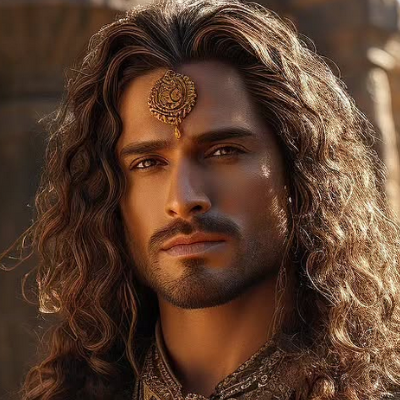
Pradyumna — Son of Krishna and Rukmini, Avatar of Kamadeva, and Hero of Dvaraka
Pradyumna · Rukminisuta · Krishnaputra · Kama · Sanatkumara · Mayaputra
Pradyumna is the eldest and most celebrated son of Krishna — the eighth avatar of Vishnu, supreme deity of the Bhagavata Purana and divine protagonist of the Mahabharata — and of Rukmini, the princess of Vidarbha who is Krishna's foremost wife and regarded in Vaishnava theology as an earthly manifestation of Lakshmi, the goddess of fortune and the eternal consort of Vishnu. Pradyumna is identified across the Bhagavata Purana, the Vishnu Purana, and the Harivamsa as an avatar or reincarnation of Kamadeva — the god of desire and love — who had been reduced to a bodiless state when Shiva incinerated him with the fire of his third eye for interrupting his meditation. Pradyumna's biography is among the most elaborated of Krishna's sons in the primary sources: his abduction as an infant by the demon Shambara, his upbringing in Shambara's household, his discovery of his true identity, his defeat of Shambara, his marriage to Mayavati, and his eventual return to Dvaraka are narrated across multiple Puranic texts with considerable consistency and narrative richness. He is further significant as the father of Aniruddha — whose abduction and rescue forms the basis of another major episode in the Bhagavata Purana — and as a member of the Vyuha (emanation) framework of Pancharatra Vaishnava theology, in which he is one of the four primary divine emanations of Vishnu. Pradyumna appears prominently in the Bhagavata Purana, the Vishnu Purana, the Harivamsa, and the Mahabharata.
✦ The Name
The name Pradyumna is a Sanskrit compound derived from the prefix pra — indicating intensity, excellence, or forward motion — and dyumna, meaning glory, splendour, or brilliance, from the root dyu meaning to shine. The full compound thus carries the sense of "the exceedingly glorious one," "the supremely brilliant one," or "he whose splendour is foremost." The name appears in the Rigveda as an epithet of Indra in the sense of great heroic power or luminous might, and its application to this son of Krishna connects him to an ancient vocabulary of divine martial and luminous excellence. The patronymic Rukminisuta identifies him as the son of Rukmini, and Krishnaputra as a son of Krishna. The epithet Mayaputra — son of Maya — refers to his relationship with his foster mother Mayavati, the form taken by the goddess Rati (wife of Kamadeva) in Shambara's household, as described below. In the Pancharatra theological framework, Pradyumna is identified as one of the four Vyuha emanations of Vishnu and is specifically associated with the function of mind (manas) in the cosmological unfolding of creation.
✦ Lineage
- Father: Krishna — the eighth avatar of Vishnu, son of Vasudeva and Devaki of the Yadava clan, raised in Gokula by Nanda and Yashoda, ruler of Dvaraka, and the supreme deity of the Bhagavata Purana's devotional theology. He is the divine charioteer of Arjuna in the Mahabharata and the speaker of the Bhagavad Gita.
- Mother: Rukmini — the princess of Vidarbha, daughter of King Bhishmaka of the Vidarbha kingdom, and the eldest and foremost of Krishna's eight principal wives. Rukmini, deeply devoted to Krishna, sent a secret message to him through a brahmin messenger requesting that he abduct her before her family could give her in marriage to the Chedi king Shishupala — whom she did not love — and whom her brother Rukmi favoured as her bridegroom. Krishna came to Vidarbha and abducted Rukmini as she emerged from the temple of the goddess on the eve of her wedding, carrying her away to Dvaraka in his chariot while defeating the armies of Shishupala and Jarasandha who pursued them. Their union was thus a love-abduction rather than a conventional arranged marriage, and the Bhagavata Purana presents it as the reunion of Vishnu and Lakshmi in their earthly forms. Rukmini is identified in Vaishnava theology as a partial manifestation of Lakshmi.
- Paternal grandparents: Vasudeva — a prince of the Yadava clan, son of Shurasena — and Devaki — a princess of the Yadava clan, daughter of Devaka. Both are central figures in the Krishna birth narrative.
- Maternal grandfather: Bhishmaka — the king of Vidarbha, a monarch of considerable standing whose kingdom is placed in the Deccan region. He is the father of both Rukmini and her brother Rukmi.
- Maternal uncle: Rukmi — the prince and later king of Vidarbha, elder brother of Rukmini, who was hostile to Krishna and favoured Shishupala as Rukmini's husband. Rukmi pursued Krishna after the abduction of Rukmini and was defeated in battle, but Krishna spared his life at Rukmini's request, though Balarama humiliated him by shaving half his head and moustache. Rukmi subsequently founded his own city, Bhojakata, and maintained his enmity toward Krishna, though he later gave his daughter Rocana in marriage to Pradyumna in an episode that further complicated the family relationship.
- Previous identity: Kamadeva — the god of desire, love, and erotic longing, son of Brahma or of Vishnu in different textual accounts, and the husband of Rati, the goddess of pleasure. Kamadeva was reduced to a bodiless state (Ananga — the bodyless one) when Shiva, whose deep meditation he had disturbed at the gods' request to make Shiva fall in love with Parvati and thereby father a son who would defeat the demon Taraka, incinerated him with the fire of his third eye. The gods, distressed by the loss of Kamadeva's embodied form and by Rati's grief, were told that Kamadeva would be reborn as the son of Krishna and Rukmini in a future age. Pradyumna is that rebirth.
- Wife: Mayavati — the form taken by Rati, Kamadeva's wife, in Shambara's household, where she had been placed as a cook in order to be present when Pradyumna arrived, so that she could recognise him and eventually unite with him. The episode and the nature of this union are discussed in detail below.
- Son: Aniruddha — the son of Pradyumna and Mayavati (or in some accounts of Pradyumna and Rukmavati, daughter of Rukmi). Aniruddha is Krishna's grandson and the subject of a major narrative episode in the Bhagavata Purana in which he is abducted to the city of Shonitapura by the demon Bana — a devotee of Shiva — after falling in love with Bana's daughter Usha, and is subsequently rescued by Krishna in a battle that brings Krishna into direct conflict with Shiva himself. Aniruddha is further identified in the Pancharatra framework as the fourth of the four Vyuha emanations of Vishnu.
- Half-siblings: Pradyumna has numerous half-brothers as sons of Krishna by his other seven principal wives. The Bhagavata Purana states that each of Krishna's eight principal wives bore ten sons, giving eighty principal sons. Among these, Samba — born of Jambavati — is the most narratively significant alongside Pradyumna himself. Pradyumna is consistently presented as the foremost of all Krishna's sons.
✦ The Abduction by Shambara and the Upbringing in His Household
The Bhagavata Purana's tenth book narrates the circumstances of Pradyumna's abduction in considerable detail. When Pradyumna was born to Krishna and Rukmini in Dvaraka, the demon Shambara — who had been forewarned by divine vision that this child would eventually be his destroyer — came to the maternity chamber and seized the infant before he was even ten days old. Shambara carried the child away and cast him into the ocean, intending to drown him. A great fish swallowed the infant. The fish was subsequently caught by fishermen and brought to Shambara's own household, where it was delivered to the kitchen to be prepared as food. When the fish was cut open in the kitchen, the living infant was found inside. Mayavati — the woman who presided over Shambara's kitchen and who was in truth the goddess Rati, the wife of Kamadeva, inhabiting this form in order to be present at the right moment — received the child. The sage Narada appeared to her and revealed the child's true identity: that this was Kamadeva reborn as the son of Krishna, destined to grow to manhood, defeat Shambara, and return with her to his true parents. Mayavati then raised Pradyumna in Shambara's household, concealing his identity from Shambara.
Pradyumna grew to young manhood in Shambara's household, renowned for his beauty and physical perfection. When the time came, Mayavati revealed to him the full truth of his origin — that he was the son of Krishna, that he had been abducted as an infant, that she herself was Rati reborn as his foster mother and now his destined wife, and that Shambara was his mortal enemy. She further instructed him in the use of the Maha-maya — the great illusory power — that she possessed and with which she could counter Shambara's own powers of maya, since Shambara was a demon of extraordinary skill in illusion and conjuration.
✦ The Defeat of Shambara
Armed with the knowledge of his true identity and with the Maha-maya given to him by Mayavati, Pradyumna confronted Shambara directly. The Bhagavata Purana narrates that Pradyumna challenged Shambara openly, denouncing him as a murderer of children and a coward who had abducted a defenceless infant rather than face a grown warrior. Shambara responded with his full arsenal of demonic magical powers, deploying multiple illusory attacks and conjurations in battle. Pradyumna countered each of Shambara's maya-weapons with the Maha-maya that Mayavati had given him. After a prolonged and dramatic combat in which Shambara's illusions were consistently neutralised, Pradyumna finally decapitated Shambara with his sword, destroying him completely.
Following Shambara's death, Pradyumna rose into the sky with Mayavati — who had now fully reassumed her identity as Rati — and flew through the air to Dvaraka. Their arrival at Krishna's household caused consternation among the women of the palace, who saw an extraordinarily handsome young man descend from the sky in the company of a beautiful woman and who initially did not recognise who he was, though his resemblance to Krishna was so marked that Rukmini herself was profoundly stirred. The sage Narada again appeared to clarify the situation, revealing to the assembled household that the young man was Pradyumna — the son who had been abducted as an infant and was now returned — and that the woman with him was Mayavati, his wife. The reunion of Pradyumna with his parents Krishna and Rukmini is described in the Bhagavata Purana as a moment of great joy. The text notes that Rukmini's grief over the loss of her infant son, sustained across the years of his absence, was dissolved in the happiness of his return.
✦ The Episode of Rukmi's Death and the Marriage of Aniruddha
A subsequent episode involving Pradyumna concerns the marriage of his son Aniruddha to Rocana, the granddaughter of Rukmi — Rukmini's hostile brother — and the fatal dice game that followed. Rukmi had founded his city of Bhojakata after his defeat by Krishna and had maintained his enmity toward the Yadavas, but he arranged the marriage of his granddaughter Rocana to Aniruddha as a dynastic alliance. The Bhagavata Purana narrates that following the wedding celebrations, Rukmi engaged Balarama — Krishna's elder brother — in a game of dice. Rukmi won repeatedly and taunted Balarama in a manner calculated to humiliate him. Balarama, a figure of volcanic temper and immense physical strength, was enraged by the taunts to the point where he seized a dice-board and struck Rukmi dead with it. The Yadavas departed from Bhojakata in discomfort following this incident — the awkwardness of Balarama having killed Rukmini's own brother within the context of a family celebration is acknowledged in the text. Krishna is specifically noted as having remained silent throughout the episode, neither preventing Balarama nor expressing approval — an authorial observation consistent with the Bhagavata Purana's presentation of Krishna as one who allows events to unfold according to their own karma without direct intervention in every situation. Pradyumna's role in this episode is as the father of Aniruddha, whose marriage occasioned the gathering at which Rukmi was killed.
✦ Pradyumna as a Warrior
Beyond the foundational episode of his defeat of Shambara, Pradyumna appears in several other martial contexts in the primary texts. The Harivamsa and the Bhagavata Purana both describe him as a warrior of the first rank among the Yadavas — second only to Krishna and Balarama themselves in the estimation of the tradition. He participates in battles fought by the Yadavas and is consistently characterised as possessing exceptional martial skill combined with the physical beauty and personal magnetism inherited from his father. The Mahabharata's Drona Parva contains references to Pradyumna as a great hero, and several passages in the epic note his prowess in war. He is described in some texts as having instructed Aniruddha in the arts of combat, continuing the martial tradition of the Yadava house.
The Bhagavata Purana also narrates an episode in which Pradyumna participates in the battle against the demon Salva, who attacks Dvaraka with a flying city-weapon called the Saubha during Krishna's absence. Pradyumna leads the Yadava forces against Salva and fights effectively, though he is at one point struck down and rendered temporarily unconscious by Salva's weapons — an episode that his charioteer Daruka (not to be confused with Krishna's charioteer of the same name) removes him from the battlefield to recover from, and which occasions a brief but intense narrative of Pradyumna's return to the fight and his continuation of the battle until Krishna himself returns to destroy Salva.
✦ Pradyumna in Pancharatra Vaishnava Theology
The most theologically elaborate dimension of Pradyumna's significance lies in the Pancharatra system of Vaishnava theology, which understands Vishnu as manifesting in a hierarchy of four primary emanations called Vyuhas — successive cosmic forms through which the supreme deity engages in the processes of creation, maintenance, and dissolution. In this framework, the four Vyuhas are Vasudeva (the supreme form), Sankarshana (identified with Balarama, Krishna's elder brother, and associated with individual consciousness or jiva), Pradyumna (associated with mind or manas and with the functions of cosmic creation), and Aniruddha (Pradyumna's son, associated with ego or ahamkara and with the sustaining of creation). Pradyumna's position as the third Vyuha — corresponding to the principle of mind — reflects a theological reading in which his identity as a reincarnation of Kamadeva, the god of desire and cosmic creative impulse, is given a cosmological dimension: desire and mind are the creative principles through which Vishnu's supreme consciousness engages in the act of generating the universe. This Pancharatra framework is elaborated in the Pancharatra Agamic texts, the Ahirbudhnya Samhita, and related literature, and is summarised in a number of the later Puranas.
✦ Textual Variants and Inconsistencies
Several genuine textual inconsistencies and points of variation arise across the primary sources.
The parentage of Kamadeva: The tradition does not speak with one voice on the parentage of Kamadeva — the deity whose reincarnation Pradyumna is. The Mahabharata and certain Puranas identify Kamadeva as born of Brahma's heart or mind. The Bhagavata Purana in some passages associates him with Vishnu — presenting him as arising from Vishnu's form — which is theologically consistent with the identification of Pradyumna as both Kamadeva reborn and a son of Vishnu's avatar Krishna. The Harivamsa and other texts give variant accounts. These inconsistencies in Kamadeva's parentage affect the understanding of Pradyumna's prior identity but do not alter the core narrative of his biography as the son of Krishna and Rukmini.
The identity of Pradyumna's wife and Aniruddha's mother: The Bhagavata Purana identifies Mayavati — the form of Rati — as Pradyumna's wife and as the mother of Aniruddha. The Vishnu Purana and some other texts name Rukmavati — a daughter of Rukmi — as the mother of Aniruddha rather than Mayavati. The Harivamsa contains passages that can be read to support either identification depending on the recension. The question of which of Pradyumna's wives bore Aniruddha is not uniformly resolved across the primary sources, and both the Mayavati tradition and the Rukmavati tradition have textual support.
The name Sanatkumara: Some texts give Sanatkumara as an alternative name or designation for Pradyumna, identifying him with the primordial celibate sage Sanatkumara who is one of the mind-born sons of Brahma. This identification is not mainstream across the Mahapuranas and appears in specific theological contexts rather than as a standard biographical designation. It is noted here as a recorded association in certain texts without being treated as an established mainstream identification.
Pradyumna's fate at Prabhasa: The Mahabharata's Musala Parva and the Bhagavata Purana's eleventh book both record the destruction of the Yadavas at Prabhasa, in which the Yadava warriors killed one another using reeds that had grown from the dust of the cursed iron pestle born of Samba. Pradyumna perished in this destruction along with the other Yadava heroes. The Musala Parva names Pradyumna specifically among the great warriors who fell, noting that his death at the hands of Bhoja — a Yadava prince — represented an extraordinary reversal, since Pradyumna was one of the clan's greatest warriors. The Bhagavata Purana's account is broadly consistent. The identification of Pradyumna's specific killer varies slightly between recensions of the Musala Parva.
✦ Theological Significance
Pradyumna's theological significance operates at multiple levels simultaneously. As a reincarnation of Kamadeva, he represents the restoration of the cosmic principle of desire and love to embodied form after Shiva's act of incineration had reduced it to a bodiless condition. The tradition's presentation of this restoration as occurring through birth as the son of Vishnu's own avatar is theologically deliberate: the supreme deity both generates and contains the principle of desire within his own divine household, affirming that cosmic Eros — the creative longing that drives the universe's unfolding — is not an independent or dangerous power but one that belongs within the governance of Vishnu's own cosmic family. The combat with Shambara further develops this theme: the restoration of Kamadeva to embodied form is accomplished through the defeat of a demon whose power lies precisely in maya — illusion — and the weapon used to defeat that illusion is the Maha-maya given by Rati-as-Mayavati, suggesting that the highest form of illusion-transcending power is itself a gift of the feminine principle associated with love and devotion.
In the Pancharatra theological framework, Pradyumna's significance is cosmological: as the Vyuha associated with manas — the principle of mind — he represents the cognitive and creative dimension of Vishnu's own self-unfolding in the process of cosmic generation. The four Vyuhas together constitute a complete account of how the supreme, undifferentiated divine consciousness progressively engages with the material of creation, with Pradyumna's mind-principle occupying the crucial middle position between individual consciousness (Sankarshana) and ego or materiality (Aniruddha). His identification as Kamadeva — the god of creative desire — is thus integrated into a sophisticated theological cosmology in which desire, mind, and creative impulse are understood as aspects of Vishnu's own self-expression in the act of creating the universe.
✦ Connection to the Wider Genealogy
Through his father Krishna, Pradyumna descends from the Yadava royal lineage and through it from the Lunar dynasty — the Chandravamsha — which traces itself through Vasudeva, Shurasena, and the Yadava royal line back to Yadu, the son of King Yayati, and through Yayati and Pururavas back to Budha — the planetary deity and son of Chandra and Rohini — and through Chandra to the primordial creative line of Brahma. Through his mother Rukmini, Pradyumna connects to the royal house of Vidarbha. His son Aniruddha — whose Bhagavata Purana episode of abduction and rescue by Krishna from the demon Bana is among the most celebrated of the post-Kurukshetra war Krishna narratives — carries the Yadava line forward one generation and is himself identified as the fourth Vyuha of the Pancharatra system, making the three-generation sequence of Krishna, Pradyumna, and Aniruddha a complete theological chain within the Vaishnava cosmological framework. The destruction of the Yadavas at Prabhasa — in which Pradyumna perishes — effectively closes this lineage as an active dynastic force within the tradition's historical narrative, though the theological significance of the Krishna-Pradyumna-Aniruddha Vyuha framework remains central to Pancharatra Vaishnava theology independent of the biographical narrative of their earthly lives and deaths.
✦ References
Primary Sources
- Bhagavata Purana, Book 10, chapters 55–56: The primary and most detailed source for the narrative of Pradyumna's abduction by Shambara, his swallowing by the fish, his upbringing by Mayavati, Narada's revelation of his identity, his defeat of Shambara, and his return to Dvaraka. The foundational Puranic text for Pradyumna's biography.
- Bhagavata Purana, Book 10, chapters 61 and 90: Chapter 61 narrates the episode of Aniruddha's marriage to Rocana and the death of Rukmi at Balarama's hands following the dice game. Chapter 90 lists the sons of Krishna's eight principal wives and confirms Pradyumna as the foremost of Rukmini's sons.
- Bhagavata Purana, Book 10, chapters 76–77: Narrates the battle against the demon Salva and his flying city Saubha, in which Pradyumna leads the Yadava forces, is struck down and temporarily removed from battle, and returns to continue fighting.
- Bhagavata Purana, Book 11, chapters 30–31: Narrates the destruction of the Yadavas at Prabhasa, in which Pradyumna perishes, and the subsequent departure of Balarama and Krishna from the world.
- Vishnu Purana, Book 5, chapters 27–28: Contains the account of Pradyumna's abduction, upbringing, and defeat of Shambara, broadly consistent with the Bhagavata Purana narrative; also contains genealogical material on Aniruddha as Pradyumna's son.
- Harivamsa, chapters 79–82 and 107–110: The Harivamsa as a supplement to the Mahabharata contains additional material on Pradyumna's biography, his martial deeds, and the genealogy of his descendants; provides supplementary and occasionally variant details relative to the Bhagavata Purana account.
- Mahabharata, Drona Parva (Book 7): References to Pradyumna as a great Yadava hero in the context of the Kurukshetra war's martial catalogue.
- Mahabharata, Musala Parva (Book 16): Records Pradyumna's death in the destruction of the Yadavas at Prabhasa, naming him specifically among the great warriors who fell in that catastrophic internecine battle.
- Ahirbudhnya Samhita (Pancharatra Agama): The primary Pancharatra source for the Vyuha theology in which Pradyumna is identified as the third of the four divine emanations of Vishnu associated with the principle of mind; essential for understanding the cosmological dimension of his theological significance.
- Matsya Purana, chapters 47–48: Contains genealogical material on Krishna's sons including Pradyumna and a version of the Shambara episode.
Modern Reference Works
- Vettam Mani, Puranic Encyclopaedia (1975): Entry on Pradyumna; comprehensive collation of all primary references across the Mahabharata, Bhagavata Purana, Vishnu Purana, and Harivamsa; summarises the principal episodes and notes key variant accounts including the question of Aniruddha's mother.
- Jan Gonda, Aspects of Early Visnuism (1954): Analyses the development of Vaishnava theology including the Vyuha framework and Pradyumna's position within it; essential for understanding the Pancharatra theological dimension of his significance.
- Suvira Jaiswal, The Origin and Development of Vaisnavism (1981): Examines the historical development of Pancharatra Vaishnava theology and the Vyuha system, with discussion of Pradyumna's role as the third emanation and the integration of the Kamadeva-reincarnation narrative into the theological framework.
- Alf Hiltebeitel, The Ritual of Battle: Krishna in the Mahabharata (1990): Contains analysis of the Krishna narrative cycle and the destruction of the Yadavas, relevant to understanding Pradyumna's place in the final phase of the Krishna story.
- J. A. B. van Buitenen (translator) and the University of Chicago Mahabharata translation project: Critical translations and notes on the relevant Mahabharata passages concerning Pradyumna, providing textual apparatus for the Musala Parva and Drona Parva references.
- Wendy Doniger O'Flaherty, Shiva: The Erotic Ascetic (1973): Contains analysis of the Kamadeva incineration episode and its consequences, essential background for understanding the theological significance of Pradyumna as Kamadeva's reincarnation and the narrative of the restoration of embodied desire through his birth.