
About
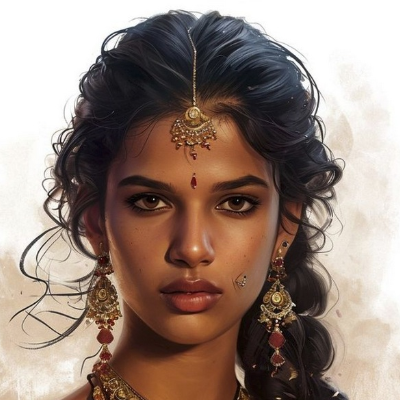
Rukmavati — Princess of Bhojakata, Daughter of Rukmi, and Wife of Pradyumna
Rukmavati · Rochana · Daughter of Rukmi · Princess of Vidarbha · Wife of Pradyumna
Rukmavati is the daughter of Rukmi — the crown prince of Vidarbha who later founded and ruled the city of Bhojakata in self-imposed exile — and is consequently the granddaughter of Bhishmaka, king of Vidarbha, and his queen Shuddhamati. She is the niece of Rukmini, the chief consort of Krishna and an incarnation of the goddess Lakshmi, making her a figure at the precise point where the estranged branches of the Vidarbha royal house and the Yadava line of Dvaraka are formally reunited across one generation. She is given in marriage to Pradyumna, the eldest son of Krishna and Rukmini, who is identified in certain Puranic texts as an incarnation of Kama, the god of love. Her marriage to Pradyumna is the central fact of her presence in the tradition. She appears by name in the Bhagavata Purana, which is the primary source for her identification, and in parallel material in the Harivamsa and the Vishnu Purana. Beyond her identification and her marriage, the primary texts do not assign her individual narrative episodes, speaking roles, or extended characterisation, and this profile reflects that limited textual base honestly.
✦ The Names
The name Rukmavati follows the gold-root naming convention established across the Vidarbha royal family of the Bhoja line. The Sanskrit root rukma, meaning gold or golden radiance, which underlies the names of her father Rukmi, her great-aunt Rukmini, and all of Bhishmaka's children, is combined here with the feminine suffix vati, meaning one who possesses or is endowed with, yielding the sense of she who is endowed with gold or the golden one. The name Rochana, by which she is identified in certain recensions, is a distinct Sanskrit formation derived from ruc or roch, meaning to shine or to be bright, and carries the sense of the radiant or the lustrous one. These two names appear to refer to the same figure across the textual tradition rather than to two different daughters of Rukmi, but the variant exists in the manuscript corpus and is noted here. Some secondary sources and regional traditions use Rochana as her primary name, while the Bhagavata Purana's genealogical passages employ Rukmavati.
✦ Lineage
- Father — Rukmi: The eldest son of Bhishmaka, crown prince and later self-exiled ruler of Bhojakata. A warrior of considerable prowess and a lifelong political opponent of Krishna, Rukmi had pressed for his sister Rukmini's marriage to Shishupala, king of Chedi, rather than to Krishna. After his defeat and public humiliation by Krishna following Rukmini's elopement — in which portions of his hair and beard were shaved as a mark of Kshatriya disgrace — Rukmi vowed never to return to Kundina until he had killed Krishna, a vow he could not fulfil. He founded the city of Bhojakata and remained there until his death. He was killed by Balarama, Krishna's elder brother, during a dice game at Bhojakata following the wedding of Rukmavati to Pradyumna.
- Paternal grandfather — Bhishmaka: King of Vidarbha and head of the Bhoja dynasty, a branch of the wider Yadava lineage, with his capital at Kundina. A pious ruler described in the Puranic texts as holding Krishna in personal esteem despite the political will of his eldest son.
- Paternal grandmother — Shuddhamati: Queen of Vidarbha, also rendered Sudhimati in some recensions, and mother of all of Bhishmaka's children.
- Paternal aunt — Rukmini: The youngest child of Bhishmaka and the sister of Rukmi, identified in the Bhagavata Purana as an incarnation of the goddess Lakshmi. Rukmini became the principal wife of Krishna after her elopement and is the foremost queen of Dvaraka. Through Rukmini's marriage to Krishna, Rukmavati's father Rukmi and Krishna became brothers-in-law, making Krishna Rukmavati's uncle by marriage before he became her father-in-law through her union with Pradyumna.
- Consort — Pradyumna: The eldest son of Krishna and Rukmini, and Rukmavati's husband. He is identified in certain Puranic texts as an incarnation of Kama, the god of love, who had been destroyed by Shiva's fire and was reborn as the son of Krishna and Rukmini. As an infant, Pradyumna was abducted by the demon Shambara, who had received a prophecy that the child would cause his death. Pradyumna was raised within Shambara's own household, killed Shambara in combat upon reaching manhood, and returned to Dvaraka. He is regarded in the Pancharatra theological tradition as one of the four primary vyuha manifestations of Vishnu.
- Son — Aniruddha: The son of Pradyumna and Rukmavati, and a grandson of Krishna. Aniruddha is a significant figure in the later books of the Bhagavata Purana, most notably in the episode of his love for Usha, the daughter of the demon king Bana, which provoked a battle between Krishna and the god Shiva. Aniruddha is also identified in the Pancharatra tradition as one of the four vyuha forms of Vishnu.
✦ The Marriage to Pradyumna
The Bhagavata Purana records in its tenth book that Pradyumna, son of Krishna and Rukmini, sought Rukmavati in marriage. The union was agreed to and the wedding was celebrated at Bhojakata, the city founded and ruled by Rukmi. The marriage is remarkable for the genealogical complexity it creates: Pradyumna's mother Rukmini is the sister of Rukmi, making Rukmavati both Pradyumna's cousin — the daughter of his mother's brother — and, after the wedding, his wife. Further, Krishna is simultaneously Rukmavati's uncle by marriage through Rukmini and her father-in-law through Pradyumna. The Bhagavata Purana does not comment on this structural complexity in explicitly analytical terms, but it presents the wedding as a moment freighted with unresolved tension: Rukmi, whose entire life had been shaped by his enmity toward Krishna and whose self-imposed exile was the direct consequence of his conflict with Krishna over Rukmini, was now hosting a celebration that brought Krishna, Balarama, and the Yadava line to his own city as guests of honour.
The Bhagavata Purana describes the wedding at Bhojakata as being attended by many kings and as an occasion of apparent celebration. Rukmavati herself is not given a speaking role or described in terms of her own disposition toward the union; the text's focus in this passage is on the political and familial dynamics of the gathering rather than on the bride as an individual agent.
✦ The Death of Rukmi at Rukmavati's Wedding
Immediately following the wedding celebrations, a dice game was arranged among the assembled kings. Rukmi challenged Balarama — Krishna's elder brother, renowned for his physical strength and his volatile temper — to play. The game proceeded with disputed outcomes; Rukmi won successive rounds in a manner that became the subject of contention, and he and the king of Kalinga mocked Balarama openly over his losses at dice, a game at which Balarama was known to be passionate but unskilled. Balarama's anger, provoked beyond restraint, led him to strike Rukmi dead on the spot. The Bhagavata Purana states that Krishna neither prevented the killing nor endorsed it, remaining in deliberate silence — unable to reproach his own elder brother yet equally unable to sanction the killing of his wife Rukmini's brother. Rukmini is described as stricken with grief.
Rukmavati's own response to the death of her father at her wedding is not narrated in the Bhagavata Purana. The text does not record her reaction, her grief, or her subsequent circumstances in any direct way. What the episode establishes is that her marriage to Pradyumna — intended, or at least functioning, as a reconciliation between the estranged families — concluded with the violent death of her father at the hands of her new father-in-law's brother, making the reconciliation immediate, ironic, and catastrophically incomplete.
✦ Textual Variants and Inconsistencies
The principal textual inconsistency regarding Rukmavati is the variation in her name. The Bhagavata Purana uses Rukmavati in its genealogical and narrative passages relating to Pradyumna's marriage. Certain other recensions and secondary Puranic material use the name Rochana for the same figure — the daughter of Rukmi given to Pradyumna. Some secondary sources attempt to resolve this by treating Rukmavati and Rochana as two distinct daughters of Rukmi, the former married to Pradyumna and the latter appearing in a separate context; however, the primary textual evidence for two distinct daughters of Rukmi is not well established in the main Puranic sources, and the more parsimonious reading is that both names refer to the same woman across different manuscript traditions.
The Harivamsa's account of the Bhojakata episode contains some variation from the Bhagavata Purana in the details of the dice game and the sequence of events surrounding Rukmi's death, though the core narrative — Rukmi killed by Balarama at the dice game following Pradyumna's wedding to his daughter — is consistent across both texts. The Harivamsa does not substantially alter Rukmavati's role or identification beyond what the Bhagavata Purana establishes.
✦ Connection to the Wider Genealogy
Rukmavati occupies a pivotal position in the genealogical structure of the Krishna cycle. Through her father Rukmi she carries the Bhoja line of Vidarbha; through her mother — whose name is not recorded in the primary sources — she may carry further lineages that the texts do not specify. Through her marriage to Pradyumna she enters the Vrishni branch of the Yadava line, becoming a daughter-in-law of Krishna and Rukmini. Her son Aniruddha — the grandson of Krishna — continues the line further, and through Aniruddha's marriage to Usha, daughter of the demon king Bana and granddaughter of the great devotee Bali, the genealogical network extends outward into the demonic and divine lineages of the wider Puranic world. Rukmavati is thus the generational hinge between the Vidarbha royal house and the dynasty of Krishna's own descendants, making her genealogical function considerably greater than her narrative presence in the texts would suggest.
✦ References
Primary Sources
- Bhagavata Purana, Skandha 10, Chapter 61: The principal source for Rukmavati's identification as the daughter of Rukmi given in marriage to Pradyumna; narrates the wedding at Bhojakata, the dice game, and Rukmi's death at Balarama's hands immediately following the celebration.
- Bhagavata Purana, Skandha 10, Chapter 61 and Skandha 10, Chapter 55: Establishes Pradyumna's identity, his return to Dvaraka, and his genealogical significance as the son of Krishna and Rukmini, providing the full context for his marriage to Rukmavati.
- Vishnu Purana, Book 5: Provides a parallel genealogical account naming Rukmavati in the context of Pradyumna's lineage and the wider Yadava family tree.
- Harivamsa, Vishnu Parva: Contains a version of the Bhojakata episode including the wedding and the dice game, with some variation in detail from the Bhagavata Purana's account.
Modern Reference Works
- Mani, Vettam — Puranic Encyclopaedia (1975): Identifies Rukmavati within the entries on Rukmi and Pradyumna, notes the variant name Rochana, and confirms her role as the mother of Aniruddha.
- Wisdomlib.org — definition entries for Rukmavati and Rochana: Provides brief individual entries and notes the variant name tradition, with references to the relevant Puranic passages in both the Bhagavata Purana and the Harivamsa.