
About
Aniruddha — Grandson of Krishna, Fourth of the Chatur-Vyuha, Father of the Last Yadu
Aniruddha · Aniruddha · Pradyumna-putra · Krishna-pautra · Chatur-Vyuha-turiya · Vajra-pita · Sonitapura-bandhi · Jana-avatara
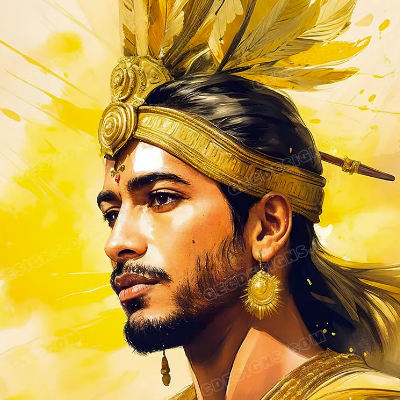
Aniruddha — whose name means unstoppable, unconquerable, unobstructed — is the son of Pradyumna and Rukmavati, the grandson of Krishna and Rukmini, and the father of Vajra — the last surviving male of the Yadu dynasty. He is the fourth and final member of the Chatur-Vyuha — the four primary expansions of Vishnu in Dvaraka: Vasudeva (Krishna), Sankarshana (Balarama), Pradyumna, and Aniruddha — and is considered by some in the Vaishnava tradition to be a Jana avatar, a partial avatar of Vishnu himself. He is described as being very much like his grandfather, to the extent that his resemblance to Krishna was one of the features that allowed Usha to recognise him from Chitralekha's portraits. His most celebrated episode is his captivity in Shonitapura — which became the occasion of the greatest divine battle of the Dvapara Yuga — and his subsequent marriage to Usha. He died in the Mausala Parva's intoxicated brawl at Prabhasa, alongside virtually all the other Yadava princes, leaving his son Vajra as the sole male survivor of the dynasty. In the Vaishnava theological tradition he is identified with the presiding deity of the mind and is associated with the boar form — appearing as a boar's head in certain Chatur-Murti iconographic forms of Vishnu.
✦ The Name
The Sanskrit name Aniruddha is formed from the negative prefix a and niruddha — stopped, obstructed, restrained — giving the meaning unstoppable, not to be obstructed, uncontrolled. The Monier-Williams Sanskrit-English Dictionary also records its use as a noun meaning a rope for fastening cattle — an irony given that Banasura bound him with the ropes of Varuna. The name is also a name of Vishnu himself — listed in the Vishnu Sahasranama — and of the fourth Vyuha form of Vishnu. In Vaishnavism he represents the principle of ahamkara — self-consciousness, the principle of individuation — and his presiding quality is the sovereignty of the individual mind. His theriomorphic aspect — the boar — connects him to the Varaha avatar and to the primordial cosmological act of lifting the earth from the waters.
✦ Lineage
- Father: Pradyumna — eldest son of Krishna and Rukmini; reincarnation of Kamadeva; avatar of the Pradyumna Vyuha; slain in the Mausala Parva
- Mother: Rukmavati — daughter of Rukmi (king of Vidarbha and elder brother of Rukmini); Pradyumna won her at her svayamvara; Rukmi, despite his enmity toward Krishna, gave his daughter to Pradyumna to please his sister Rukmini; the Bhagavata Purana (10.61.18–19) is the primary source: a mighty son Aniruddha was born of Pradyumna by Rukmavati the princess of Rukmi in the city of Bhojakata; the Vishnu Purana names his mother as Kakudvati — a variant name for the same woman or a different wife
- Paternal grandfather: Krishna — eighth avatar of Vishnu; Svayam Bhagavan per Bhagavata Purana; the tradition records that Aniruddha closely resembled his grandfather
- Paternal grandmother: Rukmini — first and most beloved wife of Krishna; incarnation of Lakshmi; daughter of King Bhishmaka of Vidarbha
- First wife: Rochana (also called Subhadra or Rukmavati in different texts) — granddaughter of Rukmi through his son; their son was Mrigaketana, an authority on architecture per the Wisdomlib source; Rukmi was killed by Balarama during the wedding celebrations after he cheated in a game of dice
- Second wife: Usha — daughter of Banasura, granddaughter of Mahabali; their son was Vajra — the last surviving male of the Yadu dynasty; note: the Rukmavati Wikipedia article assigns Vajra to Rochana rather than Usha, a textual inconsistency between Puranic sources that is not definitively resolved; the Aniruddha Wikipedia article and the Wisdomlib source identify Vajra as Usha's son
- Sons: Vajra (from Usha per primary tradition) and Mrigaketana (from Rochana)
- Grandfather-in-law (through Usha): Banasura — whom Krishna had rendered immortal and whom Shiva accepted as an eternal attendant of Kailasha
- Great-great-grandfather-in-law: Prahlada — supreme devotee of Vishnu; whose boon of protection for his lineage was the reason Krishna did not slay Banasura
✦ Birth and Early Life — Marriage to Rochana
Aniruddha was born to Pradyumna and Rukmavati. He was the grandson of Krishna and Rukmini. His mother Rukmavati was the daughter of Rukmi, the king of Vidarbha. He was also one of the few Maharathis — incredibly strong warriors — of his dynasty. The Bhagavata Purana records that he resembled his grandfather Krishna so closely — in form, bearing, and radiance — that he was considered his equivalent in a new generation. At the behest of Rukmini, Rukmi arranged for his granddaughter Rochana to marry Aniruddha. After the wedding ceremony, Rukmi was killed by Balarama after the former cheated the latter in a game of dice and insulted his Yadava heritage. The death of Rukmi at this celebration — an act of sudden violence in the midst of a joyful occasion — cast a shadow over the beginning of Aniruddha's married life, though the Bhagavata Purana records that Krishna himself did not intervene, declining to choose between a mourning Rukmini and a wrathful Balarama.
✦ The Shonitapura Episode — Captivity, Battle, and the Marriage to Usha
The central episode of Aniruddha's life — his abduction by Chitralekha, his captivity in Banasura's palace, the battle of Shonitapura, and his marriage to Usha — is described in full in the Usha profile above. The Bhagavata Purana records that even in his shrunken form, Aniruddha resisted Banasura's guards with an iron club before Banasura subdued him with the ropes of Varuna — a detail that preserves his warrior identity even in diminished circumstances. His four-month captivity in Shonitapura while the Yadavas of Dvaraka searched for him in growing anguish mirrors structurally the captivity of Sita in Lanka — the beloved's imprisonment by an Asura that becomes the occasion of a divine rescue. The parallel was not lost on the tradition's commentators.
✦ In the Chatur-Vyuha — Theological Significance
The Chatur-Vyuha — the four primary forms of Vishnu in the Pancharatra tradition — are Vasudeva, Sankarshana, Pradyumna, and Aniruddha. Each represents a different aspect of divine consciousness: Vasudeva is pure consciousness (chit); Sankarshana is the individual soul (jiva); Pradyumna is the cosmic intelligence (buddhi); and Aniruddha is self-consciousness or ego (ahamkara). Aniruddha is source of all sounds (shabdayoni) and presides over the mind as the fourth in order. He is the supreme ruler of all senses. The Shiva Purana records that Aniruddha was created specially in the battle of Lalita with Bhanda — placing his form within the Shakta theological framework as well. In Vaishnava iconography he appears as a boar's head on the Vaikuntha Chaturmurti — the four-faced icon of Vishnu combining human, lion, boar, and human faces — his theriomorphic dimension connecting him to the Varaha avatar and the cosmological act of earth-rescue that is Hiranyaksha's defining episode.
✦ Death in the Mausala Parva
Pradyumna and Aniruddha died in the intoxicated brawl between the Yadavas, which claimed the life of every Yadava prince, except Vajra, who was the only survivor. The Mausala Parva — the club-war book of the Mahabharata — records that the Yadavas, gathered at Prabhasa for a pilgrimage following Gandhari's curse, descended into a drunken brawl in which they killed each other with clubs fashioned from the sharp reeds that grew from the ground where Samba's iron pestle had been ground to dust and cast into the sea. Aniruddha died in this catastrophe alongside Pradyumna, Satyaki, Kritavarma, Samba, and virtually all the other Yadava warriors — the dynasty consuming itself in the fulfilment of Gandhari's curse. His son Vajra survived — the single thread through which the Yadu lineage continued into the age of Parikshit.
✦ References
- Bhagavata Purana — Canto 10, Chapter 61 (birth, parentage, marriage to Rochana; Rukmi's death); Chapters 62–63 (the Usha episode in full); Canto 11 (the Mausala Parva; Aniruddha's death); the primary and most authoritative source throughout
- Vishnu Purana (Book 4, Chapter 15) — Aniruddha as son of Pradyumna and Kakudvati (Rukmi's daughter under an alternate name); Usha as his wife; Vajra as their son; the Vishnu Purana genealogy as recorded in the sacred-texts.com translation
- Harivamsa (Vishnu Parva) — the Shonitapura battle; Aniruddha's imprisonment and release; additional genealogical details
- Mahabharata — Mausala Parva: Aniruddha's death in the club-war at Prabhasa; Sabha Parva (II.31.15): Aniruddha named among the great Vrishni heroes; Anushasana Parva (XIII.116.65): references to Aniruddha's military prowess
- Shiva Purana (Rudra Samhita) — Aniruddha as the fourth Vyuha form of Hari; his creation in the battle of Lalita
- Wikipedia — Aniruddha; Wikipedia — Rukmavati; Wisdomlib — Aniruddha (thirty-eight definitions); Wisdomlib — Bhagavata Purana Canto 10 Chapter 61; Vaniquotes — Bhagavata Purana 10.61; Dollsofindia — Pradyumna (Aniruddha lineage): modern summaries drawing from the above primary sources