
About
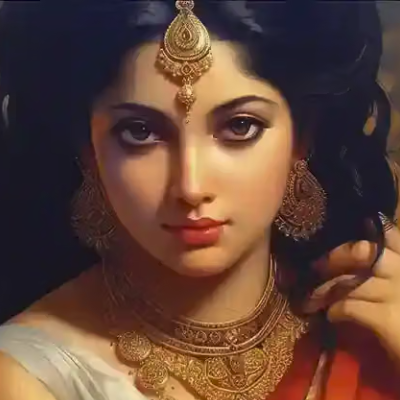
Usha — Asura Princess, Daughter of Banasura, Wife of Aniruddha
Usha · Ushā · Bana-putri · Aniruddha-patni · Sonitapura-rajkumari · Okha · Ukha · Vajra-mata
Usha is the daughter of Banasura — the thousand-armed Asura king and supreme devotee of Shiva — and the granddaughter of Mahabali. She is the wife of Aniruddha, the grandson of Krishna, and the mother of Vajra — the last surviving male of the Yadu dynasty after the Mausala Parva. Her love story — told in the Bhagavata Purana (Canto 10, Chapters 62–63), the Harivamsa, and the Shiva Purana — is one of the most celebrated romantic narratives of the Puranic tradition: a princess who fell in love with a man she had only seen in a dream, who enlisted her friend's extraordinary powers to bring him to her, and whose love set in motion the most cosmologically remarkable battle of the Dvapara Yuga — Krishna and Shiva fighting each other at Shonitapura. She is remembered in the tradition not only as a beloved princess but as the instrument of Shiva's prophecy to Banasura — the breaking of his pride that the god had long foretold. Her name in regional vernacular traditions is Okha (Gujarati) and Ukha (Assamese), and her story is the foundation of the city of Tezpur in Assam, whose name means city of blood — derived from the battle her love provoked.
✦ The Name
The Sanskrit name Usha — written Ushā — is the Vedic goddess of dawn: the most celebrated feminine figure of the Rigveda, invoked in over twenty hymns as the first light that dispels darkness and precedes the sun's arrival. The name means dawn, the rising light, the first brightness of morning. That Banasura's daughter bears the name of the Vedic dawn — the most beautiful and beloved natural phenomenon of the tradition — reflects both her celebrated beauty and the narrative arc of her story: she is the light that breaks through darkness, the love that precedes and precipitates the blazing confrontation of two divine forces. Her Gujarati name Okha and her Assamese name Ukha are regional phonetic variants of the same Sanskrit root.
✦ Lineage
- Father: Banasura — thousand-armed Asura king of Shonitapura; supreme devotee of Shiva; great-grandson of Prahlada; immortal attendant of Kailasha after his battle with Krishna
- Mother: not named in the primary Puranic texts
- Paternal grandmother: Vindhyavali — daughter of Himavat; sister of Parvati and Ganga
- Paternal grandfather: Mahabali — Asura emperor; Chiranjivi; future Indra of the Savarni Manvantara
- Paternal great-great-grandfather: Prahlada — supreme devotee of Vishnu
- Friend and confidante: Chitralekha — daughter of Kumbhanda, Banasura's minister; a yogini of extraordinary power who could teleport herself and other beings across vast distances; the agent of the abduction of Aniruddha
- Husband: Aniruddha — son of Pradyumna and Rukmavati; grandson of Krishna and Rukmini; great-grandson of Vishnu's Krishna avatar; member of the Chatur-Vyuha; Maharathi warrior
- Son: Vajra — the last surviving male of the Yadu dynasty; crowned king of Mathura-Indraprastha after the Yadava fratricide; who built the first temples of Krishna in Vrindavan and Mathura
✦ The Dream — Love Before Meeting
Usha was kept in the Agnigarh fortress of Shonitapura — surrounded at all times by a ring of fire — because Banasura, concerned about her extraordinary beauty, had determined that no man would approach her without his express permission. One day Usha saw a young man in her dream, made love to him, and fell in love. When she woke and found herself alone, she was overwhelmed with longing. She described the man of her dream to her friend Chitralekha, who possessed remarkable artistic skill. Chitralekha drew portraits of all the great kings, celestials, and Vrishni heroes from memory — one by one — until Usha recognised Aniruddha's picture among all of them. Chitralekha then used her Anima Siddhi — the yogic power of miniaturisation and teleportation — shrinking Aniruddha to the size of a doll as he slept in Dvaraka, flying to his chamber, and bringing him to Usha's palace while he was still sleeping, laying him beside the princess in the Agnigarh fortress.
✦ The Secret — Months of Hidden Love
When Aniruddha woke and saw Usha, he fell in love with her in return. Usha worshipped her lover and furnished him with priceless garments, garlands, fragrances, lamps, and with beverages, dishes, and words. Breaking her vow of chastity with him, she kept him hidden in her maiden quarters, and the lovers lost track of the days. For weeks — the Bhagavata Purana records it as a month; popular tradition extends it to several months — the two lovers lived together in secret within the fire-girt fortress, their happiness complete and their concealment apparently total. Catching wind of his daughter's activities, Banasura rushed to her chambers to find her playing dice with doll-sized Aniruddha. Even as the prince fended off the guards, Banasura subdued him with the mystical ropes of Varuna due to Aniruddha's shrunken state. Usha was overwhelmed with sorrow due to this incident.
✦ The Battle and the Wedding
Aniruddha remained captive in Shonitapura for a month until Narada brought the news to the Yadavas in Dvaraka. Krishna besieged the city with twelve akshauhini divisions. The battle that followed — described in full in the Banasura profile above — was the greatest divine duel of the Dvapara Yuga: Krishna against Shiva, the two supreme gods fighting each other on Shonitapura's battlefield on account of the love of two young people. When Banasura's arms had been severed and he had bowed before Krishna, Banasura realised his mistake and bowed his head before Krishna, arranging for a chariot to seat Aniruddha and Usha for their wedding in Dvaraka. The wedding in Dvaraka was celebrated with great ceremony. Usha became the second wife of Aniruddha — after his first wife Rochana, granddaughter of Rukmi — and through her son Vajra became the ancestral mother of the post-Mausala Yadu lineage.
✦ Theological and Narrative Significance
Usha's story is the Bhagavata Purana's most celebrated romantic narrative of the Dvapara Yuga — the Puranic tradition's nearest equivalent to a love story in the modern sense. Unlike the loves of Krishna's primary wives, which are established through formal courtship, abduction, or heroic feat, Usha's love originates in a dream — in the interior world of the unconscious — and is pursued with total commitment from that private moment of recognition to its cosmic resolution. Her agency throughout the narrative is remarkable: she identifies the man of her dream, she instructs Chitralekha, she maintains the secret, and she waits through the imprisonment and the war with complete faith in the resolution her love has set in motion. The Bengali Manasamangala Kavya records the tradition that Usha and Aniruddha were reborn as Behula and Lakshmindara in the next life and married each other again — a tradition of recurring love across lifetimes that places their bond among the tradition's most enduring devotional relationships.
✦ In Literature and the Arts
The story of Usha and Aniruddha has generated an exceptionally rich body of vernacular and classical literature across the subcontinent. The Ushaharana Kavya of Trivikrama Pandita (Sanskrit, 915 CE) is a celebrated Sanskrit retelling. The Okhaharan by Premanand Bhatt (Gujarati, 18th century) is a landmark of Gujarati Akhyana poetry with Usha as Okha. The Usha Parinayam by Vedam Venkataraya Sastry (Telugu play, 1901) was adapted as a Telugu film in 1961 by Kadaru Nagabhushanam. Usha Kalyanam (Tamil film, 1936) directed by K. Subramaniam. The Usha-Aniruddha poem by Michael Madhusudan Dutt recounts their tale in Bengali verse. Their story is depicted in Pattachitra paintings of Odisha. The Agnigarh hill in Tezpur, Assam — where Usha kept Aniruddha hidden — is a protected archaeological monument and a site of active pilgrimage.
✦ References
- Bhagavata Purana — Canto 10, Chapters 62–63 (the Usha-Aniruddha episode): the dream; the recognition from Chitralekha's portrait; the abduction; the secret; the discovery; the captivity; the siege; the battle; the wedding chariot; the return to Dvaraka; the primary and most authoritative source
- Harivamsa (Vishnu Parva) — parallel account of the episode; Usha's love described from a slightly different angle; additional details on Chitralekha's powers
- Shiva Purana (Rudra Samhita) — the Shonitapura battle from the Shaiva perspective; Usha as the occasion of Shiva's confrontation with Krishna; Banasura's final redemption
- Ushaharana Kavya of Trivikrama Pandita (Sanskrit, 915 CE) — drawing on the Bhagavata Purana; the most detailed classical Sanskrit retelling of the episode
- Manasamangala Kavya (Bengali) — the tradition of Usha and Aniruddha's rebirth as Behula and Lakshmindara
- Okhaharan (Premanand Bhatt, Gujarati Akhyana, 18th century) — Usha as Okha; one of the most celebrated vernacular retellings
- Wikipedia — Usha (princess); Wisdomlib — Ushaharana Kavya of Trivikrama Pandita (Bhagavata Purana Canto 10 Chapters 62–63); Utsavapp — Story of Usha and Aniruddha; Ritiksha Dhanraj — The Tale of Usha and Aniruddha: modern summaries drawing from the above primary sources