
About
Banasura — Thousand-Armed Devotee of Shiva, Son of Mahabali, Immortal Attendant of Kailasha
Banasura · Bana · Banaasura · Mahabali-putra · Sahasra-bahu · Shiva-bhakta · Sonitapura-adhipati · Krishnavadhya-muktah · Kailasha-dvarapala
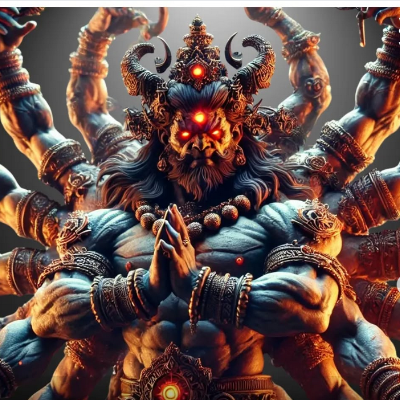
Banasura — also called simply Bana — is the eldest of the hundred sons of Mahabali and his queen Vindhyavali, the great-grandson of Prahlada, and one of the most celebrated Shaiva devotees in the Puranic tradition. He ruled the magnificent city of Shonitapura — identified in the tradition with the Tezpur region of modern Assam — with a thousand arms granted to him by Shiva through his devoted worship, playing mridangam with all thousand arms as accompaniment to Shiva's Tandava dance. His pride in his extraordinary strength eventually provoked Shiva himself to prophesy his downfall. The episode that fulfils that prophecy — the imprisonment of Aniruddha, grandson of Krishna, who had secretly entered his palace to be with his daughter Usha — triggered the most cosmologically remarkable battle of the Dvapara Yuga: Krishna and Shiva fighting each other at Shonitapura, the Vaishnava and Shaiva traditions brought into direct military collision by their respective relationships with the same man. Krishna severed 996 of his thousand arms with the Sudarshana Chakra, leaving him with four, and granted him immortality at Shiva's request — recording at once the limits of Banasura's power and the inviolability of the divine promise Vishnu had given to Prahlada that no descendant of his line would be slain. He became thereafter an immortal gana-attendant of Kailasha — his pride destroyed, his devotion vindicated, his arms reduced to the four that remained as a permanent reminder of the battle that redefined him.
✦ The Name
The Sanskrit name Banasura is formed from bana — arrow — and asura — great being, demon. Together: the arrow-demon or the great one who is swift as an arrow. The Bhagavata Purana uses the shorter form Bana throughout its narrative of the Aniruddha episode (Canto 10, Chapters 62–63). The epithet Sahasra-bahu — thousand-armed — is his defining physical description across all sources. His capital Shonitapura — the city of blood, from shonita — is so named in two different traditions: either because it was built on red soil, or because it was the site of the great bloodshed of the Aniruddha battle.
✦ Lineage
- Father: Mahabali — Asura emperor; Chiranjivi; future Indra of the Savarni Manvantara; currently in Sutala Loka
- Mother: Vindhyavali — daughter of Himavat; also called Kotara; sister of Parvati and Ganga
- Brother: Namasu — his younger brother; great devotee of Vishnu; also a Chiranjivi in Sutala
- Grandfather: Virochana — slain by Indra
- Great-grandfather: Prahlada — supreme devotee of Vishnu; whose boon from Vishnu that no descendant of his line would be slain is the reason Krishna spared Banasura
- Daughter: Usha — who fell in love with Aniruddha in a dream; the central figure of the Aniruddha episode
- Son-in-law: Aniruddha — son of Pradyumna and Rukmavati; grandson of Krishna and Rukmini; their son Vajra became the last surviving Yadava after the Mausala Parva
- Grandson: Vajra — son of Aniruddha and Usha; installed by Arjuna as king of Indraprastha after the Yadava destruction
- Son (per Bhagavata Purana, Canto 10): unnamed — who fought against Samba, son of Krishna and Jambavati, during the Shonitapura battle
- Divine patron: Shiva — who served as the guardian of Shonitapura; fought Krishna to protect Banasura; interceded with Krishna for Banasura's life; granted him immortality as a Kailasha attendant
- Descendants: the Bhagavata Purana records that Banasura had 400 million descendants collectively known as the Nivata-Kavachas — the great Asura warriors of the netherworld who in the Mahabharata's Aranyaka Parva fought Arjuna during his celestial weapons pilgrimage, could not be killed by ordinary means, and were finally destroyed through a divine stratagem
✦ Character and Devotion to Shiva
The Bhagavata Purana (Canto 10, Chapter 62) opens its narrative of Banasura with a precise characterisation: Bana was the eldest of the hundred sons of King Bali; he was devoted to Lord Shiva, worthy of honour, liberal-minded, intelligent, true to his word, and of firm resolve, ruling over the beautiful city of Shonitapura. His devotion to Shiva took the specific form of musical worship: he played mridangam with all his thousand arms during Shiva's Tandava dance — a form of offering so complete and so physically extraordinary that Shiva was deeply pleased and offered him a boon. Banasura asked for Shiva's constant presence as guardian of Shonitapura — not power or immortality, but the god's living presence. Shiva granted this. The city thus became Shiva-protected, and Banasura became effectively invincible within its walls.
✦ Shiva's Prophecy — The Breaking of the Flag
As time passed and Banasura's confidence in his thousand arms grew boundless, he became restless — unable to find a worthy opponent. He complained to Shiva that his arms ached from disuse and that no warrior in the three worlds could match him — he had even frightened elephants into flight. Listening to these words, Shiva flew into a rage and said that when his ensign would break, his encounter would appear. This prophecy — that the breaking of his battle-flag would herald the arrival of the worthy opponent he sought — was immediately both thrilling and sobering to Banasura. He returned to his palace not knowing that the flag would be broken by the consequences of his own daughter's dream.
✦ Usha, Chitralekha, and the Abduction of Aniruddha
Banasura's daughter Usha dreamed of a young man — Aniruddha, grandson of Krishna — and fell deeply in love with him. Her friend Chitralekha — daughter of Banasura's minister Kumbhanda, a yogini of remarkable powers — drew portraits of all the great Vrishni heroes from memory. Usha identified Aniruddha from among them. Chitralekha used her power of teleportation — shrinking Aniruddha to miniature size as he slept in Dvaraka — and brought him to Usha's private chambers in Shonitapura's Agnigarh fortress. The two lovers spent weeks hidden together. When Banasura's guards eventually discovered Aniruddha's presence, Banasura himself came to the chamber. The Bhagavata Purana records that even at his reduced size, Aniruddha fought the guards with an iron club — but Banasura bound him with the mystical ropes of Varuna. Usha wept. Aniruddha remained captive for four months — the entire rainy season — while his family in Dvaraka searched for him in growing anguish.
✦ The Battle of Shonitapura — Krishna Against Shiva
Narada eventually informed the Yadavas of Aniruddha's captivity. Krishna set out for Shonitapura at the head of twelve akshauhini divisions — including Balarama, Pradyumna, Samba, and Satyaki. They besieged the city from all sides. Banasura sallied forth to fight. During the war, Shiva appeared on the battlefield riding on Nandi to protect his devotee Banasura; Balarama fought against Banasura's commander, while Samba fought against Banasura's son. What followed was the most remarkable divine duel of the Dvapara Yuga: Krishna and Shiva fighting each other directly — brahmastra against brahmastra, mountain weapon against wind weapon, rain weapon against fire weapon, Narayanastra against Pashupatastra. Kartikeya, wounded by Pradyumna's arrows, fled the battlefield. Shiva's fever-demon Jvara — three-headed, three-footed, bearing scorching heat — attacked Krishna; Krishna produced his own frigid Jvara in response; overwhelmed, Shiva's Jvara surrendered. Krishna put Shiva into a temporary stupor with the Jrmbhanastra. Balarama defeated Banasura's commander. Banasura himself engaged Krishna and was steadily overwhelmed. In a desperate attempt to save Banasura, his mother Kothara stood naked before Krishna with her hair dishevelled; when Krishna looked away, Banasura fled back into the city. But the reprieve was brief.
✦ The Severing of the Arms — Krishna's Mercy
When Shiva recovered from the Jrmbhanastra, he saw Banasura's arms being cut off one by one by Krishna's Sudarshana Chakra. Moved by compassion for his devotee, Lord Shiva approached Krishna and spoke: You alone are the Absolute Truth, the supreme light, the mystery hidden within the verbal manifestation of the Absolute. He asked Krishna to spare Banasura. Krishna replied that he had never intended to kill Banasura, since he was the son of Bali and the grandson of the devout Prahlada — Vishnu had promised Bali not to kill any member of his family. However, Krishna severed Banasura's extra arms to destroy the latter's pride, leaving Banasura with only four arms. Banasura — his pride dissolved, his arrogance burned away by the encounter — bowed his head to the ground before Krishna. Krishna said: I will not kill him because he is your devotee and the great-grandson of Bhakta Prahlada. He will be your chief courtier and become immortal. Banasura then arranged a chariot for Aniruddha and Usha, who were brought before Krishna in full wedding dress, and the party returned to Dvaraka where the marriage was celebrated.
✦ In the Mahabharata — The Nivata-Kavachas
The Mahabharata's Aranyaka Parva (Book 3, Chapters 168–172) records the episode of Arjuna's celestial weapons pilgrimage — during which Indra directed him to battle the Nivata-Kavachas in their underwater city near the ocean floor, as a condition for receiving the Pashupatastra. The Nivata-Kavachas — literally those wearing armour that cannot be pierced — are recorded as Banasura's 400 million descendants, immune to the weapons of the gods. Arjuna fought them for a full divine year using every celestial weapon in his newly acquired arsenal, unable to kill them through direct combat, before finally achieving victory through a divine stratagem revealed to him by his charioteer. The scale of this episode — 400 million enemies generated by a single lineage — reflects the enormous cosmic weight given to Banasura's position in the tradition's genealogical architecture.
✦ In Tamil Sangam Literature
The Wikipedia article on Banasura records his appearance in Tamil literary tradition independent of the Puranic cycle. The Sangam-era work Manimekalai contains a narrative of Banasura as a rejected suitor for the goddess Shakti — a tradition entirely distinct from the Bhagavata Purana's account. The Sangam anthology Purananuru also references him. The 18th-century Gujarati akhyana Okhaharan by Premanand Bhatt retells the Usha-Aniruddha story with Usha called Okha and is one of the most celebrated vernacular retellings of the episode in Western India.
✦ Shonitapura — Geographic Identification
The tradition consistently identifies Shonitapura with the Tezpur region of modern Assam in northeastern India. Tezpur's name itself derives from teza pani — blood-red water — connecting the city's identity to the crimson soil or the great battle's blood that gives Shonitapura its name. The Agnigarh hill in Tezpur — where Usha kept Aniruddha hidden — is a prominent landmark, and the story of Usha and Aniruddha is deeply embedded in the local cultural and religious tradition of the Brahmaputra valley. Banasura is remembered there as a great historical king rather than a villain — a local ancestor whose defeat by Krishna was not dishonour but divine encounter.
✦ References
- Bhagavata Purana — Canto 10, Chapters 62–63 (the Usha-Aniruddha-Banasura episode): the most complete and authoritative account; Bana's character description; the thousand arms; Shiva's prophecy; Usha's dream; Chitralekha's abduction of Aniruddha; the captivity; the twelve akshauhini siege; the duel of Krishna and Shiva; the severing of 996 arms; Shiva's intercession; Krishna's promise to Prahlada; Banasura's obeisance; the wedding chariot; the return to Dvaraka
- Harivamsa (Vishnu Parva) — parallel account of the Shonitapura battle; additional details on the divine weaponry exchanged between Krishna and Shiva
- Shiva Purana (Rudra Samhita) — the Banasura episode from the Shaiva perspective; Shiva as the primary protector; the battle described with Shiva's weapons taking precedence; Banasura made immortal chief courtier of Kailasha
- Mahabharata — Aranyaka Parva, Chapters 168–172: the Nivata-Kavachas as Banasura's 400 million descendants; Arjuna's year-long battle with them; the divine stratagem of their destruction
- Tamil Sangam literature — Manimekalai and Purananuru: Banasura as rejected suitor of Shakti; independent of the Puranic tradition
- Okhaharan (Premanand Bhatt, 18th century Gujarat) — vernacular Gujarati retelling of the Usha-Aniruddha story as Okha-Aniruddha
- Wikipedia — Banasura; Wikipedia — Usha (princess); Wikipedia — Aniruddha; Wisdomlib — Ushaharana Kavya of Trivikrama Pandita (Bhagavata Purana Canto 10 Chapters 62–63 translation); Vedabase — SB 10.63 (Bhagavata Purana Canto 10, Chapter 63); Greenmesg — Vanquishing the Pride of Banasura (Shiva Purana); Sagar World Blog — Banasur, Demon with a Thousand Arms; bhgwat.com — The Battle Saga of Banasura and Lord Krishna: modern summaries drawing from the above primary sources