
About
Mahabali — Asura Emperor, Supreme Among Generous Kings, Subdued by Vamana, Chiranjivi
Mahabali · Bali · Bali Chakravarti · Indrasenan · Maveli · Prahlada-pautra · Virochana-putra · Trivikrama-vandita · Sutala-adhipati · Savarni-Indra
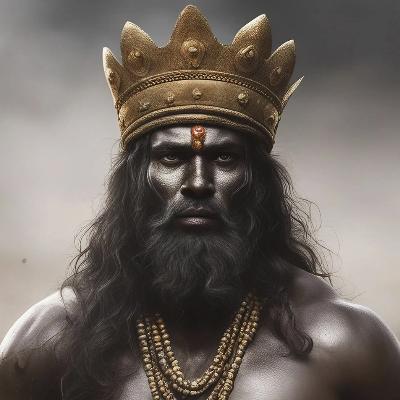
Mahabali — also known as Bali, Bali Chakravarti, Indrasenan, and Maveli — is the grandson of Prahlada and the son of Virochana, the great Asura emperor whose rule over the three worlds — earth, the heavens, and the underworld — was the most just and prosperous the tradition records for any Asura king. He is the fifth avatar of Vishnu's primary occasion of descent: Vamana, the dwarf Brahmin, took form specifically to subdue him. Unlike the majority of Asura kings who are remembered primarily as tyrants destroyed by the divine, Mahabali is remembered across the tradition as a devotee of Vishnu, a paragon of generosity, a king so righteous that the Bhagavata Purana records Vishnu himself explaining his punishment of Bali as an act of grace: before blessing someone, I destroy his wealth — one who is arrogant due to wealth and power will not respect anyone, not even me. He is one of the seven Chiranjivis — the immortals destined to live until the end of the present cosmic age — and is destined to become the king of Svarga in the next Manvantara, the era of Savarni Manu. His annual return to his former kingdom in Kerala is commemorated by the harvest festival Onam — one of the most widely celebrated festivals of South India. In the Puranic genealogy he stands at the hinge between the great Daitya lineage of Hiranyakashipu and the later Asura kings — his son Banasura, his descendants the Nivata-Kavachas — who continue the tradition's drama into the Dvapara Yuga.
✦ The Names
The name Mahabali is formed from maha — great — and bali — offering, tribute, sacrifice, strength. Together: great in sacrifice, the greatest of those who give — the name encodes the very quality that defines his story. Bali Chakravarti — chakravarti meaning universal emperor — is the formal title of his sovereignty over the three worlds. Indrasenan — he who has the army of Indra or he who has Indra's army at his disposal — records his conquest of the celestial realm. Maveli is the Malayalam popular name, by which he is celebrated in Kerala's oral tradition and in the folk songs of Onam. The Wikipedia article records the folk song: Maveli nadu vaneedum kalam, manushyarellarum onnu pole — when Maveli ruled, all people were equal. His epithet Trivikrama-vandita — he who is saluted by Trivikrama — records the extraordinary theological fact that Vishnu himself, having subdued Bali in the Vamana form, is recorded in the Ramacharitmanas of Tulsidas and the Adhyatma Ramayana as having become the permanent gatekeeper of Bali's palace in Sutala — bowing to his devotee's devotion even as he holds him in the underworld.
✦ Lineage
- Father: Virochana — son of Prahlada; killed by Indra in the Tarakamaya war; body burned to prevent revival by Shukracharya's Mritasanjivani
- Mother: Devamba — per the Sastra Caksusa and Matsya Purana account (also named Vishalakshi in the Brahmanda Purana and Narada Purana); died of grief after Virochana's death and the burning of his body
- Grandfather: Prahlada — supreme devotee of Vishnu; who raised Mahabali after Virochana's death, emphasising the importance of dharma and virtue in kingship
- Great-grandfather: Hiranyakashipu — slain by Narasimha; whose vow of revenge against Vishnu stands in direct opposition to the tradition of devotion his grandson embodied
- Wife: Vindhyavali — also called Ashrama or Balika; daughter of Himavat (the Himalayan mountain king); identified in the Bhagavata Purana (Canto 8) as pouring water alongside Bali to wash Vamana's feet; described across the tradition as beautiful, compassionate, and a dutiful queen of extraordinary virtue
- Sons: one hundred in total; the most celebrated being Banasura (eldest, thousand-armed devotee of Shiva, defeated by Krishna in the Aniruddha episode) and Namasu; the Bhagavata Purana records that Banasura's four hundred million descendants were known collectively as the Nivata-Kavachas — the great Asura warriors of the netherworld who fought Arjuna in the Mahabharata
- Daughter: Ratnamala — recorded in the Padma Purana (Brahmanda Khanda) in the Vamana episode; described as feeling drawn to Vamana and desiring him as her son; Vajrajvala named as another daughter in the Mythlok source — said to have married Kumbhakarna of the Ramayana — though this identification requires further primary-text verification
- Brother (per Mythlok): Kalanemi — a secondary Asura figure appearing in the Puranas as an adversary of the Devas; not confirmed in primary Puranic texts as Mahabali's brother in all versions
- Guru: Shukracharya — the great preceptor of the Asuras, son of Bhrigu; who warned Bali about Vamana's true identity and was overruled; who also cursed Bali temporarily for disregarding his counsel
✦ Early Life — Raised by Prahlada, Orphaned by Injustice
Mahabali was born to Virochana and Devamba. He had seen his father only twice — at his birth and when Virochana left for Prajapati's ashrama to study the nature of the Atman alongside Indra. When Virochana was killed by Indra in the Tarakamaya war and his body burned to deny it proper funeral rites, Mahabali was left an orphan. The Sastra Caksusa source records that this injustice — the killing of his father outside the bounds of fair combat, the denial of cremation rites — was what motivated Mahabali's subsequent campaigns against the Devas. He was raised by his grandfather Prahlada, who taught him dharmic governance, the importance of virtue, and devotion to Vishnu. Under Prahlada's guidance he grew into the most righteous ruler the Asura lineage had ever produced — embodying, as the Wikipedia source records, the same qualities of non-discrimination, justice, and compassion that his grandfather had displayed in subtler form as a persecuted child.
✦ Rise to Power — The Vishwajeet Yagna and Conquest of the Three Worlds
After Indra defeated Bali in an early battle, Bali approached Shukracharya for counsel. Shukracharya instructed him to perform the Mahabhishek Vishwajeet Yagna — a great sacrificial rite — to recover his power. After the yagna, Bali received divine armour, a celestial chariot drawn by four horses of wind-speed, a golden quiver with inexhaustible arrows, a flag bearing a lion's head, a garland of ever-blooming flowers, and a conch whose battle-cry shook all worlds. Armed thus and sustained by the blessings of the Bhrigu sages, Bali launched his campaign. He conquered the three worlds — earth, the underworld, and Svarga itself — driving Indra and the Devas from their celestial home. He also temporarily possessed the amrita — the nectar of immortality — which made his subjects able to revive him from death in battle, rendering him effectively invincible in open war. The Bhagavata Purana records that under his rule the three worlds flourished in an age of prosperity: everyone was honest, healthy, and happy under his reign. No discrimination existed on the basis of caste or class. There was neither crime nor corruption. People did not even lock their doors. There was no poverty, sorrow, or disease. The Indica Today source records that Skanda, Matsya, Bhagavata, Brahmanda, and Vamana Puranas all concur on the prosperity of his realm, with Vamana Purana and Harivamsa attributing it to the grace of goddess Lakshmi herself residing in his kingdom.
✦ The Warning — Prahlada's Curse
As Mahabali's empire consolidated, the Bhagavata Purana records an extraordinary episode: Mahabali, growing overconfident, began to speak ill of Vishnu even while his grandfather had built his entire life around supreme devotion to the same deity. Prahlada — who had survived fire, poison, serpents, and his own father's murderous fury for love of Vishnu — could not remain silent. He cursed Mahabali, predicting the downfall of his kingdom as the inevitable consequence of that arrogance. This curse from the greatest of devotees against his own grandson is one of the tradition's most poignant moments: the being who had conquered his father's hatred through love now watching his grandson repeat a subtler form of the same error — not hatred but pride, not enmity but self-sufficiency — and seeing in it the same inexorable trajectory toward divine correction. Meanwhile, the Anaadi source records, Mahabali noticed signs of decline in his empire. He returned to Prahlada, who explained that Vishnu was preparing to incarnate as Vamana to end his rule. Mahabali, confident in his asuras' strength, dismissed the warning and prepared instead for the grand Ashwamedha sacrifice.
✦ Aditi's Penance and the Birth of Vamana
The Bhagavata Purana (Canto 8, Chapters 16–18) records how the Devas, driven from Svarga and bereft of power, eventually found their way to relief. Indra, wandering in hiding, was advised by Brihaspati to seek Vishnu's help. His mother Aditi — the mother of all the Devas — was distressed at her sons' condition. When Kashyapa returned from a prolonged penance, he found her downcast and advised her to perform the Payovrata — a twelve-day austerity involving surviving only on milk, sleeping on bare ground, bathing three times daily, and remaining in devotion to Vishnu. Aditi performed the Payovrata faithfully. On the thirteenth day Vishnu appeared before her and granted her wish: he would incarnate as her son to restore the Devas' kingdom. On the twelfth day of the bright fortnight of Bhadrapada, under the Shravana nakshatra, at the auspicious Abhijit moment, Vamana was born — four-armed, radiant, transforming immediately into a dwarf Brahmin boy adorned with the sacred thread.
✦ The Ashwamedha Sacrifice — Three Steps of Land
At this time Mahabali was performing his great Ashwamedha sacrifice on the northern bank of the Narmada river at Bhrigukachcha — a site of immense sacred significance — under the supervision of Shukracharya and the Bhargava Brahmins. He had opened the sacrifice to the whole world as an occasion of unlimited gift-giving. Vamana arrived among the guests — the last to come, small in stature, radiant in presence. The assembled priests were struck by the luminosity of the boy and speculated on his identity. Mahabali, ever the generous host, welcomed him with great ceremony, offered him a seat, and had Vindhyavali wash his feet with water poured reverentially. He invited Vamana to ask for anything — cows, land, gold, elephants, chariots, kingdoms. Vamana's request was disarmingly small: three steps of land measured by his own feet. Mahabali, astonished that a being of such obvious extraordinary nature would ask for so little, offered much more. Vamana declined. Shukracharya, whose divine perception had penetrated the disguise, intervened urgently: do not entertain this guest — he is Vishnu himself. Mahabali replied with perfect simplicity: he had given his word. A king who had given his word could not retract it. Even if Vamana was indeed Vishnu — what greater fortune could there be than giving to Vishnu himself? He poured the water of the offering into Vamana's cupped hands, completing the irrevocable act of dana. Shukracharya, furious, entered the water-vessel to obstruct the flow — Vamana inserted his staff and blinded Shukracharya in one eye.
✦ Trivikrama — The Cosmic Expansion
The moment the irrevocable gift of water was given, Vamana began to grow. His form expanded beyond all measure — filling the earth, the heavens, the space between them, rising beyond the solar system, beyond the cosmic egg itself, into dimensions of size the Bhagavata Purana describes in staggering detail across multiple chapters (Canto 8, Chapters 20–21). With his first step he covered the entire earth and the underworld. With his second step he covered all the heavens. The Ganga — the sacred river — arose from where the waters that had washed Vamana's cosmic feet fell back to the cosmos; the Vamana Wikipedia article notes that the origin of the Ganga is linked to this moment in several Puranic traditions. Mahabali looked up at the form that had grown from the small boy he had welcomed, and recognised his guest fully. There was no third space. He offered his own head. Vamana placed his third step on Mahabali's head — pressing him gently downward into Sutala, the most sacred of the netherworld's planes, which Vishnu had already purified and arranged as a divine abode surpassing even Svarga in splendour and freedom from disease and suffering.
✦ The Bhagavata Purana's Explanation — Why Vishnu Punished His Devotee
The Bhagavata Purana records Vishnu's own explanation for his treatment of Bali — one of the most theologically striking passages in the Vamana narrative. The Indica Today source cites it: before blessing someone, I destroy his wealth. One who is arrogant due to his wealth and power will not respect anyone, not even me. Despite being dishonoured and outcast, even after losing his power, wealth, and people, Bali did not give up his devotion to me. This is why I removed all of his wealth — to show that he was not attached to it. The Bhagavata Purana further records that Bali's submission to Vamana was itself the supreme act that secured his immortality and his divine future: not the conquests, not the sacrifices, but the moment of complete self-surrender — offering his own head — in full recognition of who it was he was giving to. The Padma Purana records that Bali attained moksha through this act of atmanivedanam — total self-offering. Krishna in the Bhakti-rasamrita-sindhu of Rupa Gosvami records that Bali came to him — attained him — through this act.
✦ The Variants — Binding by Garuda, Entry into Heaven, Vaikuntha
The resolution of the Vamana-Bali episode varies significantly across the tradition. The Bhagavata Purana records that after Bali offered his head, Garuda bound him with the ropes of Varuna; Brahma then interceded and asked Vamana to release him; Bali was released and bowed before Vishnu; Brahma himself praised Bali's virtue. The Padma Purana records Bali along with all his kinsmen and followers being bound. Some texts have Bali banished to Patala; others have Garuda carry him there; in others he entered heaven through the touch of Vishnu; in at least one version he was admitted into Vaikuntha itself — the highest abode, beyond the realm of the Devas. The Wikipedia article carefully notes that the popular Kerala tradition of Bali offering his head for the third step — though celebrated in folk narrative — is not consistently attested in the primary texts; the Bhagavata and Brahmanda Puranas record that Bali told Vishnu his head or shoulder could serve, but that Vishnu did not act on this, instead pardoning his devotee.
✦ Sutala — Vishnu as Gatekeeper, Lakshmi's Intervention, Chaturmas
The Bhagavata Purana records that Vishnu, moved by Bali's devotion, granted him a supreme boon: Vishnu himself would serve as the gatekeeper of Bali's palace in Sutala Loka — the most beautiful and divine of the netherworld's realms, purified by Vishnu's own presence and free from all illness, suffering, and natural disturbance. Mahabali asked that he be given the privilege of Vishnu's constant presence and the right to see him at all times. Vishnu agreed. The Wikipedia article records the subsequent episode: when Goddess Lakshmi discovered that her husband was serving as a gatekeeper in the underworld, she was displeased. She went to Sutala, made Mahabali her brother by tying a rakhi — the bond of brotherhood — and in exchange asked him to release her husband. Mahabali agreed and released Vishnu. In response, Vishnu decided that he would visit Mahabali's palace every year and rest there for four months — the origin of Chaturmas, the four sacred months during which Vishnu sleeps in Sutala and Shiva runs the world. The annual return of Mahabali to his former subjects — permitted by Vishnu — is the theological basis of the Onam festival in Kerala.
✦ Chiranjivi Status and Future as Indra
Mahabali is one of the seven Chiranjivis — the immortals of the Hindu tradition destined to live until the end of the present cosmic age — alongside Ashvatthama, Bali, Vyasa, Hanuman, Vibhishana, Kripa, and Parashurama. His immortality was granted directly by the Vamana avatar as the supreme consequence of his surrender and devotion. The Bhavishyottara Purana records: a king should pay respect to King Bali, the future Indra. The Bhagavata Purana confirms: in the coming Manvantara — the era of Savarni Manu — Mahabali will assume the throne of Svarga as the new Indra, finally inheriting the celestial kingdom he conquered through virtue and surrendered through grace. The Indica Today source notes that the Skanda Purana places his capital city near Someshwara in Saurashtra Desha — the western coast of India — connecting the geographic domain of his earthly empire with the broader tradition of his legacy.
✦ In the Vedic and Epic Tradition
The three steps of Vishnu — Trivikrama — are first described in the Rigveda, where they are a cosmic act of solar measurement rather than a narrative episode. The Shatapatha Brahmana elaborates the story with the Asura-Deva conflict over the cosmos, with the three steps reclaiming the three worlds. The figure of Bali as the Asura king does not appear in the Rigveda by name — the narrative personalisation occurs through the Mahabharata and Puranas. The Mahabharata's Vanaparva records the Vamana-Bali episode in summary. The Ramayana's Balakanda records Vishwamitra narrating the Vamana story to Rama and Lakshmana. Across the great epics, Bali is consistently cited as the supreme example of Asura generosity — paired always with Karna as the two supreme human examples of unconditional giving.
✦ Onam — The Festival of His Return
Onam is celebrated on the Thiruvonam day of the Malayalam month of Chingam (August-September), corresponding to the Shravana nakshatra — the same nakshatra under which Vamana was born. The tradition holds that Vishnu permits Mahabali to visit his former subjects in Kerala once a year on this day. Households across Kerala prepare elaborate floral arrangements called pookalam, perform the Thiruvatira dance, race snake-boats on the rivers, and prepare a ceremonial feast of rice and curries called Onam sadhya to welcome their beloved king. The Thrikkakara temple near Kochi — identified as the ancient capital of Mahabali's kingdom — is the principal pilgrimage site of the festival. Mahabali is also commemorated at Balipratipada — the day following Diwali, the first day of the month of Kartika — across Maharashtra, Gujarat, Karnataka, Telangana, and Andhra Pradesh, where it is known as Balipadyami or Balipuja.
✦ References
- Rigveda — the three steps of Vishnu (Trivikrama) as cosmic solar measurement; the earliest layer of the Vamana narrative, without Bali named
- Shatapatha Brahmana — the Asura-Deva conflict over the cosmos; the three steps reclaiming the three worlds; the elaboration of the Trivikrama narrative
- Valmiki Ramayana (Balakanda) — Vishwamitra's narration of the Vamana-Bali episode to Rama and Lakshmana
- Mahabharata — Adi Parva, Chapter 65: Bali named as son of Virochana and grandson of Prahlada; Vanaparva: summary of the Vamana episode; Shanti Parva: Bali as supreme example of Asura generosity alongside Karna
- Bhagavata Purana — Canto 8, Chapters 15–23: the most complete and authoritative Puranic account; Aditi's Payovrata; Vamana's birth; the journey to Bhrigukachcha; the sacrifice and the gift of three steps; Trivikrama's expansion; Garuda binding Bali; Brahma's intercession; Bali's release; Vishnu's own explanation for punishing his devotee; Bali as Chiranjivi and future Indra of the Savarni Manvantara; Vishnu as gatekeeper of Sutala; Lakshmi's intervention and the origin of Chaturmas
- Vamana Purana — parallel account; Bali's Ashwamedha in Kurukshetra in some chapters; Vamana Purana and Harivamsa on the prosperity of his kingdom through Lakshmi's grace
- Padma Purana — Ratnamala, Bali's daughter, drawn to Vamana; Bali's attainment of moksha through atmanivedanam; Pulastya-Bhishma account of the Satya Yuga episode
- Brahma Vaivarta Purana — Vishnu positioning Bali in power to curb Indra's pride
- Skanda Purana — Bali's capital near Someshwara in Saurashtra; Narada as the reason for Bali's animosity toward the Devas; Trivikrama's form described in detail
- Bhavishyottara Purana — a king should pay respect to King Bali, the future Indra
- Harivamsa — the prosperity of Bali's kingdom; the role of Shukracharya and the Bhargava sages in his rise
- Tulsidas's Ramacharitmanas and Adhyatma Ramayana — Vamana as the permanent gatekeeper (Dvarapala) of Bali's palace in Sutala
- Bhakti-rasamrita-sindhu (Rupa Gosvami) — Bali coming to Krishna through atmanivedanam
- Wikipedia — Mahabali; Wikipedia — Vamana; Wikipedia — Vindhyavali; Indica Today — Trivikrama, Mahabali and Onam; Anaadi — Story of Vamana and Mahabali as in Bhagavata Purana; Glorious Hinduism — Vamana and Bali; Exotic India Art — Vamana and Bali; Mythlok — Mahabali; Fandom Demonology — Mahabali; HinduPad — Vindhyavali; Katha Kids — Mahabali and Vamana: modern summaries drawing from the above primary sources