
About
Vindhyavali — Queen of Mahabali, Daughter of Himavat, Witness to the Vamana Episode
Vindhyavali · Vindhyavalli · Vindhyavalī · Ashrama · Ashana · Kotara · Balika · Mahabali-patni · Banasura-mata
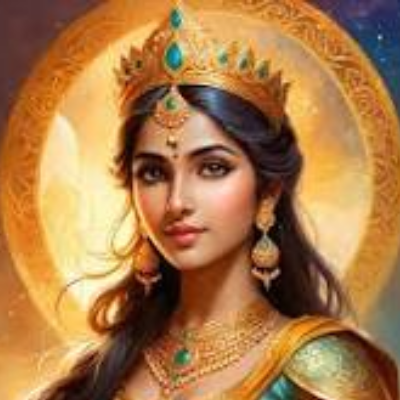
Vindhyavali is the wife of Mahabali — the great Asura emperor subdued by Vishnu's Vamana avatar — and the mother of Banasura and ninety-nine other sons, as well as the daughter named Ratnamala. She is identified in the primary tradition as the daughter of Himavat — the king of the Himalayas — making her a daughter of the same divine mountain whose daughters Ganga, Parvati, and Ragini are among the most celebrated women of the Puranic world. Her most recorded act in the canonical tradition is her role in the Vamana episode: when Mahabali resolved to give the three steps of land despite Shukracharya's warnings, it was Vindhyavali who came forward with the golden pot of water — pouring it into Vamana's hands to complete the irrevocable ritual act of dana that sealed the gift and set the cosmic transformation in motion. She is described across the tradition as beautiful, compassionate, deeply devoted to her husband, and possessed of a clear, courageous dharmic intelligence — visible in her active support of the very offering that cost Mahabali his empire. She accompanied him to Sutala Loka after the Vamana episode and is believed to reside there still.
✦ The Names
The Sanskrit name Vindhyavali — written Vindhyāvalī — is formed from Vindhya and avali, meaning a row, a line, a series. Together it means a garland or line of Vindhya mountains — suggesting a name connected to the great mountain range of central India, the Vindhyas. This is a significant name for a woman whose father is identified as Himavat — the Himalayan king — establishing her within the tradition of mountain-born divine women. The Puranic Encyclopaedia (Vettam Mani), as cited in the Dharmawiki source, records three alternate names used in the Puranas: Ashana, Kotara, and Ashrama. The Wikipedia article adds a fourth alternate name: Balika — literally a young woman or she who belongs to Bali, a name recording her identity through her husband. Across all these names the primary association is consistent: the beloved queen of Mahabali, constant in her support through the greatest test of his life.
✦ Lineage
- Father: Himavat — the personification of the Himalayan mountains; king of mountains; whose daughters include Ganga (eldest), Parvati (second, wife of Shiva), and Ragini (third); making Vindhyavali the sister of Parvati — the divine mother who later interceded to accept Andhaka back into Kailasha — and the sister of Ganga
- Mother: Mainavati — wife of Himavat; daughter of Mount Meru per the Ramayana tradition; or daughter of Svadha and Kavi of the Pitrs per the Vishnu Purana
- Husband: Mahabali — Asura emperor, son of Virochana, grandson of Prahlada; Chiranjivi; future Indra of the Savarni Manvantara; currently residing in Sutala Loka under Vishnu's protection
- Sons: one hundred in total, of whom the most celebrated are Banasura (eldest; thousand-armed; devoted attendant of Shiva on Kailasha; defeated by Krishna in the Aniruddha episode) and Namasu; the Wikipedia article confirms the hundred-son tradition as recorded in the Bhagavata Purana and the Vamana Purana
- Daughter: Ratnamala — recorded in the Padma Purana in the Vamana episode; described as feeling drawn to Vamana and wishing him as her son; the Mythlok source adds Vajrajvala as a second daughter, said to have married Kumbhakarna — though this is not confirmed in the primary Puranic texts
- Sisters (through Himavat): Parvati — wife of Shiva; Ganga — river goddess; Ragini — third daughter of Himavat; making Vindhyavali the sister-in-law of Shiva and the aunt by marriage of Ganesha and Kartikeya
- Father-in-law: Virochana — slain by Indra in the Tarakamaya war
- Mother-in-law: Devamba (or Vishalakshi in some Puranas) — who died of grief after Virochana's death
- Grandfather-in-law: Prahlada — who raised Mahabali after Virochana's death and whose teachings shaped the man Vindhyavali married
✦ At the Ashvamedha — Pouring the Sacred Water
The Bhagavata Purana (Canto 8) records Vindhyavali's central canonical act. When Vamana arrived at Mahabali's Ashvamedha sacrifice on the north bank of the Narmada at Bhrigukachcha, Mahabali received him with ceremony and washed his feet. Mahabali offered to give Vamana whatever he asked. After Vamana requested three steps of land, and after Shukracharya warned Mahabali that this was Vishnu himself and that the gift should not be made, Mahabali refused to retract his word. He turned to his queen and asked her to bring a golden pot filled with water. Vindhyavali brought the golden jug full of water. Together, Mahabali placed his hand with Tulasi leaves upon Vamana's hands while Vindhyavali poured water from the golden jug as the priests chanted the verses symbolic of the act of giving — completing the irrevocable dana that made the gift permanent. In this act Vindhyavali was not a passive figure but an active co-participant: the water she poured was the ritual mechanism by which the gift was sealed. Her presence at this moment — adorned with golden ornaments, as the Dharmawiki source records — and her active role in completing the offering establishes her as a co-giver of the three worlds, and therefore as a figure whose act of generosity was equal in quality to her husband's.
✦ After Trivikrama — Intercession and Descent to Sutala
After Vamana expanded to cosmic form, covered the three worlds in two steps, and pressed Mahabali into Sutala with the third, the Glorious Hinduism source records the scene that followed. Brahma brought Vindhyavali to where Mahabali lay bound by Garuda's ropes. She was terrified — seeing her husband tied and in tears — and begged Vamana to forgive him. Vishnu responded with a detailed explanation of why he had treated his devotee in this way: not as punishment but as liberation from the arrogance that wealth and power inevitably produce. Mahabali was released and sent to Sutala. Vindhyavali accompanied him — as the HinduPad source records — and the tradition holds that she lives with him in Sutala Loka to this day, waiting for the annual Onam permission to visit Kerala alongside her husband.
✦ The Banasura Episode — A Textual Note
The HinduPad source records a popular tradition in which Vindhyavali appeared in a state of distress before Krishna during his battle with her son Banasura — her appearance causing Krishna to withdraw from the fighting. This detail — which functions as a folk explanation for Krishna's eventual mercy toward Banasura — is not found in the primary Bhagavata Purana account of the Banasura episode (Canto 10, Chapters 62–63), where it is Parvati and Shiva who intercede for Banasura and Aniruddha, not Vindhyavali. The primary account records that Krishna, moved by Shiva's appeal, cut off all but four of Banasura's thousand arms and granted him immortality as a companion of Shiva. The popular tradition of Vindhyavali's appearance may represent a later regional elaboration — not contradicting the primary text but supplementing it with a maternal narrative of intercession not present in the canonical sources.
✦ Significance — Mountain-Born Queen, Co-Giver of the Three Worlds
Vindhyavali's genealogical position in this tradition is quietly extraordinary. She is the daughter of Himavat — the mountain king whose other daughters are Parvati and Ganga, the two great goddesses of the Shaiva tradition. She married Mahabali — the Asura emperor whose lineage descends from the tradition's greatest devotee of Vishnu, Prahlada. She is thus a figure who embodies both the divine mountain lineage and the Asura devotional lineage simultaneously — a woman in whom the rivers of Shaiva and Vaishnava traditions converge through birth and marriage. Her act at the Vamana episode — pouring the water that sealed the gift of the three worlds — places her at one of the tradition's most cosmologically decisive moments. That the woman who poured the water was the daughter of the mountain king, the sister of the goddess who became the mother of Ganesha and Kartikeya, and the mother of the thousand-armed devotee of Shiva who became an attendant of Kailasha — is a genealogical convergence of unusual density, quietly embedded in the tradition's telling of the Vamana avatar.
✦ References
- Bhagavata Purana — Canto 8, Chapters 20–22: Vindhyavali bringing the golden pot of water; the act of pouring water to complete Mahabali's gift of three steps of land; her presence at the binding of Mahabali by Garuda; her descent to Sutala with Mahabali after Vishnu's explanation; the foundational primary canonical account of all her recorded actions
- Vamana Purana — parallel account; Vindhyavali seated beside Mahabali at the Ashvamedha; her active role in the ritual gifting of the land
- Padma Purana (Brahmanda Khanda) — Ratnamala, her daughter, described as drawn to Vamana and wishing him as her son; the daughter episode set in the context of the Vamana sacrifice
- Puranic Encyclopaedia (Vettam Mani) — alternate names Ashana and Kotara recorded for Vindhyavali; Ashrama as a third alternate; the foundational English-language genealogical reference for her names and identity
- Wikipedia — Vindhyavali — daughter of Himavat; wife of Mahabali; mother of Banasura and Namasu; daughter Ratnamala; alternate name Balika; hundred sons
- Dharmawiki — Vamana Avatara — the golden pot episode; Vindhyavali described as wearing golden ornaments at the sacrifice; coming forward to pour the water as Mahabali completed his gift to Vamana
- Glorious Hinduism — Vamana and Bali — Brahma bringing Vindhyavali to the scene after Mahabali's binding; her appeal to Vamana to forgive her husband; Vishnu's explanation of why he punished his devotee
- Temple Purohit — King Mahabali, Vamana and the Story of Onam — Vindhyavali seated beside Mahabali at the sacrifice; Mahabali turning to her when Vamana arrived; their joint welcome of Vamana; her pouring of water from the golden jug
- HinduPad — Vindhyavali — her descent to Sutala with Mahabali; her continued residence there; the popular Banasura-battle tradition; her role as mother of one hundred sons; her devotion to Prahlada as father-in-law
- Mythlok — Mahabali — Ratnamala and Vajrajvala as daughters; Vajrajvala married to Kumbhakarna (noted as requiring primary text verification)
- Anaadi — Story of Vamana and Mahabali as in Bhagavata Purana — Vindhyavali bringing the golden pot and the joint act of pouring water as the ritual completion of the dana