
About
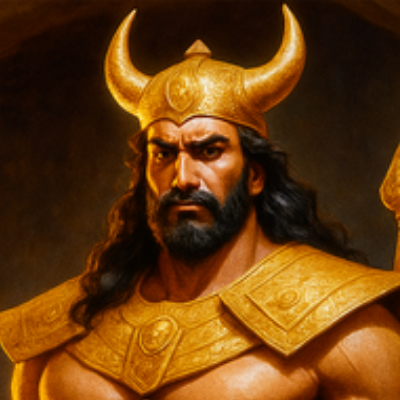
Virochana — Son of Prahlada, Father of Mahabali, King of the Asuras
Virochana · Virocana · Prahlada-putra · Bali-pita · Ditisuta · Daitya-raja
Virochana is the son of Prahlada and the father of Mahabali — placing him at the central genealogical hinge of the great Asura lineage that runs from Kashyapa and Diti through Hiranyakashipu and Prahlada to the magnanimous emperor subdued by Vishnu's Vamana avatar. He is mentioned in the Atharvaveda (VIII.10.22) — one of the very few Puranic Asura kings whose name appears in Vedic scripture — and features in one of the most philosophically celebrated passages of the Upanishads: the Chandogya Upanishad (VIII.7.2–8.5), where he and Indra sit together at Prajapati's feet for thirty-two years seeking knowledge of the Atman. Despite being the son of the tradition's supreme devotee, Virochana is presented in the Upanishadic tradition as a figure of genuine philosophical limitation — his misinterpretation of Prajapati's teaching about the Self becoming the founding doctrine of Asura materialism. Yet in the Mahabharata and the Puranas he is also remembered as a kind ruler, a performer of Vedic rites, and a devoted son who inherited Prahlada's generosity — a generosity so complete that it ultimately became the instrument of his death. He was killed by Indra in the Tarakamaya war — one of the twelve great Devasura wars — and his body was burned to prevent Shukracharya's Mritasanjivani from reviving him. His orphaned son Mahabali was raised by Prahlada himself.
✦ The Name
The Sanskrit name Virochana — written Virocana in IAST — derives from the root vi-ruc: to shine forth, to illuminate, to be brilliant. It means the shining one, the brilliant one, the radiant. The name is used elsewhere in the tradition as an epithet of the sun — Virocana as a name of Surya — and of fire. That an Asura king bears a name meaning radiance or brilliance is consistent with the Puranic tradition's recognition that the Asura lineage of Prahlada was not demonic in character but was, through its Vaishnava devotion, capable of genuine luminosity. His sister bears the feminine form of the same name — Virocanā — reflecting a family tradition of names built around the same root.
✦ Lineage
- Father: Prahlada — supreme devotee of Vishnu; one of the twelve Mahajanas; son of Hiranyakashipu and Kayadhu; king of the Asuras
- Mother: Dhrti — wife of Prahlada; per the Puranic Encyclopaedia (Vettam Mani)
- Siblings: Kumbha and Nikumbha (brothers per Bhagavata Purana, Puranic Encyclopaedia); Ayushman, Shibi, and Bashkala (additional brothers per Vayu Purana as cited in Grokipedia); and a sister Virocanā (feminine form of his own name) who married Tvashta and bore a son named Viraja and a son named Trishiras (Bhagavata Purana Skandha 5; Vayu Purana)
- Wife: Devamba — named in the Sastra Caksusa source drawing from the Matsya Purana; the Artha source records that Indra and the demigods were responsible for the death of Virochana and his wife, suggesting Devamba died of grief after Virochana was killed; the Brahmanda Purana and Narada Purana name his wives as Visalakshi and Devi per Grokipedia, with two children Bala and Yashodhara from one of these wives
- Son: Mahabali (Bali) — the magnanimous Asura emperor, most celebrated king of the Hiranyakashipu lineage; currently residing on Sutala Loka under Vishnu's protection after the Vamana episode
- Additional children (Brahmanda Purana, Narada Purana per Grokipedia): Bala (son); Yashodhara (daughter, who married Tvashta — distinct from his sister Virocanā marrying Tvashta in the Bhagavata Purana, a textual inconsistency between these sources); Manthara (daughter, killed by Indra for attempting to destroy the earth — per Valmiki Ramayana and Brahmanda Purana as cited in Grokipedia)
- Grandson: Banasura — son of Mahabali; the thousand-armed devotee of Shiva
- Grandfather: Hiranyakashipu — per Atharvaveda VIII.10.22, which names Virochana explicitly as Hiranyakashipu's grandson
✦ Character and Conduct
The Puranic Encyclopaedia records: Virochana, though an Asura, performed rites and rituals carefully and was kind towards Brahmins. The Wisdomlib and Dharmawiki sources confirm this consistently: he was raised to be religious under Prahlada's influence, and the Vishnu Purana records him as an obedient son who received teachings from Prahlada from a very young age. The Grokipedia source records that Virochana imparted the values of Vishnu bhakti and kingship to Mahabali — his son's renowned adherence to dharma reflecting paternal instruction. The Bhagavata Purana records that Prahlada, when he grew old, left his kingdom in Virochana's hands and went to the forest for penance. The Gold Coast Hindu source notes that in the story of Prithu — the earthly king who first milked the earth for the benefit of all beings — Virochana appears alongside other great kings who served as calves during the cosmic milking of the earth, demonstrating his respected position as a ruler. His generosity — the defining virtue he inherited from Prahlada — was so absolute that it eventually became the mechanism of his death.
✦ The Chandogya Upanishad — Seeking the Atman
The Chandogya Upanishad (VIII.7.2–8.5) records one of the tradition's most celebrated philosophical episodes. Virochana — representative of the Asuras — and Indra — representative of the Devas — heard that Prajapati knew the secret of the Atman, the immortal Self, and that knowing it one could conquer all worlds and fulfil all desires. Both set out together, bearing fuel sticks as a sign of studentship, and lived with Prajapati in brahmacharya for thirty-two years, serving him faithfully without asking their question. At the end of thirty-two years Prajapati asked what they sought. Both replied: knowledge of the Self. Prajapati instructed them: the being seen in the reflection in water or a mirror — that radiant form — is the Atman. He asked them to adorn themselves and look at their reflection. Both did so. Virochana immediately accepted the teaching at face value. He understood: the body is the Self. He returned to the Asuras and spread this doctrine — that the body should be adorned, cared for, and worshipped as the Self, since the body is the Atman. This became the founding doctrine of Asura material philosophy. Indra, however, was troubled. He turned back to Prajapati and spent another thirty-two years, then another thirty-two years, then five more years — a total of 101 years of brahmacharya — before Prajapati finally revealed the complete teaching: the true Atman is the pure, bodiless, deathless, undying consciousness that underlies all states — waking, dreaming, and deep sleep. The Upanishad presents the contrast of the two pupils as the philosophical divergence between Devas and Asuras: the Devas rose toward the incorporeal truth; the Asuras descended into the corporeal. The Gold Coast Hindu source raises a genuine question about the fairness of this framing: Virochana's misunderstanding was an honest one arising from incomplete teaching; Prajapati himself gave the incomplete teaching first. Whether Virochana's mistake deserves condemnation or compassion is a question the Upanishad does not fully answer.
✦ The Svayamvara of Kesini — The Arbitration of Prahlada
The Mahabharata (Sabha Parva, Chapter 63; also recorded in the Udyoga Parva and Dharmawiki) records a celebrated episode in Virochana's life. He and Sudhanva — son of the sage Angiras — both fell in love with the same princess, Kesini, at her svayamvara. A contention arose between them as to who was the greater — an Asura prince or a Brahmin sage's son. Both staked their lives on the verdict. They came together to Prahlada and asked him to arbitrate. Sudhanva immediately warned Prahlada not to favour his own son under threat of Indra's Vajra splitting his head a hundred times if he spoke falsely. Prahlada, troubled by the weight of the question, went to Kashyapa himself to clarify the relative standing of Brahmin and Asura lineages. Kashyapa declared: truth and virtue determine standing, not birth alone. Prahlada returned and gave his verdict with complete impartiality — he declared Sudhanva's lineage superior to his own son's. Virochana's life was forfeit by the terms of the wager. Sudhanva, moved by Prahlada's extraordinary fairness in condemning his own son, spared Virochana's life and granted him a boon of a hundred more years. Virochana stepped aside. Sudhanva married Kesini.
✦ The Death of Virochana — The Tarakamaya War
The Matsya Purana (Chapter 47) records Virochana's death in the Tarakamaya war — the fifth of the twelve great Devasura wars in the Puranic tradition, named for Tarakasura whose campaign against the Devas was one of the defining conflicts of this cosmic cycle. The Matsya Purana's account as cited in the Sastra Caksusa source states precisely: at the time of churning the ocean for nectar, Indra conquered Prahlada, and then killed Virochana, the son of Prahlada, in the Tarakamaya war, for the latter was always after the life of Indra and never was friendly to the deeds of the Devas. The Gold Coast Hindu source records the detailed account from the Matsya Purana: Virochana fought on Chandra's side in the Tarakamaya war — because Shukracharya, who opposed Brihaspati, had taken Chandra's side — and Indra killed Virochana in the course of this battle. Varuna joined Indra when Indra alone could not defeat him. Together they killed him. Knowing that Shukracharya possessed the Mritasanjivani — the power to revive the dead — and that it would only work if the body remained intact, Indra burned Virochana's body to prevent his revival. The Artha source records that Devamba, Virochana's wife, died of grief upon hearing of her husband's death and the burning of his body. Virochana's son Mahabali — who had seen his father only twice (at his birth and when Virochana left for brahmacharya at Prajapati's ashrama) and whose father was denied proper funeral rites — was left an orphan. This injustice, the Sastra Caksusa source records, is what caused Mahabali to oppose the Devas in his later campaigns. Prahlada raised Mahabali himself as his own grandson.
✦ The Ganesha Purana — An Alternate Death
The Ganesha Purana (an Upapurana) records a different account of Virochana's death. Virochana performed penance to Surya — the sun god — and received a solar crown with the property that he could not be killed as long as he wore it. He grew arrogant. To punish him, Vishnu assumed the form of a beautiful woman — as he had with the Samudra Manthana's distribution of amrita — and enticed Virochana into removing and surrendering the crown. Once the crown was removed, Virochana was slain. The Saurapurana also records Virochana killed by Vishnu rather than Indra. The Wikipedia article on Virochana further records a tradition — from the Bhagavata Purana — in which Indra, having learned from Prahlada that his virtue (shila) could be received as a boon, sent a servant to obtain it from Virochana by posing as a Brahmin seeking a favour. Virochana granted Indra's servant his virtue without guile, thereby losing the divine favour of Shri (Lakshmi). Indra was thus able to reclaim his throne without combat.
✦ In Buddhist Tradition
The Wisdomlib source records a brief Buddhist note: nine kappas (cosmic ages) ago there were three kings named Virochana — all identified as previous births of Salapupphadayaka Thera in the Pali Theravada tradition. This is a separate tradition entirely and does not intersect with the Hindu Puranic genealogy.
✦ References
- Atharvaveda (VIII.10.22) — Virochana named as grandson of Hiranyakashipu and son of Prahlada; the most ancient textual record of his name
- Chandogya Upanishad (VIII.7.2–8.5) — the complete narrative of Virochana and Indra at Prajapati's feet; thirty-two years of brahmacharya; Virochana's identification of the body as the Atman; the foundation of Asura material philosophy
- Mahabharata — Sabha Parva, Chapter 63 and Udyoga Parva: the Kesini svayamvara episode; Virochana and Sudhanva's wager; Prahlada's impartial arbitration; Sudhanva's grant of a hundred more years; Adi Parva, Chapter 65, Stanza 19: Virochana named as Prahlada's son and Mahabali's father
- Matsya Purana (Chapter 47) — Virochana's death in the Tarakamaya war; killed by Indra and Varuna; his body burned to prevent Shukracharya's revival; Devamba dying of grief; Mahabali's subsequent opposition to the Devas
- Bhagavata Purana — V.24.18; VI.18.16; VIII.10.20 and 29 — Virochana as son of Prahlada and father of Bali; his participation in the Devara war between Bali and Indra; the virtue-boon episode; Virocanā (sister) marrying Tvashta per Skandha 5
- Vishnu Purana (I.21.1) — Virochana as son of Prahlada and father of Bali
- Brahmanda Purana (II.20.35; III.5.41; III.72.79 and 105) and Narada Purana (2:32) — children Bala and Yashodhara born to Virochana; Yashodhara married Tvashta; Manthara killed by Indra
- Vayu Purana (84.19) — Virochana's five brothers Kumbha, Nikumbha, Ayushman, Shibi, and Bashkala, and his sister Virocanā
- Ganesha Purana (Upapurana) — Surya's gift of the solar crown; Virochana's arrogance; Vishnu's disguise as a beautiful woman; the surrendering and removal of the crown; Virochana's death
- Saurapurana (10th century) — Virochana killed by Vishnu per the Shaiva genealogical tradition
- Puranic Encyclopaedia (Vettam Mani, Pages 82, 103, 214, 338) — the foundational English-language genealogical reference: son of Prahlada and Dhrti, father of Bali; kind towards Brahmins; killed by Indra in the Tarakamaya war; Prahlada's golden chariot given to Virochana
- Wikipedia — Virochana; Dharmawiki — Virochana; Wisdomlib — Virocana (twenty-four definitions); Grokipedia — Virochana; Sastra Caksusa — Virocana the son of Prahlada Maharaja; Gold Coast Hindu — Virochana: A Wronged Asura?: modern summaries drawing from the above primary sources