
About
Durmada — Social Husband of Ananga Manjari
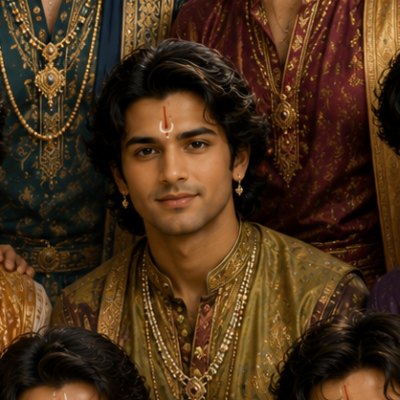
Durmada
Durmada is identified in Rupa Goswami's sixteenth-century Gaudiya Vaishnava genealogical compendium, the Shri Radha-Krishna-Ganoddesha-Dipika, as the cowherd to whom Ananga Manjari, the youngest daughter of Vrishabhanu and Kirtida Devi and the younger sister of Radha, the eternal consort of Krishna, is socially wedded within the structure of the cowherd community of Vraja. He is the younger son of Vrika, a cowherd elder of the village of Javat, and his wife Jatila, and the younger brother of Abhimanyu — also known by the Bengali vernacular name Ayan Ghosh — to whom Radha herself is socially wedded, and of Kutila, who together with Jatila forms part of the watchful household into which both daughters of Vrishabhanu married. Durmada is described in the Shri Radha-Krishna-Ganoddesha-Dipika as proud, haughty, and protective in temperament, a disposition that the tradition places in deliberate contrast to Ananga Manjari's own gentle character, and that situates him, alongside his mother Jatila and sister Kutila, among the watchful figures of the household at Javat whose vigilance forms part of the social architecture surrounding the secret pastimes of Radha and Krishna.
✦ The Name
The name Durmada is a Sanskrit compound of the prefix dur-, an intensifying or pejorative prefix meaning bad, difficult, or excessive, and mada, meaning intoxication, pride, arrogance, or excessive self-regard. The compound may be rendered as one possessed of excessive pride or as one who is difficult on account of arrogance. Rupa Goswami's characterisation of Durmada as proud and haughty in the Shri Radha-Krishna-Ganoddesha-Dipika reflects this etymology directly, the name itself functioning as a description of temperament rather than as a name carrying auspicious or honorific connotations of the kind borne by many other figures in this genealogy.
✦ Lineage
- Father: Vrika (also Vrika Gopa) — cowherd elder of Javat and head of the household into which Radha and Ananga Manjari were given in marriage. Vrika's textual presence is confined to his position as patriarch of the household, with no independent episode attributed to him.
- Mother: Jatila — recorded in Rupa Goswami's Vidagdha Madhava as a figure of habitual suspicion and vigilance toward Radha's conduct, whose authority within the household is depicted as subordinate to that of Mukhara Devi, Radha's maternal grandmother.
- Elder brother: Abhimanyu (also known as Ayan Ghosh) — identified in the Shri Radha-Krishna-Ganoddesha-Dipika as the cowherd to whom Radha is socially wedded. Gaudiya Vaishnava theology holds Abhimanyu's belief in the exclusivity of this marriage to be a false conception belonging to the level of worldly appearance, termed Maya, structurally necessary to the parakiya rasa, or paramour love, that characterises Radha's relationship with Krishna in this theological framework.
- Sister: Kutila — recorded in the Vraja dramatic tradition alongside her mother Jatila as a watchful and suspicious figure within the household, alert to any irregularity in Radha's conduct.
- Social wife: Ananga Manjari — youngest daughter of Vrishabhanu, the cowherd chieftain of Vraja, and his wife Kirtida Devi, and younger sister of Radha. Within Radha's intimate circle, Ananga Manjari occupies the position of a manjari, a category of close female attendant and confidante in Gaudiya Vaishnava devotional theology, whose role is to assist in and witness the loving exchanges between Radha and Krishna. As with her sister Radha's marriage, the tradition holds Ananga Manjari's marriage to Durmada to be a social designation that does not reflect her deeper spiritual identity or eternal service.
- Sister-in-law: Radha — venerated across the Brahma Vaivarta Purana, the Padma Purana's Uttara Khanda, the Garga Samhita, and the wider Gaudiya Vaishnava tradition as the foremost of the gopis of Vraja and as the eternal consort of Krishna, identified theologically as his Hladini Shakti, the personification of Krishna's own potency of divine bliss.
✦ The Marriage Pairing and Household Structure
The Shri Radha-Krishna-Ganoddesha-Dipika sets out a social structure for the cowherd community of Vraja in which the two daughters of Vrishabhanu and Kirtida Devi — Radha and Ananga Manjari — are married to the two sons of Vrika and Jatila, Abhimanyu and Durmada respectively, with the pairing following birth order: the elder sister Radha to the elder brother Abhimanyu, and the younger sister Ananga Manjari to the younger brother Durmada. This double pairing binds the two households together at the level of social structure, and situates Durmada's marriage to Ananga Manjari as a direct parallel to, and extension of, his elder brother's marriage to Radha. Durmada's own disposition — proud, haughty, and protective — is described in the tradition as rendering him watchful over Ananga Manjari's comings and goings, paralleling the wider vigilance exercised within the household by Jatila and Kutila toward Radha.
✦ Theological Framing
Gaudiya Vaishnava theology interprets Durmada's marriage to Ananga Manjari, like his brother's marriage to Radha, as belonging to the level of worldly social appearance, termed Maya, and not to the spiritual reality of Ananga Manjari's eternal service within Radha's intimate circle. In this interpretation, Ananga Manjari's own eternal service is understood to be directed entirely toward the secluded pastimes of Radha and Krishna in the groves of Vraja, particularly within a bower at Radha Kunda known as the Anangamanjari Kunja, regarded as her own sanctuary within that sacred site — a spiritual reality wholly independent of, and unaffected by, her social marriage to Durmada. Durmada's proud and watchful temperament, like the suspicion of Jatila and Kutila, is understood within this framework as part of the deliberate social architecture of Vraja that gives rise to the mood of parakiya rasa, the paramour love regarded in Gaudiya aesthetics as the highest form of conjugal devotion precisely because it is unsanctioned and therefore requires secrecy for its expression.
✦ Connection to the Wider Genealogy
Durmada, as the younger son of Vrika and Jatila and the social husband of Ananga Manjari, is doubly connected to the family of Vrishabhanu and Kirtida Devi: directly, through his own marriage to Ananga Manjari, and indirectly, through his elder brother Abhimanyu's marriage to Radha. Through these connections, Durmada's household is linked, at the level of social appearance, to the central relationship of Gaudiya Vaishnava theology — that of Radha and Krishna as the Hladini Shakti and its possessor — while the tradition maintains that this connection operates entirely within the doctrine of Maya and does not touch the deeper spiritual reality of either Radha's relationship with Krishna or Ananga Manjari's own eternal service within it.
✦ References
- Primary Sources
- Shri Radha-Krishna-Ganoddesha-Dipika of Rupa Goswami — Primary source for Durmada's identification as the son of Vrika and Jatila, the younger brother of Abhimanyu and Kutila, and the cowherd to whom Ananga Manjari is socially wedded, including the description of his proud and protective temperament.
- Vidagdha Madhava of Rupa Goswami — Primary dramatic source for the household at Javat into which both Radha and Ananga Manjari married, and for the social and narrative context of Durmada's marriage.
- Secondary Sources
- The Harmonist, "Ananga Manjari: A Historical and Theological Perspective" — Secondary source for the characterisation of Durmada's temperament and the parakiya theological framing of his marriage to Ananga Manjari.
- Isvara.org Archive, "Radha-Krishna-Ganoddesa-Dipika English Edition: Srimati Radharani and Her Friends" — Secondary translation consolidating the Ganoddesha-Dipika's account of the marriage pairing of Radha and Ananga Manjari with Abhimanyu and Durmada.
- Isvara.org Archive, "Ananga Manjari" — Secondary source for Ananga Manjari's association with the Anangamanjari Kunja at Radha Kunda and its bearing on the theological framing of her marriage to Durmada.