
About
Prahlada — Supreme Devotee of Vishnu, Mahajana, King of the Asuras
Prahlada · Prahlāda · Bhaktaraj · Mahajana · Ditisuta · Narasimha-rakshita · Vishnu-bhakta · Asura-raja
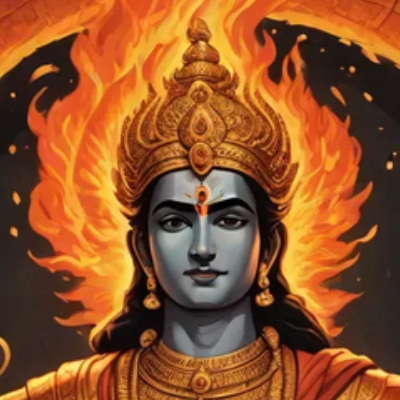
Prahlada is the most celebrated devotee in all of Puranic literature — a child who maintained absolute, unshakeable love for Vishnu in the household of the being who hated Vishnu most absolutely. He is the eldest son of Hiranyakashipu and his wife Kayadhu, the great-grandson of Kashyapa and Diti, and one of the twelve Mahajanas — the supreme devotees listed in the Bhagavata Purana — alongside Brahma, Narada, Shiva, the Four Kumaras, Kapila, Manu, Janaka, Bhishma, Bali, and Shuka. The Bhagavad Gita (10.30) records Krishna's own declaration: among the Daityas I am the devoted Prahlada. He survived every attempt on his life — poison, fire, serpents, elephants, cliffs, the sea — each time protected invisibly by Vishnu's grace. After Narasimha slew his father, he became the king of the Asuras and ruled with such virtue that he conquered the three worlds not through war but through his conduct alone — Indra abandoning Svarga out of reverence before a man who had never raised a weapon. He is the grandfather of Mahabali, the magnanimous Asura king whom Vishnu subdued in the Vamana avatar, and the ancestor of Banasura, the thousand-armed devotee of Shiva. Within the Bhagavata Purana, Prahlada eventually becomes king of the Daityas and attains a place in the abode of Vishnu (Vaikuntha) after his death.
✦ The Name
The Sanskrit name Prahlada is formed from the prefix pra — intensified, completely — and hlada — joy, delight, refreshment. Together: he who is filled with intense joy or he who refreshes deeply. The name captures the essence of his spiritual identity — the being who, in the midst of mortal terror and parental persecution, maintained an uninterrupted state of divine joy through his love for Vishnu. His epithet Bhaktaraj means king of devotees. He is called Narasimha-rakshita — protected by Narasimha — across the devotional tradition. His gotra is Kashyapa — recorded in the Brainly source — affirming his direct descent from the great Prajapati.
✦ Lineage
- Father: Hiranyakashipu — Daitya king; first incarnation of the Vaikuntha gatekeeper Jaya; slain by Narasimha avatar of Vishnu
- Mother: Kayadhu (also called Leelavati; the Apam Napat source calls her Khyathu or Dhanavi — a regional variant) — daughter of the Danava Jambha; described as sinless and a devotee of Vishnu; the medium through whom Prahlada received Narada's teachings before birth
- Brothers: Anuhlada, Hlada, and Samhlada — the four sons of Hiranyakashipu and Kayadhu
- Wife: Dhrti — recorded in the Puranic Encyclopaedia (Vettam Mani) as cited in the Dharmawiki source
- Sons by Dhrti: Virochana (eldest), Kumbha, and Nikumbha — three sons per the Puranic Encyclopaedia; the Vishnu Purana records only Virochana
- Adopted nephew (foster son in some traditions): Andhaka — the blind Asura son of Shiva and Parvati given to Hiranyaksha; after Hiranyaksha's death, Prahlada raised Andhaka and they ruled alongside each other; Andhaka was eventually slain by Shiva after his attack on Kailasha
- Grandson: Mahabali (Bali) — son of Virochana; Prahlada raised his grandson, Bali, after the devas had Virochana killed by taking advantage of his generosity.
- Great-grandson: Banasura — the thousand-armed devotee of Shiva; defeated by Krishna in the Mahabharata's episode of Aniruddha's captivity
- Cosmic identity: Raghavendra Swami in the 17th century is considered by his devotees to be a reincarnation of Prahlada.
✦ Prenatal Teaching — Narada in the Womb
While Hiranyakashipu performed his extreme penance on Mount Mandara, Indra seized the opportunity to attack his kingdom. He captured Kayadhu — pregnant with Prahlada — intending to kill the unborn child. Narada intervened, declared Kayadhu sinless, and persuaded Indra to release her. She came to live in Narada's hermitage under his protection. Each day, Narada would sing praises of Vishnu, and the child in the womb — Prahlada — absorbed the teachings, developing a profound love for the deity. When Hiranyakashipu returned from Mandara and retrieved his wife and son, he was grateful to Narada for protecting them — not yet knowing what the child had absorbed. Prahlada thus entered the world already saturated with the consciousness of Vishnu — his devotion not learned but innate, planted before birth by the greatest of divine messengers.
✦ Childhood — Devotion Against All Opposition
The Bhagavata Purana's Canto 7 devotes its central narrative to Prahlada's childhood years. When Hiranyakashipu heard his young son openly declare Vishnu as the supreme god — in school, before his classmates — he sent him back with revised instructions. Prahlada returned and taught his fellow students the glories of Vishnu instead of the prescribed lessons. He is recorded in the Bhagavata Purana as giving a discourse to his classmates on the nine modes of bhakti — shravanam (hearing), kirtanam (chanting), vishnu-smaranam (remembering), pada-sevanam (serving the lotus feet), arcanam (worshipping), vandanam (offering prayers), dasyam (servitude), sakhyam (friendship), and atma-nivedanam (complete self-surrender) — declaring all nine as simultaneously valid and mutually reinforcing. This discourse — the Prahlada-upadesa — is one of the Bhagavata Purana's most celebrated theological passages on the nature and practice of bhakti.
His teachers reported him again. Hiranyakashipu's attempts to kill his son — each of which failed — proceeded in rapid succession across the Bhagavata Purana's narrative. Hiranyakashipu tried to poison Prahlada's food. The cooks did as they were told. But because Prahlada thought of Vishnu, the poison had no effect. He ordered him thrown from a cliff — Prahlada descended safely, thinking of Vishnu. He ordered him crushed under elephants — the elephants' tusks broke on his chest. He had him thrown into the sea with rocks tied to his body — Prahlada emerged chanting Vishnu's name. He had him confined with venomous serpents — the serpents submitted. He ordered fire lit around him — Prahlada sat in meditation and emerged unburnt. He ordered the demoness Holika — who had a boon of fire immunity — to take Prahlada into a blazing pyre — Holika burned and Prahlada was unharmed. Hiranyakashipu then called Shambarasura, an asura well versed in maya. Shambarasura used maya to create illusions around Prahlada. But Prahlada kept thinking of Vishnu, and Vishnu's weapon, the Sudarshana Chakra, came and destroyed all the maya.
✦ The Pillar — Narasimha's Manifestation
The final confrontation between Hiranyakashipu and Prahlada — described in full in the Hiranyakashipu profile above — culminated in Hiranyakashipu striking the pillar and Narasimha emerging. After Narasimha slew Hiranyakashipu and his divine fury failed to subside, only Prahlada's approach calmed him. Prahlada was rescued from his evil father, the Asura king Hiranyakashipu, by Narasimha, the lion avatar of god Vishnu. Narasimha held Prahlada in his lap with extraordinary tenderness — the ferocious divine form that had just disembowelled a tyrant becoming suddenly gentle before the child's pure love. He offered Prahlada any boon. Prahlada declined all personal boons — asking only that his father be freed from his sins. Narasimha assured him that Hiranyakashipu had already been purified and had returned to Vaikuntha through direct contact with the divine body at the moment of death.
✦ As King of the Asuras — Conquest Through Character
After Hiranyakashipu's death, Prahlada assumed the Asura throne. The Bhagavata Purana and Vishnu Purana record that he ruled with virtue, generosity, and justice — qualities that made him more powerful than his father despite never wielding weapons in conquest. Without lifting a single weapon and by virtue of his good behaviour, Prahlada conquered the three worlds easily, and Indra ran away from Svarga. The episode of Indra and Prahlada's shila (good conduct) is one of the tradition's most celebrated passages on the nature of dharmic power: Indra came to Prahlada in the disguise of a Brahmin and asked him for the secret of his strength. Prahlada taught him the qualities of character — humility, truthfulness, freedom from desire, compassion, non-violence, steadiness — that constituted his unconquerable nature. Indra, recognising that he was taking Prahlada's qualities from him through the act of receiving them as a boon, received his shila and departed. The Bhagavata Purana records that the Brahma-tejas — the divine lustre — departed with it, but Prahlada's devotion to Vishnu remained intact and ultimately restored all that had been taken.
✦ The Andhaka Episode and the Devasura Wars
Prahlada had strongly advised Andhaka — his adopted nephew — against attacking Kailasha and attempting to abduct Parvati. Andhaka refused his counsel. Prahlada had strongly advised Andhaka against the invasion of Kailasha, but Andhaka refused. Andhaka was eventually killed by Shiva and Parvati, and Prahlada once more became the King of the Asuras. The Devi Bhagavata Purana records a separate episode in which Prahlada was compelled by the Daityas to lead a war against Indra and the Devas — and emerged victorious. Fearing that he would destroy the gods, Indra prayed to Parvati for help. The goddess interceded with Prahlada and pacified both sides. These episodes establish Prahlada as an Asura king of immense power — who used that power with restraint, and whose wars with the Devas were always driven by circumstance rather than desire for conquest.
✦ The Curse — Temporary Deviation from Dharma
The Wikipedia account records a remarkable episode in Prahlada's later life — one that establishes the limits of even the greatest devotees' stability when divine grace is temporarily withdrawn. A sage cursed Prahlada, declaring that he would forget Vishnu and become unrighteous. The curse soon came into fruition, with Prahlada ignoring the Vedas and the Brahmanas and soon deviating from the path of dharma. Determined to avenge his father's death, he waged war against Vishnu. When he was defeated, he realised his folly. This episode — brief in the tradition and quickly reversed — is significant in establishing that even the supreme devotee is not immune to the consequences of a sage's curse or to the temporary withdrawal of divine awareness, and that the path back to the divine is always through recognition and surrender.
✦ Virochana, Bali, and the Continuation of the Lineage
Three sons — Virochana, Kumbha, and Nikumbha — were born to Prahlada by his wife Dhrti. Virochana was the most celebrated. He was a virtuous Asura king, devoted to Vishnu like his father and kind to Brahmins. The Chandogya Upanishad (VIII.7.2–8.5) records a celebrated philosophical episode in which both Virochana and Indra went to Prajapati Brahma to learn about the Atman and lived there in brahmacharya for thirty-two years — forming different conclusions about the Self that then spread as the Daitya and Deva philosophies respectively. The Mahabharata's Sabha Parva records the episode of Sudhanva — son of Angiras — who staked his life against Virochana in a debate at a princess's svayamvara. Prahlada arbitrated impartially, declaring Sudhanva's lineage superior to his own son's — even at the cost of Virochana's life. Sudhanva, moved by Prahlada's extraordinary impartiality, spared Virochana. Pleased at the righteousness of Prahlada, Sudhanva gave Virochana a boon to live a hundred years more. Virochana was later killed by Indra in the Tarakamaya war — the Matsya Purana and Sastra Caksusa source both confirming this — his body burned to prevent Shukracharya's Mritasanjivani from reviving him. Prahlada raised Virochana's son Bali — his grandson — as his own child after Virochana's death.
✦ Life on Sutala and Final Liberation
After the Vamana avatar subdued Mahabali and sent him to the netherworld of Sutala, Vishnu himself took up permanent residence at the gate of Sutala as Mahabali's guardian. The tradition records that Prahlada and Mahabali lived on Sutala Loka under the instructions of Lord Vishnu. Prahlada thus spent his final years in the same divine company that had sustained him through his most terrible childhood hours — living near Vishnu, with his grandson, in the underworld's most sacred realm. After a long life, Prahlada attained Vaikuntha. He is one of the few beings in the tradition — along with Bali and the four Kumaras — specifically recorded as having attained Vishnu's eternal abode at the end of their earthly sojourn.
✦ In the Mahabharata
The Mahabharata references Prahlada across multiple Parvas. The Shanti Parva records his inclusion among the twelve Mahajanas. The Sabha Parva (Chapter 63) records the Sudhanva-Virochana arbitration episode — Prahlada's declaration that Sudhanva's lineage was superior to his own son's. The Udyoga Parva (Chapter 35) records that Sudhanva married Kesini in Virochana's presence after the arbitration. The Vana Parva references him as the archetype of the devoted Asura king. The Shanti Parva records Bhishma referencing him as an example of righteous Asura governance. Throughout the epic, Prahlada functions as the supreme counter-example to the demonic — an Asura who demonstrated that the categories of Deva and Asura are defined by character, not by lineage.
✦ Theological Significance — The Paradox of Grace
Prahlada's story is the Bhagavata Purana's central statement about the nature of divine grace — that it is unconditional, cannot be obstructed by any human authority however powerful, and chooses its own vessels without reference to lineage, social position, or circumstance. That the supreme devotee was born in the household of the supreme enemy of the divine is not an accident but a theological statement: God's love transcends every category that human beings use to organise their world. The child born to hatred became the greatest lover. The house most hostile to the divine became the stage of the most dramatic divine intervention. And the father who tried hardest to extinguish the flame became — through the very intensity of his hatred — an instrument of the very divine presence he had spent his life denying.
✦ References
- Bhagavad Gita (10.30) — Krishna's declaration: among the Daityas I am the devoted Prahlada
- Bhagavata Purana — Canto 7, Chapters 4–10: the complete narrative of Prahlada's childhood; the prenatal teaching by Narada; Hiranyakashipu's attempts to kill him; the pillar and Narasimha; the discourse to his classmates on nine modes of bhakti (the Prahlada-upadesa); Indra's visit in disguise and the teaching on shila; Prahlada's conquest of the three worlds through conduct; his kingship; his life on Sutala with Bali; his attainment of Vaikuntha; Canto 6 lists him among the twelve Mahajanas
- Vishnu Purana (Book 1, Chapters 17–20) — parallel account of Prahlada's childhood, the Narasimha avatar, Prahlada's accession to the throne, and Virochana as his son
- Devi Bhagavata Purana — the Devasura war episode in which Prahlada was compelled to fight Indra and the Devas; Parvati's intercession; the pacification of both sides
- Mahabharata (Vyasa) — Sabha Parva, Chapter 63: Prahlada's impartial arbitration of the Sudhanva-Virochana debate; the boon of a hundred years; Udyoga Parva, Chapter 35: Sudhanva's marriage to Kesini; Shanti Parva: Prahlada among the twelve Mahajanas; references throughout as the archetype of the righteous Asura king
- Chandogya Upanishad (VIII.7.2–8.5) — Virochana and Indra's thirty-two years at Prajapati's feet; Virochana's interpretation of the Self as the body
- Puranic Encyclopaedia (Vettam Mani) — Prahlada's wife Dhrti; sons Virochana, Kumbha, and Nikumbha; the Andhaka episode; the twelve Devasura wars
- Matsya Purana (Chapter 47) — Indra's killing of Virochana in the Tarakamaya war; the burning of Virochana's body to prevent revival
- Vayu Purana — Virochana's five brothers and one sister; family details
- Brahmanda Purana and Narada Purana — Virochana's wives Visalakshi and Devi; his children Bala and Yashodhara
- Wikipedia — Prahlada; Vyasa Mahabharata — Prahlada; Apam Napat — Prahalada; Wisdomlib — Story of Prahlada (Vishnu Purana); Dharmawiki — Virochana; Sastra Caksusa — Virochana and Chandogya Upanishad: modern summaries drawing from the above primary sources