
About
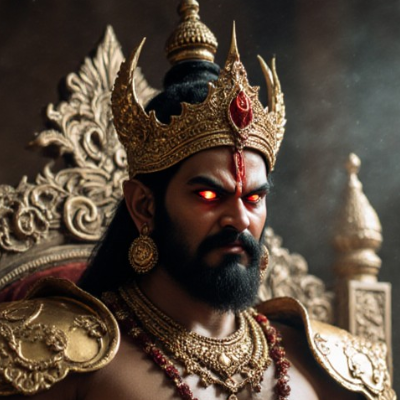
Hiranyakashipu — King of the Daityas, First Incarnation of Jaya, Slain by Narasimha
Hiranyakashipu · Hiraṇyakaśipu · Adidaitya · Ditisuta · Kashyapaputra · Prahlada-pita · Narasimha-vadhya
Hiranyakashipu is the most celebrated of the Daitya kings — the first and most powerful of the three earthly incarnations of Jaya, one of the two gatekeepers of Vaikuntha cursed by the Four Kumaras to fall from heaven. He was born in the Satya Yuga to Kashyapa and Diti — half-brother of the Adityas through his father's other wife Aditi — and twin brother of Hiranyaksha. After Hiranyaksha was slain by Vishnu's Varaha avatar, Hiranyakashipu undertook the most extreme austerities in the tradition to gain near-immortality from Brahma, conquered the three worlds, usurped Indra's throne, declared himself the supreme god, and forbade the worship of Vishnu throughout creation. His own son Prahlada — the supreme devotee of Vishnu, instructed in Vishnu's glories by Narada even while in the womb — became the focal point of the conflict between Hiranyakashipu's will and divine law. After failing to kill Prahlada by every means available to him, Hiranyakashipu was slain by Vishnu's Narasimha avatar — the man-lion form devised to circumvent every condition of his boon. He is one of the defining antagonists of the Bhagavata Purana and one of the tradition's most theologically significant figures: the being whose absolute hatred of the divine became, through the paradox of divine love, the instrument of his own liberation.
✦ The Name
The Sanskrit name Hiranyakashipu is formed from hiranya — gold — and kashipu — soft bed, cushion, or fine garments. Together: clothed in gold or he who desires golden comforts — commonly interpreted as depicting one who is deeply attached to wealth and sensual pleasures. The Wisdomlib account records a second etymology from the Puranic tradition itself: the name derived from a golden throne called Hiranyakashipu upon which the asura sat during an atiratra (soma) sacrifice in his father Kashyapa's ashrama while still a child. The Bhagavata Purana records that during Kashyapa's Ashvamedha yajna, the child sat upon one of the golden seats reserved for the Hotri priests — and the name was fixed from this act.
✦ Cosmic Identity — First Incarnation of Jaya
The Bhagavata Purana places Hiranyakashipu's story within the larger narrative of Jaya and Vijaya — the two divine gatekeepers of Vaikuntha who were cursed by the Four Kumaras after barring their entry. Given a choice between seven births as Vishnu's devotees or three births as his enemies, they chose three enemy births to return to Vaikuntha sooner. As described in the profile of the Four Kumaras in this genealogy, their three pairs of births were Hiranyakashipu and Hiranyaksha (slain by the Narasimha and Varaha avatars), Ravana and Kumbhakarna (slain by Rama), and Shishupala and Dantavaktra (slain by Krishna). Hiranyakashipu and Hiranyaksha are thus Jaya and Vijaya in their first mortal incarnation — Daityas by birth but divine gatekeepers in their essential nature, working out their chosen return to heaven through the path of intense opposition to Vishnu. The Bhagavata Purana resolves the theological tension this creates by asserting that divine hostility functions as a mode of purification: through direct contact with Vishnu at the moment of death, even the most violent enemy is sanctified and admitted into Vaikuntha.
✦ Lineage
- Father: Kashyapa — the great Prajapati, son of Marichi, universal progenitor of all living beings
- Mother: Diti — daughter of Daksha; wife of Kashyapa; her desire for a son surpassing Indra, fulfilled at an inauspicious hour against Kashyapa's warnings, produced the Daitya race
- Twin brother: Hiranyaksha — slain by Vishnu's Varaha avatar; the event that triggered Hiranyakashipu's campaign of vengeance
- Sister (in some traditions): Holika — who had a boon protecting her from fire; burned in the episode of Prahlada's attempted murder; her burning is the mythological origin of the Holi festival; the primary Puranic texts identify Simhika as his daughter rather than Holika as his sister, and the two traditions represent different Puranic strata
- Wife: Kayadhu (also called Leelavati in some traditions) — daughter of the Danava Jambha; described by Narada as sinless; a devotee of Vishnu; the medium through whom Prahlada received Narada's teachings before birth
- Sons (four, by Kayadhu): Prahlada (the eldest and most celebrated — the supreme devotee of Vishnu and one of the twelve Mahajanas; future king of the Asuras); Anuhlada; Hlada; and Samhlada
- Daughter: Simhika — who married the Daitya Viprachitti and became the mother of Rahu and other powerful beings through Kashyapa's line
- Six souls from his Asura lineage: The Bhagavata Purana (via Wisdomlib) records that six sons born of his Asura lineage were carried away by Yogamaya's effort before birth; they were subsequently born as Devaki's first six children and killed by Kamsa — a remarkable karmic thread connecting Hiranyakashipu's lineage to Krishna's birth story
- Subsequent births: Ravana (second birth), Shishupala (third birth) — completing the three incarnations of Jaya
- Grandson: Virochana (son of Prahlada); great-grandson: Mahabali (Bali) — the magnanimous Daitya king whom Vishnu subdued in the Vamana avatar
✦ Birth — The Inauspicious Hour
The Bhagavata Purana records that Diti approached Kashyapa with urgent desire at the hour of dusk — the sandhya hour, sacred to the twilight gods and considered deeply inauspicious for conjugal union. Kashyapa warned her of the consequences. She insisted. He consented reluctantly. From this inauspicious union at the inauspicious hour, Diti conceived the twin brothers — each gestation described as one hundred years. The Grokipedia account records the prolonged hundred-year gestation as establishing their immense strength and ambition from the very conditions of their birth. Their arrival was heralded by earthquakes, blazing meteors, howling storms, and cosmic portents — all creation sensing the entry of two beings whose existence would destabilise the cosmic order.
✦ After Hiranyaksha's Death — The Vow of Revenge
When news reached Hiranyakashipu that Hiranyaksha — his younger twin, who had dragged the earth to the bottom of the cosmic ocean and been restored to the surface by Vishnu's Varaha avatar — had been killed, Hiranyakashipu's grief and rage were absolute. The JKYog account drawing from the Bhagavata Purana records that he gathered his army of prominent Daityas and Rakshasas and led a campaign of destruction across all three worlds, burning the homes and villages of Vishnu's devotees with fire and sword. He then consoled his brother's widow Rushabhanu and his nephews, speaking to them about the immortality of the soul and the honour of dying on the battlefield — a striking moment in which the Daitya king demonstrates genuine philosophical understanding even as he organises his campaign of vengeance.
✦ The Penance on Mount Mandara — Brahma's Boon
Hiranyakashipu went to the valley of Mount Mandara and undertook the most extreme tapas recorded in the Bhagavata Purana. Standing on his toes with arms raised toward the sky, gaze fixed upward, motionless — he meditated for thousands of years. The heat emanating from his body began to scorch the universe: rivers and seas boiled, the earth trembled, the eight directions blazed, the heavens became unbearable. Termites covered his body; bamboo and grass grew through him; he became an anthill of bones and skin. The gods, alarmed, went to Brahma and appealed for intervention. Brahma himself arrived at Mount Mandara on his swan, accompanied by Daksha, Bhrigu, and other sages. He sprinkled Hiranyakashipu's body with sacred water from his kamandalu. From the anthill, like fire from fuel, emerged a youth of adamantine body — perfect in all limbs, complexion like molten gold — who fell at Brahma's feet.
Brahma declared himself conquered by Hiranyakashipu's austerities and offered him his desired boon. When Hiranyakashipu asked for immortality, Brahma refused — explaining that immortality was beyond any boon he could grant. Hiranyakashipu then framed his request as a comprehensive series of exclusions that together amounted to practical immortality. The Bhagavata Purana records his exact words across several verses: Let me not meet death from any living entity created by you. Let me not die within any residence or outside it, during day or at night, on the ground or in the sky. Let my death not be brought by any being, by any weapon, by any human being or animal. Let me not meet death from any entity, living or non-living. Let me not be killed by any demigod, demon, or great snake. Grant me sole rulership over all living entities and presiding deities, and all the glories obtained by that position. Brahma granted the boon. The Shiva Purana records a supplementary boon from Shiva: unrivalled combat prowess and the powers of all the gods including Indra, Yama, Varuna, Surya, Agni, Vayu, Soma, and Kubera — granted after a separate penance to Shiva described briefly in the Anushasana Parva of the Mahabharata.
✦ The Abduction of Kayadhu — Prahlada's Prenatal Teaching
While Hiranyakashipu performed his long penance, Indra and the other Devas — sensing their opportunity — attacked his palace and sacked it. Indra seized Kayadhu, who was pregnant with Prahlada, intending to kill the child before it could be born and grow into a threat. At this point Narada intervened — declaring Kayadhu sinless and forbidding Indra from harming a chaste and innocent woman. Indra released her. Narada took Kayadhu into his hermitage for protection. There, during the months she lived under his care, Narada sang the glories of Vishnu to Kayadhu daily. The unborn Prahlada — already possessed of divine consciousness in the womb — received these teachings directly and was permeated by devotion to Vishnu before birth. When Hiranyakashipu returned from Mandara with his boon, he expressed profound gratitude to Narada for protecting his wife and retrieved them both. He was overjoyed to see his son and wife healthy. Only later did it become clear what Prahlada had absorbed.
✦ Conquest of the Three Worlds
Armed with Brahma's boon and Shiva's additional gifts, Hiranyakashipu swept through all three worlds. He occupied Indra's throne in Devaloka. He occupied Yama's court. He seized the domains of Varuna, Agni, Surya, Vayu, Soma, and Kubera. Rivers and mountains obeyed him. The gods fled their celestial abodes and wandered disguised among mortals. Hiranyakashipu ruled from his capital and declared that throughout creation only he should be worshipped — not Vishnu, not any other deity, not the sacrificial fire. The Skanda Purana records that he ruled the universe for 107,280,000 years — a quarter of one Manvantara. He acquired the aurvimaya (a weapon of fire) from Aurva and the tamasimaya (a weapon of illusion) from others — magical implements that extended his capacity for destruction. Under his reign, sacrificial fires went cold, Vedic rites ceased, and the dharmic order of creation was inverted.
✦ Prahlada — The Son Who Would Not Obey
The Bhagavata Purana's Canto 7 is devoted almost entirely to the conflict between Hiranyakashipu and Prahlada. When Hiranyakashipu first heard his young son openly declare Vishnu as the supreme god — in school, before his classmates — he summoned him and questioned him with controlled fury. Prahlada declared: Vishnu is all-pervading and omnipresent. He was, he is, and he always will be. Hiranyakashipu punished the teachers for failing to correct the child. He sent Prahlada back to school with revised instructions. When Prahlada returned and continued to teach his classmates about Vishnu's glories rather than attend to his lessons, Hiranyakashipu's rage became absolute. He resolved to kill his son.
The attempts to kill Prahlada — each of which failed through Vishnu's invisible protection — form the central dramatic sequence of the narrative. Hiranyakashipu ordered demons to use their illusionary powers on Prahlada — the powers dissolved before the boy. He ordered an elephant to trample him — the elephant stopped before Prahlada in submission. He had Prahlada thrown from a cliff — the boy landed unharmed. He ordered his soldiers to hurl him into the sea with rocks tied to his body — the waves threw him back to shore. He ordered serpents to bite him — their fangs broke against his skin. He had him thrown into a pit of fire — Prahlada emerged unburnt, chanting Vishnu's name. He ordered the demon Holika — who had a boon protecting her from fire — to take Prahlada onto a funeral pyre; Holika burned, and Prahlada sat amid the flames in meditation, unhurt. The burning of Holika is the mythological origin of the Holi festival — celebrated on the night before the full moon of the month of Phalguna.
✦ The Pillar — The Narasimha Avatar
At last, Hiranyakashipu summoned Prahlada directly. In a famous exchange recorded across all primary sources — the most theologically concentrated dialogue of the entire narrative — he demanded Prahlada explain where this Vishnu was, since he was apparently not powerful enough to appear before the Daitya king himself. He pointed at a pillar in the throne room and asked with a mocking challenge: Is your Vishnu present in this pillar? Prahlada replied: He is in the pillar, just as he is in the slightest dust. He was, he is, and he will always be. Hiranyakashipu, unable to contain his fury, struck the pillar with his mace. With a sound that shook the three worlds, Vishnu emerged from the broken pillar in the form of Narasimha — half-man, half-lion — with matted hair, immense moustaches, terrible teeth, and nails like weapons. The form was designed to circumvent every clause of the boon simultaneously: Narasimha was neither a being created by Brahma (being Vishnu himself), neither fully man nor animal, and neither god nor demon nor human. He appeared at twilight — neither day nor night. He seized Hiranyakashipu at the threshold of the courtyard — neither indoors nor outdoors. He placed him on his thighs — neither on the ground nor in the sky. He used his nails — neither weapons nor living things. And he disembowelled him. Every condition of the boon was satisfied and simultaneously circumvented. Hiranyakashipu died.
✦ The Aftermath — Narasimha's Fury and Prahlada's Intercession
After Hiranyakashipu's death, Narasimha's divine fury did not subside. The accumulated ferocity of his rage was so immense that even the gods present could not approach him. Brahma and Shiva attempted to pacify him and could not. Lakshmi herself approached and was unable to calm him. Only when Brahma, at his wit's end, brought Prahlada before Narasimha did the divine fury begin to still — the deity calmed by the pure devotion of his devotee. Prahlada prostrated himself at Narasimha's feet. Narasimha, moved by Prahlada's love, offered him boons. Prahlada declined all boons for himself, asking only that his father be freed from the consequences of his transgressions. Narasimha assured him: Hiranyakashipu had already been purified — through his kinship with Prahlada and through his direct contact with Narasimha's divine body at the moment of death. He had returned to Vaikuntha. Prahlada then assumed the throne of the Asuras and ruled with virtue and justice.
✦ Theological Significance — The Enemy as Devotee
The Bhagavata Purana's account of Hiranyakashipu is one of the tradition's most concentrated theological statements. The Gupta and Valpey commentary cited in the Wikipedia article identifies the episode as the text's primary answer to King Parikshit's opening question: why does God appear partial to devotees while acting with hostility toward the Asuras? The Bhagavata Purana's answer is that divine hostility and divine love are both modes of the same divine attention — and that the intensity of Hiranyakashipu's hatred, sustained at such force over such a long period, constituted a form of constant God-consciousness that ultimately served the same function as Prahlada's love. Both father and son were, in different modes, always thinking of Vishnu. The tradition records this understanding in the saying: dveshat api mukti — even through hatred, liberation. Hiranyakashipu's liberation through Narasimha's touch is the supreme illustration of this doctrine.
✦ In the Mahabharata
The Mahabharata's Anushasana Parva (Section 14) records that the sage Upamanyu briefly mentioned to Krishna that Hiranyakashipu had also performed a separate penance to please Shiva — not only Brahma — receiving from Shiva the boon of combat supremacy and the powers of all the gods. The Vana Parva and the Udyoga Parva contain multiple references to Hiranyakashipu as the supreme example of Daitya power and the archetypal figure of the asura who challenged divine order. The Bhagavad Gita (10.30) — while not naming Hiranyakashipu directly — identifies Prahlada as the greatest among the Daityas: among the Daityas I am the devoted Prahlada. The implicit background of this declaration is Hiranyakashipu's entire story.
✦ In the Ramayana
The Uttarakanda of the Valmiki Ramayana references Hiranyakashipu in the episode of Mahabali — his great-grandson — recounting that when Narasimha slew Hiranyakashipu, one of his great earrings fell to the ground. The weight of this single earring of the dead Daitya king was so immense that even Ravana — who had just been humiliating himself before Mahabali in the underworld — could not lift it. Mahabali used this to illustrate to Ravana the difference between their respective strengths and the futility of certain aspirations.
✦ Sacred Sites and Worship
The Narsimha Temple at Sikligarh Dharhara in the Purnia district of Bihar contains a 1,411-foot-long Manikya Stambha — the pillar from which Narasimha is said to have manifested — and temple complex ruins identified as the fort of Hiranyakashipu, with a cave where Shiva is said to have meditated. The traditional birthplace of Hiranyakashipu is identified in some traditions as Moolsthan — present-day Multan in Pakistan — and the name Multan is sometimes derived from Mool Sthan (the original place) in connection with this tradition. The Holi festival — whose central mythos is the burning of Holika and the survival of Prahlada — is the primary annual commemoration of the Hiranyakashipu episode across Hindu communities worldwide.
✦ References
- Bhagavata Purana — Canto 7, Chapters 2–10: the complete and most detailed account of Hiranyakashipu's life — his grief at Hiranyaksha's death, his consolation of the family, his penance on Mount Mandara, the boon from Brahma, Kayadhu's abduction by Indra and Narada's protection, Prahlada's prenatal teaching, the conquest of the three worlds, the attempts to kill Prahlada, the pillar episode, Narasimha's manifestation and Hiranyakashipu's death, Narasimha's fury and Prahlada's intercession, Hiranyakashipu's liberation; Canto 3: Hiranyakashipu and Hiranyaksha as Jaya and Vijaya's first birth; the curse of the Four Kumaras
- Vishnu Purana — Book 1, Chapters 17–20: parallel account of Hiranyakashipu's conquest of the three worlds, Prahlada's devotion, and Narasimha's slaying of the Daitya king
- Padma Purana — Uttara Khanda, Chapter 45: the Narasimha manifestation and family details — four sons of Hiranyakashipu
- Shiva Purana — records the supplementary boon from Shiva granting Hiranyakashipu the powers of all the gods including Indra, Yama, Varuna, Surya, Agni, Vayu, Soma, and Kubera
- Vayu Purana — records the boon conditions with different phrasing; Hiranyakashipu asking to be so powerful only Vishnu could slay him
- Skanda Purana — Hiranyakashipu's rule over the universe for 107,280,000 years
- Brahmanda Purana — records Hiranyakashipu's rule for 107,280,000 years
- Mahabharata (Vyasa) — Anushasana Parva, Section 14: Upamanyu's brief mention to Krishna of Hiranyakashipu's penance to Shiva; multiple other references to Hiranyakashipu as the archetype of Daitya power throughout the Vana Parva, Udyoga Parva, and Shanti Parva
- Bhagavad Gita (10.30): Krishna's identification of Prahlada as the greatest among the Daityas — the implicit acknowledgement of Hiranyakashipu's role as background to that statement
- Valmiki Ramayana — Uttarakanda: Mahabali's reference to Hiranyakashipu's earring in the episode of Ravana's humiliation
- Wikipedia — Hiranyakashipu; Wisdomlib — Hiranyakashipu; Encyclopedia MDPI — Hiranyakashipu; Grokipedia — Hiranyakashipu; JKYog India — Hiranyakashipu; YouSigma — Prahlada Rajaru Hiranyakashipu Penance: modern summaries drawing from the above primary sources