
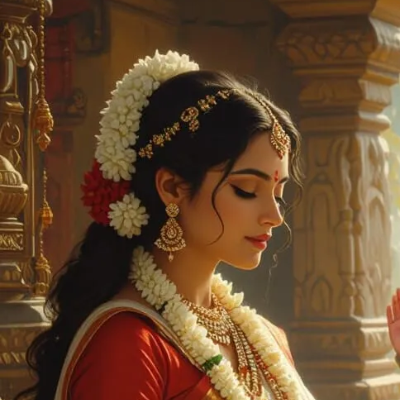
About
Kayadhu — Wife of Hiranyakashipu, Mother of Prahlada, Pupil of Narada
Kayadhu · Kayādhu · Kayādhū · Dānavi · Hiranyakashipu-patni · Prahlada-mata · Narada-shishya
Kayadhu is the wife of Hiranyakashipu — the great Daitya king — and the mother of Prahlada, the supreme devotee of Vishnu. She is the daughter of the Danava king Jambha — and thus a descendant not of the Daitya line (Kashyapa and Diti) but of the Danava line (Kashyapa and Danu) — making her marriage to Hiranyakashipu a union across the two great Asura clans. She is described in the Bhagavata Purana as sinless, virtuous, and devoted in character — an extraordinary designation for a figure born into the Danava lineage and married into the Daitya household. Her most celebrated episode is her captivity by Indra during Hiranyakashipu's penance, her protection by Narada, and her time in Narada's hermitage — during which her unborn son absorbed the divine teachings that shaped him into the greatest devotee in all of Puranic literature. She is one of the few figures in the tradition whose virtue is explicitly affirmed by a divine sage against the explicit intentions of the king of the gods. The Sastra Caksusa source records additionally that she always protested Hiranyakashipu's hatred towards Vishnu — a consistent and quiet opposition that the primary texts do not elaborate but do preserve.
✦ The Name
The Sanskrit name Kayadhu — written as Kayādhu or Kayādhū in the Devanagari sources — is recorded in the Bhagavata Purana (6.18.12) in the form hiraṇyakaśiporbhāryā kayādhurnāma dānavī — the wife of Hiranyakashipu, named Kayadhu, a Danavi. The epithet Dānavi — feminine of Dānava — is significant: it explicitly identifies her as belonging to the Danava clan (descendants of Danu) rather than the Daitya clan (descendants of Diti). She is also known in regional traditions as Leelavati — a name recording her graceful, devoted character. The Wisdomlib entry records a minority gloss from the commentaries on the Taittiriya Brahmana in which Kayadhu is identified as the wife of Kashyapa rather than of Hiranyakashipu — a variant not supported by the primary Puranic texts and almost certainly the result of a transmission error conflating her with one of Kashyapa's wives in the genealogical lists.
✦ Lineage
- Father: Jambha — a Danava king, son of Kashyapa and Danu; the great antagonist of Indra; ultimately slain by Indra in the Devasura wars; one of the Danavas named in the Rigveda's earliest enemy lists alongside Vrita, Namuchi, and Shambara
- Lineage: Danava — descendant of Danu, the mother of the Danavas and wife of Kashyapa; thus Kayadhu's grandfather through her father's line is Kashyapa himself — making her a granddaughter of the same Prajapati who is her husband's grandfather, and a cousin of her husband's lineage across two generations
- Husband: Hiranyakashipu — Daitya king, son of Kashyapa and Diti, first incarnation of the Vaikuntha gatekeeper Jaya, slain by the Narasimha avatar of Vishnu
- Sons: Samhlada (eldest per Bhagavata Purana 6.18.12 — listed first), Anuhlada, Hlada, and Prahlada (youngest, the supreme devotee); the Vaniquotes source records the birth order exactly as given in the Bhagavata Purana: Samhlada, Anuhlada, Hlada, Prahlada
- Daughter: Simhika — who married the Daitya Viprachitti and became the mother of Rahu and Ketu; per the Bhagavata Purana version (see Holika profile above for the textual complexity of Simhika's genealogy)
- Grandson: Virochana — son of Prahlada
- Great-grandson: Mahabali — son of Virochana; the magnanimous Asura king subdued by the Vamana avatar
✦ The Marriage — Not Willing in One Tradition
The Sastra Caksusa source records a tradition — not found in the primary Bhagavata Purana account but preserved in the regional Puranic tradition summarised there — that Kayadhu had not married Hiranyakashipu willingly. After becoming king of the Asuras, Hiranyakashipu had attacked Naga Loka. In the course of his conquests he encountered Kayadhu and compelled the marriage. This tradition, if accepted, adds a dimension of involuntary circumstance to Kayadhu's position in the Daitya household — she was the daughter of a Danava king, married against her inclination to a Daitya tyrant, and yet maintained her virtue and devotion throughout. The primary Bhagavata Purana text does not record this detail, describing her simply as Hiranyakashipu's wife without elaborating the circumstances of the marriage.
✦ Indra's Abduction — The Central Episode
While Hiranyakashipu was performing his immense penance on Mount Mandara, Indra and the Devas seized the opportunity to attack the Daitya capital. The attack succeeded — the kingdom fell briefly to the Devas. Indra seized Kayadhu, who was pregnant at the time, and began to drag her away. The Bhagavatam-katha source records the exchange in detail. Indra's stated intention was not to kill Kayadhu but to kill the child she was carrying. He told Narada: I intend to kill the child she is bearing — we cannot withstand the troubles Hiranyakashipu has been giving us — if I allow his family line to continue, the world will be in great danger. Narada intervened. He told Indra that killing a helpless child was a great sin, and that the child in Kayadhu's womb was already destined to be a great devotee of Vishnu — not a destroyer of the world. Narada declared Kayadhu sinless. Indra, persuaded by Narada's authority, released her. Narada then took Kayadhu under his personal protection and brought her to his hermitage — identified in the Sastra Caksusa source as the ashram of Sage Madhuchanda.
✦ In Narada's Hermitage — The Teachings and the Womb
Kayadhu lived in Narada's hermitage through the remainder of her pregnancy. The Bhagavatam-katha source records the quality of that environment precisely: great sages held discourses on righteous living and the greatness of Vishnu; Kayadhu was ensured a seat near them and listened. Narada would sometimes speak to her privately, teaching her the nature of dharma, devotion, and knowledge. The shastras emphasise — as the source records — that pregnant women living in sacred environments allow the atmosphere to positively influence the unborn child. Kayadhu would occasionally fall asleep during Narada's discourses. But the child in her womb remained awake and absorbed every word, drawing out the inner meanings of what Narada taught. Kayadhu forgot much of what she heard — but Prahlada remembered everything. He was named by Narada himself at his birth, which was accompanied by numerous good omens. This is the theological mechanism of Prahlada's devotion: not taught to him in childhood by a guru, not discovered through his own seeking, but absorbed before birth through the medium of his mother's body — Kayadhu as the vessel through which divine instruction passed into the world's greatest devotee.
✦ Return to the Palace — Silent Witness to the Conflict
When Hiranyakashipu returned from Mandara with his boon, he retrieved Kayadhu and the infant Prahlada and brought them back to the Daitya palace. The Sastra Caksusa source records that Kayadhu always protested her husband's hatred towards Vishnu — but that Hiranyakashipu never listened. The Bhagavatam-katha source records: she could not prevent any of it, for Hiranyakashipu never listened to her. This detail — sparse as it is — establishes Kayadhu as a consistently dissenting presence within the household: a Danavi who had absorbed enough of Narada's teaching to recognise the injustice of Hiranyakashipu's campaign against their son, and who maintained her opposition silently and without avail throughout. The Bhagavata Purana does not record her fate after Hiranyakashipu's death. She presumably lived on in the Daitya household and witnessed Prahlada's accession to the throne, but no further canonical episode involves her by name.
✦ Kayadhu's Father Jambha — The Defeated Danava
The Manastaramgini source — drawing on Vedic and Puranic genealogical research — confirms that Kayadhu's father Jambha was a Danava king slain by Indra. The Mahabharata's Vanaparva records an early Vaishnavabhaya stuti that lists Jambha among the great enemies of the gods — alongside Vrita, Shambara, and Namuchi — as one of the Danavas destroyed in the cosmic wars. The Bhagavata Purana (4.18.12) records Kayadhu's parentage precisely: daughter of Jambha, a Danava, and thus a descendant of Danu. Jambha's death at Indra's hands — likely before or during Hiranyakashipu's reign — may explain why no mention is made of Kayadhu's natal family after the Prahlada story begins: her father's line had been broken by the same Deva forces her husband was fighting.
✦ Theological Significance
Kayadhu's role in the Prahlada narrative is that of the unconscious or semi-conscious sacred vessel — the medium through whom divine grace descended without her full awareness. She heard the teachings. She absorbed them imperfectly. She forgot much. But her body remembered what her mind could not hold — and in that act of bodily remembering, in the physical transmission of Narada's words through the walls of the womb to the consciousness of an unborn child, the tradition records one of its most precise statements about the nature of grace: that it does not require complete understanding to operate; that it flows through imperfect channels and incomplete hearers; that the most devoted being in all of creation came into the world not through the perfect saintliness of his mother but through her ordinary, fallible, sleeping presence in a place where sacred words were being spoken.
✦ References
- Bhagavata Purana — 6.18.12–13 (the primary locus classicus): hiraṇyakaśiporbhāryā kayādhurnāma dānavī — Kayadhu named as wife of Hiranyakashipu and Danavi; her four sons named in order as Samhlada, Anuhlada, Hlada, Prahlada; daughter Simhika named; Canto 7, Chapters 5–8: the abduction by Indra, Narada's intervention, her time in the hermitage, Prahlada's prenatal absorption of Narada's teachings, the birth of Prahlada
- Vishnu Purana (Book 1, Chapter 17) — Hiranyakashipu's wife described; the penance, the Deva attack, Narada's protection of the pregnant queen
- Taittiriya Brahmana commentary (Monier-Williams Sanskrit-English Dictionary gloss and Cologne Digital Sanskrit Dictionaries) — minority variant identifying Kayadhu as wife of Kashyapa; recorded but not supported by primary Puranic texts
- Ramayana — Uttarakanda: allusion to Indra capturing the wife of Hiranyakashipu; one of the earliest textual references to the episode
- Manastaramgini (scholarly blog, July 2013) — Bhagavata Purana 4.18.12 cited; Kayadhu as daughter of the Danava Jambha who was killed by Indra; the Vedic roots of Prahlada's matronym
- Wikipedia — Prahlada and Hiranyakashipu; Vaniquotes — Bhagavata Purana 6.18.12-13; Wisdomlib — Kayadhu (seven definitions); Sastra Caksusa — Kayadhu the Saintly Mother of Prahlada; Bhagavatam-katha — Narada Teaching Prahlada in Kayadhu's Womb; Grokipedia — Hiranyakashipu: modern summaries drawing from the above primary sources