
About
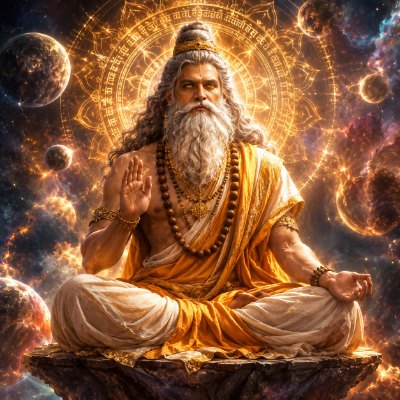
Kashyapa — Father of All Living Beings, Chief Prajapati, Progenitor of the Universe
Kashyapa · Prajapati Kashyapa · Kashyapa Muni · Arishtanemi (in the Ramayana) · Kashyapa Marichi · Saptarishi · Devapita · Asuropita · Sarvabhutapita
Kashyapa is the foremost Prajapati — the divine progenitor from whose marriages to the daughters of Daksha sprang every category of living being in the universe: the Devas, the Asuras, the Daityas, the Danavas, the Nagas, the Garudas and all birds, the Yakshas, the Rakshasas, cattle, and all animals. He is one of the Saptarishis — the seven great sages of the Rigveda — and the most widely acknowledged progenitor in the entire Puranic tradition. The Valmiki Ramayana, the Vishnu Purana, the Mahabharata, and the Agni Purana all declare that every living being visible in the world today traces its origin to Kashyapa through his various wives. The Mahabharata's Shanti Parva (Chapter 297, verse 17) records that all living beings belong to one of four original gotras — those of Angiras, Kashyapa, Bhrigu, and Vasishtha — and that all other gotras arose subsequently from these. Kashyapa's gotra is thus one of the four roots of all human lineage. He was subsequently reborn — through the consequence of a curse over a stolen divine cow — as Vasudeva, the father of Krishna.
✦ The Name
The Sanskrit word Kashyapa means tortoise or turtle. Michael Witzel connects it to Avestan kasiiapa, Sogdian kyshph, Kurdish kusi, and New Persian kashap — all meaning tortoise — tracing the word to a non-Indo-European substrate. Frits Staal agrees the word means tortoise but considers it a pre-Indo-European borrowing. The tortoise connection links Kashyapa symbolically to the Kurma avatar of Vishnu — the cosmic tortoise who supported Mount Meru during the Samudra Manthana — and to the foundational, supporting, patient quality of one who bears the entire world of living beings upon his back. The Divine Hindu source offers an alternate derivation from kash — to shine — yielding the meaning the illuminating one. In the Ramayana he is referred to as Arishtanemi. He is called Sarvabhutapita — father of all living beings.
✦ Origin — Son or Grandson of Brahma
The tradition presents a well-acknowledged inconsistency on Kashyapa's parentage. The Mahabharata's Adi Parva (Chapter 65) records six spiritual sons born from Brahma — Marichi, Angiras, Atri, Pulastya, Pulaha, and Kratu — and states that Kashyapa was born as the son of Marichi, making him Brahma's grandson. This is the most widely accepted genealogical position across the Puranic tradition. However, the Valmiki Ramayana's Aranyakanda (Sarga 14) records an account of creation in which Kashyapa is listed as the youngest brother of Marichi, Atri, Pulastya, and the others — making him Brahma's direct son. The Puranic Encyclopaedia (Vettam Mani) notes this ambiguity and concludes: there is nothing wrong in regarding him as either the son or the grandson of Brahma, since the tradition itself uses both designations. Some later texts, apparently aware of both versions, identify multiple personalities named Kashyapa corresponding to different genealogical layers of the tradition. His mother is recorded as Kala — daughter of Daksha and wife of Marichi — in those texts that hold him to be Marichi's son.
✦ The Three Successive Births — Cosmic Itinerary
The Mahapurana records Kashyapa's existence across three successive cosmic lives — a span across three Manvantaras that places him among the longest-running individual figures in the tradition. In the Chakshusha Manvantara he was the sage Sutapas, married to Prishni. Together they meditated for twelve thousand years with pure devotion to Vishnu. Vishnu appeared before them and asked them to seek a boon. Prishni asked for a son like Vishnu himself. Vishnu promised to be born as their son in three successive lives. He was first born to them as Prishnigarbha — a partial manifestation. In the Vaivasvata Manvantara that followed, Sutapas and Prishni were reborn as Kashyapa and Aditi, and Vishnu was born to them as Vamana — the dwarf avatar. Then, in the twenty-eighth Dvapara Yuga of the Vaivasvata Manvantara, Kashyapa and Aditi — along with a third wife Surasa — were reborn as Vasudeva, Devaki, and Rohini respectively, and Vishnu was born to them as Krishna. Across three separate lives, the same sage and his wife received the same divine son in progressively fuller forms.
✦ The Curse of Varuna and Brahma — The Path to Vasudeva
The occasion of Kashyapa's final mortal rebirth is described with slight variations across the Devi Bhagavata Purana, the Bhagavata Purana, and the Manuscrypts tradition. Kashyapa performed a great yajna in his hermitage. For the offerings of milk and ghee required, he borrowed a divine cow from Varuna, who stipulated its return after the yajna. The yajna lasted many days and the divine cow's miraculous capacity captivated Kashyapa. When it was over, he refused to return the cow — overcome with desire for permanent ownership of so extraordinary an animal. Varuna sought Brahma's intervention. Brahma appeared before Kashyapa and warned him that greed would destroy all his virtues. Kashyapa remained firm. Brahma cursed him to be born on earth as a cowherd. In one version, Varuna directly cursed Kashyapa and his wives Aditi and Surasa — who had been complicit in hiding the cow — to be born in Gokul as cowherds. Kashyapa repented, and Brahma, recognising his own haste, softened the curse: Kashyapa would be born as a cowherd in the Yadava clan, but Vishnu would be born as his son. Thus in the twenty-eighth Dvapara Yuga, Kashyapa was born as Vasudeva, Aditi as Devaki, and Surasa as Rohini — and Vishnu descended as Krishna.
✦ His Twenty-One Wives
The Puranic Encyclopaedia (Vettam Mani), after analysing all the epics and Puranas, concludes that Kashyapa had twenty-one wives — of whom thirteen were daughters of Daksha. The complete list is: Aditi, Diti, Danu, Arishta, Surasa, Khasha, Surabhi, Vinata, Tamra, Krodhavasha, Ira, Kadru, Muni (all daughters of Daksha) — and additionally Puloma, Kalaka, Nata, Danayus, Simhika, Pradha, Vishva, and Kapila. The Ramayana records only eight daughters of Daksha married to Kashyapa (Aditi, Diti, Danu, Tamra, Krodhavasha, Muni, Surasa, and Vinata with Kadru through Krodhavasha as a granddaughter). The Vishnu Purana records thirteen. The Mahabharata records thirteen but with some differing names. The Puranic Encyclopaedia reconciles all versions into the twenty-one figure. He is also recorded in the Hindu Blog as having married Asikni — daughter of Virana — through whom he begot Narada, and as being the father of Vatsara and Asita by other wives.
✦ Children by Each Wife — The Full Taxonomy of Life
By Aditi — the twelve Adityas: Vishnu, Shakra (Indra), Aryama, Dhata, Mitra, Varuna, Bhaga, Vivasvan (Surya), Pusha, Savita, Tvashta, and Amsha. From Aditi and Kashyapa was also born Vamana — the dwarf avatar of Vishnu — a thousand years after the other Adityas, per the Mahabharata (Vana Parva 272.62 and Anushasana Parva 83.25–26) and the Ramayana (Sarga 29). From the twelve Adityas descended thirty-three crore (330 million) Devas.
By Diti — the Daityas, chief among them Hiranyakashipu and Hiranyaksha (who in their next births became Ravana and Kumbhakarna, and in their third births Shishupala and Dantavaktra — all slain by successive avatars of Vishnu); also Simhika and all other major Daityas. Diti also had a late-born son by Kashyapa, conceived through intense penance — intended to be a destroyer of Indra — but Indra entered the foetal form and split it into forty-nine pieces; these became the forty-nine Maruts (storm gods).
By Danu — the Danavas: Dwimurdha, Shambara, Ayomukha, Shankashiras, Kapila, Shankara, Ekachakra, Mahabahu, Taraka, Mahabala, Svarbhanu, Vrishaparva, Puloma, and Viprachitti among the most celebrated; all other Danavas evolved from them.
By Kadru — the thousand Nagas (serpents), foremost among them Shesha (Ananta), Vasuki, Takshaka, Airavata, Karkotaka, and Dhananjaya. The Nagas became venomous after Kadru cursed those among her sons who refused to blacken Uccaishravas's tail in her deceptive bet with Vinata. Brahma gave Kashyapa the knowledge of curing snake-poison (vishasamhara) after this curse, so that humanity could be protected from venomous bites — this is recorded as the origin of snakebite treatment in the world.
By Vinata — two sons: Aruna (the charioteer of the sun; prematurely hatched by Vinata in her impatience, resulting in Aruna's incomplete lower body) and Garuda (the mighty eagle-king, vehicle of Vishnu, supreme enemy of the Nagas).
By Surabhi — Aja, Ekapad, Ahirbudhnya, Tvashta, and Rudra; and also the eleven Ekadasha Rudras: Hara, Bahurupa, Tryambaka, Aparajita, Vrishakapi, Shambhu, Kapardi, Raivata, Mrigavyadha, Sarpa, and Kapali.
By Tamra — five daughters: Krounchi, Bhasi, Shyeni, Dhritarashtri, and Shuki — from whom came the various orders of birds, owls, falcons, eagles, and parrots.
By Krodhavasha — eight daughters; and from those daughters came many species of the animal kingdom; one of her daughters was Kadru in the Ramayana's alternate genealogy.
By Muni — the Apsaras (celestial dancers).
By Arishta — the Gandharvas (celestial musicians).
By Ira — herbs, trees, creepers, and plants; the vegetable kingdom.
By Khasha — Yakshas and Rakshasas.
By Surasa — the Nagas of a particular order; she was reborn as Rohini, wife of Vasudeva.
By Pradha — Apsaras, Gandharvas, and celestial singers.
By Simhika — Rahu and other powerful beings; Simhika is the mother of the demon who seized the moon during the Samudra Manthana and was beheaded by Vishnu's Sudarshana Chakra, his separated head becoming Rahu and his body becoming Ketu.
By Kapila — the Kinnaras and Gandharvas of a different order.
By Puloma and Kalaka — the Paulomas and Kalakanjas — a tribe of fierce Asuras who were later subdued by Arjuna during his sojourn in Indra's heaven.
✦ The Garuda Episode — Kashyapa on the Gandhamadana
The Mahabharata's Adi Parva (Chapters 29–32) records that when Garuda set out to steal the Amrita from Devaloka to free his mother Vinata from Kadru's bondage, he stopped on the way to visit his father Kashyapa — who was performing penance on the Gandhamadana mountain. Garuda, hungry after an immense journey, asked his father if there was food. Kashyapa narrated the story of two ancient sages, the brothers Vibhavasu and Supratika, who had been cursed to become an elephant and a tortoise after a quarrel over inheritance. He directed Garuda to find this enormous elephant and tortoise — fighting forever in a great lake — and eat them. Garuda found them, lifted both the fighting elephant and the tortoise simultaneously in his claws, perched on a gigantic fig tree to eat — the tree's branches broke under the combined weight — and held both animals in his beak while repositioning. He then consumed them both and proceeded to heaven to steal the Amrita.
✦ The Kadru-Vinata Conflict — Kashyapa's Household
The Brahma Purana records a domestic episode in Kashyapa's household involving Kadru and Vinata. Kashyapa, before departing on an errand, warned his wives not to leave the house or they would get into trouble. Both Kadru and Vinata disobeyed, went to the Ganga's banks where sages were performing sattra rites, and disturbed the ceremonies. Enraged, the sages cursed both wives to become rivers. Kashyapa returned and learned what had occurred. On the sages' advice, he performed penance to Shiva at Gautami Ganga, reciting a hymn praising Shiva's triple nature. Shiva restored both wives and blessed them to bear children again through the grace of Ganga. Subsequently, during their hair-parting ceremony of pregnancy (the Seemantonnaya), when Kashyapa had fed the invited sages and stood before them with his wife to thank them, Kadru looked at the sages with a sly glance. The sages cursed her to lose that eye — and Kadru became one-eyed.
✦ Brahma Teaches Kashyapa the Cure for Snakebite
When Kadru's sons — those Nagas who had obeyed her deceptive instructions to blacken Uccaishravas's tail — had done so, Kadru cursed those who refused, prophesying their death at Janamejaya's Sarpa Satra. The venomous nature of the Nagas thereafter became a danger to all living beings. Brahma appeared before Kashyapa after this curse and informed him that the curse was necessary and appropriate — since the Nagas had become menaces to the world. However, to protect those who would be bitten by venomous snakes, Brahma taught Kashyapa the complete knowledge of vishasamhara — the counteraction of snake-poison. The Mahabharata's Adi Parva (Chapter 20) records this as the origin of snakebite treatment in human history.
✦ Parashurama's Gift of the Earth
After Parashurama had circumambulated the earth eighteen times and exterminated all the Kshatriya kings, he performed an Ashvamedha Yajna. As the Gurudakshina (sacrificial fee) for that yajna, he gave the entire earth — all the lands he had conquered — to Kashyapa. This is recorded in the Mahabharata's Aranya Parva (Chapter 117). Kashyapa then directed Parashurama — who had nowhere on earth to live, since he had given away all the land — to go south to where the ocean could give him space. The ocean parted and gave Parashurama a coastal strip called Shurparaka. But even that land Kashyapa took back and gave to Brahmins. Parashurama went to the forests thereafter. In a consequence recorded in the Shanti Parva (Chapter 49), the region began to sink into the underworld due to the absence of Kshatriyas to govern it. Kashyapa, observing this, held the land up and brought Kshatriyas from the north to rule it — stabilising the region. Kashyapa's connection to Kerala through this narrative is elaborated in the Manuscrypts tradition: the land Parashurama reclaimed from the sea (a tradition associated with the Kerala coast) is said to have come under Kashyapa's administration and ultimately his domain. Some traditions identify Kashyapa as the deity who drained the original lake in the Kashmir Valley, and the name Kashmir itself is derived from Kashyapa Mira (Kashyapa's lake) or Kashyapa Meru (Kashyapa's mountains).
✦ In the Rigveda and as Saptarishi
Kashyapa is one of the Saptarishis — the seven great sages considered the authors of the Rigveda's hymns and the founders of the Vedic tradition. He and his lineage are credited with composing the second verse of Rigveda 10.137, and numerous hymns in the eighth and ninth Mandalas — including Rigveda 9.114.2, a hymn in praise of Soma. He is called a mantra-drashta — a visionary of Vedic mantras — across multiple traditions. The Brihadaranyaka Upanishad's colophon verse lists him as the most ancient and venerated rishi. The Atharvaveda (Book 19, Hymns 51–53) contains references to him. The Gopatha Brahmana (1.2.8) records that Kashyapa stood on one leg for a thousand years in the forest, supported the immortal waters on his head for another thousand years, and then heated himself for 48,000 Brahma years on top of the waters — an account of austerity without parallel in the tradition. He is also one of the Saptarishis presiding over the current seventh Manvantara — the Vaivasvata Manvantara — in progress now.
✦ Kashyapa and the Curse of Shiva on Surya
The Vedic Feed source records an episode in which Surya — the sun god, Kashyapa's own son by Aditi — grew arrogant. Shiva, angered, killed Surya with his trident. Kashyapa, witnessing the death of his son at Shiva's hands, cursed Shiva in turn — declaring that since Shiva had killed the son of one who had done him no wrong, Shiva would be forced to behead his own son. This curse was later fulfilled when Shiva beheaded Ganesha — and then replaced his head with an elephant's. This episode positions Kashyapa as a figure of such spiritual authority that even Shiva was not immune to the consequences of his curse.
✦ Cosmic Significance — The Universal Father
Kashyapa's position in the tradition is unique: he is the singular figure through whom the entire biological diversity of the universe — gods, demons, serpents, birds, animals, humans, plants — is explained as a single cosmic family. Every being in creation is, through one line or another, his descendant. The Devas and Asuras are half-brothers; the Nagas and Garudas are half-brothers — the great enmity between them arising from their mothers' rivalry within the same household. The entire moral drama of the Puranas — the wars between Devas and Asuras, the twelve labours of Vishnu's avatars, the fratricidal wars of the epics — is in cosmic terms a family conflict within Kashyapa's household. His cosmic role is thus not merely biological but theological: he is the hinge-point at which the spiritual world and the material world, the divine and the demonic, the celestial and the terrestrial are all held together in one genealogical web.
✦ Texts Attributed to Kashyapa
- Kashyapa Samhita (also called Vriddha Jivakiya Tantra or Jivakiya Tantra) — a classical Ayurvedic text on paediatrics, gynaecology, and obstetrics; the foundational text of Kaumarabhritya (paediatric medicine)
- Kashyapa Jnanakanda — a 9th-century text in the Vaishnava tradition
- Kashyapa Dharmasutra — an ancient lost treatise on dharma; referenced in multiple medieval texts
- Kashyapa Sangita — an ancient lost treatise on music in the Shaiva tradition
- Kashyapa Silpa (also called Amsumad Agama or Silpa Shastra of Rishi Kashyapa) — a text on Hindu temple architecture, iconography, and artistic decoration
- Rigveda hymns — second verse of Mandala 10.137; hymns in Mandala 9 (Soma Pavamana hymns) — Rigveda 9.114.2 most cited
✦ In Buddhism
The Buddha, in the Tevijja Sutta of the Digha Nikaya, names ten great rishis as the original sages and makers of ancient Vedic verses still chanted in his era — and Kassapa (the Pali form of Kashyapa) is among them. The Buddha treats him as a figure of historical and textual antiquity, not legend. Three Buddhas in Buddhist cosmology bear the name Kassapa — the most recent being the immediate predecessor of the historical Shakyamuni Buddha — though these are separate figures from the Hindu sage.
✦ References
- Rigveda — Mandala 9 (Soma Pavamana hymns including 9.114.2); Mandala 10.137.2; listed as one of the ten great rishis in the Brihadaranyaka Upanishad colophon verse
- Atharvaveda — Book 19, Hymns 51–53: references to Kashyapa
- Gopatha Brahmana (1.2.8) — the description of Kashyapa's extraordinary tapas across immeasurable years
- Brihadaranyaka Upanishad — lists Kashyapa as the most ancient of the seven Saptarishis in the colophon verse; describes him as a self-made scholar in the Atharvaveda
- Valmiki Ramayana — Bala Kanda, Chapter 29: declares all living beings as Kashyapa's offspring; Aranyakanda, Sarga 14: Kashyapa as youngest brother of the Saptarishis (son of Brahma version); Uttarakanda: Garuda's visit to Kashyapa on the Gandhamadana
- Mahabharata (Vyasa) — Adi Parva, Chapters 16 and 65: Kashyapa as son of Marichi; his twenty-one wives and their offspring; the Garuda-elephant-tortoise episode (Chapters 29–32); the cure for snakebite (Chapter 20); Aranya Parva, Chapter 117: Parashurama's gift of the earth to Kashyapa; Shanti Parva, Chapter 49: Kashyapa stabilising the south by bringing Kshatriyas; Shanti Parva, Chapter 297, verse 17: the four original gotras
- Vishnu Purana (Book 1, Chapters 15–21) — the thirteen wives of Kashyapa; the complete taxonomy of offspring by each wife
- Vayu Purana — Kashyapa as father of Devas, Asuras, Yakshas, Daityas, and all living creatures
- Agni Purana (Chapter 18) — all living beings as descendants of Kashyapa
- Devi Bhagavata Purana (Skanda 4) — the three successive births: Sutapas-Prishni, Kashyapa-Aditi, Vasudeva-Devaki; the curse of Varuna and Brahma over the stolen cow
- Bhagavata Purana — Canto 10: Krishna's birth to Vasudeva (Kashyapa reborn) and Devaki (Aditi reborn); Vamana avatar born to Kashyapa and Aditi; the Diti-Maruts episode
- Brahma Purana — the Kadru-Vinata domestic conflict; Kashyapa's penance to Shiva for restoration of his wives
- Puranic Encyclopaedia (Vettam Mani) — reconciliation of the twenty-one wives; the three successive births; the gift of earth by Parashurama; the Garuda episode; the snakebite cure
- Digha Nikaya (Tevijja Sutta) — the Buddha names Kassapa among the ten great original Vedic sages
- Wikipedia — Kashyapa; Vyasa Mahabharata — Kashyapa; Vedic Feed — Kashyap Rishi; ISVARA.org — Kasyapa Muni; Wisdomlib — Story of Kashyapa; Manuscrypts — Kashyapa (1); Divine Hindu — Sage Kashyapa; Mahapurana — Kasyapa: modern summaries drawing from the above primary sources