
About
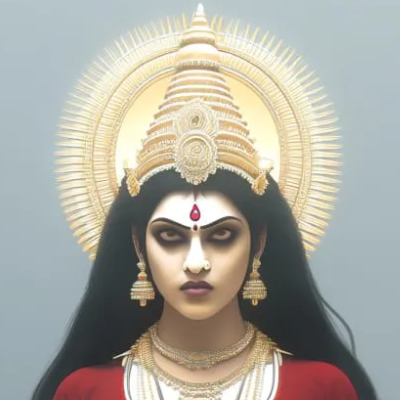
Diti — Mother of the Daityas and Cosmic Rival of the Gods
Diti · Daityanamata · Dakshakanya · Kashyapapatni
Diti is a daughter of Daksha, the great progenitor lord and one of the Prajapatis appointed by Brahma to oversee the multiplication of living beings, and of his wife whose name varies across sources — Panchajani in some Puranas, Prasuti in others. She is one of the thirteen daughters of Daksha given in marriage to the primordial sage Kashyapa, who is a grandson of Brahma through the seer Marichi and who serves as the progenitor of virtually every category of being in the cosmos through his many wives. Diti is the mother of the Daityas — the great race of anti-gods who stand in perpetual opposition to the Adityas, the gods born of Diti's sister Aditi. Her sons Hiranyakashipu and Hiranyaksha are among the most prominent Daityas in the entire Puranic tradition, and the narratives arising from their actions occasion two of the most celebrated avatars of Vishnu. Diti appears prominently in the Vishnu Purana, the Bhagavata Purana, the Matsya Purana, the Mahabharata, and numerous other texts.
✦ The Name
The name Diti is most naturally understood as the counterpart and structural opposite of Aditi. Where Aditi signifies the boundless, the uncut, the infinite — derived from the negative prefix a and the root da — Diti signifies the bounded, the limited, and the defined. The name thus encodes the theological relationship between the two sisters at the level of language itself: Aditi is the infinite cosmic matrix, and Diti is the finite, conditioned world of individual beings whose greatness is real but circumscribed. Some commentators have further connected the name to the root di, meaning to shine or to cut, suggesting the sense of that which is separated or individuated. The patronymic Dakshakanya marks her as a daughter of Daksha, and Daityanamata means "mother of the Daityas."
✦ Lineage
- Father: Daksha — a Prajapati and primordial lord of creation, son of Brahma, charged with populating the cosmos. One of the most significant patriarchal figures in the Puranic genealogical tradition and the father of a large number of daughters given in marriage to sages and divine beings.
- Mother: The name varies by source. The Vishnu Purana refers to Panchajani as mother of Daksha's daughters in one passage; the Bhagavata Purana names Prasuti, herself a daughter of Svayambhuva Manu and Shatarupa, as Daksha's wife and the mother of his daughters including Diti. The Mahabharata refers elsewhere to Virani. These are variant traditions representing different textual strata.
- Siblings: Diti is listed alongside twelve or more sisters as daughters of Daksha and co-wives of Kashyapa. Her most significant sibling in narrative terms is Aditi — mother of the Adityas including Indra, the lord of heaven — whose sons stand in permanent cosmic opposition to Diti's own. Other sisters include Danu (mother of the Danavas), Kadru (mother of the Nagas or serpent beings), Vinata (mother of Garuda and Aruna), Surasa, Muni, Krodhavasha, Surabhi, Tamra, Ira, Timi, and Arishta, among others named in the Vishnu Purana and Bhagavata Purana.
- Spouse: Kashyapa — a primordial seer of the highest rank, counted among the seven great Saptarishis, and grandson of Brahma through the sage Marichi. Through his many wives he fathers the full range of living beings. Diti is among his principal wives.
- Sons:
- Hiranyakashipu — the eldest and most celebrated of the Daityas, a figure of immense power and pride who forbids the worship of Vishnu within his kingdom and is ultimately destroyed by Vishnu in the Narasimha (man-lion) avatar. His story forms the core of Bhagavata Purana Book 7.
- Hiranyaksha — the younger of the two great Daitya brothers, who drags the earth goddess to the bottom of the cosmic ocean; Vishnu descends as the Varaha (boar) avatar to slay him and retrieve the earth. His episode is narrated in Bhagavata Purana Book 3 and in the Vishnu Purana.
- Daughter (contested): The Bhagavata Purana identifies Simhika — a female demon who becomes the mother of Rahu, the eclipse-causing demon — as a daughter of Diti and Kashyapa, though this attribution is not universal across sources.
- The Maruts (variant account): An episode narrated in the Vishnu Purana, Bhagavata Purana, and Mahabharata records a later attempt by Diti to conceive a son who would kill Indra. This episode is narrated in full below. Its outcome — the transformation of the embryo into the forty-nine or sixty Maruts, the storm deities — is presented in some texts as giving Diti additional offspring of a transformed kind, though they serve Indra rather than opposing him.
✦ The Inauspicious Request and the Birth of Hiranyakashipu and Hiranyaksha
The Bhagavata Purana, in its third book, narrates the circumstances under which Diti's two great sons came into being. Diti, overcome by desire, approached her husband Kashyapa at an inauspicious hour — the twilight hour of the evening, a time specifically prohibited by Vedic injunction for conjugal relations, as it belongs to the malevolent beings who roam at dusk. Kashyapa, recognising the transgression but unable to refuse, warned Diti of the consequences and performed what purificatory rites he could, but the act had already violated the sanctity of the hour. The sage warned that the sons conceived at such a time would be mighty but destructive, and that they would cause suffering to the three worlds before being eventually destroyed by Vishnu himself. The sons born of this union were Hiranyakashipu and Hiranyaksha, whose careers of cosmic devastation and ultimate destruction at the hands of Vishnu's avatars form the central content of the Puranic cycles concerning the Daityas. This episode functions in the Bhagavata Purana as a causal explanation for the appearance of the anti-gods in the world: they arise not from malice in the parents but from a violation of sacred time, encoding the tradition's view that cosmic disorder has specific ritual and temporal causes.
✦ Diti's Penance and the Episode of the Maruts
Following the deaths of Hiranyaksha and Hiranyakashipu at the hands of Vishnu's Varaha and Narasimha avatars respectively, Diti resolved to obtain another son powerful enough to destroy Indra, the lord of heaven and the son of her sister Aditi. This episode is narrated in the Vishnu Purana, the Bhagavata Purana, and the Mahabharata, with some variations in detail. Diti approached Kashyapa and petitioned him for a son who would defeat Indra. Kashyapa agreed, but stipulated that she must observe an extremely demanding vow of purity for one hundred years — maintaining absolute ritual cleanliness in body, mind, and conduct, eating only pure food, and harbouring no impure thought — before she could bear such a son.
Indra, learning of Diti's intention, adopted a strategy of sabotage. He came to Diti in a guise of filial devotion — presenting himself as her attendant and serving her throughout her penance. For ninety-nine years Diti maintained her vow without failing. In the hundredth year, near the completion of her observance, Indra observed that Diti had fallen asleep with her feet pointing upward and her head pointing downward — an inauspicious and ritually impure posture. Seizing the opportunity, Indra entered Diti's womb with his thunderbolt and severed the embryo into forty-nine pieces. Each piece wept, and Indra commanded them to cease weeping, using the words ma ruda — "do not weep." These fragments became the Maruts, the storm gods who are among the most powerful of Indra's attendant deities and who are counted among the divine hosts in the Rigveda. In this telling, Diti's attempt to produce an Indra-slayer was wholly frustrated, and the very son intended to destroy Indra became instead a troop of Indra's allies. The Mahabharata version of this episode follows the same broad outline, though its details of the embryo's division vary slightly from the Bhagavata account.
✦ Textual Variants and Inconsistencies
The number of Maruts: Different texts give different numbers for the Maruts produced from the severed embryo. The Vishnu Purana and the Bhagavata Purana give forty-nine, which is consistent with a seven-times-seven structure. The Rigveda knows the Maruts as a group of variable size — sometimes twenty-one, sometimes twenty-seven, sometimes sixty. The Mahabharata gives figures that differ from both the Rigvedic and the Puranic counts in different passages. The Puranic tradition's standardisation at forty-nine is not replicated uniformly across all sources.
The Maruts in the Rigveda: In the Rigveda the Maruts are addressed as powerful storm deities and companions of Indra, but their origin from Diti's embryo is not mentioned. The Rigveda describes them as sons of Rudra and the cow Prishni in its own mythological framework. The Puranic derivation of the Maruts from Diti represents a later genealogical synthesis that integrates these originally separate traditions.
The identity of Diti's mother: As with Aditi, the name of Daksha's wife and thus of Diti's mother varies between Panchajani (Vishnu Purana), Prasuti (Bhagavata Purana), and Virani (certain passages of the Mahabharata). No single account is universally adopted.
✦ Theological and Philosophical Significance
Diti functions in the Puranic theological scheme as the cosmic principle of limitation and individuation — the bounded counterpart to Aditi's infinite expanse. Her sons, the Daityas, are not straightforwardly evil in the tradition's own terms: figures such as Prahlada (son of Hiranyakashipu) and Bali (grandson of Prahlada) are celebrated as exemplary devotees of Vishnu, and the tradition consistently presents the Daitya lineage as one capable of supreme spiritual attainment even while their collective role is to challenge and periodically disturb the cosmic order maintained by the gods. The inauspicious hour of their conception and Diti's grief-driven desire for revenge serve the theological function of explaining how beings of cosmic power and genuine merit could simultaneously stand in opposition to the divine governance of the world. The episode of the Maruts further illustrates the tradition's view that even the most determined effort to subvert divine order is ultimately turned back toward that order's own purposes.
✦ Connection to the Wider Genealogy
Diti stands at the root of the entire Daitya lineage that runs through the major Puranic narratives. Through Hiranyakashipu she is the grandmother of Prahlada — the great devotee of Vishnu whose story is among the most beloved in the Bhagavata Purana — and the great-grandmother of Virochana, and the great-great-grandmother of Bali, the Daitya king whose displacement of the gods from heaven occasions Vishnu's Vamana avatar born of Diti's sister Aditi. This means that the Vamana episode involves both great branches of Kashyapa's progeny simultaneously: the Daitya challenger Bali is a descendant of Diti, while the divine avenger Vamana is a son of Aditi. Through her father Daksha, Diti connects to the line of Brahma. Through her husband Kashyapa she is structurally linked to every race of being in the cosmos, as Kashyapa's progeny through his various wives encompass gods, demons, serpents, birds, and all created life.
✦ References
Primary Sources
- Bhagavata Purana, Book 3, chapters 14–19: Contains the foundational account of Diti's inauspicious request to Kashyapa, the warning of consequences, and the birth of Hiranyakashipu and Hiranyaksha, as well as the Varaha episode in which Hiranyaksha is slain.
- Bhagavata Purana, Book 6, chapters 17–19: Narrates Diti's penance to obtain a son to destroy Indra, Indra's infiltration, the severing of the embryo, and the transformation of the fragments into the Maruts. Also provides the full list of Daksha's daughters as wives of Kashyapa.
- Bhagavata Purana, Book 7: Narrates the career of Hiranyakashipu, his persecution of his son Prahlada, and his destruction by Narasimha, providing the richest account of Diti's most prominent son.
- Vishnu Purana, Book 1, chapters 15, 21, and 22: Lists Diti among Kashyapa's wives, narrates the birth of Hiranyakashipu and Hiranyaksha, and gives a version of the Marut episode.
- Mahabharata, Adi Parva, sections 65–66: Establishes the genealogical framework of Daksha's daughters and Kashyapa's wives, naming Diti and listing her progeny in the context of the cosmic genealogy.
- Mahabharata, Udyoga Parva and Shanti Parva: Further references to the Daitya lineage and to Diti's role as mother of the race of anti-gods.
- Rigveda, various hymns to the Maruts: The Rigvedic hymns to the Maruts describe them as sons of Rudra and Prishni, a tradition distinct from the Puranic derivation from Diti's embryo; relevant for establishing the difference between the two traditions.
- Matsya Purana, chapters 6 and 146: Lists Diti among Daksha's daughters and provides a compressed account of her sons.
- Vayu Purana, chapters 67–68: Contains an account of the Daitya genealogy descending from Diti through Hiranyakashipu.
Modern Reference Works
- Vettam Mani, Puranic Encyclopaedia (1975): Entry on Diti; collates all major Puranic references to Diti and her sons, summarises the Marut episode, and notes the key variant accounts.
- A. A. Macdonell, Vedic Mythology (1897): Discussion of the Maruts in the Rigvedic tradition and their Rudra-Prishni parentage, essential for contrasting with the later Puranic account of their origin from Diti.
- Wendy Doniger O'Flaherty, The Origins of Evil in Hindu Mythology (1976): Analyses the mythological explanation for the origin of the Daityas, the role of the violated twilight hour, and the tradition's treatment of anti-divine beings as products of circumstance rather than inherent depravity.