
About
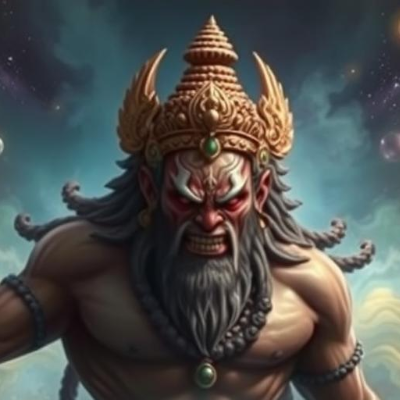
Hiranyaksha — Daitya King, Submerger of the Earth, Slain by Vishnu's Varaha Avatar
Hiranyaksha · Hiranyanetra · Adidaitya · Ditisuta · Kashyapaputra · Andhaka-pita · Varaha-vadhya
Hiranyaksha is the younger twin brother of Hiranyakashipu, born to Kashyapa and Diti in the Satya Yuga. He is the second of the two incarnations of Vijaya — one of the two gatekeepers of Vaikuntha cursed by the Four Kumaras to fall from heaven. He is most celebrated in the tradition for a single cosmic act of supreme transgression: seizing the earth goddess Bhumi and dragging her to the bottom of the primordial cosmic ocean — an act that plunged all of creation into existential crisis and compelled Vishnu to incarnate as Varaha, the cosmic boar, to retrieve her. His death at Varaha's hands, after a thousand-year battle in the depths of the ocean, is the event that triggered his elder brother Hiranyakashipu's vow of revenge — and thus set in motion the entire chain of events leading to the Narasimha avatar and Prahlada's story. In the Shiva Purana, he is the adoptive father of Andhaka — the blind asura destined to be slain by Shiva. He is one of the most cosmologically significant figures in the Puranic tradition: the being whose single act of abducting the earth required God himself to descend and lift it back into place.
✦ The Name
The Sanskrit name Hiranyaksha is formed from hiranya — gold — and aksha — eye. Together: golden-eyed — a name describing the blazing, terrifying golden eyes that the tradition records as one of his most striking physical features. He is also called Hiranyanetra — hiranya (gold) and netra (eye) — a direct synonym used across the Shiva Purana and other texts. His golden eyes are understood in the tradition as a mark of both his extraordinary power and his attachment to wealth and sensory grandeur — the same attachment encoded in his brother's name Hiranyakashipu.
✦ Cosmic Identity — Second Incarnation of Vijaya
As described in the profiles of the Four Kumaras and Hiranyakashipu in this genealogy, Hiranyaksha and Hiranyakashipu are the first mortal incarnations of Jaya and Vijaya — the two gatekeepers of Vaikuntha. After the Four Kumaras cursed them for barring their entry, they chose three births as Vishnu's enemies rather than seven as his devotees. Hiranyaksha is the incarnation of Vijaya. The Bhagavata Purana (Canto 3) narrates that Brahma himself explained to the assembled gods the reason for the cosmic darkness that accompanied the twins' gestation: the two gatekeepers of Vaikuntha had entered Diti's womb, and their immense divine energy was already destabilising creation before their birth. Their underlying nature — as Vishnu's own eternal servants — means that their hostility to the divine is simultaneously an expression of that intimacy: like Hiranyakashipu, Hiranyaksha was always in contact with the divine through the force of his opposition.
✦ Lineage
- Father: Kashyapa — the great Prajapati, son of Marichi, universal progenitor of all living beings
- Mother: Diti — daughter of Daksha; whose desire for a son conceived at the inauspicious dusk hour against Kashyapa's warnings produced the Daitya race
- Elder twin brother: Hiranyakashipu — who survived him by many years and whose vow of revenge for Hiranyaksha's death drove the events of the Narasimha avatar
- Sister: Holika — who had a boon protecting her from fire; burned in the episode of Prahlada's attempted murder; her burning is the origin of the Holi festival — though the primary Puranic texts more often identify Simhika as a daughter of Hiranyakashipu rather than Holika as a sister of both brothers
- Widow: Rushabhanu — wife of Hiranyaksha; the Bhagavata Purana (JKYog source) records that after Hiranyaksha's death, Hiranyakashipu consoled both Rushabhanu and his nephews
- Sons by Rushabhanu (per the Padma Purana and Grokipedia): Jambha, Shaka, Shankha, and several others — Daitya kings who continued their father's campaign against the Devas in subsequent episodes of the Puranas
- Adopted son (per the Shiva Purana): Andhaka — born of Shiva and Parvati, or from Shiva's sweat per different accounts; blind from birth; given by Shiva to Hiranyaksha to raise as his own son since Hiranyaksha had no sons at the time; later became king of the Asuras after Prahlada's reign; ultimately slain by Shiva and made a gana-chief; the Kurma Purana records Andhaka as the natural son of Hiranyaksha
- Cosmic identity: Vijaya — the second of the two gatekeepers of Vaikuntha; whose subsequent births were Kumbhakarna (second birth, slain by Rama) and Dantavaktra (third birth, slain by Krishna)
✦ Birth and Prodigious Strength
The Bhagavata Purana (Canto 3, Chapter 17) records that when the twins were born, the entire universe was shaken. Mountains trembled, the seas churned, blazing meteors fell from the sky, comets streaked across the heavens, earthquakes convulsed the earth, and winds blew with howling violence. The gods, alarmed, appealed to Brahma for an explanation — and Brahma revealed the truth about the fallen gatekeepers who had entered Diti's womb. The twins grew to enormous stature — their frames described as resembling forged steel, their power exceeding all created beings. Hiranyaksha, born into the Daitya lineage as the son of Diti and the sage Kashyapa, exhibited prodigious strength from his youth, growing into a colossal figure whose frame resembled forged steel and whose roars shook the heavens. The JKYog account records that Kashyapa named the elder Hiranyakashipu and the younger Hiranyaksha — and that while Hiranyakashipu eventually received his boon of near-immortality through intense penance, Hiranyaksha was already so powerful that he served as his brother's right hand in the conquest of the three worlds.
✦ Brahma's Boon — The Conditions of Near-Immortality
Hiranyaksha performed severe penance and received a boon from Brahma that he would not be killed by any god, human, Daitya, Asura, or beast. A popular account of his boon records that when listing the beings who could not kill him, he forgot to include the boar — since the boar seemed too insignificant and lowly a creature to be worth mentioning. This omission became the opening through which Vishnu incarnated as Varaha to destroy him. The Bhagavata Purana's account is slightly different — the boon's conditions mirror those granted to Hiranyakashipu, establishing the brothers as a matched pair in their approach to the problem of mortality.
✦ The Campaign of Conquest — Terror Across Three Worlds
Armed with his boon, Hiranyaksha swept through all the celestial realms. The JKYog account drawing from the Bhagavata Purana records that he roamed Svarga, searching for worthy opponents. Indra and the other Devas, unable to face him, hid in fear. When no god dared confront him, he dived into the vast cosmic ocean and spent many years playing in the waters. The ocean itself was disturbed by the force of his presence — waves lashed its shores, storms broke above it. Eventually he reached the underwater capital of Varuna — Vibhavari Puri. There he confronted Varuna directly and challenged him to combat. Varuna, containing his fury with wisdom, declined and directed Hiranyaksha to Vishnu — the only being in creation who could provide the worthy battle he sought. He challenged the sea god Varuna to combat, who redirected him to the more powerful Vishnu. When he heard Vishnu's name, Hiranyaksha felt a strange sensation — the deep instinctive recognition, beneath the surface of his Asura identity, of the being toward whom his soul was inexorably drawn. He set out to find Vishnu.
✦ The Abduction of Bhumi — The Earth Dragged to the Depths
As Hiranyaksha roamed the cosmic ocean in search of Vishnu, he encountered the earth — Bhumi, the earth goddess, also called Prithvi — lying in the cosmic waters. In a spontaneous act of supreme arrogance and disregard for creation, he seized her and dragged her into the deepest layer of the primordial ocean — the Garbhodaka, the dark foundational waters that lie beneath all planes of existence. The Bhagavata Purana (Canto 3, Chapters 13–19) records the immensity of this disruption: without the earth on her axis, the cycle of the yugas could not turn, sacrificial fires could not be lit, crops could not grow, life could not be sustained, and the entire order of creation was suspended. The earth goddess, sinking into the abyss, prayed to Vishnu for deliverance. The gods, in existential terror, approached Brahma. Brahma, understanding what had occurred, directed them to Vishnu.
✦ The Varaha Avatar — The Rescue and the Battle
The Bhagavata Purana records the origin of Varaha in two ways across its narrative tradition: in the earlier Vedic accounts he emerged as a tiny boar from Brahma's nostril and then expanded to cosmic size; in the full Puranic account Vishnu himself took the form of a cosmic boar. The Bhagavata Purana (Canto 3, Chapter 13) describes Varaha's form in extraordinary terms: his body was immense as a mountain, his hide dark as a cloud, his tusks blazing like twin peaks of Dharma, his eyes blazing like lightning, his roar filling all the worlds. The assembled sages praised him with Vedic hymns as he prepared to descend into the Garbhodaka Ocean.
Varaha plunged into the cosmic ocean. In the abyss he found the earth — still, sunken, forgotten. With divine tenderness he lifted her on his tusks and began to carry her upward through the vast darkness. At this point, Hiranyaksha — who had been searching the ocean for Vishnu — encountered Varaha in the act of rescuing the earth. He confronted him with mockery and challenge, demanding that Varaha place the earth under his care and face him in combat instead of running off with a woman. Varaha ignored the challenge, completed lifting the earth to her proper position in the cosmos, and only then turned to face Hiranyaksha.
The battle that followed lasted a thousand years in divine time — measured in the Bhagavata Purana as a prolonged cosmic duel of extraordinary ferocity. The two combatants were matched in the intensity of their power. Varaha engaged in a mace-duel with the demon. Varaha destroyed the demon horde created by the demon's magic with his discus; finally slaying Hiranyaksha by hitting him with his foreleg after the thousand-year battle. As the battle reached its climax, Brahma — watching from above — urged Varaha to end it swiftly before the demoniac night hour arrived, when Hiranyaksha's power would have been at its greatest. The Grokipedia account records the final blow: Varaha pressed the attack, ultimately delivering a resounding slap to Hiranyaksha's right ear with his hand, shattering the demon's skull and causing him to collapse lifeless, his eyeballs protruding in defeat.
✦ After the Death — Varaha and Bhumi
With Hiranyaksha slain, Varaha placed the earth back in her rightful position — stabilising the cosmic order, restoring the cycle of creation, and re-establishing the conditions for life and sacrificial dharma. The Brahmavaivarta Purana records that Varaha and the earth goddess were drawn to each other and their union produced Mangala — the deity of the planet Mars, representing renewed cosmic strength. In another tradition recorded in the Vishnu Purana and Bhagavata Purana, Varaha and Bhumi's union produced Narakasura — the demon later slain by Krishna and Satyabhama (Bhumi's own avatar) during the Dvapara Yuga. The Venkatacala Mahatmya section of the Skanda Purana records that after placing the earth, Varaha set beneath her the world elephants, the serpent Shesha, and the world turtle as support — establishing the cosmological architecture that would sustain the earth through the present cosmic cycle.
✦ Andhaka — His Adopted Son
The Shiva Purana records a notable episode in Hiranyaksha's life independent of the Varaha narrative. Hiranyaksha had no sons. He approached Shiva and prayed for a son. Shiva, moved by his devotion, offered him Andhaka — the blind asura born from his own divine energy (through Parvati covering his eyes, causing darkness, from whose sweat Andhaka had arisen) — to raise as his own child. Hiranyaksha accepted and raised Andhaka as his heir. Andhaka was later crowned king in Hiranyaksha's kingdom. After the deaths of Hiranyaksha and subsequently Hiranyakashipu, Andhaka became one of the great Asura kings — eventually attacking Kailasha in his desire to abduct Parvati, being impaled on Shiva's trident after a vast battle, and ultimately being redeemed — his sins burned away through Shiva's touch — and made a gana-chief of Shiva's retinue. The Kurma Purana records an alternate tradition in which Andhaka is directly the natural son of Hiranyaksha rather than his adopted son.
✦ Vedic Roots of the Narrative
The Varaha-Hiranyaksha narrative has its earliest roots in Vedic literature — before the Daitya antagonist was named or personalised. The Taittiriya Samhita and Shatapatha Brahmana record cosmogonic accounts of a primordial boar (called Emusha — the tusked one) who dives into the primordial waters and extracts a small, hand-sized earth on his tusks, bringing her to the surface — with no named antagonist. The Shatapatha Brahmana identifies this boar as Prajapati himself in his creative capacity. The Mahabharata's early references to Vishnu slaying the demon Hiranyaksha do not yet connect him to the Varaha form — that association develops through the Puranic elaboration. By the full Bhagavata Purana account, the cosmogonic myth has been fully personalised: the formless primordial boar of the Vedic texts has become Vishnu's avatar, and the impersonal resistance of the waters has become Hiranyaksha — a named, characterised, cosmically significant being whose enmity with the divine is both personally motivated and cosmically scripted.
✦ In the Shiva Purana
The Shiva Purana's version of Hiranyaksha's death differs significantly from the Bhagavata Purana's account. In the Shiva Purana, Vishnu-Varaha slaughters the entire demon army by trashing them with his snout and piercing them with his tusks — and finally decapitates the demon king with his Sudarshana Chakra, rather than slaying him with a blow to the ear. He then crowns Andhaka as the successor to the Daitya throne before lifting the earth on his tusks.
✦ Theological Significance
Hiranyaksha's cosmic role is that of the disruptor whose disruption becomes the occasion for divine revelation. The earth requires Vishnu to descend; the descent requires Hiranyaksha to have submerged her. Without the crime, there is no rescue. Without the disruption, there is no Varaha — no demonstration of Vishnu's capacity to descend to the deepest darkness of the cosmic ocean and bring life back to the surface with divine tenderness. The Grokipedia account summarises this precisely: By dragging the Earth into the primordial waters of the cosmic ocean, Hiranyaksha initiates a crisis that Varaha resolves through incarnation as a cosmic boar, lifting Prithvi back to its orbital plane and restoring dharma across the lokas. Like his brother, Hiranyaksha was liberated through direct contact with Vishnu at the moment of death — his Vaikuntha gatekeeper identity restored through the instrument of divine combat.
✦ References
- Taittiriya Samhita and Shatapatha Brahmana — the Vedic cosmogonic accounts of the primordial boar (Emusha) extracting the earth from the primordial waters; the earliest roots of the Varaha narrative without a named antagonist
- Bhagavata Purana — Canto 3, Chapters 13–19: the most complete and authoritative account of Hiranyaksha's birth; the prodigious omens at the twins' gestation; Brahma's explanation to the gods; Hiranyaksha's boon from Brahma; his conquest of Svarga; his challenge to Varuna; the abduction of Bhumi into the Garbhodaka Ocean; Varaha's manifestation from Brahma's nostril; the descent into the ocean; the thousand-year battle; the killing blow; the restoration of the earth; Brahma's explanation of Jaya-Vijaya as the identities of the twins
- Vishnu Purana (Book 1, Chapters 4–6) — parallel account of the Varaha avatar and Hiranyaksha's destruction
- Matsya Purana — references to Hiranyaksha's slaying on Mount Sumana near Jambudvipa
- Vayu Purana and Brahmanda Purana — Hiranyaksha's slaying on Mount Sumana (also called Ambikeya or Rishabha) near the legendary island of Jambudvipa
- Shiva Purana — the Andhaka episode: Hiranyaksha's prayer to Shiva for a son; Shiva's gift of Andhaka; Hiranyaksha as Andhaka's adoptive father and king; Varaha decapitating Hiranyaksha with his discus; Andhaka crowned as Daitya successor
- Kurma Purana — Andhaka as the natural son of Hiranyaksha; Andhaka becoming king of the Asuras after Prahlada's reign
- Matsya Purana — Andhaka as Hiranyaksha's natural son; the episode of Andhaka's battle with Shiva in the Mahakala forest
- Brahmavaivarta Purana — Varaha and Bhumi's union producing Mangala (the deity of Mars)
- Padma Purana (Uttara Khanda) — Jaya and Vijaya's choice of three births as Vishnu's enemies; Hiranyaksha as Vijaya's first birth
- Skanda Purana (Venkatacala Mahatmya and Avantikshetra Mahatmya) — Varaha placing the world elephants, Shesha, and the world turtle beneath the earth after restoring her
- Harivamsa (Bhavishya Parva) — brief account of Varaha's triumph over Hiranyaksha
- Mahabharata — early references to Vishnu slaying Hiranyaksha; Vana Parva mentions; the Anushasana Parva's treatment of the Daitya lineage
- Wikipedia — Hiranyaksha; Wikipedia — Varaha; Grokipedia — Hiranyaksha; Detechter — Mystery of the Parentage of Andhakasura; Cultural Samvaad — Varaha Avatar; JKYog India — Tale of Jay and Vijaya; TimesLife — How Earth Sank and Rose Again: modern summaries drawing from the above primary sources