
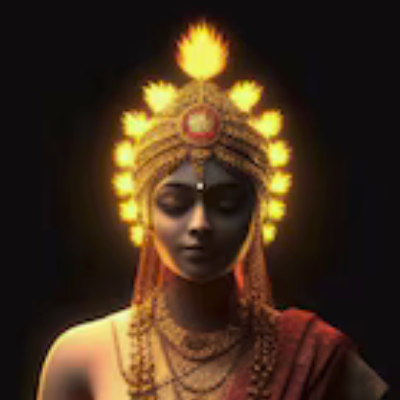
About
Holika (Simhika) — Sister of Hiranyakashipu, Slain by Fire, Origin of the Holi Festival
Holika · Simhika · Sinhika · Angaraka · Hiranyakashipu-bhagini · Prahlada-pitrushvasru
Holika is the sister of Hiranyakashipu and Hiranyaksha and the paternal aunt of Prahlada. She is the central figure of the Holika Dahan — the great bonfire of the night before Holi — whose burning is commemorated annually across the Hindu world as the triumph of divine devotion over demonic power. She possessed a boon from Brahma rendering her invulnerable to fire. When all of Hiranyakashipu's attempts to kill Prahlada failed, she entered a burning pyre with Prahlada on her lap — and was herself incinerated, while Prahlada emerged unharmed. The festival of Holi takes its name from her. The primary tradition identifies her with Simhika — the daughter of Kashyapa and Diti listed in the Vishnu Purana and Agni Purana as the sister of the twin Daityas — who married the Daitya Viprachitti and became the mother of Rahu, Ketu, and numerous other Asuras. A separate tradition of the Ramayana knows Simhika as the demoness who seized Hanuman by his shadow during his flight to Lanka. The textual relationship between these figures — whether Holika and Simhika are the same being or simply share a name — is a genuine ambiguity in the tradition, addressed in this profile.
✦ The Names
The name Holika derives from the Sanskrit root hol — to burn or to offer into fire — or from the name of the Vedic fire ritual Holaka performed in the month of Phalguna. The Medium Hindu Aesthetic source records that the first direct textual reference to a rakshasi named Holika appears in the Narada Purana — where she is described as a rakshasi who caused fear in Prahlada rather than specifically as his paternal aunt sitting in a fire. The more familiar episode of the fire and the boon is first recorded in the Vishnu Purana — which records that Holika told Hiranyakashipu she had a boon of fire invulnerability and offered to sit on the pyre with Prahlada. The Bhavishya Purana also records a related ritual tradition. The name Simhika derives from simha — lion — and the feminine suffix ika: she who is like a lioness. She is called Angaraka — the fiery one — in the Skanda Purana's account of her birth through Kashyapa and Surasa.
✦ The Textual Problem — Simhika as Sister or Daughter
The primary Puranic sources present a clear inconsistency on whether Simhika-Holika is the sister of Hiranyakashipu or his daughter. The Vishnu Purana (Amsa 1, Chapter 15) and the Agni Purana (Chapter 19) both record that Kashyapa and Diti had two sons, Hiranyakashipu and Hiranyaksha, and a daughter Simhika — establishing her as their sister. The Vayu Purana reinforces this, explicitly naming Simhika as sister of both brothers. However, the Bhagavata Purana — which records Hiranyakashipu's four sons as Prahlada, Anuhlada, Hlada, and Samhlada — also records a daughter named Simhika as the daughter of Hiranyakashipu himself and his wife Kayadhu. The Grokipedia entry records this directly: Hiranyakashipu had four sons and a daughter named Simhika who married the Daitya Viprachitti. The Dharmawiki entry records the Mahabharata Adi Parva (Chapter 65) as stating that Simhika was the daughter of Prajapati Daksha and the wife of Kashyapa — an entirely different genealogical position, treating Simhika as one of Kashyapa's wives rather than his daughter. The tradition thus contains three distinct positions: Simhika as daughter of Kashyapa and Diti (Vishnu Purana, Agni Purana, Vayu Purana), Simhika as daughter of Hiranyakashipu (Bhagavata Purana), and Simhika as wife of Kashyapa and daughter of Daksha (Mahabharata). All three cannot be simultaneously correct; the overlap in names across different genealogical levels of the tradition caused these identifications to become conflated.
✦ Holika and Simhika — The Same Figure?
The Wikipedia article on Holika explicitly states that she is also known as Simhika. The Dharmawiki article on Simhika confirms: Simhika was the daughter of Prajapati Kashyapa and Diti and the sister of the Asuras Hiranyakashipu and Hiranyaksha — also known as Holika, according to one version, she is said to have plotted to take the life of Prahlada. The Medium Hindu Aesthetic source, however, raises a critical objection: the early and classical Puranic accounts of the Prahlada story — in the Bhagavata Purana and Vishnu Purana — do not mention Holika at all. The Narada Purana first introduces a female figure named Holika in connection with Prahlada. Simhika as the demoness who encounters Hanuman in the Ramayana is a completely different story with no connection to the fire episode. The identification of the two as the same figure is a later Puranic and popular synthesis — plausible given their shared lineage and name, but not confirmed in the most ancient layers of either narrative. This profile acknowledges the identification while recording the textual evidence honestly.
✦ Lineage
- Father: Kashyapa — per the Vishnu Purana, Agni Purana, and Vayu Purana; or Hiranyakashipu — per the Bhagavata Purana; or Daksha — per the Mahabharata Adi Parva
- Mother: Diti — per the Vishnu Purana version (she is Diti's daughter and Hiranyakashipu's sister); or Kayadhu — per the Bhagavata Purana version (she is Hiranyakashipu's daughter)
- Brothers (per Vishnu Purana): Hiranyakashipu and Hiranyaksha
- Nephew (per Vishnu Purana): Prahlada — the supreme devotee she attempted to kill
- Father (per Bhagavata Purana): Hiranyakashipu; siblings: Prahlada, Anuhlada, Hlada, Samhlada
- Husband (per all genealogical accounts): Viprachitti — a Daitya king, son of Kashyapa and Danu, hence a cousin of Hiranyakashipu through their common father Kashyapa; the marriage connected the Daitya and Danava clans
- Sons by Viprachitti: Svarbhanu (who became Rahu after Vishnu's Sudarshana Chakra severed his head during the Samudra Manthana), Ketu (Svarbhanu's headless body), and numerous others — the Grokipedia source lists twelve named sons including Vyamsha, Shalya, Nabha, Vatapi, Namuchi, Ilvala, Khasrima, Anjaka, Naraka, Kalanabha, Svarbhanu, and Vaktrayodhi; some accounts record 101 sons in total collectively known as the Simhikeyas
- Additional sons by Viprachitti (Brahmanda Purana): Supunjika — killed by Parashurama
✦ The Boon — Fire Invulnerability
According to the Vishnu Purana, Holika told her brother that, due to a boon she had received, she was invulnerable to fire. The source of the boon varies across traditions. The Brahmakumaris source records: his sister Holika had a boon from Lord Brahma that the fire would not harm her, that is, she would not burn in the fire — but while giving the boon, Brahma had also said that if she misused it, the boon would automatically become ineffective. The Encyclopedia MDPI source records the alternate form: Hiranyakashipu gave Holika a special cloak or garment that was fireproof, rather than a personal boon inscribed in her body — the distinction mattering to the resolution of her death. Both the internal boon and the external garment versions agree on the outcome: the protection failed when deployed against Prahlada, and she burned.
✦ The Episode — The Burning Pyre
When all of Hiranyakashipu's attempts to kill Prahlada had failed — poison, elephants, the cliff, the sea, serpents, fire, magic — he called upon his sister for help. Hiranyakashipu asked his sister, Holika, to enter a blazing fire with Prahlad in her lap, knowing that Holika had a boon whereby she could enter the fire unscathed. Treacherously, Holika coaxed young Prahlad to sit in her lap and she herself took her seat in a blazing fire. Prahlada, without resistance or fear, accepted and sat in her lap — chanting the names of Vishnu throughout. The tradition records two versions of what then occurred. In the first version — the fire-boon version — Holika's personal boon failed because it had been granted on the condition it would never be used to harm another: her misuse voided the protection and she burned. Holika was not aware that the boon worked only when she entered the fire alone. In the second version — the garment version — as the fire roared, the garment flew from Holika and covered Prahlad. Holika burnt to death, and Prahlad came out unharmed. A third variant recorded by the Simi K. Rao source and the Encyclopedia MDPI source offers a more benevolent reading: that Holika was herself good and at the critical moment chose to give her protective garment to Prahlada to save him — sacrificing herself willingly rather than being overcome by divine intervention. This third version, though less widely cited, is noted in the tradition as a counterpoint to the reading of Holika as purely malevolent.
✦ Simhika in the Ramayana — The Shadow-Seizer
The Valmiki Ramayana (Sundara Kanda) records a separate narrative for Simhika — whether the same figure as Holika or a different being of the same name. During Hanuman's aerial leap across the ocean to Lanka, Simhika attempts to devour Hanuman by seizing his shadow during his aerial journey to Lanka, only to be slain when he enters her mouth and rips out her vital organs. She had the power to seize the shadows of beings in flight and drag them down into her mouth. Hanuman, sensing the pull on his shadow, identified her and allowed himself to be drawn in — then contracted his body to a tiny form, entered deep into her body, expanded suddenly to his full size, ripped out her internal organs, and emerged. The Dharmawiki source explicitly notes: there is no mention of the rakshasi Simhika meeting her death through her participation in the attempted killing of Prahlada — in the Ramayana, the demoness is killed by Hanuman while on his way to Lanka. This confirms that the Ramayana Simhika and the Holika figure are presented as separate narratives in the primary sources, even if the tradition identifies them as the same being.
✦ The Skanda Purana — Simhika as Angaraka
The Skanda Purana (Asura Kanda) presents an alternate genealogy for Simhika entirely separate from both the Diti-lineage and Hiranyakashipu-lineage accounts. In this version, Kashyapa married Surasa (the daughter of an Asura who escaped to Patala after the Devasura wars). To Kashyapa and Surasa were born two daughters — Angaraka (Simhika) and Ajamukhi — and four sons — Surapadma, Simhavaktra, Tarakasura, and Gomukha. In this version Simhika is the sister of Tarakasura — the great demon whose death was the primary purpose of Kartikeya's birth. The Skanda Purana version is entirely inconsistent with both the Vishnu Purana and the Bhagavata Purana genealogies, representing a regional or sectarian tradition rather than the mainstream Puranic consensus.
✦ Rahu and Ketu — Her Most Famous Children
Regardless of which genealogical version of Simhika-Holika is accepted, all traditions agree on her marriage to Viprachitti and the birth of Rahu. During the Samudra Manthana — the churning of the cosmic ocean — Svarbhanu, a son of Simhika and Viprachitti, disguised himself among the Devas and drank from the vessel of Amrita (the nectar of immortality). The sun god Surya and the moon god Chandra identified him and alerted Vishnu. Vishnu released his Sudarshana Chakra, which severed Svarbhanu's head. However, he had already drunk enough Amrita that he could not die — his head became Rahu and his body became Ketu, both immortal. Rahu and Ketu — the shadow planets in Hindu astrology — are the source of solar and lunar eclipses in the tradition: Rahu periodically swallows the sun and moon in revenge, causing the eclipse, but they slip out of his severed neck immediately. Thus Simhika, through her son Svarbhanu, became the cosmic mother of the two shadow planets that govern karmic destiny in the Hindu astrological tradition.
✦ Holika Dahan — The Festival
Holika Dahan — the burning of Holika — is the central ritual of the first night of Holi, celebrated on the full moon night of the month of Phalguna (February-March). Bonfires are lit at crossroads, in public squares, and outside homes across North India and the broader Hindu world. The effigy of Holika is burned; in some traditions a figure of Prahlada is placed beside it and rescued from the fire. The ashes of the Holika bonfire are considered sacred — at the Prahlada Stambha temple in Sikligarh Dharhara, Bihar, the ashes are sprayed into the air and people play Holi with them. The name Holi itself derives directly from Holika — the festival is her perpetual commemoration, her burning re-enacted annually as a reminder that divine devotion cannot be extinguished by any power, however absolute. The Medium Hindu Aesthetic source notes that the Bhavishya Purana offers an alternate origin for the Holi bonfire — as a Homa ritual performed on Phalguna Purnima to ward off the evil rakshasi Dhaundha who frightened children — and that a third tradition identifies Holika with Putana, the demoness who tried to poison the infant Krishna. These alternate traditions reflect the richness of popular Holi mythology beyond the Prahlada episode.
✦ References
- Vishnu Purana (Amsa 1, Chapter 15) — the primary genealogical source recording Simhika as the daughter of Kashyapa and Diti and the sister of Hiranyakashipu and Hiranyaksha; Holika's fire-invulnerability boon and its use against Prahlada
- Agni Purana (Chapter 19) — records Diti and Kashyapa having two sons and a daughter Simhika; Rahu as the first of the Simhikeyas born of Simhika and Viprachitti
- Vayu Purana — explicitly names Simhika as sister of both Hiranyakashipu and Hiranyaksha
- Bhagavata Purana — Canto 7: records four sons of Hiranyakashipu and Kayadhu — Prahlada, Anuhlada, Hlada, Samhlada — and a daughter Simhika who married Viprachitti; makes Simhika Hiranyakashipu's daughter rather than his sister
- Mahabharata — Adi Parva, Chapter 65: Simhika as daughter of Prajapati Daksha and wife of Kashyapa — a third genealogical position inconsistent with the Puranic accounts
- Narada Purana — the first text to introduce Holika as a rakshasi causing fear in Prahlada; the earliest textual mention of the name Holika in connection with Prahlada's story
- Bhavishya Purana — the Homa ritual on Phalguna Purnima to ward off the rakshasi Dhaundha; an alternate origin tradition for the Holi bonfire
- Valmiki Ramayana — Sundara Kanda: Simhika seizing Hanuman's shadow during his leap to Lanka; killed by Hanuman from inside her body
- Skanda Purana (Asura Kanda) — Angaraka (Simhika) as daughter of Kashyapa and Surasa; sister of Tarakasura — a separate tradition inconsistent with the mainstream genealogy
- Brahmanda Purana (3.6.13–12) — Supunjika, son of Viprachitti by Simhika, killed by Parashurama
- Wikipedia — Holika; Dharmawiki — Simhika; Grokipedia — Simhika; Encyclopedia MDPI — Holika; Hindu Aesthetic Medium — Origins of Holika Dahana; Brahmakumaris — Holika; Holifestival.org — Legend of Holika and Prahlad; Simi K. Rao — Story of Holika: modern summaries drawing from the above primary sources