
About
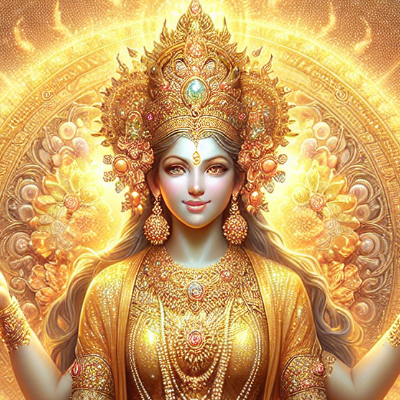
Aditi — Mother of the Adityas and Sovereign of the Gods
Aditi · Devamata · Amaramata · Suradevi · Dakshakanya
Aditi is one of the most ancient and theologically significant feminine figures in the Hindu canonical tradition. She is the daughter of Daksha — the great progenitor lord and one of the Prajapatis, the primordial patriarchs appointed to populate creation — and of Daksha's wife Panchajani (also called Prasuti or Virani in variant accounts). Aditi is the wife of the sage Kashyapa, one of the seven great primordial seers (Saptarishis), and she is celebrated above all as the mother of the Adityas, the twelve sovereign gods of cosmic order who include among their number Indra, lord of the heavens, and Vivasvat, the solar deity from whom the human lineages of the Mahabharata descend. Her name and her symbolic identity appear across the Rigveda, the Atharvaveda, the Shatapatha Brahmana, the Mahabharata, the Ramayana, and virtually every major Mahapurana, making her one of the most consistently attested figures in the entire tradition.
✦ The Name
The name Aditi derives from the Sanskrit root da with the negative prefix a, yielding the sense of "she who is not bound" or "the boundless one." The term carries the meaning of infinite expanse, freedom from limitation, and inexhaustible abundance. In the Rigveda she is invoked as the embodiment of the boundless sky, the earth, the atmosphere, and all that lies beyond — a cosmic totality rather than a figure with a merely personal or local function. The Nirukta, the ancient Vedic text on etymology attributed to Yaska, glosses the name as signifying that which cannot be cut, divided, or constrained. Her epithet Devamata means "mother of the gods," and Amaramata carries the same sense, amara meaning the immortals. The patronymic Dakshakanya identifies her simply as the daughter of Daksha.
✦ Lineage
- Father: Daksha — a Prajapati and primordial progenitor lord, son of Brahma according to most Puranic accounts, charged with the proliferation of living beings across the cosmos. He is among the most prominent patriarchal figures in the Puranic genealogical tradition.
- Mother: The name of Aditi's mother varies by source. The Vishnu Purana names her Panchajani as the mother of Daksha's daughters in one context, while the Bhagavata Purana names Prasuti (herself a daughter of Svayambhuva Manu and Shatarupa) as Daksha's wife and the mother of his daughters. The Mahabharata and certain Puranas further complicate this by positing Virani as the mother of Daksha's progeny. These are variant traditions and not a single agreed lineage.
- Siblings: Aditi is consistently listed alongside a large number of sisters who are also daughters of Daksha and who are given in marriage to the sage Kashyapa. The Vishnu Purana and Bhagavata Purana enumerate thirteen of Daksha's daughters as wives of Kashyapa, including Diti (from whom the Daityas or anti-gods descend), Danu (mother of the Danavas), Kadru (mother of the Nagas or serpent beings), Vinata (mother of Garuda and Aruna, the eagle-beings who serve Vishnu), Krodhavasha, Muni, Ira, Arishta, Surasa, Surabhi, Tamra, Timi, and others. Aditi is counted among these sisters but is distinguished as the foremost by virtue of her divine progeny. The Mahabharata also names Diti, mother of the Daityas, as Aditi's full sister and presents their sons — Adityas and Daityas — as cosmic rivals.
- Spouse: Kashyapa — one of the seven primordial seers (Saptarishis) and a grandson of Brahma through Marichi. Kashyapa is the progenitor of a vast range of beings through his many wives. He is regarded in the Puranic tradition as the father of both the gods and the demons by different wives, making him a figure of total cosmic generativity.
- Children — the Adityas: The number and names of the Adityas vary between sources. The Rigveda names six or seven Adityas: Mitra, Varuna, Aryaman, Bhaga, Daksha (here treated as an Aditya rather than a Prajapati, in a notable variance), Amsha, and occasionally Surya. The Shatapatha Brahmana expands this to eight. The Vishnu Purana, Bhagavata Purana, and Mahabharata standardise the count at twelve, giving their names as: Vivasvat (the solar god, ancestor of the Lunar and Solar dynasties of the epics), Aryaman, Pusha, Tvashtr (also called Tvashta), Savita, Bhaga, Dhata, Vidhata, Varuna (lord of cosmic order and the waters), Mitra (lord of covenants), Indra (lord of heaven and the gods), and Urukrama (identified with Vishnu in his Vamana or dwarf avatar form). The Bhagavata Purana gives a slightly different list and identifies the twelfth as Vishnu directly. These inconsistencies are standard across the texts and reflect different strata of composition.
- Other notable children: Several texts record that Aditi also bore Vamana, the dwarf avatar of Vishnu, in a specific and celebrated episode. The Bhagavata Purana devotes extended passages to this birth. Some accounts also credit her with bearing the divine physicians, the Ashvins or Nasatyas, though other texts assign their parentage differently, making this attribution textually contested.
✦ Aditi in the Rigveda
Aditi is among the few feminine powers addressed directly in Rigvedic hymns with any degree of theological elaboration. She appears in multiple hymns, both as a deity invoked in her own right and as the mother through whose womb the Adityas — particularly Mitra and Varuna, the guardians of cosmic order — come into being. In the Rigveda, Aditi is associated with the unbounded expanse of the sky and with the earth itself, and she is invoked as a protector, a deliverer from sin, and a source of abundance. One notable passage identifies her simultaneously with the sky, the atmosphere, the mother, the father, all the gods, the five tribes of men, and all that has been and shall be — a formulation of extraordinary cosmological scope that elevates her from a personal deity to a universal principle. She is also invoked alongside Varuna in prayers for liberation from transgression and for the renewal of life-breath. Her role in the Vedic hymns is thus both cosmic and intimately protective, functioning simultaneously as the matrix of divine existence and as an accessible power of grace.
✦ The Rivalry with Diti and the War of Gods and Demons
A structural theme in the Puranas and in the Mahabharata is the cosmic opposition between the sons of Aditi — the Adityas, who uphold divine order — and the sons of Diti, Aditi's sister and co-wife of Kashyapa — the Daityas, who oppose the gods and periodically overturn the governance of the three worlds. This rivalry is framed not as a simple battle between good and evil but as a structural opposition built into the architecture of creation itself, since both groups share the same father, Kashyapa, and emerge from the same household. The Mahabharata and the Bhagavata Purana describe multiple cycles of conflict in which the Daityas drive the Adityas from heaven, causing Aditi and her sons to seek refuge and assistance. It is in direct response to these reversals — specifically the defeat of the gods by the Daitya king Bali — that the Vamana episode occurs.
✦ Aditi's Penance and the Birth of Vamana
The Bhagavata Purana, in its eighth book, narrates in detail an episode in which the Daitya king Bali — grandson of the great devotee Prahlada and himself a figure of formidable merit and power — performs a vast sacrifice that compels the gods to surrender the three worlds to him. Indra, Aditi's son and the lord of heaven, is displaced. Aditi, in grief for her sons and in devotion, undertakes a rigorous vow and fast known as the Payovrata — a twelve-day observance involving subsistence on milk alone, conducted with concentrated worship of Vishnu. At the conclusion of this austerity, Vishnu appears before her and, acceding to her prayer for the restoration of her sons' sovereignty, agrees to take birth as her son. The divine being who is then born to Aditi and Kashyapa is Vamana — the dwarf, the twelfth son of Aditi and the avatar of Vishnu — who subsequently approaches Bali's sacrifice and, through the celebrated episode of three strides, reclaims the three worlds. The Bhagavata Purana is the most elaborate source for this episode, though its broad outline also appears in the Vishnu Purana and the Mahabharata.
✦ Aditi in the Mahabharata and Ramayana
In the Mahabharata, Aditi appears primarily in genealogical and cosmological contexts rather than as a protagonist of discrete narrative episodes. The Adi Parva sets out the lineage of the gods and the Daityas in detail, firmly establishing Aditi as the mother of the Adityas and the source of the divine order that underlies the epic's moral world. The twelve Adityas are listed as her sons, and their role in maintaining cosmic governance is articulated in connection with their mother's identity. In the Ramayana, Aditi is referenced with reverence at several points: she appears in the genealogical backgrounds provided by the sage Vishvamitra and in passages affirming the divine origin of certain principal figures. The Ayodhya Kanda and Uttara Kanda of the Valmiki Ramayana invoke her as Devamata in contexts of benediction. Her presence in both epics is primarily symbolic and genealogical rather than narratively active.
✦ Textual Variants and Inconsistencies
Several genuine inconsistencies arise across the primary sources and deserve clear statement.
The number and names of the Adityas: The Rigveda gives six or seven names. The Shatapatha Brahmana proposes eight. The Vishnu Purana, Bhagavata Purana, and Mahabharata standardise the figure at twelve but do not agree entirely on all twelve names. The inclusion of Vishnu or Urukrama as one of the twelve Adityas is a theological development visible in the Puranic layer and is not present in the earliest Vedic texts, where Vishnu is a distinct though allied deity.
Daksha as both Aditi's father and an Aditya: The Rigveda includes Daksha among the Adityas — that is, among the sons of Aditi. The Puranas, however, make Daksha the father of Aditi. These two positions are mutually contradictory and represent different strata of tradition. The Puranic genealogical framework appears to have restructured the older Vedic material significantly. No satisfactory harmonisation of these two positions exists within the texts themselves; several Puranas acknowledge the difficulty obliquely by treating the Vedic Daksha-Aditya as a separate being from the Prajapati Daksha.
The identity of Daksha's wife and Aditi's mother: As noted in the Lineage section, the Vishnu Purana, the Bhagavata Purana, and the Mahabharata each present slightly different accounts of Daksha's principal wife, giving the names Panchajani, Prasuti, and Virani respectively. The Bhagavata Purana's identification of Prasuti — herself a daughter of Svayambhuva Manu, the first Manu — as the mother of Daksha's daughters including Aditi represents the most elaborate genealogical construction of the Aditi lineage.
The Ashvins as children of Aditi: Some passages in the tradition credit Aditi with the birth of the divine twin physicians, the Ashvins (also called Nasatyas). However, the mainstream Puranic position assigns the Ashvins a different birth — as sons of Saranyu (also called Sangya), the daughter of the divine craftsman Tvashtr and the wife of Vivasvat, the solar Aditya. Since Vivasvat is himself a son of Aditi, this would make the Ashvins her grandsons under the dominant account rather than her sons. The attribution of the Ashvins directly to Aditi appears in a minority of passages and is not the standard Puranic position.
✦ Theological and Philosophical Significance
Aditi occupies a position in the Hindu canonical tradition that is without precise parallel among its feminine figures. In the Vedic layer she functions as a cosmic principle — the infinite ground of existence, the unconditioned matrix from which the ordered powers of the universe emerge. She is not a goddess with a specific domain in the manner of Ushas (dawn) or Sarasvati (speech and learning) but rather a totalising presence whose significance is precisely her boundlessness. Later Puranic theology recasts this cosmic function in genealogical terms: the boundless one becomes the mother of the twelve Adityas, each of whom presides over one month of the solar year, making Aditi the source of time's annual cycle. Her role as mother of Vishnu's Vamana avatar positions her within Vaishnava theology as the instrument through whom the supreme deity enters the world for the restoration of cosmic order — a theological function closely analogous to that of the earth goddess Bhumi or of Devaki (the mother of Krishna) in later traditions. The Payovrata episode in the Bhagavata Purana thus presents Aditi as a model of feminine devotion whose prayer directly occasions a divine descent.
✦ Connection to the Wider Genealogy
Aditi stands at a pivotal node in the genealogical architecture of the Puranic and epic traditions. Through her father Daksha she connects to the line of Brahma, the creator deity, from whom the entire fabric of Puranic genealogy descends. Through her husband Kashyapa she is co-mother, alongside her sisters, of virtually every category of non-human being described in the tradition: the gods through her own sons the Adityas, the Daityas through her sister Diti, the Danavas through her sister Danu, the Nagas through her sister Kadru, and the great eagle-beings Garuda and Aruna through her sister Vinata. The twelve Adityas who are her direct sons themselves generate further lineages: Vivasvat, the solar Aditya, is the ancestor of the two great human royal dynasties that supply the protagonists of the Mahabharata and the Ramayana — the Solar dynasty (Suryavamsha), from which Rama of Ayodhya descends, and through Vivasvat's son Vaivasvata Manu, also the progenitor of the Lunar dynasty (Chandravamsha), from which the Pandavas and Kauravas of the Mahabharata descend. Aditi is therefore, through her son Vivasvat alone, a remote ancestress of virtually every named royal lineage in the Hindu epics.
✦ References
Primary Sources
- Rigveda, Book 1, hymns 89 and 94; Book 7, hymn 82; Book 8, hymn 56; Book 10, hymn 63 and 72: The foundational Vedic source for Aditi as a cosmic principle; hymns address her as the boundless matrix of gods and existence, and invoke her alongside Mitra and Varuna. The celebrated verse identifying her with sky, earth, and all existence appears in Book 1.
- Atharvaveda, Book 7: Contains prayers to Aditi for protection and freedom from misfortune, affirming her Vedic role as a guardian power.
- Shatapatha Brahmana, Book 8 and Book 11: Provides ritual and cosmological elaboration of the Adityas, listing eight sons of Aditi and connecting her to the solar sacrificial cycle.
- Nirukta of Yaska, Chapter 12: Provides the classical etymological gloss on the name Aditi as "the unbound" or "the indivisible," foundational for all subsequent name-analysis.
- Mahabharata, Adi Parva (Book 1), sections 65 and 66: Sets out the genealogy of the gods including the twelve Adityas as sons of Aditi and Kashyapa; establishes the rivalry between Aditi's and Diti's progeny.
- Mahabharata, Udyoga Parva and Shanti Parva: Further references to Aditi as Devamata and to the Adityas in cosmological discussions.
- Valmiki Ramayana, Bala Kanda and Uttara Kanda: Invocations of Aditi as mother of the gods in genealogical and benedictory passages.
- Vishnu Purana, Book 1, chapters 15 and 21: Lists the thirteen wives of Kashyapa including Aditi, names her daughters alongside her sisters, and sets out the lineage of the Adityas. One of the primary Puranic sources for the full Daksha-Kashyapa-Aditi framework.
- Bhagavata Purana, Book 6, chapters 6 and 18; Book 8, chapters 16 through 23: Book 6 gives the full list of Daksha's daughters and their marriages to Kashyapa. Books 8, chapters 16–23 contain the most elaborate account of the Payovrata and the birth of Vamana, presenting Aditi's devotion and her role as mother of the Vishnu avatar in full narrative detail.
- Brahma Purana, chapters 1–3: Genealogical account of Daksha's daughters and the Kashyapa marriages; broadly consistent with the Vishnu Purana account.
- Matsya Purana, chapters 6 and 146: Lists Aditi among Daksha's daughters, names the Adityas, and contains a version of the Vamana narrative.
- Agni Purana, chapters 3 and 4: Provides a compressed account of the Aditya lineage and affirms Aditi's status as Devamata.
- Padma Purana, Svarga Khanda: Narrates the Vamana episode and Aditi's penance; broadly follows the Bhagavata version.
Modern Reference Works
- Vettam Mani, Puranic Encyclopaedia (1975): Entry on Aditi; collates references across multiple Puranas and epics, notes the variant lists of Adityas, and summarises the Vamana narrative. An invaluable cross-referencing tool for identifying textual variants.
- A. A. Macdonell, Vedic Mythology (1897): Detailed analysis of Aditi's role and characterisation in the Rigveda; foundational scholarship on the Vedic Adityas and their relationship to the figure of Aditi as cosmic principle.
- Jan Gonda, Aspects of Early Visnuism (1954): Discusses the absorption of Vishnu into the Aditya group and the theological significance of Vamana as a son of Aditi, relevant to the Puranic development of her identity.
- Wendy Doniger O'Flaherty, Women, Androgynes, and Other Mythical Beasts (1980): Includes analysis of the cosmic maternal figures of the Vedic and Puranic traditions, with discussion relevant to Aditi's dual function as cosmic principle and personal mother-goddess.
- F. B. J. Kuiper, Ancient Indian Cosmogony (1983): Examines the cosmological dimensions of the Vedic material including the conception of Aditi as boundless expanse and her relationship to Vedic cosmogonic thought.