
About
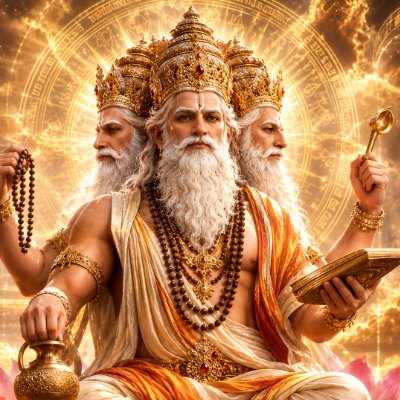
Brahma — Creator of the Universe, First of the Trimurti
Svayambhu · Pitamaha · Prajapati · Hiranyagarbha · Chaturmukha · Virinchi · Vidhi · Vedamurti · Lokesha · Dhata · Vidhata · Abjaja · Nabhija · Kamalodbhava · Padmaja · Vedagarbha · Sanat · Abhava · Srashta
Brahma is the creator deity of the Hindu tradition and the first member of the Trimurti — the divine triad in which Brahma undertakes Srishti (creation), Vishnu undertakes Sthiti (preservation), and Shiva undertakes Samhara (dissolution). He is the secondary creator: not the source of existence itself, but the architect of all forms within an already-existing cosmic framework. He brings forth the worlds, the living beings, the orders of time, the Vedas, and the social and cosmic structures that govern life. His consort is Saraswati, the goddess of knowledge, speech, learning, and the arts. His vehicle is the hamsa — the swan or goose — a symbol of discriminating wisdom. His abode is Satyaloka, also called Brahmaloka, the highest of the seven upper worlds situated at the summit of the cosmic structure. In the genealogical system to which this profile belongs, Brahma is placed as one of the four primary divine nodes beneath Para Brahman — the absolute root — alongside Vishnu, Shiva, and Adi Parashakti. He is the fountainhead of all creaturely genealogy: the Prajapatis, the seven great sages, and the progenitors of all living beings flow from him, making him the structural origin of the entire genealogical tree below the divine level. His principal textual sources include the Rigveda, the Atharvaveda, the Shatapatha Brahmana, the Aitareya Brahmana, the Mahabharata, the Ramayana, the Brahma Purana, the Brahmanda Purana, the Vayu Purana, the Bhagavata Purana, the Vishnu Purana, the Matsya Purana, the Markandeya Purana, the Shiva Purana, the Linga Purana, the Skanda Purana, and the Brahmavaivarta Purana.
✦ The Name
The name Brahma derives from the Sanskrit root brh — to expand, to grow, to be great — and is etymologically related to but distinct from Brahman, the impersonal absolute of Vedantic philosophy. Brahman is the formless, attributeless ultimate reality; Brahma is the personal, formed, attribute-bearing deity who creates within and from that reality. The distinction is grammatical as well as theological: Brahman is neuter gender in Sanskrit, while Brahma is masculine. The confusion of the two is a persistent theological issue addressed explicitly by Vedantic commentators from Shankaracharya onward. Brahma as a name thus means the great one, the expansive one, the one who embodies and enacts the principle of growth and creation.
Svayambhu — self-born or self-existent — is among his most theologically significant epithets. It designates a being who has no external cause or parent, who comes into existence through his own inherent creative potency. The name asserts Brahma's independence from any prior creative act, even while the Puranic narrative tradition simultaneously places him as emerging from Vishnu's lotus or from the cosmic egg — an apparent contradiction that Puranic theology resolves by distinguishing the absolute level (at which Brahma is self-born as a cosmic principle) from the narrative level (at which he has an origin story). Pitamaha — grandfather — expresses his genealogical primacy: he is the father of the Prajapatis and thus the grandfather of all beings. Prajapati — lord of creatures or lord of progeny — is an ancient Vedic title originally applied to the primordial creator figure who preceded Brahma conceptually and was gradually identified with him as the tradition developed. Hiranyagarbha — golden womb or golden embryo — names the luminous cosmic seed from which creation unfolds, the first cosmic manifestation of light and intelligence in the primordial void. Chaturmukha — four-faced — refers to his characteristic iconographic form with faces looking in all four cardinal directions, expressing omniscience and the universality of his creative attention. Virinchi is a name of uncertain etymology used extensively in Sanskrit poetry and drama to designate Brahma, carrying connotations of the creator's unique and originary nature. Vidhi — the ordainer or the law — expresses Brahma's role as the one who lays down the structures, rules, and destinies that govern all created existence. Vedamurti — embodiment of the Vedas — reflects the tradition that Brahma is the source and first speaker of the Vedas, which he recites at each act of creation. Dhata and Vidhata — the placer and the disposer — together name his function in arranging the fates and circumstances of all beings. Abjaja, Nabhija, Kamalodbhava, and Padmaja are all synonymous names meaning lotus-born — he who arose from the lotus at Vishnu's navel. Vedagarbha — he who has the Vedas in his womb — complements Vedamurti by emphasising that the Vedas are not merely recited by Brahma but are intrinsic to his very nature. Srashta — the creator — is the simplest and most direct designation of his primary function.
✦ Vedic Antecedents — Prajapati and Hiranyagarbha
The Brahma of the Puranic tradition does not emerge fully formed from the Vedas. His Puranic identity is the product of a long theological development in which several distinct Vedic concepts — principally Prajapati, Hiranyagarbha, and Brahmanaspati — gradually converged and were unified under the single name Brahma.
Prajapati is the dominant creator figure of the Vedic Brahmana literature. In the Shatapatha Brahmana — the most extensive and philosophically developed of the Brahmana texts, associated with the Shukla Yajurveda — Prajapati is the primordial creator who desires to multiply and, through an act of creative will and austerity (tapas), brings forth the worlds and all beings. The Shatapatha Brahmana narrates extensive cosmogonic myths in which Prajapati creates through speech, through breath, through desire, and through the sacrifice of his own body — themes that recur in the Puranic Brahma mythology. Prajapati is not yet consistently personalised as Brahma in this literature; the name Brahma appears but does not yet designate a single, fully individualised deity.
Hiranyagarbha — the golden embryo or golden womb — is the subject of one of the most celebrated cosmogonic hymns in the Rigveda, the one hundred and twenty-first hymn of the tenth mandala. This hymn asks: who was the one deity who stood in the beginning, who held the earth and heaven, who is the god to whom we should offer worship? Each verse describes the primordial creator's attributes and concludes with this refrain, and the final verse names the deity as Prajapati. Hiranyagarbha in this hymn is the first manifestation — the golden seed that arises in the primordial waters before the worlds are differentiated. The hymn is one of the earliest speculative cosmogonic texts in Sanskrit and plants the seed of what will become the Brahma-as-creator theology of the Puranas. The concept of a luminous cosmic embryo or egg from which creation unfolds is directly continuous with the Puranic Hiranyagarbha and Brahmananda (cosmic egg) narratives.
Brahmanaspati (also Brihaspati in some contexts) is the Vedic lord of sacred speech and prayer, the deity who presides over the power of the sacred word. Since Brahma is the one who speaks the Vedas into creation — Vedamurti, the embodiment of the Vedas — this Vedic figure of the lord of speech contributes to the composite Puranic Brahma. By the time of the Atharvaveda and the Brahmana literature, these streams are converging, and by the epic and early Puranic period the unified figure of Brahma as the four-faced, Veda-bearing creator god is fully established.
✦ Origin Narratives
The Puranic tradition preserves multiple, partially irreconcilable accounts of Brahma's origin. These are not presented as contradictions requiring resolution but as different windows into the same cosmic event, each emphasising a different theological dimension. The principal accounts are the following.
The Lotus from Vishnu's Navel: The most widely known Puranic account, narrated in the Bhagavata Purana, the Vishnu Purana, and the Padma Purana, describes Brahma as arising from a lotus that grows from the navel of Vishnu as Vishnu lies in cosmic sleep upon the serpent Ananta Shesha on the Kshirasagara, the ocean of milk. At the beginning of a new cycle of creation, when the previous universe has been dissolved and before any new creation has begun, a lotus stalk emerges from Vishnu's navel and unfolds into a thousand-petalled flower of extraordinary radiance. Within this flower Brahma is born. The Bhagavata Purana narrates that when Brahma first opens his eyes, he finds himself seated on the lotus in the midst of the cosmic waters, with no knowledge of who he is, where he has come from, or what he is to do. He looks in all four directions — the origin, in some accounts, of his four faces — but sees only water and sky and the lotus stem descending into the depths. He hears the syllables ta-pa (austerity) resounding in the void and, understanding this as instruction, performs tapas for a hundred divine years. At the end of this austerity, the cosmic waters part, Vishnu becomes visible, and Brahma receives from Vishnu the knowledge — particularly the Vedas — that he needs to proceed with the act of creation. This account firmly establishes Brahma's dependence upon and derivation from Vishnu in the Vaishnava theological framework.
The Hiranyagarbha and the Cosmic Egg: A second, older account — traceable to the Rigveda's Hiranyagarbha hymn and developed in the Shatapatha Brahmana, the Manusmriti, and the Brahmanda and Vayu Puranas — describes Brahma as arising within a golden cosmic egg called the Hiranyagarbha or Brahmananda. In the primordial state, the universe exists as an undifferentiated ocean of darkness and water. The divine creative impulse stirs, and from this impulse a luminous golden seed forms in the water — the Hiranyagarbha. This seed floats on the primordial waters and within it Brahma comes into being. After a period of gestation, the cosmic egg splits into two halves: the upper half becomes the heavens (Svarga), the lower half becomes the earth (Bhumi), and the space between becomes the atmosphere (Antariksha). Brahma, the being within the egg, is thus the structural cause of the cosmos's differentiation into its three primary levels. This account presents Brahma as more genuinely self-arising — Svayambhu — and is less theologically subordinating than the lotus-from-Vishnu's-navel account. The Manusmriti opens with this cosmogony as its foundational account of creation.
The Shaiva Account: In the Shaiva Puranas — particularly the Shiva Purana and the Linga Purana — Brahma and Vishnu are presented as created beings whose ultimate source is Shiva or the Shiva-Shakti principle. In one version, Shiva appears as Ardhanarishvara — the form that is half Shiva and half his consort Parvati — and from this androgynous form Brahma and Vishnu emerge as the creative and preserving principles. In another Shaiva account, Brahma and Vishnu arise from the Shiva-linga or from Shiva's cosmic dance. The theological function of these accounts within the Shaiva tradition is the same as the lotus-from-Vishnu account in the Vaishnava tradition: to place the supreme deity (Shiva in this case) as the ultimate source from which the secondary cosmic functions of creation and preservation derive.
The Shakta Account: The Devi Bhagavata Purana and related Shakta texts present a cosmogony in which the goddess Adi Parashakti is the ultimate source, and Brahma, Vishnu, and Shiva are her creations — each emerging from her body or will and assigned their respective cosmic functions. In this framework, Brahma receives from the goddess both his existence and his creative knowledge, including the Vedas.
✦ The Five Heads — Acquisition and Loss
One of the most significant and theologically complex narratives associated with Brahma is the story of his fifth head — how he acquired it and how Shiva destroyed it. This episode is narrated in the Shiva Purana, the Matsya Purana, the Linga Purana, and the Skanda Purana, and it accounts for both Brahma's current four-headed form and for the origin of one of Shiva's most fearsome aspects.
The narrative begins with the creation of Shatarupa — described in more detail in the Shatarupa section below — Brahma's first female creation. Different versions of the story describe Shatarupa as his daughter, his creation, or in some accounts as having emerged from his own body. Brahma is overcome with desire for Shatarupa and gazes at her with all four of his faces as she moves around him trying to avoid his gaze. As she moves upward to escape, Brahma grows a fifth face on the top of his head so that he can continue to look at her in every direction. This fifth head faces upward. In some versions of the narrative, the fifth head also becomes the one that recites the Vedas with particular authority and arrogance, claiming creative supremacy over Shiva himself — in one version it addresses Shiva disrespectfully, asserting that Brahma is Shiva's father or superior.
Shiva, offended by the arrogance of Brahma's fifth head — or, in the Shaiva Puranas, angered by its disrespect — takes the form of Bhairava, his most terrifying manifestation. With the nail of his left thumb, or in some versions with his trident, Shiva severs the fifth head of Brahma. The head sticks to Shiva's hand and cannot be dislodged — a condition that is both punishment and theological statement: Brahma's pride has polluted Shiva, and the skull (kapala) of a Brahmin (which Brahma effectively is, as the father of the brahmin order) is the gravest possible ritual pollution. Shiva, now bearing the skull of Brahma on his hand, wanders the three worlds in the form of Bhikshatana — the wandering ascetic-beggar — performing the penance known as Brahmahatya (expiation for the killing of a brahmin). He wanders to various sacred pilgrimage sites, but none can wash away the pollution until he reaches Varanasi (Kashi), where the skull finally falls from his hand and the sin is expiated. The spot where the skull falls is called Kapalamochana — the place of skull-release — a sacred site within the Kashi pilgrimage geography. This episode is narrated in the Shiva Purana's Jnanasambhita section and in the Skanda Purana's Kashi Khanda. It explains why Brahma is now depicted with four heads rather than five, why Shiva in his Bhairava form carries a skull-cup (the kapala of Brahma becomes Bhairava's iconic attribute), and it serves as a theological subordination narrative — Brahma's pride is destroyed by Shiva, literally and permanently.
The episode also contributes to the Puranic explanation for why Brahma receives no temple worship: a deity who was punished for arrogance and whose fifth head was severed by Shiva cannot claim the unambiguous sanctity required for widespread temple veneration. Shiva himself, in several Puranic versions, pronounces that Brahma shall not be widely worshipped as a consequence of his transgression.
✦ The Shatarupa Episode
Shatarupa — meaning she of a hundred forms — is Brahma's first female creation and one of the most theologically complex figures associated with him. The episode of her creation and Brahma's response to her is narrated in the Matsya Purana, the Brahma Purana, the Vishnu Purana, and the Bhagavata Purana, with significant variation across these accounts.
In the most common account, Brahma creates Shatarupa directly from his own body — she divides from him as the first act of duality in creation, the separation of the primordial unity into male and female principles that makes procreation and therefore all further creation possible. She is thus simultaneously his creation, his daughter (emerging from his body), and, in the narrative's further development, his wife — a figure who will become the first mother of humanity by marrying the first Manu, Svayambhuva Manu, who is also created from Brahma. Shatarupa is named for her ability to take many forms — to shift appearance — an attribute that also makes her difficult to observe from a single vantage point. As she moves around Brahma, he grows faces in each direction to keep her in his sight, leading directly to the five-head episode narrated above.
The Matsya Purana's account is the most explicit about the discomfort this episode creates within the tradition. Brahma's desire for his own creation-daughter is presented in these texts with a degree of moral tension. The Bhagavata Purana's version is more restrained: the seven sages (Marichi and others) and ultimately Shiva reprove Brahma for this desire, and Brahma — overcome with shame — releases Shatarupa to be united with Svayambhuva Manu rather than retaining her himself. The episode serves a cosmogonic function: by separating from Brahma, Shatarupa enables the first sexual duality from which all further biological creation will proceed. The theological tradition generally interprets the episode at a cosmogonic-allegorical level: the desire that Brahma feels for his first creation is the creative impulse itself — the desire of the one to become many — which is the engine of all further creation.
Shatarupa, in her union with Svayambhuva Manu, becomes the mother of the primordial human lineage. Their children include Priyavrata and Uttanapada (the two sons), and Akuti, Devahuti, and Prasuti (the three daughters) — from whom all the major genealogical lines of the Puranic tradition eventually descend. Shatarupa is thus the first mother of humanity in the Puranic framework, making the Brahma-Shatarupa-Manu relationship the structural foundation of all human genealogy.
✦ The Failed Creations and the Manasaputras
The Puranic accounts of Brahma's creative activity do not begin with the Manasaputras (mind-born sons). They are preceded by a series of failed or incomplete creative attempts that are narrated in the Vishnu Purana, the Bhagavata Purana, and the Vayu Purana, and which carry significant theological meaning.
In his first creative attempts, Brahma produces beings dominated by tamas (the quality of inertia, darkness, and ignorance) — these beings are the asuras and other dark beings who emerge when creation's first impulse is not yet properly oriented toward the light of knowledge and dharma. Brahma, dissatisfied, abandons this body. He then creates beings dominated by rajas (the quality of passion and activity) — but these beings are excessively agitated and desire-driven. He abandons this body as well. His discarded bodies are described in some texts as becoming the morning and evening twilights.
Brahma then creates the four Kumaras — Sanaka, Sanandana, Sanatana, and Sanatkumara — his first mind-born sons (manasaputras). These four appear as eternally young children of five years, of radiant beauty and supreme knowledge. Brahma commands them to multiply and populate the universe. They refuse. The four Kumaras have, from birth, attained the highest knowledge and have no desire for worldly activity, progeny, or engagement with material existence. They are perpetual celibate sages who wander the three worlds absorbed in meditation on the absolute. Brahma's anger at their refusal is so great that it burns within him uncontrollably, and from his forehead — from the fire of his anger — Rudra (a form of Shiva) is born, weeping with cosmic anguish, which is why he is called Rudra (the one who weeps or the howler). Brahma, now having produced both the dark (tamas) beings and the rebellious (celibate) mind-born sons, proceeds to create the seven great sages who will accept his command.
The seven great sages — the Saptarishi or Manasaputras — are born from Brahma's mind. Their standard enumeration in the Puranas is: Marichi (born from Brahma's mind or eyes), Atri (born from his eyes or mind), Angiras (born from his mouth), Pulastya (born from his ears), Pulaha (born from his navel), Kratu (born from his hand), and Vasishtha (born from Brahma's breath or vital force in most accounts; in the Rig Veda he is the son of Mitra and Varuna by the Apsara Urvashi). The specific body parts from which each sage is born vary across texts. From the seven Manasaputras all the major sage lineages (gotras) of the tradition descend, making them the progenitors of the Brahminic genealogical order. A further mind-born creation is Narada — Brahma's devoted sage-son who becomes the greatest Vaishnava devotee, roams all the worlds, and refuses procreation just as the Kumaras did, earning Brahma's frustrated curse that Narada will never remain in one place for long. Daksha is another important direct creation of Brahma — the great Prajapati from whose daughters come the major lineages of gods, demons, Nagas, and other beings through their marriages to the sage Kashyapa.
Beyond the mind-born sons, Brahma also creates the ten Prajapatis in some Puranic accounts — a larger group of progenitor-sages tasked with specific creative assignments. The Vishnu Purana and the Bhagavata Purana enumerate these with some variation. The Puranic accounts also credit Brahma with creating Svayambhuva Manu — the first human ruler — and Shatarupa (described above), and with producing from various parts of his body the different classes of beings: from his mouth the Brahmins, from his arms the Kshatriyas, from his thighs the Vaishyas, and from his feet the Shudras — a cosmogonic foundation for the varna system narrated in the Rigveda's Purusha Sukta (tenth mandala, ninetieth hymn) and developed in the Puranas.
✦ Divine Family
- Cosmic Position: One of the four primary divine nodes beneath Para Brahman, the absolute root; the creator principle of the Trimurti.
- Origin: Arises from the lotus at Vishnu's navel (Vaishnava accounts); from the Hiranyagarbha cosmic egg (Vedic and independent accounts); from Shiva or Ardhanarishvara (Shaiva accounts); from Adi Parashakti (Shakta accounts).
- Consort: Saraswati — goddess of knowledge, learning, speech, music, and the arts; simultaneously his consort and, in some accounts, his creation or daughter (Shatarupa being identified with Saraswati in some Puranic streams). She is the one who provides the knowledge without which Brahma cannot complete creation.
- First Female Creation: Shatarupa — the first woman, who becomes the wife of Svayambhuva Manu and the mother of the first human lineage.
- Mind-born Sons (Primary Manasaputras): Sanaka, Sanandana, Sanatana, and Sanatkumara (the four Kumaras — eternally celibate, refused to procreate); Marichi, Atri, Angiras, Pulastya, Pulaha, Kratu, and Vasishtha (the seven Saptarishis who accepted the mandate to create); Narada (the divine wandering sage and supreme Vaishnava devotee, also celibate by inclination); Daksha (the great Prajapati, progenitor of the daughters who marry Kashyapa).
- Born from His Anger: Rudra (a primordial form of Shiva) — born from Brahma's forehead when his rage at the Kumaras' refusal to procreate became uncontainable; this makes Brahma, in one textual strand, the origin of Rudra-Shiva.
- Notable Grandsons: Kashyapa (son of Marichi) — the great Prajapati who is the progenitor of gods, demons, humans, serpents, and all living beings; making Kashyapa the most generatively important of all Brahma's grandchildren. Svayambhuva Manu (in some accounts created directly by Brahma; in others his son) — the first king and ancestor of all humanity.
✦ Brahma and Saraswati
The relationship between Brahma and Saraswati is one of the most theologically layered in the Puranic tradition. Saraswati in the Rigveda is primarily a river goddess — the deified Saraswati river of northwest India — and a goddess of sacred speech and eloquence. By the epic and Puranic period she has become the goddess of all learning, knowledge, music, poetry, and the arts, and she is identified as Brahma's consort. The theological logic of this pairing is coherent: the creator god requires the goddess of knowledge and speech to articulate and give form to creation. Without Saraswati, Brahma cannot speak the Vedas and without the Vedas, creation cannot be properly ordered.
The complication arises from those Puranic accounts — most explicitly the Matsya Purana and the Brahma Purana — that identify Saraswati with Shatarupa, Brahma's first creation. In these accounts, the same female being who emerged from Brahma's body (or was created by him) and whom he desired becomes, after her union with Manu, elevated to the status of his consort-goddess. The tradition manages this complexity in different ways across different texts: some simply present Saraswati and Shatarupa as distinct figures; others acknowledge the identification but present it at a symbolic level (the creative power desiring its own expression); others treat it as a transgression that contributes to Brahma's eventual punishment and marginalisation.
Saraswati is also credited in some Puranic passages with providing Brahma the lost Vedas — a cosmic memory function in which the goddess of knowledge restores the sacred texts to the creator when they have been lost or stolen. This narrative thread connects to the broader Puranic pattern in which the Vedas are stolen by demons at the beginning of each cycle and must be recovered by divine intervention.
✦ Brahma as Grantor of Boons — The Theological Problem
One of Brahma's most significant and most narratively problematic functions across the epics and Puranas is his role as the grantor of boons (varadayaka). Throughout the Puranic literature, powerful demons — Asuras and Rakshasas — perform extreme austerities (tapas) directed at Brahma, compelling him by the power of those austerities to appear and grant them boons. The pattern is consistent: the demon performs tapas of exceptional severity, often threatening cosmic stability; Brahma appears, pleased by the penance; the demon requests effective invincibility — protection from death at the hands of gods, humans, or any combination of beings; Brahma grants the boon, with or without reservations; the empowered demon conquers the three worlds; the gods appeal to Vishnu or Shiva; the supreme deity finds the loophole in Brahma's boon and destroys the demon.
This pattern appears in the stories of Hiranyakashipu (whose boon from Brahma specifies immunity from death by any man or beast, by any weapon, by day or night, inside or outside — the boon that requires the Narasimha manifestation to circumvent), Hiranyaksha (whose boon contributes to his conquest of the three worlds), Ravana (who receives from Brahma invincibility against gods, demons, and supernatural beings — making no mention of humans, the loophole through which Rama's human-form avatara operates), Tarakasura (whose boon specifies that only Shiva's son can kill him — prompting the entire narrative of Shiva's marriage, the birth of Kartikeya, and Tarakasura's eventual destruction), and numerous others.
This pattern creates a persistent theological problem: Brahma, the creator and grandfather of all, is repeatedly the mechanism by which evil gains enough power to threaten cosmic order — forcing Vishnu or Shiva to intervene. The Puranic tradition addresses this problem in several ways. First, it is suggested that Brahma cannot refuse a petitioner who has performed genuine and supreme tapas — the power of austerity is a cosmic law that even the creator is subject to. Second, Brahma always leaves a gap in the boon, whether by oversight or by deliberate design, which becomes the instrument of the demon's eventual destruction — suggesting that Brahma's apparent generosity is actually part of the cosmic plan. Third, some theological commentators understand Brahma's boon-granting as the necessary mechanism by which the universe maintains its moral dynamism: if evil could never become powerful enough to threaten the gods, there would be no occasion for the supreme deity to descend, no testing of righteousness, and no demonstration of the ultimate superiority of dharma. Brahma thus functions as the cosmic catalyst whose boons generate the crises that require divine resolution.
✦ Cosmic Time — The Kalpa and Manvantara System
The Puranic system of cosmic time is Brahma's most direct cosmological contribution — he is the creator and embodiment of time as it governs the manifest universe, and the units of cosmic time are measured by reference to his days, nights, and lifespan.
The basic unit of cosmic time is the Kalpa — one day in Brahma's existence. A single Kalpa equals 4.32 billion human years and corresponds to one full period during which the universe is manifest. At the end of each Kalpa, a partial dissolution occurs — the three lower worlds (Bhur, Bhuvar, Svar) are dissolved while the higher worlds persist — and Brahma rests in his cosmic night (also 4.32 billion human years), during which creation is withdrawn. This alternation of Brahma's days (creation) and nights (partial dissolution) constitutes the basic rhythm of cosmic existence.
Within each Kalpa (Brahma's day), the manifest period is divided into fourteen Manvantaras — each governed by a Manu, the ruler and ancestor of humanity for that period. Each Manvantara lasts approximately 308 million human years and comprises seventy-one Mahayugas (great age-cycles). Each Mahayuga in turn consists of four Yugas: the Krita (or Satya) Yuga, the Treta Yuga, the Dvapara Yuga, and the Kali Yuga — in decreasing order of duration and moral quality. The present cosmic moment is within the Kali Yuga of the twenty-eighth Mahayuga of the seventh Manvantara (governed by Vaivasvata Manu, the son of Vivasvat the sun god) of the current Kalpa — the Shveta Varaha Kalpa. This positions the present moment within a vast framework of cyclical time in which the current human era is a brief episode in an almost unimaginably vast temporal structure.
Each Manvantara has its own Indra (king of the gods), its own set of seven sages (Saptarishis), and its own complement of gods and semi-divine beings — all renewed with each period. The Manus themselves are described as sons or partial manifestations of Brahma, and their succession constitutes the framework of sacred history as the Puranas understand it.
Brahma's full lifespan is one hundred Brahma years (each year consisting of 360 Brahma days and nights) — a period of 311.04 trillion human years. At the end of Brahma's full lifespan, a complete (maha) dissolution occurs: all worlds, including Satyaloka itself, are dissolved, and even Brahma ceases to exist, along with all the beings of the universe. After a period equal to Brahma's lifespan in a state of primordial potential, a new Brahma comes into being and a new cosmic cycle begins. The Bhagavata Purana states that in the infinite cosmos there are innumerable universes each with its own Brahma — reflecting the multiverse cosmology implicit in the Puranic framework. The current Brahma is said to be in the first day of his fifty-first year, placing us at approximately the midpoint of the current Brahma's creative lifespan.
✦ Brahma's Role in the Mahabharata
Brahma's presence in the Mahabharata is extensive and structurally important, though his role is primarily that of the cosmic background — the ultimate authority behind the cosmic order within which the epic's events unfold — rather than an active narrative participant in the way that Vishnu-Krishna or Shiva are.
The most direct Brahma episode in the epic is the account of the composition of the Mahabharata itself. When the sage Vyasa (Krishna Dvaipayana, the arranger of the Vedas and composer of the Puranas) has conceived the entire epic in his mind and seeks a scribe capable of writing it down, he approaches Brahma. Brahma instructs him to invoke Ganesha as his scribe — a directive that leads to the famous arrangement in which Ganesha agrees to write the Mahabharata as fast as Vyasa can compose it, on the condition that Vyasa never pauses; Vyasa in turn stipulates that Ganesha must understand every verse before writing it, allowing Vyasa to compose complex verses that give him time to think. Brahma's role in this episode is that of the ultimate authoriser of the epic's composition.
In the Adi Parva, Brahma attends the serpent sacrifice of King Janamejaya (Arjuna's great-grandson) and other cosmic assemblies described in the epic's frame narrative. In the Udyoga Parva and Shanti Parva, Brahma is invoked repeatedly in cosmological and theological discussions, particularly in the Narayaniya section of the Shanti Parva, where the theological relationship between Brahma, Vishnu, and Shiva is extensively debated. The Anushasana Parva contains passages in which Brahma's creative role and his relationship to dharma are discussed. Throughout the epic, Brahma is the ultimate source of the divine weapons (divyastras), including the Brahmastra — the most powerful weapon in the epic's arsenal, capable of destroying the universe if improperly used. Brahma is also associated with the Brahma Kavaca (the protective armour of Brahma) and similar esoteric formulae invoked by the epic's heroes.
In the Shanti Parva's cosmic discussions, it is notable that the early strata of the Mahabharata present Brahma as supreme in the divine hierarchy — a position that reflects the earlier theological ordering before the Vaishnava and Shaiva traditions fully asserted their supremacy claims. This is one of the clearest textual markers of the epic's compositional layering: the earlier sections reflect a Brahma-centred or Brahma-prominent theological world, while the later additions (particularly the Narayaniya and devotional sections) place Vishnu-Narayana at the apex.
✦ Brahma's Role in the Ramayana
Brahma's appearances in the Valmiki Ramayana are fewer but narratively significant, particularly in the Bala Kanda (first book) and the Yuddha Kanda (the war book).
In the Bala Kanda, Brahma appears to the sage Valmiki to authorise and commission the composition of the Ramayana. When Valmiki, moved by compassion at the sight of a hunter killing a crane (the episode that produces the first Sanskrit poetic verse — the shloka metre emerging from Valmiki's grief-cry), receives Brahma's visit, Brahma instructs him that his compassion is divinely sanctioned and commands him to compose the story of Rama. Brahma guarantees that every detail of the story Valmiki composes — including scenes he has not witnessed — will be true, revealed to his inner vision through divine grace. This episode establishes Brahma as the authoriser of the Ramayana just as he authorises the Mahabharata.
In the Bala Kanda, Brahma also appears in the narrative of Ravana's boon. Ravana performs extreme austerities for ten thousand years, offering one of his heads to the fire at the end of each millennium. When nine heads have been offered and Ravana raises his sword to offer the tenth, Brahma appears, pleased by this supreme sacrifice, and grants Ravana his boon — immunity from death at the hands of gods, demons, Gandharvas, Yakshas, Rakshasas, and serpents. As in the Hiranyakashipu episode, the boon does not cover humans — an oversight (or deliberate gap) that Rama's human-form avatara exploits. Brahma thus directly enables the crisis that the Ramayana resolves, functioning as the cosmic catalyst described in the boon-granting section above.
In the Yuddha Kanda, after the death of Ravana and Rama's reunion with Sita, Brahma descends from Satyaloka with the assembled gods to affirm Rama's divine nature, to comfort Sita, and to confirm that the purpose of the avatara has been fulfilled. He addresses Rama as Narayana and recounts his divine identity, removing any ambiguity about the nature of the being who has just accomplished the destruction of Ravana. Brahma's appearance at this moment serves the theological function of divine certification — the creator confirms what the narrative has demonstrated.
✦ The Brahmastra
The Brahmastra — the weapon of Brahma — is the most powerful divine weapon described in the Mahabharata and the Ramayana, and its association with the creator god reflects the theological principle that the power of creation, when reversed or unleashed without its ordering purpose, becomes the power of total destruction. The Brahmastra is described as a weapon of absolute, indiscriminate destructive capacity: when invoked and released, it cannot be stopped except by another Brahmastra or by the Brahmanda Astra (the weapon of the cosmic egg), and even a partial release without proper withdrawal causes devastation across vast areas.
In the Mahabharata, the Brahmastra is known to Drona (Brahma's foremost human devotee in the epic context and the teacher of both the Pandavas and the Kauravas), to his son Ashvatthama, to Arjuna, and to several other great warriors. The episode in which Ashvatthama and Arjuna both release their Brahmastra weapons simultaneously — and the weapons, meeting in the sky, threaten to destroy the earth — is one of the most dramatic in the epic's post-war narrative. The sage Vyasa intervenes and compels both warriors to withdraw their weapons. Arjuna is able to withdraw his; Ashvatthama, who does not know the technique of withdrawal, redirects his weapon into the womb of Uttara (the pregnant wife of Abhimanyu) in an act of deliberate malice. This destroys the foetus — the unborn Parikshit, the last Pandava heir — but Vishnu-Krishna resuscitates the child in the womb, an episode that demonstrates both the Brahmastra's ultimate power and the superior power of Vishnu to override even Brahma's weapon.
In the Ramayana, Rama invokes the Brahmastra as his final weapon against Ravana after all other weapons have failed to permanently kill the demon king. The Brahmastra is here described as having been fashioned by Brahma himself using the wind in its fletching, fire and sun in its head, and the weight of Mount Meru and Mandara in its body. When released, it destroys Ravana's chest and the weapon, having done its work, returns to Brahma's armoury. This episode establishes the Brahmastra as the definitive weapon that ends the Ramayana's central conflict.
✦ The Curses — Why Brahma Is Not Widely Worshipped
The Puranic tradition offers several explanations for the remarkable fact that Brahma — the creator of the universe, grandfather of all beings, first member of the Trimurti — has only one major active temple dedicated to him in all of India, and receives little regular liturgical worship compared to Vishnu, Shiva, the goddess, and even subsidiary deities. These explanations take the form of curses pronounced against Brahma by powerful figures, each curse arising from a specific transgression.
The Curse of Shiva: Arising from the five-head episode described above — Brahma's arrogant fifth head, its destruction by Shiva in the Bhairava form, and the attendant narrative of Brahma's transgression — Shiva pronounces that Brahma shall not receive worship or temples. This curse, narrated in the Shiva Purana and the Skanda Purana, is the most widely cited explanation for Brahma's absence from active worship.
The Curse of Narada: Narrated in the Brahmavaivarta Purana, this curse arises from Brahma's interference in Narada's spiritual development. Narada, in a previous existence, was the son of a maidservant who served the sages and absorbed spiritual knowledge from them. When he died young, he was reborn as Narada the divine sage. In the version where the curse arises, Brahma had in some way obstructed or disturbed Narada's spiritual practice or given him misdirected instruction. Narada pronounces that Brahma shall remain largely unworshipped for three aeons. In other versions, the conflict between Brahma and Narada arises from Brahma commanding Narada to marry and procreate — Narada refuses, being a confirmed celibate sage by nature — and Brahma curses Narada to be always wandering and never settled; Narada retorts with the counter-curse against Brahma's worship.
The Curse of Savitri: A further explanation, found in the Skanda Purana and local traditions associated with the Pushkar temple, involves Savitri — a name sometimes applied to Saraswati in her form as Brahma's wife. According to this account, Brahma needed a wife to perform a particular sacrifice (the Pushkar yajna) at a specific auspicious moment, and Saraswati-Savitri was delayed in arriving. Brahma, unable to wait, married a local cowherd girl named Gayatri (who was ritually purified and elevated to the status of a Brahmin wife by the sage Vasishtha) and performed the sacrifice with her. When Savitri arrived and found Gayatri seated in her place beside Brahma at the sacred ceremony, she was enraged and cursed Brahma: he would be worshipped only at Pushkar and nowhere else in the world. She also cursed Vishnu (who had presided at the event) and the other gods present. This narrative is specific to the Pushkar tradition and accounts for why the Pushkar Brahma temple is the only major Brahma temple in India.
✦ Theological and Philosophical Significance
The Hiranyagarbha Doctrine in the Upanishads: The Hiranyagarbha concept, originating in Rigveda 10.121, is developed philosophically in the Upanishads — particularly the Mundaka Upanishad and the Chandogya Upanishad. In these texts, Hiranyagarbha is identified with the first cosmic intelligence — the principle of cosmic mind (Mahat) that arises from the interaction of Purusha (consciousness) and Prakriti (matter) in the Samkhya philosophical framework. Brahma as Hiranyagarbha thus represents not merely a personal deity but a cosmic metaphysical principle: the first differentiation of the infinite into form, the first moment of cosmic self-awareness.
Brahma and Samkhya Philosophy: In the Samkhya philosophical system — one of the six classical schools of Indian philosophy, foundational to the Yoga school and to much of Puranic cosmology — the cosmic evolution of the universe proceeds from Prakriti (primordial matter) through a sequence of twenty-four principles (tattvas). The first principle to emerge from Prakriti is Mahat (the cosmic intellect or cosmic mind), followed by Ahamkara (cosmic ego), and then the remaining principles. Brahma in his Hiranyagarbha aspect corresponds closely to the Mahat principle — the first luminous, intelligent principle that arises from the primordial undifferentiated nature. This alignment between the personal mythology of Brahma and the impersonal philosophy of Samkhya is one of the points at which Puranic narrative and philosophical system most clearly converge.
The Marginalisation of Brahma: The gradual theological and cultic decline of Brahma — from a position of supreme or near-supreme importance in the Vedic Brahmana literature to a largely worshipped but rarely venerated figure in the Puranic period — is one of the most significant developments in the history of Hindu religion. Scholars have proposed several explanations. One is the theological logic of sectarianism: as Vaishnavism and Shaivism developed into fully elaborated devotional traditions, each required that their supreme deity be not merely the preserver or destroyer but also the ultimate creator — making the separate creator-god Brahma redundant in each tradition's theological architecture. Another explanation concerns the completeness of Brahma's work: unlike Vishnu, who is perpetually engaged with the world through his avataras, or Shiva, who is perpetually active through his cosmic dance and his role in dissolution, Brahma's primary creative act was accomplished at the beginning of the current cycle and he is not narratively active in the ongoing drama of cosmic history. A third explanation is the narrative tradition of Brahma's transgression and punishment, which creates a theologically awkward position for him as an object of unconditional devotion.
Brahma in Advaita Vedanta: In Shankaracharya's Advaita framework, Brahma — like Vishnu and Shiva — is a manifestation of saguna Brahman (the absolute with qualities) at the level of phenomenal reality. His creative function is understood as part of the divine lila (cosmic play) of the absolute, which creates, preserves, and dissolves the apparent universe within what is ultimately a non-dual reality. At the level of ultimate knowledge (paramarthika), the creative act is itself within maya (cosmic illusion), and Brahma as a separate, individual divine person is not ultimately real.
✦ Iconography and Worship
Brahma is depicted uniformly across the tradition as a mature, bearded male figure of red or golden complexion. His most distinctive feature is his four heads (Chaturmukha), each facing one of the four cardinal directions. The four heads carry multiple layers of symbolic significance: they represent his omniscience (seeing in all directions simultaneously), his authorship of the four Vedas (each head recites one Veda — Rigveda, Samaveda, Yajurveda, Atharvaveda), the four Yugas (cosmic ages), the four Varnas (social orders), and the four Purusharthas (goals of human life — Dharma, Artha, Kama, and Moksha). A fifth head existed and was destroyed, as narrated above.
Brahma has four arms. His typical attributes are: the kamandalu (water pot), signifying the primordial waters from which creation arises and his ascetic nature; the aksamala (rosary of prayer beads), with which he counts cosmic time and recites the Vedas; the sruk or sruva (sacrificial ladle), signifying his role as the lord of sacrifice and the originator of Vedic ritual; and either a book (the Vedas themselves) or a lotus. In some iconographic traditions, the fourth arm holds a Brahmastra weapon, a water vessel, or is in the Varada Mudra (boon-granting gesture). He is dressed in white or red garments, seated on a lotus throne, and wears a garland of lotuses. He wears a crown (kiriti mukuta) and ornaments appropriate to a divine king.
His vehicle is the hamsa — the divine swan or goose. The hamsa is a symbol of profound spiritual discrimination: the mythological ability of the swan to separate milk from water (to extract the pure from the impure) is a metaphor for the capacity of pure intelligence to discriminate the real from the unreal, the eternal from the transient, Brahman from maya. As Brahma's vehicle, it expresses that the creative intelligence moves on the vehicle of discriminating wisdom — creation is not blind but guided by discernment. The hamsa is also associated with the syllable So'ham (I am that), the natural mantra of breathing which the Upanishads identify with the individual soul's identity with Brahman.
Brahma's abode is Satyaloka (also Brahmaloka) — the world of truth or the world of Brahma — the highest of the seven upper worlds (lokas) in Puranic cosmology. It is situated at the apex of the cosmic structure, above Tapoloka, Janaloka, Maharloka, Svarloka, Bhuvarloka, and the earth. Satyaloka is described as a realm of pure radiance in which Brahma resides with Saraswati and the great sages. It is not a final resting place for liberated souls (moksha grants entry to Vaikuntha or the formless absolute, depending on the theological tradition) but the highest station within the manifest, time-bound universe — even Satyaloka is dissolved at the end of Brahma's life.
Despite his theological primacy as creator, Brahma's active worship tradition is limited. The Brahma Temple at Pushkar, Rajasthan — one of the most ancient pilgrimage sites in India, situated on the banks of the sacred Pushkar lake — is the only temple in India dedicated exclusively and primarily to Brahma that has continuous, active traditional worship. The Pushkar site is associated in the Puranas with Brahma's performance of the Pushkar yajna (sacrifice), the episode of Gayatri's installation as his second wife at that location, and Savitri's curse. Other temples with significant Brahma presence include the Brahma temple at Tirunavaya (Kerala), at Srikalahasti (Andhra Pradesh, though primarily a Shaiva site), and the Adi Brahma Temple at Khokhan in Himachal Pradesh. Outside India, Brahma is actively worshipped at the Erawan Shrine in Bangkok (Thailand) and has significant iconographic and ritual presence within the Angkor Wat complex (Cambodia) — reflecting the spread of Hindu theology and iconography across Southeast Asia in the early medieval period.
✦ Textual Variants and Inconsistencies
Origin accounts: The lotus-from-Vishnu's-navel account and the Hiranyagarbha-cosmic-egg account are genuinely irreconcilable as literal narratives. They reflect different cosmological frameworks — the first is Vaishnava and personalistic, establishing Vishnu as Brahma's source; the second is older and more cosmogonic, treating Brahma as a self-arising principle. Both coexist in the tradition without being harmonised in the primary texts themselves.
Saraswati and Shatarupa: The identification of Saraswati with Shatarupa (Brahma's first female creation) is present in some Puranic streams and absent in others. The Brahma Purana and Matsya Purana are more willing to make this identification; the Bhagavata Purana tends to keep them as distinct figures. This is a genuine textual inconsistency that the tradition has not resolved uniformly.
Number and identity of Manasaputras: The Puranas vary in the number of mind-born sons attributed to Brahma. The standard seven sages (Saptarishis) are broadly consistent but their specific membership varies: some lists include Daksha as a Manasaputra while others make him a separately created Prajapati; some include Vasishtha in the list while acknowledging his Rigvedic birth from Mitra and Varuna; some lists extend to ten Prajapatis rather than seven sages. The Bhagavata Purana, Vishnu Purana, and Matsya Purana each give somewhat different enumerations.
Brahma and Rudra's origin: Some Puranic accounts describe Rudra as born from Brahma's anger (as narrated in the Failed Creations section above), making Brahma Rudra-Shiva's progenitor. This sits in direct tension with the Shaiva accounts in which Shiva is the supreme deity who creates Brahma, and with the accounts in which Shiva destroys Brahma's fifth head in punishment. Different Puranas hold different positions on the Brahma-Shiva generative relationship, reflecting the underlying theological competition between Brahma-centred, Vaishnava, and Shaiva cosmological frameworks.
Brahma's supremacy in early vs late texts: The Shatapatha Brahmana and early strata of the Mahabharata present Brahma as supreme or near-supreme. The Bhagavata Purana and later Vaishnava Puranas consistently subordinate him to Vishnu. The Shaiva Puranas subordinate him to Shiva. This developmental trajectory is traceable across the textual tradition and is a genuine historical-theological shift rather than a simple inconsistency.
✦ Connection to the Wider Genealogy
Brahma's position in this genealogical system — as one of the four primary divine nodes beneath Para Brahman — makes him the structural origin of all creaturely genealogy in the tree. Every sage lineage, every dynastic line, and every class of being in the Puranic tradition traces its ultimate origin to Brahma through his mind-born sons and other creations.
The most genealogically productive of Brahma's immediate creations is his son Marichi, whose son Kashyapa is the great Prajapati who fathers essentially all living beings through his many wives (daughters of Daksha). The Adityas (including Vishnu in his Aditya form), the Daityas, the Danavas, the Nagas, the birds, the animals, and human beings all descend from Kashyapa through different wives — making Brahma-Marichi-Kashyapa the three-generation bridge between the divine source and all manifest genealogical life.
Through his son Daksha, Brahma connects to all the major dynastic and divine lineages indirectly: Daksha's daughters marry Kashyapa and the other sages, generating the classes of gods, demons, and beings that populate the Puranic universe. Through Atri (another Manasaputra), Brahma connects to the Chandravamsha (Lunar Dynasty) — Atri's son Chandra (the moon god) is the progenitor of the entire lunar genealogical line that ultimately produces the Pandavas and Kauravas of the Mahabharata. Through Angiras, Brahma connects to the important Angirasa sage lineage. Through Vasishtha, he connects to the royal family of Ayodhya — Vasishtha is the royal priest (purohita) of the Ikshvaku Solar Dynasty and its foremost spiritual authority.
Brahma is also directly connected to Vishnu through the lotus-birth narrative: he emerges from Vishnu and is thus genealogically downstream from Vishnu in the Vaishnava framework, even while being structurally alongside Vishnu as one of the four primary divine nodes in this genealogical system. The tension between these two framings — the cosmological equality of the four primary nodes and the narrative subordination of Brahma to Vishnu — is inherent in the tradition itself and is not resolved in this profile beyond noting that both framings exist.
✦ References
Primary Sources
- Rigveda, Mandala 10, Hymn 121 (Hiranyagarbha Sukta): The foundational Vedic cosmogonic hymn that establishes the Hiranyagarbha concept — the golden embryo who is the first cosmic manifestation — as the antecedent of the Puranic Brahma.
- Rigveda, Mandala 10, Hymn 90 (Purusha Sukta): Narrates the creation of the four Varnas from the body of the cosmic Purusha — the cosmogonic foundation for Brahma's creative act of producing the social orders.
- Atharvaveda, various books: Contains early references to Brahma-Prajapati as the supreme creator and transitional material between Vedic and Puranic Brahma theology.
- Shatapatha Brahmana (Shukla Yajurveda): The primary Brahmana source for Prajapati cosmogony — the most detailed and philosophically developed Vedic account of the creator god's nature and creative acts; provides the transitional material between Vedic Prajapati and Puranic Brahma.
- Aitareya Brahmana (Rigveda): Contains additional Prajapati-Brahma material and accounts of the creator's cosmogonic acts.
- Mundaka Upanishad and Chandogya Upanishad: Develop the Hiranyagarbha concept philosophically and connect it to the principle of cosmic intelligence (Mahat); relevant to the Theological Significance section.
- Manusmriti (Laws of Manu), Book 1: Opens with the Hiranyagarbha cosmogony and provides the most systematic Brahma-centred account of creation including Shatarupa and Svayambhuva Manu; foundational for the Shatarupa and Cosmic Time sections.
- Valmiki Ramayana, Bala Kanda and Yuddha Kanda: Provides Brahma's commissioning of the Ramayana's composition, his granting of the boon to Ravana, and his appearance at the war's conclusion to affirm Rama's divine nature.
- Mahabharata, Adi Parva, Shanti Parva (Narayaniya section), Anushasana Parva, Drona Parva: Provides Brahma's role in authorising the epic, the Brahmastra episodes, the cosmic hierarchy debates, and the theological discussions of Brahma's nature and creative function.
- Brahma Purana: One of the eighteen Mahapuranas, dedicated to Brahma's significance; provides creation narratives, the Shatarupa episode, and accounts of sacred pilgrimage sites associated with Brahma.
- Brahmanda Purana: Contains the cosmic egg (Brahmanda) cosmogony, the Hiranyagarbha creation account, and genealogical material on Brahma's creations; an important source for the Vedic-to-Puranic transition in Brahma theology.
- Vayu Purana: Contains the Hiranyagarbha cosmogony, accounts of Brahma's creative acts, and the sequence of Manvantaras; an important early Purana for Brahma's cosmological role.
- Vishnu Purana, Book 1: Narrates Brahma's origin from Vishnu's lotus, the failed creations and the Manasaputras, the Shatarupa episode, and the Manvantara system; one of the most systematic Brahma creation accounts in Vaishnava literature.
- Bhagavata Purana, Books 2, 3, and 4: Provides the most philosophically developed account of Brahma's emergence from Vishnu's navel, his confusion and tapas, the Kumaras' refusal to procreate, the Rudra-birth-from-anger episode, and the creation of Shatarupa; the Bhagavata's Brahma material is among the most extensive in any Purana.
- Matsya Purana: Contains the Shatarupa-Saraswati identification, the five-head acquisition narrative, accounts of Brahma's boon-granting to demons, and creation mythology.
- Markandeya Purana: Describes Brahma reciting the Vedas at creation and contains material on the Manvantara system and cosmic time.
- Shiva Purana (Jnanasambhita and other sections): The primary Shaiva source for the five-head destruction episode (the Brahma Kapala narrative), Brahma's transgression and punishment, Shiva's curse against Brahma's worship, and the Shaiva cosmogony in which Brahma is created by Shiva.
- Linga Purana: Contains additional Shaiva material on Brahma's origin from Shiva and the Lingodbhava episode in which Brahma's false claim is punished.
- Skanda Purana, Kashi Khanda and other sections: Narrates the Brahma Kapala episode (the skull's fall at Kapalamochana in Kashi), the Savitri curse at Pushkar, and contains the most detailed pilgrimage-geography material on Brahma-associated sites.
- Brahmavaivarta Purana: Records Narada's curse against Brahma's worship and the episode of the conflict between Brahma and Narada over procreation.
- Devi Bhagavata Purana: The Shakta account of Brahma's origin from Adi Parashakti and the goddess's assignment of creative functions to the Trimurti.
Secondary Sources
- Vettam Mani, Puranic Encyclopaedia (1975): Cross-textual reference for Brahma's episode locations, genealogical variants, and the enumeration of Manasaputras across different Puranas.
- Wisdomlib (wisdomlib.org): Online Sanskrit textual database used for chapter and verse identification across the Bhagavata, Vishnu, Matsya, and Shiva Puranas referenced in this profile.
- A. A. Macdonell, Vedic Mythology (1897): Provides the philological and mythological analysis of the Hiranyagarbha hymn (Rigveda 10.121) and the Prajapati concept foundational to the Vedic Antecedents section.
- Wendy Doniger O'Flaherty, Hindu Myths (1975) and The Origins of Evil in Hindu Mythology (1976): Scholarly analysis of the Brahma transgression episodes (five heads, Shatarupa), Brahma's boon-granting role, and the theological problem of the creator-god's marginalisation.
- Jan Gonda, Prajapati and the Year (1984): Scholarly study of the Prajapati-Brahma theological development and the cosmological functions of the creator-god across Vedic and Puranic literature.