
About
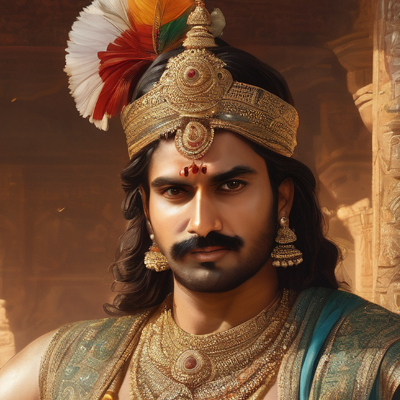
Vajra (Vajranabha) — Last Surviving Yadu, King of Mathura, Builder of the First Krishna Temples
Vajra · Vajranabha · Vajranābha · Aniruddha-putra · Yadu-shesha · Mathura-adhipati · Braj-sthapaka · Usha-putra · Krishna-prapautra
Vajra — also known as Vajranabha or Vajranabhi — is the son of Aniruddha and Usha, the great-grandson of Krishna and Rukmini, and the grandson of Banasura through his mother's line. He is the sole surviving male of the Yadu dynasty after the Mausala Parva's catastrophic club-war at Prabhasa — in which virtually every Yadava prince perished — making him the thread through which the most celebrated dynasty of the Dvapara Yuga continued into the Kali Yuga. He was crowned king of Mathura and Indraprastha by Arjuna at Krishna's own request before the Pandavas departed on their great journey north. He is celebrated in the tradition primarily for the devotional and architectural work of his reign: guided by the sage Sandilya and with the assistance of Parikshit, he rebuilt the sacred landscape of Braj Mandala — restoring the sites of Krishna's childhood leelas to their sacred identity — and commissioned sixteen idols of Krishna carved from an imperishable stone called Braja, which he enshrined in temples across Mathura and Vrindavan. These temples and their presiding deities — Govindaji, Madana Mohan, and Gopinath among them — form the sacred geography that was rediscovered by Chaitanya Mahaprabhu in the 16th century and that remains the heart of Vaishnava pilgrimage to this day.
✦ The Names
The Sanskrit name Vajra means thunderbolt, diamond, the hardest substance — the weapon of Indra, the symbol of indestructible strength, the hardest of all materials. It is the same word that gives Vajrayana — the diamond vehicle of Buddhist tantra — and Vajrasana — the diamond throne. The extended name Vajranabha — formed from vajra (diamond) and nabha (navel, sky, centre) — means he whose navel is like a diamond or he at the diamond centre. The Alchetron source confirms: the name Vajra means thunderbolt or diamond; a Vajra is a virtual object that represents firmness of spirit and spiritual power. The Wisdomlib concept entry records that Vajra as the grandson of Krishna is designated as the future king at Shakraprastha — Indraprastha — signifying the continuation of leadership within the Vrishni lineage. He is also the founding ancestor of the Jadon Rajput clan and the founder of the historical Braj region.
✦ Lineage
- Father: Aniruddha — son of Pradyumna; grandson of Krishna; fourth of the Chatur-Vyuha; killed in the Mausala Parva
- Mother: Usha — daughter of Banasura; granddaughter of Mahabali; whose love story with Aniruddha set in motion the greatest divine battle of the Dvapara Yuga; note: the Rukmavati Wikipedia article names Rochana rather than Usha as Vajra's mother — a textual inconsistency in the Puranas not definitively resolved
- Paternal grandfather: Pradyumna — son of Krishna and Rukmini; avatar of Kamadeva; killed in the Mausala Parva
- Paternal great-grandfather: Krishna — eighth avatar of Vishnu; Svayam Bhagavan; whose departure from the world preceded the Kali Yuga
- Paternal great-grandmother: Rukmini — first wife of Krishna; incarnation of Lakshmi
- Maternal grandfather: Banasura — thousand-armed Asura king; immortal attendant of Kailasha; through whom Vajra is descended from Mahabali, Prahlada, Hiranyakashipu, and Kashyapa
- Maternal great-grandfather: Mahabali — Asura emperor; Chiranjivi; future Indra of the Savarni Manvantara
- Son (per Vishnu Purana): Bahu — his son, and Bahu's son Sucharu, through whom the line continued
- Contemporary: Parikshit — grandson of Arjuna; crowned king of Hastinapur and Indraprastha at the same time Vajra was crowned king of Mathura; the two kings who inherited the post-Mahabharata world
✦ The Mausala Parva and the Rescue
After the great club-war at Prabhasa in which virtually every Yadava prince — including Pradyumna, Aniruddha, Satyaki, Samba, and Kritavarma — perished, and after Krishna and Balarama both departed the world, Dvaraka was submerged by the ocean seven days later. Arjuna came from Hastinapur to Dvaraka to escort the survivors — the elderly, the women, the children — to safety. After Krishna left for Vaikuntha, about 36 years after the Kurukshetra War, Arjuna went to Dvaraka to bring the last surviving Yadus — that is, Krishna's great-grandson Vajra and the Yadava wives and elderly people — to safety in Hastinapur. On the journey north, the party was attacked by bandits — the Abhiras — who overpowered even Arjuna in a striking episode of the Mahabharata's closing books, carrying off many of the Yadava women. This defeat deeply shook Arjuna, who understood it as the final evidence of the Kali Yuga's arrival: the same weapons that had served him at Kurukshetra failing him completely in the protection of the helpless. Vajra was safely brought to Hastinapur.
✦ Coronation as King of Mathura
Before the Pandavas departed on their great northward journey — their final pilgrimage to the Himalayas — Vajra was crowned as the King of Indraprastha on the request of Krishna by the Pandavas after the Yadava fratricide just before the Pandavas' exile. The Alchetron and Jatland sources are more specific: Arjuna proclaimed Vajra as king of Mathura at Indraprastha. The Vishnu Purana source records him as the king of Mathura specifically — the city of Krishna's birth — while Parikshit, Arjuna's grandson, inherited Indraprastha and Hastinapur. The arrangement established the two young kings as the custodians of the post-Mahabharata world: Parikshit the Kuru king and Vajra the Yadu king, inheriting their respective ancestral cities.
✦ The Desolation of Mathura — Meeting with Parikshit
The Jatland source records a poignant episode from Vajra's early reign. When Parikshit came to visit Mathura to inquire about Vajra's welfare, Vajra welcomed him with great respect. When Parikshit asked if he needed any help, Vajra replied with the words that became the foundation of the entire project of Braj restoration: although I am now the King of Mathura, I am unable to enjoy the rule. The happiness of a kingdom is due to the people that live there, and I have no idea where the residents of this place have gone. Mathura is deserted. Parikshit immediately sent for Sage Sandilya — a preceptor to King Nanda, Krishna's foster father — to guide them. Sandilya explained the sacred geography of Braj: that Vrindavan was Krishna's childhood home, that Braja meant omnipresent, and that Vajra needed to revitalise the landscape with the energy of Krishna's presence — to restore the sites of the leelas so that the land itself became a living sanctuary.
✦ The Sixteen Idols — The Founding of Braj Mandala
Vajra had never seen Krishna — he had only heard stories from his grandmother Usha and others who had known the divine form directly. Inspired by the sacred importance of preserving Krishna's image for future generations, he commissioned sixteen idols of Krishna and other gods carved from an imperishable stone called Braja. The Alchetron and Tales of Sanatan sources record that he first had three idols carved from Uttara's written description — Uttara was Abhimanyu's wife and Parikshit's mother, who had personally seen Krishna during her lifetime and left a detailed account of his appearance. None of the three initial idols perfectly captured the complete form: Govindaji resembled the face; Madana Mohan resembled the navel down to the lotus feet; and Gopinath resembled the trunk of the body from the navel to the neck. Together these three principal idols formed the complete image of Krishna across three sites. The four presiding deities of Braj Mandala — Sri Harideva of Govardhan, Sri Keshava Deva of Mathura, Sri Baladeva of Baladeo, and Govindaji of Vrindavan — are among the deities Vajra established. The Krishna Janmbhoomi Temple complex at Mathura is traditionally traced to Vajranabha as its original founder — believed to have built the first temple at Krishna's birthplace approximately 5,000 years ago.
✦ Rediscovery by Chaitanya Mahaprabhu
The temples Vajra built were eventually destroyed or forgotten — buried during successive invasions and periods of abandonment — Vrindavan becoming an overgrown forest and the idols' locations lost to memory. In the 16th century, the saint Chaitanya Mahaprabhu visited Vrindavan, and guided by meditation and ancient scriptures — including the Bhagavata Purana passages that mentioned Vajranabha's idols — identified the sacred sites and directed his disciples to excavate and restore them. The idols were rediscovered; the temples were rebuilt; the six Gosvamis of Vrindavan established the scholarly and devotional infrastructure of Vaishnava pilgrimage at the sites Vajra had first consecrated. The great Govindaji temple of Vrindavan, the Madana Mohan temple, and the Gopinath temple — all originally founded by Vajranabha — stand today as the oldest continuously venerated Vaishnava sacred sites in the Braj region.
✦ In the Vishnudharmottara Purana
The Vishnudharmottara Purana — an encyclopaedic Upapurana on Vaishnava theology, iconography, and sacred geography — is structured as a dialogue between the sage Markandeya and King Vajra. Vajra is the primary interlocutor who asks the questions that prompt the Purana's extensive teaching on diverse topics — from cosmology, astronomy, and geography to painting, sculpture, dance, and temple architecture. His role as the questioner in this important Upapurana establishes him not only as a historical king but as a canonical figure of Vaishnava textual transmission — the great-grandson of Krishna through whom much of the tradition's encyclopaedic knowledge was formally organised.
✦ References
- Bhagavata Purana — Canto 10 (Aniruddha and Usha's episode; Vajra as their son); Canto 11 (Mausala Parva; the survivors; Vajra's survival); Canto 12 (Vajra as the last Yadu king; the continuation of the dynasty into the Kali Yuga)
- Vishnu Purana (Book 4, Chapter 15) — Aniruddha married Subhadra (Rukmi's granddaughter) and she bore him Vajra; Vajra's son Bahu and grandson Sucharu; the Yadu lineage continuing beyond Vajra
- Mahabharata — Mausala Parva: the club-war at Prabhasa; Arjuna's journey to Dvaraka; the rescue of Vajra and the Yadava survivors; the attack by the Abhiras; Arjuna crowning Vajra king of Mathura
- Vishnudharmottara Purana — the entire Purana structured as a dialogue between Markandeya and Vajra; Vajra as primary questioner and interlocutor on Vaishnava theology, iconography, and sacred geography
- Bhagavata Purana passages cited in the Bhaktivedanta Purport tradition — Vajranabha's sixteen idols; the restoration of Braj Mandala; Chaitanya's rediscovery as recorded in the Gaudiya Vaishnava tradition
- Wikipedia — Aniruddha; Wikipedia — Rukmavati (conflicting account of Vajra's mother); Jatland Wiki — Vajra; Alchetron — Vajra (king); Tales of Sanatan — Krishna's Idols Created by Vajranabha; Mathura Vrindavan City — Krishna Janmbhoomi; Wisdomlib — Vajra (concept); Wisdomlib — Vishnudharmottara Purana Study: modern summaries drawing from the above primary sources