
About
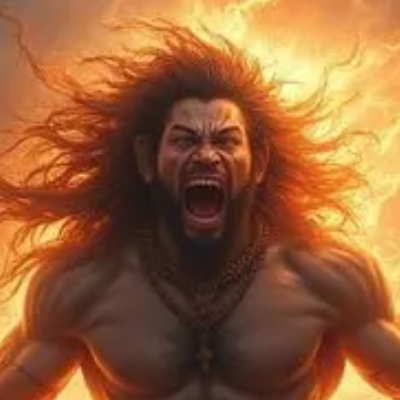
Viprachitti — Elder Danava, King of the Danava Race
Viprachitti · Vipracitti · Vipracitta · Sainhikeya (by progeny) · Danavendra
Viprachitti is the eldest of the Danavas — the class of powerful asuras born of the sage Kashyapa and his wife Danu, a daughter of Daksha the progenitor-patriarch. He is named in the Mahabharata's Adi Parva as the foremost among the thirty-three or more notorious offspring of Danu, with Shambara and the rest among his younger brothers. His marriage to Simhika — herself a daughter of Kashyapa by Diti, and therefore a Daitya princess and sister of Hiranyakashipu and Hiranyaksha — bridges the two great asura lineages of the Kashyapa clan. From this union were born a formidable progeny, most significantly Swarbhanu, who is identified with Rahu the shadow-planet and cause of eclipses, along with Vatapi, Namuchi, Ilvala, and others whose names recur throughout the epics and Puranas as antagonists of gods and sages. Viprachitti appears in the Mahabharata's Adi Parva, Sabha Parva, Shalya Parva, and Shanti Parva; in the Vishnu Purana; the Bhagavata Purana; the Vayu Purana; the Shiva Purana; the Brahmanda Purana; and he is identified in the Mahabharata's Adi Parva as the previous life of Jarasandha, the mighty king of Magadha who becomes a principal antagonist of Krishna and the Pandavas.
✦ The Name
The name Viprachitti is a Sanskrit compound of vipra meaning a learned one, a brahmin, or one of keen intelligence, and citti or citta meaning thought, mind, or consciousness; together the compound means one of learned or penetrating mind, or one possessed of profound consciousness. The Monier-Williams Sanskrit dictionary notes the adjective form vipracitti meaning sagacious, attested in the Taittiriya Brahmana, and gives Viprachitti as a name of a Danava who is the father of Rahu, attested in the Suparnadhyaya and the Mahabharata. The same dictionary also records a Viprachitti as the name of a teacher or preceptor in the Brihadaranyaka Upanishad, and as a feminine name for an Apsara in the Vishnu Purana, all of which are distinct from the Danava figure treated in this profile. The name Danavendra, meaning lord of the Danavas, is an appropriate descriptive designation for his role as the elder and eventually the king of the Danava race.
✦ Lineage
- Father: Kashyapa — one of the seven primordial sages, son of Marichi and grandson of Brahma; husband of numerous daughters of Daksha; the supreme progenitor of gods, demons, serpents, birds, and all principal classes of beings in the Puranic cosmos. Kashyapa is simultaneously the father of both the Danavas through Danu and the Daityas through Diti, making Viprachitti and his Daitya half-siblings all descendants of the same patriarch.
- Mother: Danu — a daughter of Daksha; one of Kashyapa's wives; mother of the Danava race; the Vishnu Purana lists thirty-three Danavas among her sons, with Viprachitti the eldest, while the Mahabharata gives a figure of forty and other Puranas vary; her name gives the Danava race their designation.
- Elder half-siblings through Kashyapa's other wives (selected): The Adityas born of Aditi — including Indra, Viprachitti's principal divine adversary; the Daityas born of Diti — including Hiranyakashipu and Hiranyaksha; the avian Vainateyas born of Vinata — Aruna and Garuda; and the Naga race born of Kadru.
- Brothers among the Danavas (per Vishnu Purana, Book I, Chapter 21): Dvimurdha, Shankara, Ayomukha, Shankushiras, Kapila, Shambara, Ekachakra, Taraka, Swarbhanu, Vrishaparvan, and Puloman, among the principal named Danavas born of Danu alongside Viprachitti.
- Wife (principal account, Vishnu Purana): Simhika — a daughter of Kashyapa and Diti; sister of Hiranyakashipu and Hiranyaksha; a Daitya princess whose name means lioness and who is described in the Ramayana as a monstrous being possessing the power to seize victims by capturing their shadow. Through this marriage Viprachitti is the father of Simhika's Daitya line's most significant progeny.
- Wife (variant, Wikipedia and Padma Purana): Holika — described as a sister of Hiranyakashipu and a daughter of Diti; distinguished from Simhika in some sources but treated as equivalent or confused with her in others; see the textual variants section below.
- Sons by Simhika (per Vishnu Purana, Book I, Chapter 21): Vyamsha, Shalya the strong, Nabha the powerful, Vatapi, Namuchi, Ilvala, Khasrima, Anjaka, Naraka, Kalanabha, Swarbhanu — identified with Rahu the shadow-planet — and Vaktrayodhi. The Bhagavata Purana and Vayu Purana additionally affirm Rahu and Ketu as sons of this union, with Rahu named as the eldest of the progeny by Simhika in those sources. Together these sons form a branch of the asura race whose members recur throughout the epics and Puranas as formidable adversaries of gods, sages, and heroes.
✦ The Danava Lineage and Viprachitti's Position Within It
The Danavas are one of the two principal asura races born of Kashyapa, the other being the Daityas born of Diti. While the Daityas are generally the more prominent antagonists in the central Puranic narratives — with Hiranyakashipu, Hiranyaksha, and Bali among their most celebrated figures — the Danavas are no less cosmologically significant. The Vishnu Purana places Viprachitti at the head of the Danava list, naming him the most powerful of Danu's sons and listing his brothers beneath him. The Brahmanda Purana's chapter on the race of Danu similarly emphasises Viprachitti's preeminent position within that lineage. The Mahabharata's Adi Parva at Chapter 65 verse 25 names Viprachitti as the eldest of Danu's thirty-three asura sons and specifies Shambara and the rest as younger. His seniority and power made him the natural leader and ultimately the king of the Danavas after the death of his brother Puloman.
✦ Kingship of the Danavas
The Surya Purana, as noted in secondary sources, records that Viprachitti ascended to the kingship of the Danavas after his brother Puloman was slain by Indra. Puloman had a daughter named Shachi, whom Indra had taken as his consort; the conflict arising from this abduction eventually led to Puloman's death at Indra's hands. With Puloman gone, Viprachitti — the eldest of Danu's sons — became the acknowledged leader and king of the Danava race. This position placed him at the head of the ongoing cosmic conflict between the asura and deva forces that runs through the Puranic and epic tradition.
✦ Marriage to Simhika and the Union of Danava and Daitya Lines
Viprachitti's marriage to Simhika, as established in the Vishnu Purana at Amsha 1 Chapter 15, is genealogically among the most consequential unions in the asura cosmology. Simhika is a daughter of Kashyapa and Diti, making her the sister of Hiranyakashipu — the great Daitya tyrant whose son Prahlada became Vishnu's supreme devotee — and of Hiranyaksha, who seized the earth and was slain by Vishnu in the Varaha avatar. By marrying Simhika, Viprachitti united the two great asura lineages of Kashyapa's household: his own Danava descent through Danu and the Daitya line through Diti. Both he and Simhika are thus children of Kashyapa through different mothers, making their marriage an intra-lineage union across half-sibling branches, a feature the primary texts record without comment. Their sons Vyamsha, Shalya, Nabha, Vatapi, Namuchi, Ilvala, Khasrima, Anjaka, Naraka, Kalanabha, Swarbhanu, and Vaktrayodhi became the main propagators of the Danava-Daitya combined race through succeeding generations.
✦ Swarbhanu — Rahu — the Most Celebrated Son
The most cosmologically significant of Viprachitti's sons is Swarbhanu, identified across the Bhagavata Purana, the Vayu Purana, and related texts with Rahu, the shadow-planet held responsible for solar and lunar eclipses in the Vedic astronomical and astrological tradition. According to the narrative of the Samudra Manthan — the churning of the cosmic ocean — Swarbhanu disguised himself as a deva in order to consume the amrita, the nectar of immortality that emerged from the churning and was being distributed among the gods by Vishnu in the form of the enchantress Mohini. The sun god Surya and the moon god Soma recognised the impostor and reported him to Vishnu, who immediately severed Swarbhanu's head with his Sudarshana Chakra. Because Swarbhanu had already swallowed some of the amrita, however, his head and his body each became immortal. The head became Rahu and the body became Ketu. The Bhagavata Purana names Rahu as the eldest of the Sainhikeyas — the progeny of Simhika — and the Vayu Purana similarly confirms this. Rahu's subsequent enmity toward Surya and Soma — the two who exposed him — is the Puranic explanation for solar and lunar eclipses: Rahu periodically swallows these luminaries to avenge the betrayal, but since he has no body to hold them, they pass through and emerge again. Viprachitti is therefore the father of the being whose immortal head controls the eclipse cycles of the cosmos.
✦ Episodes in the Mahabharata
The Mahabharata records Viprachitti in several distinct contexts. The Sabha Parva at Chapter 9 verse 12 places him in the palace of Varuna, the god of cosmic waters and law, where he is among the assembled powerful beings praising and glorifying Varuna — an image that locates even the Danava king within the broader divine ceremonial order. The Sabha Parva's southern recension passage at Chapter 38 records that when Vishnu took the form of Vamana — the dwarf avatar — and began to measure the three worlds with three cosmic strides in the episode of King Bali's dispossession, Viprachitti along with other asuras surrounded Vamana in opposition. The Shalya Parva at Chapter 31 verse 12 contains the statement that in former times Mahavishnu, having assumed the form of Indra, killed Viprachitti. The Shanti Parva at Chapter 47 verse 11 separately records that Viprachitti was killed by Indra in the war between the devas and the asuras. These two statements — Vishnu as Indra killing him, and Indra directly killing him — represent either a variant tradition or two separate events described in different portions of the text; the primary sources do not harmonise them. The Adi Parva at Chapter 67 verse 4 states plainly that Viprachitti was reborn as Jarasandha.
✦ Rebirth as Jarasandha
The Mahabharata's Adi Parva at Chapter 67 verse 4 identifies Viprachitti as the previous birth of Jarasandha, king of Magadha. Jarasandha is one of the most formidable human antagonists of the Mahabharata's period: a mighty king whose daughter Asti was married to Kamsa, the maternal uncle of Krishna; who conducted repeated campaigns against Mathura and drove Krishna and the Yadavas from the city to establish Dwaraka; and who performed the ritual sacrifice of defeated kings in honour of Shiva until he held nearly a hundred kings captive. Jarasandha was eventually killed by Bhima in a wrestling match arranged by Krishna and Arjuna in the guise of brahmins, after a protracted combat of twenty-eight days. The identification of Viprachitti as Jarasandha's previous incarnation places the Danava king's asura nature in continuity with the human antagonist of the Dvapara Yuga — the same spirit of opposition to the cosmic and divine order persisting across a rebirth from demon to king.
✦ Textual Variants and Inconsistencies
The principal textual inconsistency regarding Viprachitti concerns the identity of his wife. The Vishnu Purana at Amsha 1 Chapter 15 names her as Simhika, identifies her explicitly as the daughter of Kashyapa and Diti and the sister of Hiranyakashipu and Hiranyaksha, and lists their sons. The Puranic Encyclopaedia, drawing on this and other primary passages, confirms Simhika as the wife. The Wikipedia article on Viprachitti, by contrast, names the wife as Holika, described as a sister of Hiranyakashipu and daughter of Diti. The Religion Fandom source similarly names her as Holika. Holika and Simhika are two distinct figures in the Puranic tradition: Holika is the sister of Hiranyakashipu who possessed the boon of immunity from fire and who entered a pyre with Prahlada intending to destroy the boy, only to be consumed herself, an event commemorated in the festival of Holi. Simhika is the mother of Rahu and possessor of the shadow-seizing power. The two figures share the same relationship to Hiranyakashipu — both are his sisters — but are otherwise distinct in their narratives and their attributed powers. The primary Puranic sources consistently name Simhika as Viprachitti's wife and the mother of Rahu and his siblings. The identification with Holika appears to derive from secondary sources and the Padma Purana, but the Vishnu Purana and Mahabharata evidence firmly supports Simhika as the primary and historically dominant account.
Regarding the number of Danu's sons: the Mahabharata's Adi Parva and various Puranas give different totals — thirty-three, forty, and one hundred are all attested across the tradition. The Vishnu Purana's list of named Danavas gives twelve prominent names without claiming to be exhaustive. These variations reflect the different genealogical traditions preserved across texts compiled at different periods and do not represent fundamental contradictions about Viprachitti's own position as the eldest.
The two Mahabharata passages on Viprachitti's death — one attributing it to Vishnu taking Indra's form (Shalya Parva), the other to Indra directly (Shanti Parva) — represent a minor internal inconsistency within the epic that the text does not resolve.
✦ The Name Viprachitti in Other Contexts
The Monier-Williams dictionary records Viprachitti as a name of a teacher or preceptor in the Brihadaranyaka Upanishad at passages 2.6.3 and 4.6.3, where it appears in a lineage of teachers. This Viprachitti belongs to the brahminical instructional tradition and has no stated connection to the Danava. The Vishnu Purana also uses Viprachitti in its feminine form as the name of an Apsara, a celestial dancer. These usages of the same name in entirely different contexts are noted here to prevent confusion; none of them are the subject of this profile.
✦ Connection to the Wider Genealogy
Viprachitti stands at one of the most consequential genealogical junctions in the Puranic cosmos. As the eldest Danava he heads the Danava line of Kashyapa. Through his marriage to Simhika he consolidates the Danava and Daitya branches of Kashyapa's asura progeny into a single powerful combined lineage. Through his son Swarbhanu-Rahu he is the father of one of the nine celestial bodies of Vedic astrology, a being whose cosmic function — causing eclipses — is permanent and universal. Through his identification with Jarasandha's previous life the same asura force is carried into the human era of the Dvapara Yuga, making him genealogically present in the Mahabharata's narrative world through two different modes of existence. He is the counterpart, on the asura side of the Kashyapa lineage, to Garuda on the divine side: both are the eldest or foremost of their respective races, and both were ultimately subject to Vishnu's cosmic authority, Garuda through consent and Viprachitti through defeat.
✦ References
- Mahabharata, Adi Parva, Chapter 65, verse 25: Names Viprachitti as the eldest of Danu's thirty-three asura sons; lists Shambara and the rest as younger brothers; the primary epic genealogical source.
- Mahabharata, Adi Parva, Chapter 67, verse 4: States that Viprachitti was reborn as Jarasandha, king of Magadha; the primary source for the rebirth identification.
- Mahabharata, Sabha Parva, Chapter 9, verse 12: Places Viprachitti among the powerful beings gathered in Varuna's palace offering praise.
- Mahabharata, Sabha Parva, southern recension, Chapter 38: Records that Viprachitti and other asuras surrounded Vamana during the measurement of the three worlds.
- Mahabharata, Shalya Parva, Chapter 31, verse 12: States that Mahavishnu in the form of Indra killed Viprachitti in former times.
- Mahabharata, Shanti Parva, Chapter 47, verse 11: States that Viprachitti was killed by Indra in the war between devas and asuras; the variant account of his death.
- Vishnu Purana, Amsha 1, Chapter 21: Lists Viprachitti among the principal Danavas born of Kashyapa and Danu; names his twelve sons by Simhika; establishes the genealogical framework for the Danava race.
- Vishnu Purana, Amsha 1, Chapter 15: Identifies Simhika as the wife of Viprachitti, her parentage as daughter of Kashyapa and Diti, and her relationship as sister of Hiranyakashipu and Hiranyaksha.
- Bhagavata Purana and Vayu Purana: Affirm Rahu and Ketu as sons of Viprachitti and Simhika; name Rahu as the eldest of the Sainhikeyas; provide the eclipse mythology associated with Swarbhanu's immortalisation.
- Brahmanda Purana, Chapter 6 (Glorification of the Race of Danu): Elaborates on the Danava lineage with Viprachitti as its elder figure.
- Shiva Purana, Chapter 32 (Description of Creation, Family of Kashyapa): Names Viprachitti as a son of Danu and notes his powerful son Dambha as a devotee of Vishnu; contributes the account of Viprachitti's lineage continuing through the Danava line.
- Vettam Mani, Puranic Encyclopaedia (1975): Modern reference; consolidates all primary source references for Viprachitti across the Mahabharata and Puranic texts; the most complete secondary synthesis available.
- Wisdomlib.org, Vipracitti definition entry: Modern reference; compiles the Puranic Encyclopaedia account with additional source citations from the Shiva Purana and the Monier-Williams dictionary entries.
- Monier-Williams Sanskrit-English Dictionary: Modern reference; provides etymological analysis of Viprachitti and lists all distinct usages of the name across the scriptural tradition, distinguishing the Danava, the Upanishadic teacher, and the Apsara.