
About
Rahu — The Severed Head, Shadow Planet, Cause of Solar Eclipse
Rahu · Swarbhanu · Sainhikeya · Rahuketu · Bhayanaka · Tamasa
Rahu is the immortal severed head of the asura Swarbhanu, son of Viprachitti — the eldest of the Danavas born of Kashyapa and Danu — and of Simhika — a Daitya princess, daughter of Kashyapa and Diti, and sister of Hiranyakashipu. During the Samudra Manthan, the churning of the cosmic ocean, Swarbhanu disguised himself as a deva to consume the amrita, the nectar of immortality. Discovered by Surya the sun god and Soma the moon god, he was decapitated by Vishnu with the Sudarshana Chakra before the amrita had passed his throat. Because the amrita had already been swallowed, the severed head became immortal; this head is Rahu. The headless body became Ketu. Rahu is counted among the Navagraha, the nine celestial bodies of Vedic astrology, as the ascending lunar node — the north node of the moon. He is understood as the cause of solar eclipses, periodically swallowing Surya in retribution for the sun's betrayal. Rahu appears in the Bhagavata Purana, the Vishnu Purana, the Vayu Purana, the Mahabharata, and the Matsya Purana, among other primary sources.
✦ The Names
The name Rahu derives from a Sanskrit root associated with seizing, grasping, or swallowing; it conveys the sense of one who seizes or takes hold, directly appropriate to the eclipse mythology in which Rahu swallows the sun. The pre-decapitation name Swarbhanu is a compound of svar meaning heaven or the celestial realm and bhanu meaning light, brightness, or the sun; it therefore means one of heavenly radiance or celestial brilliance — an ironic name in retrospect, given that Swarbhanu's most significant act is to extinguish that celestial light by swallowing it. The epithet Sainhikeya means son of Simhika, identifying him by his maternal lineage. Rahuketu is a name that treats the head and body as a single compound being, appearing in some texts before the clear distinction between Rahu and Ketu was fully established. The Rigveda uses the word svarbhanus in certain passages in a cosmological context, and some scholars connect this to the later mythological figure, though the textual identification is not uniform across scholarly opinion.
✦ Lineage
- Father: Viprachitti — eldest of the Danava race, son of Kashyapa and Danu; king of the Danavas after his brother Puloman's death; identified in the Mahabharata's Adi Parva as the previous life of Jarasandha.
- Mother: Simhika — daughter of Kashyapa and Diti; sister of Hiranyakashipu and Hiranyaksha; a Daitya princess whose name means lioness; described in the Valmiki Ramayana as a monstrous being capable of seizing victims by catching their shadow, which she attempted against Hanuman as he flew over the ocean toward Lanka.
- Paternal grandfather: Kashyapa — one of the seven primordial sages; also Rahu's maternal grandfather, since both Viprachitti's mother Danu and Simhika's mother Diti are daughters of Daksha and wives of Kashyapa; Rahu is thus doubly a grandchild of Kashyapa.
- Maternal uncles: Hiranyakashipu — the great Daitya tyrant slain by Vishnu in the Narasimha avatar; and Hiranyaksha — the Daitya who seized the earth and was slain by Vishnu in the Varaha avatar.
- Brothers (by Simhika, per Vishnu Purana): Vyamsha, Shalya, Nabha, Vatapi, Namuchi, Ilvala, Khasrima, Anjaka, Naraka, Kalanabha, and Vaktrayodhi. The Bhagavata Purana and Vayu Purana name Rahu as the eldest of all Simhika's sons. The Vayu Purana states that these other sons of Simhika were all ultimately slain by Parashurama.
- Sibling: Ketu — the headless body of Swarbhanu, which became the descending lunar node; perpetually separated from Rahu yet always positioned directly opposite him in the celestial order, one hundred and eighty degrees apart.
- Daughter (per Vishnu Purana): Swarbhanu, listed among the Danavas in the Vishnu Purana's Chapter 21, had a daughter named Prabha before the decapitation. This is a distinct Swarbhanu listed as a Danava among Danu's sons in that chapter, not the son of Viprachitti, though the name overlap creates potential confusion; the footnote to the Vishnu Purana's Wilson translation notes this ambiguity.
✦ The Samudra Manthan and the Decapitation
The foundational narrative of Rahu's origin is narrated in the Bhagavata Purana, the Vishnu Purana, and the Mahabharata's Adi Parva, with variations across sources. In the principal account, the gods and the asuras undertook together the churning of the cosmic ocean — using Mount Mandara as the churning rod and Vasuki the serpent king as the rope — in order to produce the amrita, the nectar of immortality, which had sunk to the depths. Many treasures emerged from the churning, including the goddess Lakshmi, the divine physician Dhanvantari bearing the pot of amrita, and the deadly poison Halahala which Shiva consumed to save the cosmos. When the amrita was finally produced and it came time to distribute it, Vishnu took the form of Mohini — an enchanting female figure — and undertook to distribute the nectar. Mohini arranged the gods and the asuras in separate rows and gave the nectar exclusively to the gods.
Swarbhanu, described as the most perceptive among the asuras, recognised the deception. He slipped away from the asura row and seated himself between Surya and Soma among the gods, thereby receiving a portion of the amrita and swallowing it. Surya and Soma recognised him as an asura and alerted Vishnu. Vishnu immediately abandoned the Mohini form, revealed himself, and hurled the Sudarshana Chakra, the spinning discus weapon, at Swarbhanu. The Chakra severed his head from his body. However, because the amrita had already entered his throat and been swallowed before the beheading, both the head and the body had absorbed enough of the nectar to become immortal. The head became Rahu; the body became Ketu.
In some accounts, Brahma had previously granted Swarbhanu the status of a planet — a graha — as a boon for his austerities, with the fulfilment of this boon deferred to a future time. The decapitation and immortalisation brought this boon into effect: Rahu and Ketu together became the two shadow grahas, the ninth and a supplementary entity among the Navagraha, the nine celestial bodies of Vedic reckoning.
✦ Eclipse Mythology — Rahu and the Sun and Moon
The Puranic tradition's explanation for solar and lunar eclipses is rooted entirely in Rahu's act of vengeance against Surya and Soma for their betrayal at the distribution of the amrita. Rahu, as an immortal disembodied head, periodically swallows Surya, causing a solar eclipse, and swallows Soma, causing a lunar eclipse. Because Rahu has no body and no stomach, the swallowed luminaries pass through his severed neck and immediately re-emerge, which is why eclipses are brief. The sun and moon are visible again within minutes. This cosmological narrative maps directly onto the astronomical reality of the lunar nodes: a solar eclipse occurs when the moon is near the ascending node of its orbit at new moon, and a lunar eclipse occurs when the moon is near the descending node at full moon. In Vedic astronomical reckoning, these intersection points are identified with Rahu and Ketu respectively, giving the mythological narrative a precise astronomical correlate.
✦ Appearances in the Epics and Puranas
Beyond the foundational birth narrative, Rahu appears in several other contexts across the primary sources. The Mahabharata's Adi Parva at Chapter 17 records that during the distribution of the amrita, Surya and Soma identified Swarbhanu as the asura in disguise; from this moment Rahu harboured a permanent enmity against both luminaries and attacked them periodically. The Valmiki Ramayana features Simhika — Rahu's mother — as a creature encountered by Hanuman during his flight over the ocean to Lanka; she attempts to seize him by capturing his shadow, and Hanuman destroys her. The Bhagavata Purana at Skandha VIII contains the most detailed Puranic account of the Samudra Manthan and Swarbhanu's decapitation. The Vishnu Purana lists Rahu and Ketu among the Sainhikeyas — the sons of Simhika — and notes that the Vayu Purana specifies them as the two most celebrated of these, with Rahu as the eldest. The Suparnadhyaya, a late Vedic period composition, also names Viprachitti as the father of Rahu.
✦ Rahu in Vedic Astrology
In the Vedic astrological tradition codified in texts such as the Brihat Parashara Hora Shastra, Rahu is the ascending or north lunar node — the point where the moon's orbital path crosses the sun's ecliptic path from south to north. He is counted as the eighth or ninth among the Navagraha. His orbital cycle, shared with Ketu and always diametrically opposite, is approximately eighteen and a half years. He moves in retrograde motion relative to the other planets. He is classified as a shadow planet — chaya graha — because he has no physical body and no light of his own; his power is real but his physical existence is of a different order from that of the other grahas. In the astrological framework, Rahu is associated with worldly ambition, material desire, illusion, deception, foreign connections, and the realm of the unconventional. His period in the Vimshottari dasha system lasts eighteen years. The three nakshatras he governs are Ardra, Swati, and Shatabhisha.
✦ Iconography
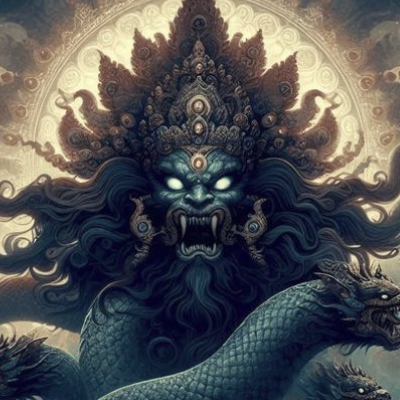
Rahu is depicted in iconographic tradition as a disembodied head — the head of an asura with a dark complexion, fierce expression, and in many representations a serpent's body attached below the neck in place of a human torso, since he has no human body. He is shown wearing regal ornaments and attire appropriate to his status as the eldest of the Sainhikeyas. In some traditions he rides a tiger as his vahana. His depiction always contrasts with Ketu, who bears the complementary form: a serpent's or smoke-like head on a human torso. In Navagraha temple arrangements, Rahu and Ketu are placed at the periphery or at specific directional positions, treated as a pair despite their mythological opposition.
✦ Textual Variants and Inconsistencies
The Vishnu Purana's Chapter 21 lists a Swarbhanu among the Danavas — the sons of Danu, Viprachitti's mother — with a daughter named Prabha, appearing to treat Swarbhanu as a Danava in his own right separate from being described as a son of Viprachitti by Simhika. This creates an ambiguity: one reading places Swarbhanu as a full Danava on Danu's side; another, supported by the Bhagavata Purana and Vayu Purana, places him as the eldest son of Viprachitti by Simhika, combining Danava and Daitya descent. The Wilson translation's footnote to the Vishnu Purana acknowledges this difficulty. Most Puranic sources, including the Bhagavata Purana's Skandha VIII account, treat the Samudra Manthan Swarbhanu as the son of Viprachitti and Simhika, which is the position adopted in this profile.
The Mahabharata's version of the Samudra Manthan, found in the Adi Parva, differs from the Bhagavata Purana's version in several details — including whether Vishnu took the Kurma avatar to support the mountain, and the precise sequence of events — but is consistent in the essential fact of Swarbhanu's decapitation by Vishnu and his transformation into Rahu. The identification of Rahu and Ketu as the two shadow nodes and their perpetual enmity toward the sun and moon is consistent across all major sources.
✦ Connection to the Wider Genealogy
Rahu stands at a genealogical crossroads that concentrates the asura lineage of Kashyapa in a single figure. Through his father Viprachitti he is a grandson of Kashyapa through Danu, the Danava line. Through his mother Simhika he is a grandson of Kashyapa through Diti, the Daitya line. He is therefore doubly a grandchild of Kashyapa and doubly connected to the same patrilineal sage who also fathered the Adityas through Aditi, the gods through their divine line. Rahu's permanent enmity with Surya — who is himself an Aditya, a son of Kashyapa through Aditi — makes the eclipse mythology an intra-family conflict within the extended progeny of Kashyapa, a fact the tradition does not foreground but which is structurally present in the genealogical record.
✦ References
- Bhagavata Purana, Skandha VIII (Samudra Manthan section): Primary and most detailed Puranic source for the churning narrative, Swarbhanu's disguise, his recognition by Surya and Soma, his decapitation by Vishnu, and the creation of Rahu and Ketu.
- Vishnu Purana, Amsha 1, Chapter 9 (Samudra Manthan) and Chapter 21 (genealogy): Narrates the churning and decapitation; lists the Sainhikeyas including Rahu and Ketu as sons of Simhika; notes the Vayu Purana's identification of Rahu as the eldest.
- Mahabharata, Adi Parva, Chapter 17 (Astika Parva section): Records the episode of Surya and Soma identifying Swarbhanu at the amrita distribution; establishes the permanent enmity between Rahu and the two luminaries as the cause of eclipses.
- Mahabharata, Adi Parva, Chapter 65, verse 25: Names Viprachitti as the eldest Danava, establishing the paternal genealogy; the Sainhikeya sons including Rahu are mentioned in related genealogical passages.
- Vayu Purana: Names Rahu as the eldest of the Sainhikeyas; states that the other sons of Simhika were all killed by Parashurama; confirms Rahu and Ketu as the two most celebrated of Simhika's offspring.
- Matsya Purana: Contains the Samudra Manthan narrative with reference to Swarbhanu's decapitation; among the sources for Rahu's origin cited in secondary literature.
- Valmiki Ramayana, Sundara Kanda: Describes Simhika — Rahu's mother — as the creature who attempts to seize Hanuman by his shadow during his flight to Lanka; establishes Simhika's power and nature independently of the Puranic genealogical passages.
- Suparnadhyaya (late Vedic period composition): Names Viprachitti as the father of Rahu; one of the earliest literary sources for this genealogical detail, predating many of the Mahapuranas.
- Brihat Parashara Hora Shastra: The foundational Vedic astrological text; establishes Rahu's position as the ascending lunar node, his eighteen-year dasha period, the three nakshatras under his governance, and his characteristics in the horoscope.
- Vettam Mani, Puranic Encyclopaedia (1975): Modern reference; consolidates all primary source references for Rahu and Swarbhanu across the epics and Puranas.
- Wikipedia, Ketu (mythology) article: Modern secondary reference; provides the astronomical identification of Rahu and Ketu as the lunar nodes and confirms the 18.6-year orbital cycle.