
About
Ketu — The Severed Body, Shadow Planet, Cause of Lunar Eclipse
Ketu · Dhuma Ketu · Sainhikeya · Ananga · Cauda Draconis
Ketu is the immortal headless body of the asura Swarbhanu, son of Viprachitti the Danava king and Simhika the Daitya princess, produced when Vishnu severed Swarbhanu's head with the Sudarshana Chakra during the Samudra Manthan. The head became Rahu; the headless torso — body, limbs, and all — became Ketu. Like Rahu, Ketu became immortal because the amrita had been swallowed before the beheading. Ketu is counted among the Navagraha, the nine celestial bodies of Vedic astrology, as the descending lunar node — the south node of the moon. He is perpetually positioned one hundred and eighty degrees opposite Rahu in the celestial order. He is understood as the cause of lunar eclipses. Ketu shares the same primary source foundation as Rahu — the Bhagavata Purana, Vishnu Purana, Vayu Purana, Matsya Purana, and Mahabharata — since the two figures are products of the same single event. Their profiles are therefore closely related, but they diverge significantly in their astrological and theological characterisations, where Ketu is treated as a spiritually distinct and opposite force to Rahu.
✦ The Names
The name Ketu derives from a Sanskrit root associated with brightness, a flag or banner, a comet, or a distinguishing mark; it carries meanings of eminence, signal, and the kind of streaking or trailing luminosity associated with comets and flames. The name Dhuma Ketu, meaning smoke-banner or smoky comet, appears in some Puranic passages and astrological texts as an alternate designation, and it connects Ketu to the imagery of smoke, incense, and the fading trail of a flame — evoking both his headless and therefore undirected nature and his comet-like quality. Ananga means without a body or without form, from the prefix an meaning without and anga meaning body or limb — an irony, since Ketu is in fact all body and no head, rather than the reverse. Sainhikeya, meaning son of Simhika, is shared with Rahu as both are progeny of the same mother. In Western astronomical tradition, the descending lunar node corresponding to Ketu is called Cauda Draconis — the tail of the dragon — a designation that maps precisely onto Ketu's mythological identity as the lower half of a severed asura.
✦ Lineage
- Father: Viprachitti — eldest of the Danava race, son of Kashyapa and Danu; king of the Danavas; the previous birth of Jarasandha according to the Mahabharata.
- Mother: Simhika — daughter of Kashyapa and Diti; sister of Hiranyakashipu and Hiranyaksha; possessor of the power to seize beings by their shadow; encountered and slain by Hanuman during his flight to Lanka in the Valmiki Ramayana.
- Original identity: Swarbhanu — the asura whose head became Rahu and whose body became Ketu; the two are therefore not separate beings in origin but are two halves of a single being divided by the Sudarshana Chakra.
- Sibling: Rahu — the immortal head of Swarbhanu; the ascending lunar node; always positioned diametrically opposite Ketu in the celestial order; the cause of solar eclipses.
- Brothers (by Simhika): Vyamsha, Shalya, Nabha, Vatapi, Namuchi, Ilvala, Khasrima, Anjaka, Naraka, Kalanabha, and Vaktrayodhi, as named in the Vishnu Purana; the Vayu Purana states that all these brothers were eventually destroyed by Parashurama.
- Paternal and maternal grandparents: Kashyapa on both sides; Danu through Viprachitti, Diti through Simhika. Ketu is doubly a grandchild of Kashyapa, the same sage who fathered the Adityas through Aditi — including Surya, the sun god against whom Ketu shares Rahu's enmity.
✦ Origin — The Severed Body at the Samudra Manthan
The narrative of Ketu's origin is inseparable from that of Rahu, both being produced by the single act of Vishnu's decapitation of Swarbhanu at the Samudra Manthan. The full account is given in the Rahu profile above. What is specific to Ketu's identity is that it is the lower half — the body below the neck — that constitutes him. Some texts describe the serpent's body as having been formed at Ketu's neck in place of the missing head: that is, a serpent's head was placed on the human torso to give Ketu a functioning form. Other traditions simply present Ketu as headless, which is the source of his association with blind or undirected spiritual energy. The Matsya Purana states that Ketu's body is flag-shaped — dhuma ketu — suggesting a smoke-banner or comet-like form rather than a precise human outline. The Bhagavata Purana confirms Ketu's existence as the body of Swarbhanu, immortalised by the amrita, and his status as a shadow graha alongside Rahu.
✦ Eclipse Mythology — Ketu and the Moon
As Rahu causes solar eclipses by swallowing Surya, so Ketu causes lunar eclipses by swallowing Soma the moon god. Like Rahu, Ketu shares the enmity toward Surya and Soma that arose from their betrayal at the distribution of the amrita. The astronomical correlate of Ketu is the descending or south lunar node — the point where the moon's orbit crosses the sun's ecliptic from north to south. A lunar eclipse occurs when the full moon is near this descending node, and this is understood in the Puranic tradition as Ketu swallowing the moon. Because Ketu, like Rahu, has no stomach — in his case, because he has a serpent's head or no head at all in place of a proper digestive system — the moon passes through and re-emerges, ending the eclipse. The two shadow grahas Rahu and Ketu are always precisely one hundred and eighty degrees apart on the ecliptic, which corresponds directly to the astronomical fact that the ascending and descending lunar nodes are always diametrically opposite each other.
✦ Theological and Spiritual Significance
In the Vedic and Puranic interpretive tradition, Rahu and Ketu are understood as opposite poles of a single cosmic axis — the karmic axis of the soul's journey through incarnation. Rahu, the head, embodies desire, ambition, craving, and the hunger of material existence; it looks forward, seeking experience it has not yet had. Ketu, the body without a head, embodies renunciation, detachment, accumulated past experience, and the spiritual impulse toward liberation; it carries the residue of what has already been lived and points toward moksha, the release from the cycle of birth and death. This polarity between the two halves of the same original being gives the Rahu-Ketu axis its distinctive theological character: it represents the fundamental tension between attachment and detachment, between the pull of the world and the pull of liberation, that lies at the heart of the Hindu understanding of the soul's condition within samsara.
Ketu in particular is associated in the astrological and spiritual literature with past-life karma, psychic insight, mysticism, unworldly wisdom, and the capacity for sudden spiritual awakening. Because Ketu has no head with which to desire or crave, he cannot be satisfied by the material world and instead turns naturally toward the inner life. In certain Vaishnava and Shaiva devotional traditions, Ketu is propitiated as a guardian of the threshold between the material and the transcendent, and his austerity is considered aligned with the detachment cultivated by the ascetic and the renunciant.
✦ Ketu in Vedic Astrology
In the Vedic astrological tradition, Ketu is the descending or south lunar node, perpetually one hundred and eighty degrees from Rahu and always in retrograde motion. He shares the eighteen and a half year orbital cycle with Rahu. His period in the Vimshottari dasha system lasts seven years — the shortest of all the graha dashas, and often experienced as a period of sudden dissolution, unexpected detachment from material circumstances, or awakening to spiritual concerns. The three nakshatras he governs are Ashwini, Magha, and Mula. He is classified as both malefic and benefic depending on placement and association: malefic in the sense that he creates loss, separation, and confusion; benefic in the sense that these experiences can precipitate genuine spiritual growth. The Brihat Parashara Hora Shastra identifies Ketu as exalted in Scorpio or Sagittarius depending on the interpretation, and debilitated in Taurus or Gemini. He is associated with Ganesha and Matsya as the deities to be propitiated for his remediation. The Matsya Purana describes his body as flag-shaped, and this image — the smoke-banner, the trailing comet — persists in iconographic tradition as the distinctive mark of Ketu's form.
✦ Iconography
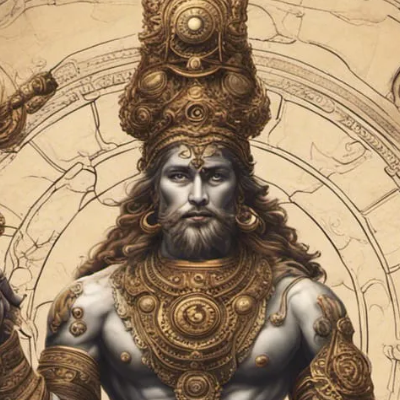
Ketu is depicted iconographically as the complement and opposite of Rahu. Where Rahu has a human head and a serpent's body below the neck, Ketu has a serpent's head — or in some traditions a head of smoke or flame — and a human torso and limbs below. He is shown with a spiritual or ascetic aura rather than the fierce regal bearing of Rahu. His form is often depicted as somewhat indistinct or smoke-like in its upper portions, reflecting the flag-shaped or comet-like description in the Matsya Purana. In Navagraha arrangements he is placed at the position corresponding to the south lunar node, directly opposite Rahu. His vahana varies across traditions and is not as standardised as that of several other grahas. His general bearing is other-worldly and inward-turning, in deliberate contrast to Rahu's outward-facing hunger.
✦ Textual Variants and Inconsistencies
The Vishnu Purana's Chapter 21 list of the Sainhikeyas omits Rahu and Ketu from the named sons of Simhika in the main body text, though the footnote in the Wilson translation notes that both the Bhagavata Purana and the Vayu Purana specify Rahu and Ketu among these sons, with Rahu named as the eldest. The omission in the Vishnu Purana's main text is therefore a peculiarity of that recension rather than a contradiction with the tradition at large.
The question of whether Ketu has a serpent's head, a smoke or flame head, or no head at all is not resolved consistently across the primary sources. The Matsya Purana's description of Ketu's body as flag-shaped points toward an amorphous or comet-like upper portion rather than a defined serpent's head. Later iconographic tradition and astrological literature standardised the image of the serpent's head on a human body, making this the most widely recognised depiction in temple sculpture and paintings, but this is a later consolidation rather than an original textual prescription.
✦ Connection to the Wider Genealogy
Ketu's genealogical position is identical to Rahu's: doubly a grandchild of Kashyapa through both the Danava line (Viprachitti via Danu) and the Daitya line (Simhika via Diti). Like Rahu, Ketu is therefore a cousin of the Adityas — including Surya — through the shared patriarchal line of Kashyapa and his wife Aditi. The eclipse mythology thus places this intra-Kashyapa-lineage conflict permanently into the structure of the cosmos, with the sun and moon perpetually subject to the shadow of the two halves of the being their ancestors' betrayal created. Ketu's particular position as the spiritually oriented half of this pair gives the Vainateya-Danava-Daitya complex of Kashyapa's progeny a dimension beyond the merely martial: through Ketu, the asura line of Kashyapa produces a force that the tradition reads as aligned — despite its origins in deception and dismemberment — with the movement of the individual soul toward liberation.
✦ References
- Bhagavata Purana, Skandha VIII (Samudra Manthan section): Primary Puranic source for the churning narrative and the creation of Rahu and Ketu from the severed halves of Swarbhanu; the most detailed account of their origin.
- Vishnu Purana, Amsha 1, Chapters 9 and 21: Narrates the Samudra Manthan and names the Sainhikeyas; the footnote to Chapter 21 in the Wilson translation specifically identifies Rahu and Ketu as the most celebrated sons of Simhika per the Bhagavata and Vayu Puranas.
- Vayu Purana: Names Rahu as the eldest of the Sainhikeyas; states the other sons were killed by Parashurama; affirms Ketu alongside Rahu as the two most significant progeny of Simhika.
- Matsya Purana: Describes Ketu's body as flag-shaped; among the sources for Ketu's distinctive iconographic form.
- Mahabharata, Adi Parva (Samudra Manthan passages): Contains the epic version of the churning and Swarbhanu's decapitation; establishes the enmity between the severed being and Surya and Soma.
- Brihat Parashara Hora Shastra: Foundational Vedic astrological text; establishes Ketu as the descending lunar node, his seven-year dasha period, his three nakshatras (Ashwini, Magha, Mula), his exaltation and debilitation signs, and his association with Ganesha and Matsya for remediation.
- Wikipedia, Ketu (mythology) article: Modern secondary reference; provides the astronomical identification of Ketu as the south lunar node, the 18.6-year orbital period, and the eclipse mechanism.
- Vettam Mani, Puranic Encyclopaedia (1975): Modern reference; consolidates all primary source references for both Rahu and Ketu within the broader Sainhikeya and Samudra Manthan entries.
- Monier-Williams Sanskrit-English Dictionary: Modern reference; confirms the etymology of Ketu from the root associated with brightness, flag, comet, and distinguishing mark, and of Dhuma Ketu as the smoky-comet designation.