
About
Andhaka (Andhakasura) — Blind Asura King, Adopted Son of Hiranyaksha, Redeemed by Shiva
Andhaka · Andhakasura · Andhakanetra · Hiranyaksha-putra · Shiva-gana · Bhringi
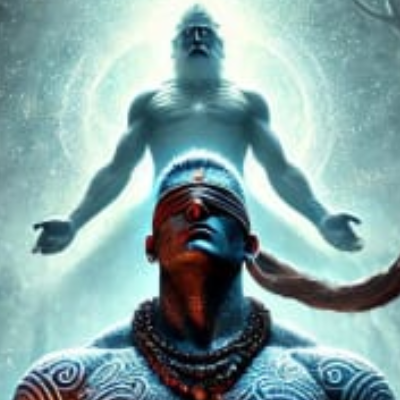
Andhaka — whose name means he who darkens — is an Asura king born of the divine energies of Shiva and Parvati, given as an infant to the childless Daitya king Hiranyaksha, raised as his son and successor, and ultimately redeemed through Shiva's own hand after a war of cosmic dimensions. His story is told across the Shiva Purana, Matsya Purana, Kurma Purana, Linga Purana, Vamana Purana, and Padma Purana — with significant variation in each. The common thread across all versions is the central irony of his existence: the being born from the god who will ultimately destroy him; the adopted Asura son of a Daitya family who is not truly of Asura birth; the king whose desire for the world's most beautiful woman leads him straight to the one woman he must never desire — his own divine mother. He ends his story not dead but transformed — impaled on Shiva's trident for a thousand years until his sins burned away, then released, made handsome, made a gana-chief of Kailasha, and accepted by Parvati herself as her son. Among the great Asura antagonists of the Puranas, Andhaka is one of the very few whose story ends in complete redemption rather than death.
✦ The Name
The Sanskrit name Andhaka derives from andha — blind, or that which causes darkness. He was born blind, as Shiva's eyes were effectively closed when he came into being; and his name records both his physical condition at birth and the spiritual blindness — towards his own origin, his own mother, his own dharma — that drove his downfall. His epithet Andhakasura combines his name with asura — the great demon. One tradition recorded in the Divine Hindu source identifies him with Bhringi after his redemption — the devoted Shaiva sage known for his single-minded worship of Shiva to the exclusion of all else, including Parvati herself — though this identification is not consistent across all Puranas.
✦ Birth — The Darkness from Shiva's Closed Eyes
The Shiva Purana (Rudra Samhita, Yuddha Khanda) records the most widely cited account of Andhaka's birth. Shiva was meditating on Mount Mandara. Parvati, in a playful mood, crept behind him and covered his eyes with her hands. The moment Shiva's eyes were closed, the entire universe was plunged into darkness. The heat of Shiva's three eyes — including the terrible third eye — passed into the palms of Parvati's hands as sweat. This sweat fell to the ground and from it arose a boy — dark, fierce, terrible in appearance, roaring as he came into being. Parvati was terrified. Shiva rebuked her gently: since the child had been born of their physical contact, he was their child. Because he had been born in darkness, with Shiva effectively blind at the moment of his birth, the boy was himself born blind. He was named Andhaka — the dark one, the blind one. A variant in the Fandom Demonology source records a slightly different account: that Andhaka was born from a drop of sweat from Shiva's forehead during his battle against the demon Jalandhara — placing his birth in a different context while preserving the essential feature of his origin from Shiva's own body.
✦ Given to Hiranyaksha
Hiranyaksha — the great Daitya king, husband of Rushabhanu, who had no sons of his own — performed severe penance to Shiva requesting a son of great power. Shiva, rather than granting an ordinary boon, offered him Andhaka — the child born of divine energy, already in existence and needing a parent. He gave Andhaka to Hiranyaksha to raise as his own, instructing him to treat the boy as his son. Hiranyaksha accepted and raised Andhaka in the Daitya household. The HinduPad source records that together Hiranyaksha and the growing Andhaka fought the three worlds — Andhaka beside his adoptive father in conquest before Varaha's arrival. The Kurma Purana presents a different tradition: in that text Andhaka is the natural son of Hiranyaksha — not adopted at all — removing the divine-birth dimension entirely and making his story purely a Daitya lineage narrative. This genealogical inconsistency between the Shiva Purana and Kurma Purana versions is a genuine textual divergence in the tradition.
✦ Lineage
- Divine parents (Shiva Purana): Shiva and Parvati — born from their sweat; his true biological parents
- Adoptive father: Hiranyaksha — Daitya king, son of Kashyapa and Diti, slain by Varaha avatar of Vishnu
- Adoptive mother: Rushabhanu — wife of Hiranyaksha
- Natural son (Kurma Purana): of Hiranyaksha — in the alternate tradition where Andhaka's divine origin is not recorded
- Cousin (per Shiva Purana tradition): Prahlada — son of Hiranyakashipu, brother of Hiranyaksha; the two are cousins in the Daitya household, though not by blood in the Shiva Purana version
- Uncle (adoptive): Hiranyakashipu — elder brother of Hiranyaksha; who along with Prahlada eventually became subservient to Andhaka after his boon from Brahma
- Son: Adi — recorded in the Encyclopedia MDPI source
- Divine guru: Shukracharya — guru of the Asuras who repeatedly revived Andhaka's slain soldiers using the Mritasanjivani vidya during the war against Shiva
✦ After Hiranyaksha's Death — Disownment and Penance
When Hiranyaksha was slain by Varaha, Andhaka became the new king of the Asuras. But his position was immediately challenged. Because he had been born of the Devas — of Shiva himself — rather than of Diti's lineage, the majority of his Asura clan did not regard him as a true Asura. His cousin-brothers mocked him: what would a blind fellow like him do with the kingdom? Disowned by much of his clan and stripped of legitimacy, Andhaka went into a forest and performed severe penance to Brahma for ten thousand years — standing without water or food, severing his own limbs as offerings. Brahma appeared before him and offered him a boon. Andhaka asked for several things: extraordinary divine vision in place of his blindness, vast power, and immortality. Brahma granted vision and power. He could not grant immortality — that was not within his gift. Instead, he invited Andhaka to choose the condition of his death. Andhaka, in his arrogance, declared that he would die only if he desired a woman he should never desire. This boon — framed as near-immortality — carried within it the precise mechanism of his destruction: he would eventually desire Parvati, his own divine mother, and that desire would trigger the condition of his death.
✦ Conquest of the Three Worlds
Armed with Brahma's boon, his restored sight, and immense power, Andhaka conquered the three worlds. His cousin-brothers who had mocked him — including Prahlada — became subservient to him. He conquered Indra's Svarga, made the Devas prisoners, and terrorised sages and humans across all planes. The Vamana Purana records that Andhaka and Prahlada together at one point defeated the Devas, with Prahlada becoming king of the three worlds — only for Prahlada to later appoint Andhaka as king in his place after his own cursed war against Vishnu. The Linga Purana records Andhaka traversing all the worlds and conquering Svarga, driving the Devas to retreat to Mount Mandara. The HinduPad source records that Narada eventually visited Andhaka's court and — whether out of cosmic inevitability or mischief — described to him the beauty of Parvati, the most beautiful woman in all the worlds, who lived with a matted-hair ascetic on Kailasha. Andhaka, hearing this, adorned himself with golden ornaments and fine garments and set out for Kailasha.
✦ The War on Kailasha — The Battle That Could Not Be Won
The Shiva Purana records Andhaka's demand: Shiva must surrender Parvati and vacate Kailasha. Shiva refused. A vast war followed — involving Andhaka's generals, the Asura army, Shiva's ganas, the Devas, Vishnu, the Matrikas, and eventually Shiva himself. The war's central tactical problem — recorded identically across the Shiva Purana, Matsya Purana, Kurma Purana, and Linga Purana — was Andhaka's boon: every drop of his blood that fell to the ground gave rise to a thousand new demons identical to him. Every wound Shiva or Vishnu inflicted multiplied the enemy. Vishnu created or summoned several Matrikas — the divine mother goddesses — to drink Andhaka's blood the moment it fell, preventing new demons from spawning. The HinduPad source records that Shukracharya, guru of the Asuras, was simultaneously reviving the fallen Asura soldiers using the Mritasanjivani vidya — making the enemy army effectively inexhaustible from two directions. Shiva, incensed that the Mritasanjivani was being deployed to extend the war, killed Shukracharya; as the guru cried out in regret, the merciful Shiva released him through his own semen — Shukracharya was reborn from Shiva's body and restored to the Asuras. The HinduPad source records Devi Chandika — invoked by Parvati — expanding her tongue across the battlefield to drink the last of Andhaka's blood completely, exhausting his multiplying power.
✦ Impalement — The Trident and the Thousand Years
With Andhaka's blood finally contained and his army destroyed, Shiva drove his trident through Andhaka's body and lifted him into the sky — holding him there, suspended and impaled, as the battle finally stilled. The Shiva Purana records that Andhaka hung on the trident and, in that extremity of defeat and pain, meditated on the hundred and eight forms of Shiva. His pride was destroyed. His sins began to burn away through Shiva's divine proximity. He chanted Shiva's names. The Greenmesg source records: hanging on the trident, Andhaka became sinless; he became a devotee of Shiva and Parvati. The Fandom Demonology source states that Shiva held Andhaka on his trident until the sun had withered away all of Andhaka's sins — after which he was purified by Shiva's touch. In the Tales of Sanatan version, Shiva held him for a thousand years until Andhaka realised the full folly of his actions and surrendered completely. At that point, Shiva lowered the trident, rubbed Andhaka's body with his holy hands, and made him pure.
✦ Redemption — Made a Gana-Chief, Accepted by Parvati
Shiva restored Andhaka's form, making him handsome and whole. He granted him the position of leader of the ganas — the divine attendants of Kailasha. Andhaka bowed to Parvati, begging her forgiveness. Parvati — who is his true mother by origin — accepted him as her son. The Divine Hindu source records that in this final form, Andhaka became known as Bhringi, the fierce but devoted Shaiva gana. After Andhaka was made a Shiva gana, the Devas regained their wealth and positions, Indra returned to Svarga, and Prahlada restored his kingdom and ruled peacefully under Narasimha's blessings. The great war of Andhaka thus ends not in death but in adoption — the blind demon son of darkness, born from Shiva's own body, returning at last to the foot of his father's throne.
✦ Iconography
Andhaka is depicted in temple sculpture most commonly in the form of Andhakasura Vadha Murti — Shiva in the act of impaling him on his trident, lifting the demon's emaciated, blood-drained body into the air. He is shown as dark-skinned and skeletal, his body covered in wounds, his blood being drunk by the surrounding Matrikas. This iconographic form is found prominently in Shaiva temples across South India and in the cave temples of Ellora (Cave 29 — Dhumar Lena) where a dramatic panel depicts the scene. Shiva in this form is sometimes called Virabhadra or depicted with multiple arms holding various weapons.
✦ References
- Shiva Purana (Rudra Samhita, Yuddha Khanda, Chapters 42–49) — the most complete account: birth from Shiva and Parvati's sweat on Mount Mandara; gift to Hiranyaksha; penance after Hiranyaksha's death; conquest of the three worlds; the demand for Parvati; the blood-multiplying boon; the Matrikas; the death of and release of Shukracharya; impalement on the trident; meditation on Shiva's 108 forms; purification; appointment as gana-chief
- Matsya Purana — Andhaka as son of Hiranyaksha; the battle in the Mahakala forest; blood producing a thousand demons; Suska-Revati drinking all the blood; Andhaka's surrender and appointment as gana-chief
- Kurma Purana — Andhaka as natural son of Hiranyaksha (not adopted); king of Asuras after Prahlada; the Kailasha attack; Nandi wounded; the blood-multiplying crisis; Vishnu summoning the Matrikas; Shiva and Vishnu together battling and killing him; purification and gana-chiefship
- Linga Purana — Andhaka given immunity from death by Brahma; conquest of Svarga; Devas retreat to Mount Mandara; Shiva challenges Andhaka; destroys his army; impales him; divine sight burns away his sins; made chief of all ganas
- Vamana Purana — Andhaka and Prahlada together defeating the Devas; Prahlada as king of the three worlds; Prahlada appointing Andhaka as king; Andhaka's eventual desire for Parvati and war with Shiva
- Padma Purana — references to Andhaka's lineage and kingship
- Wikipedia — Andhaka; Detechter — Mystery of the Parentage of Andhakasura; Encyclopedia MDPI — Andhaka; Greenmesg — Vanquishing the Pride of Andhakasura (Shiva Purana); HinduPad — Andhaka; HinduPad — Andhakasura's Story; Tales of Sanatan — Andhakasura; Divine Hindu — Andhaka Unleashed; Villains Wiki — Andhaka: modern summaries drawing from the above primary sources