
About
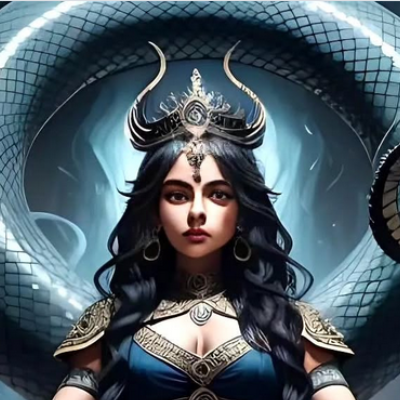
Surasa — Mother of the Nagas and Goddess of the Southern Ocean
Surasa · Nagamata · Dakshakanya · Kashyapapatni
Surasa is a daughter of Daksha, the primordial progenitor lord and one of the Prajapatis, and one of the wives of the sage Kashyapa — the great primordial seer who is the common progenitor of both the gods and many races of non-human beings through his various wives. Surasa is identified in the Puranic genealogical tradition as the mother of a group of serpentine beings — Nagas — though the exact nature and extent of her progeny differs across sources and must be carefully distinguished from those of her sister Kadru, who is the primary and far more elaborately attested mother of the Nagas. Surasa is best known outside of genealogical lists from her prominent role in the Valmiki Ramayana, where she appears as a formidable being in the ocean encountered by Hanuman during his aerial journey to Lanka. Her textual presence is concentrated in that one episode of the Ramayana and in the genealogical passages of the Vishnu Purana and Bhagavata Purana.
✦ The Name
The name Surasa derives from the Sanskrit su (good, well, excellent) and rasa (juice, essence, taste, fluid). The compound thus carries the sense of "she who has good juice or essence" or "the pleasantly flavoured one," though in mythological usage it is more generally taken as a name denoting a being of the waters or a being associated with fluid and oceanic essences. The name has no elaborated etymology in the primary texts themselves; it functions as a proper name rather than as an epithet with sustained theological commentary. In the Ramayana the name is simply used as her designation by the gods who send her as a test for Hanuman.
✦ Lineage
- Father: Daksha — primordial progenitor, one of the Prajapatis and son of Brahma, who distributed his daughters as wives to the great sages to generate the diverse races of beings.
- Siblings: Surasa is one of the group of Daksha's daughters given in marriage to Kashyapa. Her sisters in this household include Aditi (mother of the Adityas), Diti (mother of the Daityas), Danu (mother of the Danavas), Kadru (mother of the primary Naga lineage), Vinata (mother of Garuda and Aruna), Muni, Krodhavasha, Tamra, Ira, Arishta, Surabhi, and Timi, among others as enumerated in the Vishnu Purana and Bhagavata Purana.
- Spouse: Kashyapa — the primordial sage and common father of the gods, demons, serpents, birds, and other beings through his many wives.
- Children: The Vishnu Purana identifies Surasa as the mother of a group of Nagas. However, the primary and vastly more elaborated mother of the Nagas in the tradition is Kadru, whose sons include Shesha (the cosmic serpent who bears the world), Vasuki (the serpent used as a churning rope in the Samudra Manthan), Takshaka, Airavata, and hundreds of others. The relationship between Surasa's Nagas and Kadru's Nagas is not clearly systematised across texts. Some passages treat Surasa's progeny as a related but subsidiary group of serpentine beings, distinct from Kadru's main Naga lineage. The Ramayana's presentation of Surasa as mother of the Nagas in the Sundara Kanda is not inconsistent with the Puranic account but does not elaborate it further.
✦ The Encounter with Hanuman in the Ramayana
The episode for which Surasa is most widely known occurs in the Sundara Kanda of the Valmiki Ramayana. Hanuman — the son of Vayu, the wind god, and the devoted servant of Rama, the prince of Ayodhya and the seventh avatar of Vishnu — has leapt across the ocean toward Lanka to search for Sita, the wife of Rama who has been abducted by the demon king Ravana. During his aerial crossing of the southern ocean, the gods and the great sages, wishing to test Hanuman's capabilities and wisdom, ask Surasa to intercept him in the form of a vast and terrible Rakshasi — a female demon of the night — and to place an obstacle before him.
Surasa rises from the ocean and confronts Hanuman, declaring that the gods have ordained him as her food and that he must enter her mouth. Hanuman reasons with her, asking her to allow him first to complete his mission of finding Sita, promising to enter her mouth freely upon his return. Surasa refuses, insisting that none may pass without entering her jaws. A contest of size then ensues: Surasa opens her mouth to an enormous width to swallow Hanuman; Hanuman expands his body to match her gape; she continues to expand; he continues to grow, until she has extended her mouth to a span of sixteen yojanas. At this point Hanuman suddenly contracts himself to the size of a thumb, enters her mouth, and immediately exits from her ear or cheek — having technically satisfied the condition of entering her mouth without being consumed. Surasa, recognising this display of intelligence and power, reverts to her true and benevolent form, blesses Hanuman warmly, and declares that his mission will succeed. The episode thus functions as a test not merely of Hanuman's physical power but of his wit, ingenuity, and composure under pressure.
The Valmiki Ramayana is the primary source for this episode. Later retellings of the Ramayana — including the Adhyatma Ramayana, Tulsidas's Ramcharitmanas, and regional vernacular Ramayanas — repeat and often elaborate the episode, but the core narrative of the size-contest and the thumb-sized exit is consistent across versions.
✦ Textual Variants and Inconsistencies
The most significant textual ambiguity concerning Surasa involves the relationship between her Naga progeny and those of Kadru. Both Surasa and Kadru are wives of Kashyapa and both are associated with serpentine offspring, but Kadru is far more extensively treated as the mother of the Nagas across the full span of the Puranic tradition. The Vishnu Purana attributes a group of Nagas to Surasa, but does not provide the kind of extensive named enumeration of her sons that it gives for Kadru's sons. Some commentators have proposed that Surasa's sons form a distinct subcategory of serpentine beings rather than being identical with the classical Naga lineage; others treat the two lists as belonging to a single undifferentiated tradition of serpent-being genealogy. The texts do not resolve this explicitly.
A further point of variation concerns Surasa's characterisation in the Ramayana. In that text she is described as a being who can assume a terrible form at the gods' request, and who reveals a benevolent aspect once Hanuman has passed her test. Some regional Ramayana traditions present her differently — as a more consistently malevolent figure or as an embodiment of a natural force of the ocean — but these are elaborations rather than direct contradictions of the Valmiki text.
✦ Theological and Narrative Significance
Within the Ramayana's narrative structure, the Surasa episode forms one of a sequence of tests and obstacles that Hanuman encounters during his ocean crossing, each designed to establish different aspects of his extraordinary nature. Surasa's test is the one that demonstrates his mental agility and his capacity to fulfil a condition through creative interpretation rather than brute force. The episode is thus theologically important for the Hanuman devotional tradition as an illustration of the quality of his intelligence alongside his more celebrated physical and devotional attributes. Surasa's transformation from threatening obstacle to blessing figure at the episode's conclusion is a recurring narrative pattern in the tradition — the being who opposes and tests a divine agent ultimately becomes their endorser and well-wisher.
✦ Connection to the Wider Genealogy
Through her father Daksha and her husband Kashyapa, Surasa is embedded in the same primordial genealogical framework that generates all the major races of beings in the Puranic cosmos. Her Naga progeny, however defined in relation to Kadru's more prominent Naga lineage, belong to the vast subterranean and oceanic population of serpentine beings who inhabit the Patala worlds beneath the earth in Puranic cosmology. The Nagas as a collective group are significant in the tradition as powerful semi-divine beings, as guardians of subterranean treasure, as figures of ambiguous cosmic standing, and as the subjects of several major narrative cycles in the Mahabharata — particularly the Astika sub-narrative in the Adi Parva, which concerns the great serpent sacrifice of King Janamejaya.
✦ References
Primary Sources
- Valmiki Ramayana, Sundara Kanda, chapters 1 and 11–12: The primary narrative source for the Surasa episode; narrates her interception of Hanuman, the size-contest, his exit from her mouth, and her blessing. This is the most elaborated treatment of Surasa as an active figure in any primary text.
- Vishnu Purana, Book 1, chapter 21: Lists Surasa among Kashyapa's wives and identifies her as the mother of a group of Nagas, placing her in the genealogical framework of Daksha's daughters.
- Bhagavata Purana, Book 6, chapter 6: Enumerates the wives of Kashyapa, including Surasa, in the context of the genealogy of Daksha's daughters.
- Mahabharata, Adi Parva, sections 65–66: Includes Surasa in the list of Kashyapa's wives as part of the broad cosmological genealogy.
- Adhyatma Ramayana, Sundara Kanda: Retells the Surasa episode with some devotional elaboration; broadly consistent with the Valmiki version.
- Ramcharitmanas of Tulsidas, Sundara Kanda: Vernacular Hindi retelling of the Surasa encounter; follows the core narrative pattern while adapting tone and emphasis.
Modern Reference Works
- Vettam Mani, Puranic Encyclopaedia (1975): Entry on Surasa; summarises the Ramayana episode and notes her genealogical position among Kashyapa's wives.
- Robert P. Goldman (general editor), The Ramayana of Valmiki — Sundara Kanda, translated by Robert P. Goldman and Sally J. Sutherland Goldman (1996): Critical edition and translation of the Sundara Kanda containing detailed notes on the Surasa episode, textual variants, and the scholarly discussion of the sequence of obstacles Hanuman encounters.