
About
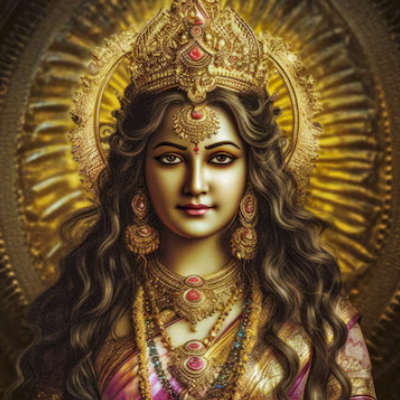
Sati (Dakshayani) — First Wife of Shiva, Daughter of Daksha, Origin of the Shakti Peethas, Previous Birth of Parvati
Sati · Satī · Dakshayani · Dakshakanya · Dakshaja · Dakshi · Uma · Gauri · Mriganaini · Adi Parashakti-avatara · Shiva-patni-prathama · Parvati-purvajanma
Sati — also known as Dakshayani, the daughter of Daksha — is the first wife of Shiva; the daughter of the Prajapati Daksha and his wife Prasuti; an incarnation of Adi Parashakti, the primordial divine feminine; and the previous birth of Parvati, Shiva's eternal consort. Her story — spanning her devotion to Shiva from earliest childhood, her marriage against her father's wishes, the catastrophic insult at Daksha's grand sacrifice, her self-immolation, Shiva's catastrophic grief, the dismemberment of her body, and the creation of the fifty-one Shakti Peethas from its scattered fragments — is one of the most consequential myths in the entire Hindu tradition. It is the foundational narrative of Shaktism, the creation myth of the Shakti Peetha pilgrimage network that spans the entire subcontinent, and the explanation for Shiva's withdrawal into ascetic grief that made necessary the entire subsequent arc of Parvati's rebirth and tapas. The name Sati — from the Sanskrit root meaning truthful, virtuous, chaste — has entered global usage as the designation for the practice in which some Hindu widows historically immolated themselves on their husbands' funeral pyres; the connection to the goddess is not a reflection of her actual narrative (she was not a widow; she immolated herself in the sacrificial fire on a matter of dharmic principle while her husband was still living) but of the cultural veneration of her self-immolation as the supreme act of spousal loyalty. She is worshipped as the goddess of marital felicity and longevity and is the archetype of pativrata dharma — devoted wifehood as a spiritual practice — in the Hindu tradition.
✦ The Names
The name Sati derives from the Sanskrit root sat — truth, existence, being, virtue — and means truthful, virtuous, chaste, a woman of good character. It is simultaneously a common noun (a virtuous woman), an abstract principle (truth), and a proper name. The Monier-Williams Sanskrit-English Dictionary records it as the feminine form of sat — the existent, the real, the good — making Sati literally she who is real, she who is true, she who truly is. Her patronymic Dakshayani means simply daughter of Daksha; Dakshakanya and Dakshaja carry the same meaning through slightly different compounds. She is called Mriganaini — deer-eyed, one whose eyes are as large and gentle as a deer's — in texts that emphasize her beauty. Her name Uma, which she shares with Parvati, records her identity as the goddess who in the Kena Upanishad mediated between the Vedic devas and the supreme Brahman. In the Shakta tradition she is identified as the earthly incarnation of Adi Parashakti — the absolute divine feminine — who took human birth at Brahma's arrangement to bring Shiva out of his ascetic isolation and restore the creative engagement of the divine masculine with the world.
✦ Lineage
- Father: Daksha — Prajapati; son of Brahma; one of the creators and governors of the world; whose capital was at Kankhal, near present-day Haridwar; whose pride and rigidity constituted the cosmic blindness that the entire Sati episode was required to break; already profiled in this series as one of Brahma's sons
- Mother: Prasuti — third daughter of Svayambhuva Manu and Shatarupa; given in marriage to Daksha by her father Manu; already profiled in this series; who bore Daksha sixteen daughters including Sati and the twenty-four wives of Dharma and thirteen wives of Kashyapa
- Position among siblings: Sati is recorded in most primary texts as the youngest and most beloved of Daksha's daughters; the Study.com source records her as the youngest daughter; other texts record her as the sixteenth among Daksha's daughters born of Prasuti
- Husband: Shiva — Mahadeva; the Destroyer in the Trimurti; whose marriage to Sati was cosmically necessary for the production of Kartikeya to slay Tarakasura, and was arranged by Brahma though carried out over Daksha's explicit opposition
- Next birth: Parvati — daughter of Himavat and Mena; younger sister of Ganga; who performed extraordinary tapas to win Shiva after his long ascetic withdrawal; mother of Ganesha and Kartikeya; already profiled in this series
- Grandfather (paternal): Brahma — the Creator; who had arranged the cosmic necessity of Sati's birth and her marriage to Shiva; who later intervened to pacify Shiva after the Daksha Yajna and restore the broken sacrifice
- Alternate mother (Shiva Purana, Matsya Purana, Kalika Purana variant): Asikni — named in these texts as Daksha's wife rather than Prasuti; a genealogical variant not found in the Bhagavata Purana lineage already established in this series
✦ Previous Life — Brahma's Arrangement and the Cosmic Purpose
The Shakta texts — the Devi Bhagavata Purana and the Mahabhagavata Purana — record the cosmic arrangement that preceded Sati's birth. Shiva, in his form as the supreme ascetic, was entirely withdrawn from the world — absorbed in eternal meditation, unengaged with creation, declining all social relationship, dressed in funeral ash and animal skins, inhabiting cremation grounds. The creative and reproductive functions of the cosmos depended on the engagement of the divine masculine with the divine feminine — the union of Purusha (consciousness) and Prakriti (energy) — and Shiva's withdrawal from the world was leaving the creative force unactivated. Brahma recognised this cosmic deficiency and went to the Goddess — the supreme Adi Parashakti — to request her to incarnate in human form, become Shiva's wife, and draw him back into engaged relationship with the world. The Goddess agreed, but on one condition — if she was ever insulted or dishonoured, she would immediately withdraw her incarnation. Brahma then instructed Daksha to perform tapas to receive the Goddess as his daughter. Daksha and Prasuti performed intense penance. The Goddess was pleased and agreed to be born as their daughter — as Sati.
✦ Childhood and Devotion to Shiva
From the earliest days of her childhood Sati was entirely devoted to Shiva. The Shiva Purana and the Dolls of India source record that the sage Narada was a frequent visitor to Daksha's palace and would tell Sati stories of Shiva's greatness, power, and divine nature — and that she absorbed these stories with complete absorption. She decorated every available surface with images of Shiva. She refused food offered to any other deity. As she grew, marriage proposals arrived from princes and kings of every description — she declined them all. She had resolved that she would marry only Shiva or remain unmarried. The Bhagavata Purana records that Daksha organised a svayamvara for Sati and invited all the gods — deliberately not inviting Shiva, whose appearance and lifestyle he found inappropriate. When Sati saw that Shiva was absent from the assembly of gods, she threw her marriage garland into the air, mentally choosing Shiva as her husband. The garland — guided by divine power — fell onto Shiva himself, who appeared in the assembly to claim it. The tradition records this as the moment the choice was formalised. In the more widely narrated version, Sati performed her own tapas in the forest — giving up the comforts of the palace, wearing bark, worshipping Shiva continuously — until Shiva accepted her as his wife.
✦ The Marriage — Against Daksha's Will
Daksha opposed the marriage with complete determination. His objections were social as much as personal: Shiva had no proper lineage, no palace, no wealth, no attendants appropriate to a royal court — only his ganas, the ash-smeared wild beings of the cremation ground. He dressed in animal skins and funeral ash. He frequented cemeteries. He stood entirely outside the ordered Vedic social world that Daksha embodied and administered. Brahma intervened — pointing out to Daksha the cosmic necessity of the union and the identity of his daughter as the incarnation of the Goddess herself — and eventually Daksha yielded. The marriage was performed with Brahma as the officiating priest and with the assembly of all the gods as witness. Sati left her father's palace and went with Shiva to Mount Kailasha. From this point the tension between Daksha and Shiva was never resolved — it merely waited for an occasion to manifest. The Devi Bhagavata Purana records an additional detail that deepens the tragedy: shortly after the marriage, Daksha accidentally polluted a sacred flower garland and as a result was cursed — he would come to hate his beloved daughter Sati, for whom his affection had until then been extravagant. This curse — operating within the father who had previously loved her above all his other children — ensured that the insult at the yajna, when it came, would be delivered with a ferocity that was not natural to Daksha but was the consequence of a cosmic mechanism operating through him.
✦ The Episode at Brahma's Yajna — The First Insult
The Bhagavata Purana and the Daksha Yajna Wikipedia article describe the sequence that directly precipitated the catastrophic events of the Daksha Yajna. Before the famous Daksha Yajna, Brahma organised a grand cosmic sacrifice to which all beings — including all the Prajapatis, deities, and kings — were invited. Daksha attended. When Daksha entered the assembly, everyone present rose to offer him respect — with two exceptions: Brahma, who as Daksha's father was not required to rise; and Shiva, who as Mahadeva was the supreme cosmic reality before whom all beings including Daksha should have risen. Daksha understood Brahma's exception immediately but read Shiva's remaining seated as a deliberate insult and a refusal to acknowledge the Prajapati's authority. Daksha left the assembly burning with resentment. He made a vow to retaliate against Shiva in kind. The subsequent Daksha Yajna — the grand sacrifice at which Sati was humiliated and destroyed — was this retaliation organised with the specific aim of insulting Shiva publicly and denying him his sacred share.
✦ The Daksha Yajna — Invitation Withheld, Attendance Uninvited
Daksha organised a yajna of universal scope — the Brihaspati Sarva Yajna performed at Kankhal, near present-day Haridwar — and invited every deity, sage, Prajapati, and king in the three worlds. He deliberately did not invite Shiva and Sati. The Vayu Purana records this as the primary account; the same event is also recorded with variations in the Shiva Purana, Linga Purana, Matsya Purana, Kurma Purana, Padma Purana, Skanda Purana, Harivamsa, and Bhagavata Purana. Sati came to know about the sacrifice — the Mahakavya source records that the sage Narada informed her. She saw the divine chariots of all the gods flying toward her father's kingdom and understood that a great sacred event was underway. Her natural impulse was a daughter's — to attend her father's house, to see her mother and her sisters, to be present at a sacred family event. Shiva advised her strongly against going. He told her that going uninvited to her father's yajna — from which both she and her husband had been deliberately excluded — would result in humiliation rather than welcome. Sati did not accept the warning. In the Mahabhagavata Purana account she transformed into the ten Mahavidyas and surrounded Shiva from all ten directions to overcome his resistance. In most primary texts she simply insisted and he eventually relented, sending her with a retinue of his ganas as escorts. When Sati arrived at the yajna site, the reception was as Shiva had predicted. Her mother and sisters received her warmly. But Daksha greeted her with contempt rather than affection. He publicly denounced Shiva in the assembly — listing his faults, his unkempt appearance, his association with cremation grounds and ghosts, his lack of proper lineage, his unsuitability as a husband for a Prajapati's daughter — and refused to offer the portion of the sacrifice due to Shiva. He rejected the gifts Sati had brought. He denied Shiva's share of the sacred oblations. Nandi — Shiva's devoted bull-guardian, who had accompanied Sati — could not contain his fury and cursed Daksha in return, adding to the gathering catastrophe. The Vayu Purana records in detail the specific wounding of each deity who was present: Saraswati's and Aditi's noses were cut by Virabhadra's forces; Yama's staff was broken; Mitra's eyes were pulled out; Indra was trampled; Pushan's teeth were knocked out; Chandra was beaten heavily; Bhrigu's beard was cut off; the hands of Vahini were severed.
✦ The Self-Immolation
Standing in the assembly where her husband was being publicly dishonoured by her own father, Sati reached the limit of what she could endure. The primary texts — the Bhagavata Purana, Shiva Purana, Linga Purana, and others — describe the moment with varying degrees of detail but with consistent meaning. Sati declared, before the assembled deities, that she could not continue to inhabit the body born from someone who dishonoured Shiva. She stated that she would be reborn in a family that was worthy of giving a daughter to Shiva — a family headed by a father who would reverence rather than revile him. Then she walked into the sacred fire of the yajna. Some texts record that she used the inner fire of her own yogic concentration — the tapas-fire accumulated through years of devoted austerity — rather than the outer sacrificial fire. The Rudraksha-Ratna source records that as an incarnation of the Goddess herself, she was simply withdrawing her incarnation, returning to her divine source, as she had warned Brahma she would do if ever dishonoured. The self-immolation was not despair but divine will — a conscious act of cosmic withdrawal, the pulling back of the divine feminine from a world that had proven itself unworthy of her presence.
✦ Shiva's Grief — Virabhadra and the Destruction of the Sacrifice
News of Sati's death reached Shiva. His grief and fury were of cosmic scale — the tradition describes them as simultaneously the deepest sorrow ever felt by any being in creation and the most dangerous outburst of divine energy since the beginning of time. From a matted lock of his hair he tore free and created Virabhadra — a being of enormous destructive power — and simultaneously Bhadrakali from his wrath. He directed them to Daksha's sacrifice. Virabhadra and Bhadrakali destroyed the yajna utterly: Daksha was beheaded and his head thrown into the sacrificial fire; the assembled devas and sages were beaten, wounded, and killed. The Vayu Purana enumerates the injuries to each deity in graphic detail. Within a single night the greatest sacred gathering in creation had been turned to ruin. Brahma and Vishnu came to Shiva. They comforted him and pointed out that the destruction of the yajna — in which the sacred fire and the cosmic ritual had been violated — was itself a disorder that needed to be rectified. Shiva agreed to allow the restoration. He forgave Daksha and the assembled deities, revived the dead — restoring most of them to life — and permitted the completion of the yajna. Daksha was revived with the head of a goat in place of his own — the divine reconciliation simultaneously being a permanent reminder of his humiliation. Having learned his lesson, Daksha spent the remainder of his existence as a devoted worshipper of Shiva.
✦ Shiva's Wandering — The Body and the Grief
After the restoration of the yajna, Shiva retrieved Sati's charred body from the sacrificial fire and was unable to part from it. The Shakta Puranas — particularly the Devi Bhagavata Purana and the Kalika Purana — provide the fuller account: Shiva placed Sati's body on his shoulder and wandered through all the worlds, performing the Rudra Tandava — the cosmic dance of destruction — as he walked, deranged with grief. The wandering was catastrophic for the cosmos. The presence of a divine corpse being carried by the grieving god of destruction, as he danced the annihilating dance, threatened to unravel the fabric of creation entirely. The gods went to Vishnu, distressed and helpless. Vishnu, understanding the emergency, followed behind Shiva and used the Sudarshana Chakra to cut Sati's body piece by piece as Shiva carried it. Some texts record that as the pieces fell from the body, Shiva gradually became lighter; his grief, still immense, became bearable; and as the last piece fell he was finally empty-handed and gradually recovered his equanimity. He then withdrew once more into the Himalayas for the long ascetic meditation from which only Parvati's tapas would eventually draw him.
✦ The Fifty-One Shakti Peethas — The Geography of the Divine Feminine
Each of the fifty-one pieces of Sati's body that fell to earth became a Shakti Peetha — a seat of the divine feminine, a place of concentrated spiritual power, a pilgrimage site. The tradition records various numbers across different texts: the Shiva Charitra and the widely accepted canon give fifty-one; the Kalika Purana gives twenty-six; the Tantra Chudamani and Durga Saptashati give fifty-two; the Bhagavata Purana gives one hundred and eight. The fifty-one Shakti Peethas are the most widely accepted count, corresponding to the fifty-one alphabets of Sanskrit and representing the fifty-one sounds the larynx can produce — the entire range of sacred sound, the Nada-Brahma, distributed across the sacred geography of the subcontinent. At each Shakti Peetha the goddess is worshipped in a specific local form associated with the body part that fell there, and each site has a corresponding Bhairava — a manifestation of Shiva — who stands beside her as her eternal guardian. The four most sacred of the fifty-one are identified in the Devi Bhagavata Purana and the Kalika Purana: Kamakhya in Assam (where the yoni — the most sacred organ of the creative feminine — fell); Kalighat in West Bengal (the toes of the right foot); Vimala at Puri in Odisha (the feet or lower limbs); and Tara Tarini at Berhampur in Odisha (the breasts). These four represent the goddess in her aspects of creation, nourishment, sustenance, and the foundation of all movement. The fifty-one Shakti Peethas are distributed across the entire Indian subcontinent and extend into present-day Pakistan, Bangladesh, Nepal, Tibet, Bhutan, and Sri Lanka. The northernmost is at Hinglaj in the Makran coast of Baluchistan, Pakistan — where the top of Sati's head (Brahmarandhra) fell; she is worshipped here as Kottari Shakti. Other notable sites include: Sugandha Peetha in Bangladesh (the nose); Gandaki Chandi in Nepal at Muktinath (the forehead); Dakshayani in Tibet near Kailash Mansarovar (the right hand); Manasa near Mansarovar in Tibet (also the right hand in a different account); Vishalakshi at Varanasi in Uttar Pradesh (earring or face); Lalita Devi at Prayagraj (the finger); the Tripura Sundari temple in Tripura (the right foot); the Nartiang temple in Meghalaya (the left thigh); Biraj in Jajpur, Odisha (the navel); and Chandranath in Chittagong, Bangladesh (the right arm). Each site preserves in its very location the mark of Sati's dispersed body — the divine feminine distributed across the subcontinent, worshipped simultaneously in fifty-one places, whole in each.
✦ The Episode of Sati Testing Rama
The Wikipedia Sati article records an episode found in the Adhyatma Ramayana and the Bhagavata Purana tradition in which Sati figures after the marriage. During the period when Rama was wandering the forest in search of Sita, Shiva and Sati witnessed him from their vantage point. Shiva identified Rama as a complete incarnation of Vishnu and paid him homage. Sati was unconvinced that the grief-stricken man searching the forest for his wife was indeed the supreme divine reality. Shiva, seeing her doubt, encouraged her to test him for herself. Sati took the form of Sita and appeared before Rama in the forest. Rama addressed her calmly as Sati — recognising her immediately despite the disguise, calling her the wife of Shiva whom he revered, and asking gently why she had taken this form. Her doubt dissolved. She returned to Shiva, now uncertain how to face him, knowing he would know what she had done. Shiva, perceiving the full situation through his divine vision, was deeply troubled: the wife who had taken the form of Sita was now, in his inner perception, identified with Sita — and Sita was for him as a mother-figure through her relationship to Rama whom he honoured as his own Lord. The episode created a distance between Shiva and Sati that is described in some texts as the internal reason, alongside the Daksha episode, for Sati's eventual self-immolation and rebirth — the troubled intimacy needed to be resolved and renewed in the new birth of Parvati.
✦ Rebirth as Parvati — The Continuation
Sati's self-immolation and the cosmic events that followed — Virabhadra's destruction of the sacrifice, Shiva's wandering with the body, the dismemberment, the creation of the Shakti Peethas, and Shiva's subsequent withdrawal into ascetic isolation in the Himalayas — set the stage for the entire Parvati narrative already profiled in this series. Sati herself, before self-immolating, declared in the assembly that she would be reborn in a family worthy of her devotion to Shiva — a family headed by a father who would reverence her husband rather than revile him. She was born as Parvati, the daughter of Himavat — who was Shiva's own devotee, whose mountain was Shiva's abode — and performed tapas of extraordinary severity to win Shiva's acceptance again in her new body. The tradition consistently insists that Sati and Parvati are the same being — the same divine energy, the same soul, the same devotion — inhabiting successive bodies. Shiva himself is recorded in the Shiva Purana as knowing, from the moment of Parvati's birth, that she was Sati returned. His eventual acceptance of her was not the beginning of a new relationship but the resumption of an eternal one that had been interrupted by death.
✦ Theological Significance
Sati's theological significance operates on several simultaneous levels. As the incarnation of Adi Parashakti she demonstrates that the divine feminine does not merely endure dishonour — it withdraws from any situation that cannot sustain its presence, and that withdrawal is itself a cosmic action with consequences that reshape the world. As the wife of Shiva she demonstrates the theological principle that Shiva without Shakti is inert — his grief without her is not creative but destructive, dangerous to the cosmos, requiring the intervention of Vishnu himself to manage. As the creator of the Shakti Peethas her dismembered body becomes the most generous possible act: the body that was destroyed by dishonour became the sacred geography of the subcontinent, distributing the divine feminine's presence across every corner of the land in fifty-one places simultaneously. The Hindu sacred geography of the Shakti Peethas is literally the map of Sati's dispersed body — every pilgrimage to a Shakti Peetha is a pilgrimage to the site of the goddess's most intimate gift. In the Tantric tradition the fifty-one Shakti Peethas correspond to the fifty-one Sanskrit letters — Sati's body becomes language; the divine feminine is dispersed not only across geographic space but across the entire range of sacred sound. The Nada-Brahma — the universe as vibration, as sound — finds its geographic anchor in the places where Sati's body touched the earth. And in the social history of the subcontinent, Sati's story has exerted an influence that extends far beyond the theological: it generated both the practice of Sati — the widow's self-immolation at the funeral pyre, which the goddess's story was used to valorise — and, in the reformist tradition of the 19th century under figures like Raja Ram Mohan Roy, the most sustained campaign against any traditional practice in modern Hindu history.
✦ Worship and Sacred Sites
Sati is worshipped primarily through the fifty-one Shakti Peethas — pilgrimage sites that constitute the most complete sacred geography of the divine feminine in any tradition. The most sacred is the Kamakhya Temple at Guwahati in Assam — one of the most powerful Tantric sites in the world, where the goddess's yoni is worshipped in the form of a natural rock fissure from which water perpetually springs; the annual Ambubachi Mela, commemorating the goddess's menstrual cycle, is one of the largest religious gatherings in India. The Kalighat Temple in Kolkata; the Vimala Temple at Puri; the Tara Tarini shrine at Berhampur; the Jwalamukhi Temple in Himachal Pradesh (where Sati's tongue fell, and where flames spring perpetually from the earth without fuel); the Vishalakshi Temple at Varanasi; the Hinglaj shrine in Baluchistan; the Manasa Devi shrine at Kailash Mansarovar; the Daksha Prajapati Mandir at Kankhal in Haridwar (the actual site of the Daksha Yajna) — all are among the principal pilgrimage sites of her worship. The Navaratri festival — observed twice yearly — is the most important festival of Shakti worship encompassing Sati in her many forms. Maha Shivaratri, which commemorates Shiva and Parvati's marriage (the reunion after the Sati episode's resolution), also honours her implicitly as the origin of that reunion.
✦ Connection to This Genealogical Series
Sati connects to this genealogical series through multiple threads. She is the daughter of Daksha and granddaughter of Brahma — already profiled in this series as the root of the cosmic genealogy. Her mother Prasuti is the daughter of Svayambhuva Manu and Shatarupa — both profiled in this series. Her stepmother Asikni (in the Shiva Purana, Matsya Purana, and Kalika Purana variant) is the daughter of Virana — also profiled in this series. Through her reincarnation as Parvati she becomes the sister-in-law of Ganga (who is Parvati's elder sister) and thus connected to the entire solar-Kuru lineage through Ganga's children. And through Parvati she becomes the mother of Ganesha and Kartikeya — two of the most widely worshipped deities in the tradition — making Sati the grandmother-in-essence of the entire subsequent mythology of the Ganesha and Kartikeya cycles. Most significantly for this series: the Daksha Yajna episode involves Virabhadra cutting off Bhrigu's beard — the same Bhrigu already profiled in this series as the son of Brahma and father of Shukracharya; and the destruction of the yajna was the event that most forcefully rearranged the entire cosmic hierarchy, moving Shiva from the margins of the Vedic sacrificial order to its centre — a rearrangement whose consequences extend through every subsequent episode in the tradition.
✦ References
- Taittiriya Samhita — the first text to mention the Daksha Yajna episode in the Vedic literature; the earliest layer of the myth
- Mahabharata — the Daksha Yajna and the destruction of the sacrifice; Sati's death mentioned as background for the Shiva-Parvati narrative; the Sabha Parva and Shanti Parva references to Sati as Shiva's first wife
- Valmiki Ramayana — early references to Sati as Shiva's wife and to the Daksha Yajna context
- Vayu Purana — the principal and most detailed canonical account of the Daksha Yajna: the injuries to each deity enumerated; Virabhadra's assault on the sacrifice; the primary textual source for the episode according to the Daksha Yajna Wikipedia article
- Bhagavata Purana (Canto 4, Chapters 1–7) — the fullest Vaishnava account: Sati as the youngest daughter of Daksha; the svayamvara episode and the flower garland; Daksha's insult at Brahma's yajna and the origin of the feud; the Daksha Yajna; Sati's death; Virabhadra's destruction of the sacrifice; Brahma and Vishnu's intervention; the restoration of Daksha with a goat's head; the Rudra Tandava and the cosmic grief; the creation of the Shakti Peethas
- Shiva Purana (Rudra Samhita, Sati Khanda) — the Shakta arrangement: Brahma instructing Daksha to perform tapas to receive the Goddess as his daughter; the condition of immediate withdrawal upon dishonour; Sati's birth and childhood devotion to Shiva; her tapas and marriage; the Daksha Yajna; the self-immolation; Shiva's grief; Vishnu's dismemberment of the body; the Shakti Peethas; the Devi Bhagavata Purana addition of the polluted garland curse on Daksha
- Devi Bhagavata Purana — the most detailed Shakta account: Adi Parashakti's agreement to incarnate; the condition of withdrawal; Daksha cursed by the polluted garland to hate Sati; the ten Mahavidyas appearing when Shiva tried to stop Sati from attending the yajna; the Shakti Peetha creation; Sati's reincarnation as Parvati
- Mahabhagavata Purana — the ten Mahavidyas manifesting from Sati to overcome Shiva's resistance
- Linga Purana — the Daksha Yajna episode; Virabhadra's creation and the destruction of the sacrifice; the Shakti Peethas
- Kalika Purana — the Shakti Peetha theology; the four primary Shakti Peethas; the twenty-six variant count
- Kurma Purana, Matsya Purana, Padma Purana, Skanda Purana (Kashi Khanda), Harivamsa — parallel and variant accounts of the Daksha Yajna episode and the Shakti Peetha tradition
- Tantra Chudamani — the fifty-two Shakti Peethas; the detailed listing of body parts at each site; Parvati's narration to Skanda of the specific body parts at each location
- Pithanirnaya Tantra — the geographic distribution of the fifty-one Shakti Peethas across the countries of the Indian subcontinent
- Kalidasa — Kumarasambhava (circa 5th–6th century CE) — the literary treatment of Sati's self-immolation as the event whose cosmic consequences require the entire subsequent narrative of Parvati's tapas and Shiva's remarriage
- Wikipedia — Sati (Hindu goddess); Wikipedia — Daksha Yajna; Wikipedia — Shakta Pithas; Rudraksha-Ratna — Goddess Sati; Dolls of India — Devi Sati; HinduTemple Talk — Goddess Sati The Divine Tale of Self-Sacrifice; JKYog — The Story of Sati Daksha and Lord Shiv; HinduScriptures.in — Devi Sati; Study.com — Devi Sati in Hindu Mythology; Indian Story Time — The Story of the First Sati; AlightIndia — 51 Shakti Peethas; MyBestTrip — List of 51 Shakti Peethas with name and body part of Devi Sati; SanatanaJourney — 51 Shakti Peeth List; AllWorldTemple — 51 Shakti Peethas; Mahakavya — 51 Shakti Peeth; SiddhatvaWithAmatya — Saktipeeth: modern summaries drawing from the above primary sources