
About
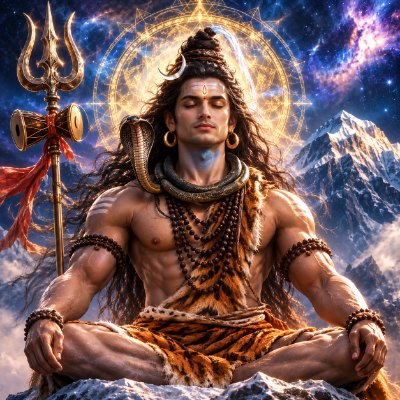
Shiva — Mahadeva, the Great God, Destroyer and Regenerator, Adiyogi, Lord of Kailasha
Shiva · Mahadeva · Rudra · Maheshvara · Shankar · Shankara · Sadashiva · Parameshvara · Hara · Neelakantha · Tryambaka · Pashupati · Nataraja · Dakshinamurti · Gangadhara · Ardhanarishvara · Bhairava · Virabhadra · Adiyogi · Yogiraj · Umapati · Girisha · Kaparddin · Trilokanatha · Smashana-adhipati · Pinaki · Chandrashekhara · Jatadhara
Shiva — whose name in its simplest meaning is simply the auspicious one — is the third deity of the Hindu Trimurti (the cosmic triad of Brahma the creator, Vishnu the preserver, and Shiva the destroyer and regenerator), and in the Shaiva tradition he is simultaneously the supreme, ultimate, beginningless, and endless reality of which all other gods — including Brahma and Vishnu — are partial manifestations. He is the husband of Parvati (formerly Sati); the father of Ganesha and Kartikeya; the lord of Kailasha; the master of the cosmic dance as Nataraja; the first and supreme yogi as Adiyogi; the supreme teacher of sacred knowledge as Dakshinamurti; the bearer of the river Ganga in his matted locks as Gangadhara; the drinker of the cosmic poison Halahala as Neelakantha; the destroyer of Daksha's sacrifice; the incinerator of Kamadeva; the slayer of the three demon cities as Tripurantaka; and the giver of the Pashupatastra to Arjuna. He is worshipped most widely in the aniconic form of the Shivalinga — the vertical pillar of light representing his beginningless and endless nature — and is the presiding deity of the twelve Jyotirlingas scattered across the subcontinent. His primary sacred texts include the Shiva Purana, the Linga Purana, the Skanda Purana, the Vayu Purana, the Shvetashvatara Upanishad, the Taittiriya Samhita (the Shatarudriya), the Mahabharata (particularly the Anushasana Parva and the Shanti Parva), the Valmiki Ramayana, and the vast body of Shaiva Agamas and Tantric texts. He is simultaneously the most marginal deity of the Vedic tradition — Rudra who received only the polluted remainder of sacrificial offerings — and the supreme reality of the Puranic and Tantric traditions, in which Brahma and Vishnu themselves arise from and return to him. This productive paradox — the outside becoming the supreme, the excluded becoming the all-encompassing — is the theological core of Shiva's place in the tradition.
✦ The Names
The name Shiva appears in the Rigveda as an adjective meaning auspicious, kind, gracious, propitious — applied to multiple Vedic deities including Rudra, in whose beneficent healing aspect the word Shiva first appears. The Shvetashvatara Upanishad is the first text to use Shiva as a proper noun for the deity himself rather than merely as an adjective. The etymology of the name is debated: the most common derivation connects it to the root shiv — to be auspicious, to be kind; a second connects it to sharv — to destroy, to injure — making Shiva the destroyer; a third connects it to the root meaning liberation and emancipation. The compound Sadashiva — the eternally auspicious — denotes his highest transcendent form beyond the Trimurti. His oldest name Rudra derives from rud — to howl, to cry, to roar — and denotes the storm wind, the violent natural force; but it was later reanalyzed as meaning the one who drives away suffering. The Bhagavata Purana records the eight names given to Shiva at birth from Brahma's forehead: Rudra, Sharva, Bhava, Ugra, Bhima, Pashupati, Ishana, and Mahadeva — each associated with a specific cosmic element: earth, water, fire, wind, sky, a meditating yogin, the sun, and the moon respectively. Neelakantha — blue-throated — records the moment he drank the Halahala poison. Tryambaka — three-eyed — records his third eye on the forehead. Pashupati — lord of all creatures — is one of his oldest titles, already present in the Rigveda and possibly on the disputed Pashupati seal of the Indus Valley Civilization. Nataraja — king of dancers — denotes his cosmic dancing form. Dakshinamurti — the south-facing form — denotes his aspect as universal teacher. Gangadhara — bearer of the Ganga — records his reception of the descending river in his matted locks. Pinaki records his bow Pinaka. Chandrashekhara — moon-crested — records the crescent moon in his hair. The Shiva Sahasranama — the thousand names of Shiva — appears in the Mahabharata (Anushasana Parva, Chapter 17) and constitutes the most comprehensive enumeration of his epithets in the canonical tradition.
✦ Origins — From Vedic Rudra to Puranic Mahadeva
Shiva's textual history spans at least three and a half thousand years of continuous development, from the Rigveda through the living traditions of the present day. The process is not a simple evolution but a series of absorptions, syntheses, and theological reframings — each generation of texts finding new ways to articulate an identity that was already ancient. In the Rigveda (circa 1500–1200 BCE) Rudra appears rarely — a marginal, dangerous, storm-wind deity whose arrows bring disease and death to cattle and people. He is feared rather than loved. He receives the polluted, leftover remnants of sacrificial offerings rather than the auspicious share — excluded from the order of the Vedic sacrifice that defines the cosmos. Yet even in the Rigveda he has a healer's aspect: invoked to withdraw his arrows, to bring medicine, to be gentle. His children the Maruts — the storm winds — surround him. He is Nila-griva (blue-throated), Kaparddin (wearing matted hair), and already associated with the wilderness beyond the settled Vedic world. In the Atharvaveda and the Yajurveda, Rudra's prominence grows. The Shatarudriya — the hymn to the hundred Rudras, found in the Taittiriya Samhita of the Krishna Yajurveda — is the most elaborate Vedic text dedicated to him and lists over one hundred epithets, including Sarva, Bhava, Pashupati, Ishana, Ugra, Bhima — names that persist into the Puranic tradition. The Shatarudriya is still chanted today in the Abhisheka ritual of Shiva worship. In the Brahmanas (900–700 BCE) Rudra begins to acquire a more defined personality: he is the lord of the forest, the wild margins, the cremation ground — the world beyond the Vedic order. By the time of the Shvetashvatara Upanishad (circa last centuries BCE) — one of the earliest theistic Upanishads — Rudra is explicitly called Shiva for the first time and is honoured as the supreme deity: the Atman, the Brahman, the personal and impersonal absolute simultaneously. This Upanishad is the foundational text of the proto-Shaiva theology. By the time of the Mahabharata and the Puranas, Shiva is fully elaborated as a supreme deity with a complete mythology, family, iconography, cosmology, and philosophical theology. The Shiva Purana — the most comprehensive text dedicated to him — asserts that Shiva communicated the Vedas themselves to Vishnu, and that Brahma and Vishnu owe their respective functions as creator and preserver to their devotion to Shiva in previous lives. The Bhagavata Purana, while maintaining Vishnu's supremacy in its own theological framework, reveres Shiva as the greatest of Vaishnavas — the supreme devotee of Vishnu, whose entire existence is saturated with Vaishnava bhakti.
✦ Birth — Multiple Accounts
The tradition records several incompatible accounts of Shiva's birth or manifestation, belonging to different theological schools and different primary texts. In the Bhagavata Purana account — the most widely known — when Brahma's sons the four Kumaras refused his command to create progeny, Brahma's anger became so intense that it burst from his forehead. A child appeared from the cleft — crying inconsolably, half male and half female — and Brahma, moved by his crying, named him Rudra. The child cried seven more times; each time Brahma gave him a new name. The eight names — Rudra, Sharva, Bhava, Ugra, Bhima, Pashupati, Ishana, and Mahadeva — became his eight cosmic identities. Brahma then asked Rudra to go forth and create beings. Rudra did so — producing beings of his own immense and terrifying nature. Brahma, alarmed at the rate and character of the creation, asked him to stop and withdraw into meditation. Shiva obeyed, withdrawing into the ocean of creation, and Brahma continued the work of creation through other means. In the Shiva Purana account — the Shaiva theological framework — Shiva has no birth at all. He is the eternal, beginningless, endless absolute. Brahma and Vishnu are the ones who are born, from the primordial waters, and it is Shiva himself who sets them to work as creator and preserver. What the Bhagavata Purana records as Shiva's birth from Brahma's forehead is, in the Shiva Purana's framing, the manifestation of Rudra — an aspect of Shiva that Shiva himself promised Brahma would appear — not the birth of the supreme Shiva himself. The Vishnu Purana records that Rudra manifested in the Ardhanari form — half male, half female — and then divided into eleven male and eleven female forms. The eleven male forms became the eleven Rudras; the eleven female forms became the Rudranis, their wives. The Puranic Encyclopaedia and the Veda Wikidot source note that the eight names given by Brahma to the crying child are each associated with one of the eight fundamental elements of the cosmos — earth, water, fire, wind, sky, meditating yogin, sun, and moon — making Shiva's birth simultaneously the naming of the eight cosmic principles. His birth from Brahma's anger and his subsequent withdrawal into meditation at Brahma's request establishes from the beginning the central paradox of his nature: he is both the destroyer who must be contained and the meditating ascetic who voluntarily withdraws from the world.
✦ Lineage and Family
- Ultimate origin (Shaiva tradition): the self-existent, uncreated, beginningless absolute — Sadashiva — who precedes and encompasses all creation; the tradition of birth from Brahma's forehead (Bhagavata Purana) is understood in the Shaiva framework as the manifestation of one Rudra-aspect, not the origin of the supreme Shiva
- First wife: Sati — daughter of Daksha and Prasuti; who married Shiva against her father's wishes; who self-immolated at Daksha's yajna when her father publicly dishonoured Shiva; whose fifty-one bodily fragments became the fifty-one Shakti Peethas when Vishnu's Sudarshana Chakra dismembered her body to free Shiva from the madness of grief
- Second wife: Parvati — daughter of Himavat and Mena; younger sister of Ganga; reincarnation of Sati; who performed extraordinary tapas to win Shiva's acceptance after his long withdrawal following Sati's death; the most complete and celebrated of his divine consorts
- Son (born of Parvati's body alone): Ganesha — the elephant-headed god of wisdom and auspicious beginnings; whose head Shiva severed upon first seeing him, not recognising him as his son; whom he restored with an elephant's head; whom he accepted as his eldest son and appointed guardian of all thresholds and gana-chief
- Son (born of Shiva's seed without Parvati): Kartikeya — the war-god, also called Skanda, Murugan, Subrahmanya, Shanmukha; born through the combined agency of Agni, Ganga, and the six Krittikas after the devas interrupted the divine union; commander of the divine army; slayer of Tarakasura; the cosmic purpose for which the entire Sati-Parvati sequence was set in motion
- Father-in-law (second marriage): Himavat — the Himalayas personified; a devoted Shiva-worshipper whose own peak hosted the meditating Shiva throughout his ascetic withdrawal; whose household bridged the mountain world and the divine world
- Sister-in-law: Ganga (as wife's sister in the Valmiki Ramayana tradition of Himavat's daughters); borne on his head as the Gangadhara — a singular situation in which his wife's elder sister rests perpetually in his matted locks
- Devotees and students: the tradition of Shiva as Dakshinamurti — the teacher who instructed the four Kumaras (Sanaka, Sanandana, Sanatana, Sanatkumara) through complete silence — makes him the teacher of the very sages who refused Brahma's command and thereby precipitated Shiva's own manifestation from Brahma's forehead; an extraordinary circular genealogy of teaching
- Attendant and vehicle: Nandi — the divine bull; lord of Shiva's ganas; who sits at the threshold of every Shiva temple facing the linga; who transmits Shiva's teachings to the Pashupatinath tradition; whose ear is whispered with prayers destined for Shiva
- Ganas: the vast retinue of supernatural, misshapen, wild, ash-smeared beings who follow Shiva — the ganas of the cremation ground; led since the Ganesha episode by Ganesha as Ganapati; a retinue that stands deliberately outside the ordered social and cosmic hierarchy of the Vedic world
- Principal weapon: Trishula — the trident; forged by Vishvakarma from the excess radiance of the sun god Vivasvat when Sanjna could not endure it; given to Shiva; the three prongs representing creation, preservation, and dissolution; or the three gunas; or the three states of consciousness
- Other attributes: Pinaka (his bow); Damaru (the hourglass drum); Pashupatastra (the most terrifying weapon in creation, capable of destroying the entire universe, given to Arjuna after testing); the serpent Vasuki as necklace; the crescent moon (Soma) adorning his matted locks; the third eye on his forehead; the sacred ash (bhasma) smeared across his body; the skull garland; the deer skin
- Abode: Mount Kailasha — the sacred peak of the Himalayas; also the cremation ground (Smashana) — Shiva presides over both the world's most austere sacred mountain and the world's most inauspicious polluted space simultaneously
✦ The Daksha Yajna — Exclusion, Destruction, and Integration
The Daksha Yajna episode — narrated in the Bhagavata Purana, the Shiva Purana, the Vishnu Purana, the Brahma Purana, the Mahabharata, and elsewhere — is the foundational myth that explains Shiva's movement from the margins of the Vedic sacrificial order to the centre of the Hindu tradition. Daksha, the Prajapati and son of Brahma, organised a grand universal sacrifice and invited every god, sage, and divine being — deliberately excluding Shiva, whom he considered an unkempt ascetic beneath the dignity of the Vedic rite. Sati, his own daughter and Shiva's wife, attended uninvited. Daksha publicly humiliated Shiva before the assembled celestials. Sati, unable to bear the insult to her husband, self-immolated in the sacrificial fire. News reached Shiva. His grief and fury were cosmic in scale. From a matted lock of his hair he produced Virabhadra — a being of terrifying destructive power — and hurled him at the yajna along with Bhadrakali. Virabhadra destroyed the sacrifice — beheading Daksha, gouging out Indra's eyes, smashing Pushan's teeth, clipping off Bhrigu's beard, tearing Chandra's chariot apart. The assembled gods fled in all directions. Brahma and Vishnu eventually intervened. Shiva was appeased. Daksha was revived with the head of a goat. The yajna was allowed to be completed — with Shiva now included in the sacrifice as a major recipient. Theologically, the episode records exactly what Britannica identifies as its most important function: it is the story of Shiva's journey from exclusion to inclusion in the Vedic order — from the marginal, feared deity who gets only the polluting remainder, to the supreme deity who must be included first or the entire cosmic order collapses.
✦ The Halahala — Drinking the Cosmic Poison
When the devas and asuras churned the cosmic ocean of milk — the Samudra Manthana — using Mount Mandara as the churning rod and Vasuki the serpent as the rope, the first substance to emerge was not the amrita (nectar of immortality) but the Halahala — a poison of such catastrophic destructive power that its very vapours began to kill gods, asuras, and living beings alike. Both devas and asuras fled. The entire cosmic creation was on the verge of annihilation. Brahma and Vishnu had no means to neutralise the poison. They went to Shiva. Parvati, alarmed for her husband's safety, urged restraint. Shiva, moved by compassion for all beings — the defining quality of Maheshvara in the Shaiva tradition — drank the entire poison. Parvati, watching in horror, pressed his throat with both her hands to prevent the poison from descending into his stomach. The poison was held in his throat — which turned permanently blue-black. From this episode he received the epithet Neelakantha — the blue-throated one — the name that records forever the moment when the destroyer-god became the supreme protector of creation at cost to himself. The Shivalinga in its blue-black stone form (particularly the Neelakantha lingams of the Ganga origin) commemorates this episode in every temple where it is installed.
✦ The Incineration of Kamadeva
After Sati's death Shiva withdrew into the Himalayas in desolate, celibate meditation — a withdrawal so complete that even the ordinary creative and preserving functions of the cosmos were disrupted. The demon Tarakasura, protected by a boon that only Shiva's son could kill him, had expelled the devas from Svarga and was rampaging unchecked. The devas, desperate for Shiva to produce a son, sent Kamadeva — the god of desire and erotic love — with his bow of flowers and his five arrows (each a different variety of intoxicating flower) to shoot Shiva and awaken desire in him toward Parvati, who was performing tapas nearby. Kamadeva discharged his flower arrow. It struck Shiva. The faintest disturbance entered his meditation. He opened his third eye — the eye on his forehead that turns everything before it to ash when directed outward — and a beam of fire consumed Kamadeva instantaneously, reducing him to nothing. Rati, Kamadeva's wife, was devastated. The devas were horrified. Parvati was unperturbed and redoubled her tapas. Later — after Parvati had successfully won Shiva's acceptance through her extraordinary austerity, and the purpose of the arousal had been served — Shiva restored Kamadeva. He was reborn as Pradyumna, the son of Krishna and Rukmini, already profiled in this series. In the Brahma Vaivarta Purana tradition it is Parvati who specifically interceded for Kamadeva's restoration. The episode establishes that Shiva's third eye — his concentrated inner awareness directed outward — is the most destructive force in creation, and that desire cannot breach his meditation by assault. Only Parvati's own concentrated tapas, drawing him out through the recognition of his equal, could accomplish what Kamadeva's arrow could not.
✦ Tripura Samhara — The Destruction of the Three Cities
The Tripura Samhara — Shiva's destruction of the three demon cities — is one of the most celebrated episodes in the Shiva Purana and the Mahabharata (Karna Parva) and the basis of the iconographic form Tripurantaka. Three demon brothers — Tarakaksha, Vidyunmali, and Viryavana, sons of Tarakasura — had obtained boons from Brahma granting them invincible cities of gold, silver, and iron floating in heaven, the atmosphere, and on earth. The cities could only be destroyed when they aligned in a single line — an event that would occur once in a thousand years — and could only be destroyed by a single arrow shot by a single divine archer riding a single divine chariot. For years the three cities floated invulnerable, their demonic inhabitants consuming the worlds below. The devas and sages went to Shiva. An elaborate cosmic chariot was assembled: the earth itself was the chariot's body; the sun and moon were the wheels; Mount Meru was the bow; Vasuki was the bowstring; Vishnu himself became the arrow; Agni and Vayu were the two horses; Brahma was the charioteer. Shiva mounted this cosmic chariot and waited. When the three cities aligned for the single moment in a thousand years, Shiva smiled — and a single shaft of fire, shot from the Pinaka bow, burned all three cities simultaneously to ash. The episode is the tradition's most elaborate statement of Shiva's role as the destroyer of demonic power that has grown beyond the capacity of all other gods to restrain — and of his economy of destructive force: the smile, the single arrow, the total result.
✦ The Jyotirlinga — The Pillar of Infinite Light
The Shiva Purana (Satarudra Samhita, Chapter 42) records the episode of the Jyotirlinga. Brahma and Vishnu once disputed their respective supremacy. To settle the dispute, Shiva pierced the three worlds as a limitless pillar of blazing light — the Jyotirlinga — and challenged them to find its top or bottom. Vishnu took the form of a boar and descended into the earth; Brahma took the form of a swan and flew upward. Neither could find the end of the pillar. Vishnu acknowledged his failure with honesty; Brahma falsely claimed to have found the top, producing a ketaki flower as fraudulent proof. Shiva appeared and cursed Brahma that he would never be worshipped in ceremonies, and declared that Vishnu would be worshipped eternally for his honesty. The Jyotirlinga — the self-manifesting pillar of light — is the iconic form in which Shiva appears at the twelve Jyotirlinga shrines across India, representing his nature as the beginningless, endless, uncontainable absolute. The twelve principal Jyotirlingas as recorded in the Shiva Purana are Somnath (Gujarat), Mallikarjuna (Andhra Pradesh), Mahakaleshwar (Ujjain, Madhya Pradesh), Omkareshwar (Madhya Pradesh), Kedarnath (Uttarakhand), Bhimashankar (Maharashtra), Vishvanath (Varanasi, Uttar Pradesh), Trimbakeshwar (Maharashtra), Vaidyanath (Jharkhand), Nageshwar (Gujarat), Rameshwar (Tamil Nadu), and Grishneshwar (Maharashtra). Originally the tradition spoke of sixty-four Jyotirlingas; of these twelve are regarded as supreme.
✦ Gangadhara — Receiving the River
When Bhagiratha's extraordinary penance persuaded Ganga to descend from heaven to earth, Brahma warned that her force of descent would shatter the earth. Only Shiva could absorb it. Bhagiratha performed a year of penance to Shiva. Shiva agreed to receive Ganga in his matted locks. Ganga — proud of her celestial power and resentful of being ordered to descend to the mortal world — rushed down with full destructive force, intending to sweep everything away including Shiva himself. Shiva received her in the coils of his matted hair. She could not escape; she could not drown him; the matted locks of the Himalayan ascetic were more capacious than the entire cosmic ocean. Shiva held her in his hair for some time, releasing her eventually as seven streams at Bhagiratha's continued penance. From this episode he acquired the form Gangadhara — bearer of the Ganga — in which he is depicted with the river flowing from his matted locks, while beside him Parvati observes the scene in which her elder sister takes up permanent residence in her husband's hair.
✦ The Kirata and Arjuna — The Pashupatastra
The Mahabharata (Vana Parva and Kirata Parva) records the most celebrated encounter between Shiva and a Mahabharata hero. At Krishna's direction, Arjuna set out to perform tapas on the Himalayas to obtain the Pashupatastra — the most powerful weapon in creation, capable of destroying the universe if used without restraint, and the one weapon needed to face Karna's divine armament in the coming war. As Arjuna meditated in the forests, the demon Muka, sent by Duryodhana to kill him, took the form of a wild boar and charged at him. Arjuna loosed an arrow. Simultaneously, a tribal hunter — a Kirata, a mountain-dweller — also shot the boar. Both arrows struck it simultaneously. A dispute arose between Arjuna and the hunter over which arrow had killed the animal. They fought. Arjuna exhausted every weapon in his divine arsenal — his quiver emptied, his sword shattered against the hunter's body, his bow broke — and was beaten to the ground. He mentally fashioned a garland of forest flowers and offered it to Shiva in worship. When he looked up, the garland was resting on the head of the Kirata. Arjuna understood. He fell at the hunter's feet. Shiva revealed his true form, praised Arjuna's courage and patience, declared that no warrior was his equal, and bestowed on him the Pashupatastra — with full instruction in its use and the solemn warning that it must never be used against lesser enemies or by lesser warriors. This episode established the direct martial relationship between Shiva and Arjuna — and explains the tradition that Arjuna, the supreme archer of the Mahabharata, carries a weapon of Shiva's own giving into the Kurukshetra war.
✦ Shiva and the Andhaka Episode
Andhaka — the demon born from sweat on Shiva's hand during an episode in which Parvati playfully covered his eyes on Mount Mandara, plunging the world into darkness — was given to Hiranyaksha to raise and is already profiled in this series. When Andhaka, grown to full demonic power, invaded Kailasha and desired Parvati (not knowing she was his own divine mother), Shiva impaled him on the tip of his Trishula and held him there for thousands of years. During those years Andhaka's blood poured to the ground — each drop becoming a new demon, which the Matrikas drank. Andhaka, held on the trident and unable to die, meditated on Shiva's 108 forms through his entire period of impalement. After the completion of this involuntary tapas, his accumulated sins had been burned away entirely. Shiva released him, accepted him as a gana — one of his divine attendants — and Parvati accepted him as an adopted son. The episode is the tradition's most dramatic statement of Shiva as the destroyer who transforms: the demon who desired his own mother is not destroyed but purified through pain into a devotee.
✦ The Moon on His Head — Someshvara
Shiva wears the crescent moon Soma in his matted hair — giving him the epithet Chandrashekhara. The Shiva Purana and the Mahabharata (Britannica reference) record the episode that connects Shiva to the moon. The moon-god Chandra — husband of Daksha's twenty-seven daughters (the nakshatras, the lunar mansions) — showed extreme favoritism toward only one wife, Rohini. The other twenty-six complained to Daksha. Daksha cursed Chandra to wane and become emaciated — and as the moon weakened, the herbs and plants that depended on moonlight began to wither, and the animals and people who depended on herbs began to waste away. Chandra performed tapas to Shiva at what became the first Jyotirlinga site — Somnath in Gujarat. Shiva intervened, offering the solution: the curse would not be wholly revoked but modified; Chandra would wax and wane each month rather than simply diminishing, spending equal time with all his wives through the monthly cycle. This mitigation — the waxing and waning of the moon — is described by both the Mahabharata and the Shiva Purana as Shiva's gift to the cosmic order; it is why Shiva is called Someshvara — lord of the moon — and why the crescent of the waxing moon rests permanently in his hair. The moon on Shiva's head is simultaneously the rescued god and the symbol of the cosmic rhythm of increase and decrease that Shiva's mediation made possible.
✦ Nataraja — The Cosmic Dancer
The form of Nataraja — Shiva as the lord of cosmic dance — is the most philosophically complete single icon in the entire Hindu artistic tradition. It was developed in South Indian Shaiva art from at least the 6th century CE and reached its most celebrated form in the Chola bronze tradition (9th–13th centuries CE). The Nataraja dances the Ananda Tandava — the dance of cosmic bliss — within a ring of fire that simultaneously represents the cosmos and its destruction. Each element of the image carries precise symbolic meaning. The raised right hand holds the damaru — the hourglass drum whose two-headed beat represents the primordial sound of creation, the nada-brahma, the sound from which all existence emerges. The lower right hand is in the Abhaya mudra — the gesture of protection and fearlessness. The lower left hand points toward the raised left foot — the foot of liberation, the refuge for the devoted soul. The upper left hand carries a tongue of fire — the flame of destruction that dissolves the cosmos at the end of each cycle. Shiva dances on the dwarf Apasmara — the demon of ignorance, of heedlessness — whose suppression is necessary for the dance of conscious cosmic creation. The Chidambaram Nataraja Temple in Tamil Nadu is the most celebrated site of Nataraja worship; the Nataraja form is the presiding icon and the temple's sanctum sanctorum holds only empty space — the Chidambara Rahasya, the secret of Chidambaram — representing the formless, spacious awareness at the heart of all dance.
✦ Dakshinamurti — The Guru Who Teaches Through Silence
The Dakshinamurti aspect — Shiva as the universal teacher sitting under a banyan tree, facing south — is the foundational image of the Advaita Vedanta teaching tradition and the most contemplative of Shiva's iconographic forms. In this form Shiva is a young man, eternally youthful, seated in meditation, with his right hand in the Chin mudra — the gesture of knowledge in which the thumb and forefinger touch, representing the union of the individual self and the cosmic self. He is surrounded by elderly sages — including the four Kumaras — who are his students. The teaching he imparts is done entirely in silence. The tradition records that the four Kumaras — Sanaka, Sanandana, Sanatana, Sanatkumara, who had refused Brahma's command to create progeny and chosen eternal celibate contemplation instead — could only have their deepest spiritual questions answered by Shiva in this form. Shiva's silence was itself the teaching: the highest knowledge cannot be transmitted through words because the separation between speaker and listener is itself the ignorance that the knowledge must dissolve. Adi Shankaracharya's Dakshinamurti Stotram is the most celebrated Sanskrit text honouring this form — eight verses that describe the Guru who teaches the universe through the eloquence of complete silence.
✦ Bhairava — The Fierce Manifestation
Bhairava — the terrible form of Shiva — manifested when Brahma's fifth head became arrogant and began to abuse and belittle Shiva. Shiva produced Bhairava from his fingernail and severed the offending head. Brahma's skull stuck to Bhairava's hand — the sin of Brahminicide was attached to him, and could not be shaken off. Bhairava wandered through the three worlds performing penance and begging with the skull as his bowl (Kapala) — hence the tradition of the Kapalikas, the skull-bearers, the most extreme ascetic Shaiva sect. Eventually the skull was released at Kashi (Varanasi) — the city where Shiva's grace grants liberation to all who die within its bounds. This event is why Varanasi is Shiva's city — it is the place where even the sin of Brahminicide is dissolved by Shiva's own presence. Bhairava as Kala Bhairava is the guardian and ruler of Kashi — the one who grants or denies moksha to those who die there. The fifty-two Bhairava Peethas across the subcontinent are the sacred sites of his worship in this fierce form.
✦ Adiyogi — The First Yogi
The tradition of Shiva as Adiyogi — the first and supreme master of yoga — is rooted in the Shvetashvatara Upanishad's identification of Rudra-Shiva as the supreme yogin and the Mahabharata's extensive treatment of Shiva-yoga in the Shanti Parva. The Shiva Purana identifies Shiva as the originator of the entire yogic tradition: it was from his cosmic meditation that the first impulse of consciousness and creation arose; it is his own state of samadhi that is the model for the highest human spiritual attainment. The tradition of the first yogic transmission records that seven sages — the Saptarishis — once came to Shiva sitting in deep meditation on the banks of a lake and asked to receive the knowledge he possessed. Shiva initially ignored them. After eighty-four years of patient waiting, he began to transmit — in the form of the dance of Nataraja — the foundational principles of yoga to the seven sages, who carried the knowledge to humanity. This transmission is commemorated at the Velliangiri Mountains in Tamil Nadu where the event is said to have occurred. The Yoga Sutras of Patanjali and the entire tradition of Raja Yoga trace their descent ultimately to this first transmission.
✦ Principal Mantras
The five-syllabled Panchakshara Mantra — Om Namah Shivaya — is the supreme mantra of Shiva worship, described in the Shiva Purana as taught by Shiva himself and as the essence of the entire Vedic teaching. The five syllables Na, Ma, Shi, Va, Ya are associated with the five elements: earth, water, fire, air, and ether respectively. The Maha Mrityunjaya Mantra — the great mantra conquering death, found in the Rigveda (7.59.12) — is addressed to Rudra-Shiva: its recitation is believed to liberate the dying soul from the cycle of rebirth and is one of the most widely chanted Vedic mantras in present-day practice. The Shatarudriya — the hymn of a hundred names of Rudra from the Yajurveda — is chanted during the Abhisheka (sacred bathing ritual) of the Shivalinga. The Rudrashtadhyayi is a supplementary collection of Vedic hymns to Rudra.
✦ Iconography
In his most common anthropomorphic depictions Shiva is shown as white or ash-white in complexion (from the funeral ash smeared on his body), with a blue or blue-black throat (from the Halahala), with matted locks (jatamakuta) coiled on his head bearing the crescent moon and the small Ganga figure. He has three eyes — two seeing the world normally, one on his forehead capable of incinerating whatever it observes directly. He wears a tiger skin (sometimes an elephant skin). Around his neck is the serpent Vasuki; around his neck also hangs a garland of skulls. He carries in his hands the Trishula (trident), the Damaru (drum), the Pinaka (bow in some forms), and sometimes a skull-topped club. He sits in the posture of deep meditation — Padmasana or Vajrasana. His vehicle Nandi the bull crouches at his feet or sits in front of the lingam in the outer hall of every Shiva temple. The Shivalinga — the aniconic vertical pillar in which he is most commonly worshipped — rests in the Yoni-pitha, the feminine receptacle representing Parvati, making every act of Shivalinga worship simultaneously an act of worship of the Shiva-Shakti unity. The oldest surviving archaeological Shivalinga — the Gudimallam Lingam of Andhra Pradesh — dates to the 3rd century BCE and already displays the fully formed iconographic conventions.
✦ Philosophical Significance
The philosophical traditions that take Shiva as their supreme reality constitute one of the most sophisticated bodies of thought in the Hindu tradition. Kashmir Shaivism — the Trika system of Abhinavagupta (circa 975–1025 CE) — is the most philosophically ambitious: a non-dual idealism in which the entire cosmos is the spontaneous self-expression of Shiva's unlimited consciousness (Chit-Shakti), and in which the practitioner's task is the recognition (pratyabhijna) of one's own identity with that consciousness. Tamil Shaiva Siddhanta — the most devotional Shaiva school — presents a more qualified theology in which Shiva, the individual soul (Pasu), and the material world (Pasha) are three distinct and eternal realities, with Shiva as the supreme lord who liberates souls from bondage through grace. Lingayatism — founded in 12th-century Karnataka by Basavanna — a radical devotional reformation that rejected caste hierarchy, ritual purity rules, and temple worship in favour of direct personal devotion to Shiva worshipped through a personal linga worn on the body. Pashupata Shaivism — the oldest surviving Shaiva sect, associated with Lakulisha — presents Shiva as Pashupati, the lord of souls who are bound like cattle (Pashus) in the bondage of karma, and whose grace alone can sever the bonds. The Advaita Vedanta of Adi Shankaracharya — while technically a Vedantic rather than a strictly Shaiva system — explicitly identifies the personal Shiva of devotion with the impersonal Brahman of Vedanta, and Shankaracharya is honoured in the tradition as an incarnation of Shiva. The Bhagavata Purana's statement that Shiva is the greatest of Vaishnavas — that his entire being is saturated with devotion to Vishnu — simultaneously the most celebrated statement of Vaishnava respect for Shiva and the source of the longstanding Shaiva-Vaishnava theological dialogue in which each tradition claims the other's supreme deity as, in the deepest sense, subordinate to or an expression of its own.
✦ Principal Festivals and Sacred Sites
Maha Shivaratri — the great night of Shiva, observed on the fourteenth night of the dark fortnight of Phalguna (February-March) — is the most important festival of Shiva worship. Tradition records it simultaneously as the night of Shiva's marriage to Parvati, the night when Shiva performed the Ananda Tandava, and the night when the Jyotirlinga first manifested. Devotees fast through the day, maintain all-night vigils, and perform the Abhisheka of the Shivalinga with water, milk, curd, honey, and sacred ash. Shravan Maas — the entire month of Shravan (July-August) — is sacred to Shiva, with Mondays in particular (Shravan Somavara) observed with special worship. The Kanwar Yatra — in which millions of devotees walk barefoot carrying Ganga water from Haridwar or other Ganga sources to pour on Shiva lingas at their home temples — is one of the largest religious pilgrimages in the world. The twelve Jyotirlinga sites (Somnath, Mallikarjuna, Mahakaleshwar, Omkareshwar, Kedarnath, Bhimashankar, Vishvanath, Trimbakeshwar, Vaidyanath, Nageshwar, Rameshwar, Grishneshwar) constitute the supreme Shiva pilgrimage circuit. Pashupatinath in Kathmandu, Nepal; Brihadishvara Temple in Thanjavur, Tamil Nadu; Nataraja Temple in Chidambaram, Tamil Nadu; Amarnath in Jammu and Kashmir; and the Kailash-Mansarovar Yatra — the pilgrimage to Mount Kailash itself — are among the most significant Shiva sacred sites. Kailash Mansarovar in Tibet is identified as Shiva's actual abode and the circumambulation (parikrama) of Mount Kailash — a 52-kilometre walk at high altitude — is among the most demanding and most revered pilgrimages in the tradition.
✦ Connection to This Genealogical Series
Shiva is present throughout this entire genealogical series as the recurring divine figure whose interactions with the Daitya-devotional lineage of Prahlada define the most dramatic episodes of each generation. Hiranyakashipu — Prahlada's father — was Shiva's devotee and it was Shiva who tried to protect him from Narasimha. Andhaka — born from Shiva's own energy — was ultimately impaled on Shiva's trident and transformed into his devotee. Banasura — great-grandson of Prahlada — was Shiva's most devoted worshipper; Shiva served as his city's guardian and fought the greatest divine duel of the Dvapara Yuga against Krishna in Banasura's defence. Shiva's wife Parvati is the sister of Vindhyavali — Mahabali's wife — making Shiva himself a brother-in-law of Mahabali by marriage, thus intimately connected to the Daitya lineage through his own household. Shiva received the Ganga — sister of Parvati — in his matted locks, making her simultaneously his wife's sister and a permanent resident of his own body. And through the Pashupatastra given to Arjuna — the great-great-grandson of Tapati, daughter of Chhaya, wife of Surya — the entire solar, Daitya, and Kuru genealogical lineages converge in the weapon that Shiva placed in Arjuna's hands.
✦ References
- Rigveda — the Rudra hymns (Mandala 1.114, 2.33, 7.46) — the earliest layer of the Rudra-Shiva theology; the storm-wind deity; the fearsome archer; the healer; the marginal recipient of the polluted sacrificial remainder
- Atharvaveda — multiple hymns to Rudra; the Shatarudriya root hymn; the names Sarva, Bhava, Nilakantha, Pashupati, Mahadeva first appearing here
- Taittiriya Samhita (Krishna Yajurveda) — the Shatarudriya: the hymn to the hundred Rudras; the most elaborate Vedic text dedicated to him; still chanted in Abhisheka ritual
- Shvetashvatara Upanishad (circa last centuries BCE) — the first text to call Rudra by the name Shiva; the first theistic Upanishad; Rudra-Shiva as the supreme deity; the Brahman; the Atman; the foundational proto-Shaiva theology
- Mahabharata — Anushasana Parva (Shiva Sahasranama, Chapter 17); Vana Parva and Kirata Parva (the Kirata episode and granting of the Pashupatastra to Arjuna); Shanti Parva (the Shiva-Vishnu identity discourse); Shalya Parva (Kartikeya's birth); Karna Parva (the Tripura Samhara); Sabha Parva (Shiva's court); Udyoga Parva (Shiva's role); the Harivamsa (Shiva's role in the Banasura episode and the Krishna-Shiva battle)
- Valmiki Ramayana — Bala Kanda (Bhagiratha and Ganga's descent; Shiva receiving the river); Uttara Kanda (various Shaiva episodes)
- Shiva Purana (all seven Samhitas, particularly the Rudra Samhita and Satarudra Samhita) — the most comprehensive canonical text of the Shaiva tradition: Shiva's birth from Brahma's forehead; the eight names; the Daksha Yajna and Sati; the grief; Virabhadra's destruction of the sacrifice; Parvati's tapas and marriage; the Kamadeva incineration; the Tripura Samhara; the Jyotirlinga episode; Ganesha's birth; Kartikeya's birth; the Andhaka episode; the Halahala drinking; the twelve Jyotirlinga descriptions; the five basic incarnations; the Shiva Sahasranama
- Linga Purana — the Jyotirlinga theology; the Yupa-Skambha to Shivalinga development; the twenty-eight forms of Shiva; the Dakshina Shiva tradition; the Tripura Samhara; the Bhairava manifestation
- Skanda Purana (the largest Purana, with six thousand chapters) — the most encyclopaedic source on Shiva's pilgrimage sites, regional temples, local legends, and sacred geography; Kashi Khanda (Shiva at Varanasi); Kailasha Samhita; the Nataraja tradition; the Kartikeya birth narrative; the Andhaka episode variants
- Vayu Purana — one of the oldest Shiva Puranas; Shiva's cosmic role; the Rudra lineage; the earliest systematic Shaiva theology
- Bhagavata Purana — the birth of Rudra from Brahma's forehead; the eight names; the eleven Rudras (Canto 3 and Canto 6); Shiva as the greatest of Vaishnavas; the Halahala episode; the Samudra Manthana; the Daksha Yajna; the Tripura Samhara in summary
- Vishnu Purana — Rudra in Ardhanari form dividing into eleven; the Rudranis; Shiva's relationship to the Trimurti
- Brahma Purana and Brahma Vaivarta Purana — the Daksha Yajna variants; Shiva's grief; the Bhairava episode; Parvati's restoration of Kamadeva
- Kalidasa — Kumarasambhava (circa 5th–6th century CE) — the most celebrated Sanskrit literary treatment of the Kamadeva-incineration, Parvati's tapas, and the Shiva-Parvati marriage; the literary tradition's highest rendering of the central Shaiva myth cycle
- Adi Shankaracharya — Dakshinamurti Stotram — eight verses on the Guru who teaches through silence; the most celebrated philosophical text on the Dakshinamurti form
- Wikipedia — Shiva; Wikipedia — Rudra; Wikipedia — Jyotirlinga; Wikipedia — Nataraja; Wikipedia — Pashupatastra; Wikipedia — Rudras; Britannica — Shiva; Hinduwebsite — History of Shaivism; Veda Wikidot — Shiva; Chintan India Foundation — Iconography of Shiva; ShivKnowledge — Shiva's Role in the Mahabharata; Wisdomlib — Twelve Jyotirlinga Incarnations of Lord Shiva; Travel Sifar — 12 Jyotirlingas; Namasteindiatrip — 12 Jyotirlingas; SpiritualGuru LK — Shiva Purana Sacred Heart of Shaivism; Shree Hindu Temple Leicester — 12 Jyotirlingas: modern summaries drawing from the above primary sources