
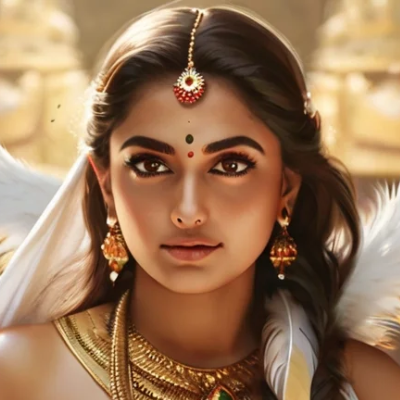
About
Vinata — Mother of Garuda and Aruna, and Co-Wife of Kadru
Vinata · Garudamata · Arunamata · Dakshakanya · Kashyapapatni · Suparnajananai
Vinata is a daughter of Daksha, the primordial progenitor lord and one of the Prajapatis appointed by Brahma to oversee the proliferation of living beings, and one of the principal wives of the sage Kashyapa — grandson of Brahma through the seer Marichi and the common progenitor of all the major races of beings in the Puranic cosmological system. Vinata is celebrated above all as the mother of two extraordinary beings: Aruna, the reddish deity of the dawn who serves as the charioteer of the sun, and Garuda — the great eagle, lord of birds, vehicle of Vishnu, and one of the most powerful beings in the cosmos. Her personal narrative, elaborated in the Astika sub-parva of the Adi Parva of the Mahabharata, is among the most dramatically constructed stories of co-wife rivalry in the epic tradition. It involves a fateful wager with her co-wife Kadru — mother of the thousand Nagas — a deception, a prolonged servitude, and her ultimate liberation through the extraordinary deeds of her son Garuda. Vinata appears in the Mahabharata, the Vishnu Purana, the Bhagavata Purana, and several other Mahapuranas, though the Mahabharata's Astika narrative is by far the richest source for her story.
✦ The Name
The name Vinata derives from the Sanskrit root nam with the prefix vi, yielding the sense of "she who is bowed," "the bent one," or "the humble one." The name thus carries connotations of lowering or inclining, which some commentators have read as foreshadowing her eventual condition of subservience to Kadru. The epithet Garudamata means "mother of Garuda," and Arunamata means "mother of Aruna." Suparnajananai means "mother of the beautifully winged one," Suparna being one of Garuda's most common epithets. The patronymic Dakshakanya identifies her as a daughter of Daksha.
✦ Lineage
- Father: Daksha — a Prajapati and primordial progenitor, son of Brahma, who distributed his daughters in marriage to the great sages as a means of generating the diverse races of beings across the cosmos.
- Mother: The name of Daksha's wife varies across sources as it does for all his daughters — Panchajani in some Puranic passages, Prasuti in the Bhagavata Purana's framework, and Virani in certain passages of the Mahabharata. These represent distinct textual strata rather than a single agreed genealogy.
- Siblings: Vinata is one of the group of Daksha's daughters given in marriage to Kashyapa. Her most narratively significant sibling is Kadru — mother of the thousand Nagas — with whom she shares a household and against whom her story is entirely structured. Other sisters as co-wives of Kashyapa include Aditi (mother of the twelve Adityas), Diti (mother of the Daityas), Danu (mother of the Danavas), Surasa (mother of a group of Nagas), Muni, Krodhavasha, Tamra, Ira, Arishta, Surabhi, and Timi, among others named in the Vishnu Purana and Bhagavata Purana.
- Spouse: Kashyapa — the primordial seer of the highest rank, common progenitor of all created beings through his various wives.
- Son — Aruna: Aruna is the elder of Vinata's two sons, born from the first of her two eggs after Vinata broke it open prematurely in impatience, before the full five-hundred-year incubation period had elapsed. Because the egg was opened too soon, Aruna emerged fully formed only in his upper body; his lower half remained undeveloped. In his anger at being thus incomplete, he cursed his mother to become a slave to her co-wife Kadru for five hundred years — a curse that was partially mitigated by the promise that her second son would eventually liberate her. Aruna is identified as the reddish deity of the pre-dawn sky and serves as the charioteer of Surya, the sun god, driving his seven-horsed chariot across the sky. His reddish, somewhat indistinct form — the quality of the light just before the sun fully rises — is understood in the tradition as a visual expression of his incompletely formed birth.
- Son — Garuda: Garuda is the younger of Vinata's two sons, born from the second egg after the full incubation period. He emerged at his birth in a blaze of such tremendous power and radiance that the gods, terrified by his appearance, initially mistook him for Agni, the fire god, incarnated in a new form. He is the lord of all birds, the sworn enemy of the Naga race, and the vehicle on whom Vishnu rides — a role granted to him directly by Vishnu in recognition of the feat by which Garuda retrieved the amrita from the gods. Garuda is regarded in Vaishnava theology as an eternal and inseparable companion of Vishnu rather than a merely functional vehicle.
✦ The Eggs, the Premature Opening, and Aruna's Curse
The Mahabharata's Astika narrative describes how Kashyapa, pleased with both Kadru and Vinata, offered each of them a boon. Kadru asked for one thousand Naga sons of equal power; Vinata asked for only two sons but stipulated that each would surpass all of Kadru's thousand in brilliance and strength. Kashyapa granted both requests. Both wives laid eggs — Kadru laying one thousand and Vinata laying two — which were placed in warm vessels for incubation. After five hundred years, Kadru's eggs hatched and her thousand Naga sons emerged. Vinata's two eggs had not yet hatched. Envious of Kadru's already-born progeny and unable to wait the remaining incubation period, Vinata broke open one of her eggs herself. The being inside — Aruna — was only half-formed: his upper body was complete and resplendent, but his lower body was still undeveloped. Furious at this premature release, Aruna cursed his mother to enter servitude to Kadru for five hundred years, and warned her not to repeat the same rashness with the second egg. He then departed to take up his position in the sky as the deity of the pre-dawn light. The second egg was left intact and eventually produced Garuda, fully formed and in full power, who was destined to liberate his mother from the bondage his brother's curse had imposed.
✦ The Wager with Kadru and the Enslavement
The episode that triggered Vinata's actual enslavement is narrated immediately after the account of the eggs in the Mahabharata's Astika narrative. Both Kadru and Vinata observed the appearance of Ucchaishravas — the magnificent white horse that had emerged from the Samudra Manthan, the churning of the cosmic ocean. Kadru asserted that the horse's tail was black; Vinata maintained it was white. They agreed that the one proved wrong the next day would become the other's slave. The horse's tail was in fact entirely white. Kadru, knowing this and unwilling to accept defeat, instructed her Naga sons to cling to the hairs of the horse's tail and make it appear black. When Kadru and Vinata went the following day to inspect the horse, its tail appeared black as a result of the Nagas' presence. Vinata, seeing what appeared to be a black tail, accepted that she had lost the wager and entered the agreed condition of servitude to Kadru. The deception on Kadru's part is explicit in the Mahabharata's telling: the text does not present this as an ambiguous outcome but as a deliberate fraud. Vinata thus became Kadru's slave not through any fault of her own judgment but through her co-wife's dishonesty.
✦ Garuda's Quest for the Amrita and Vinata's Liberation
Garuda, born after his mother had already entered her servitude, grew up aware of the condition under which Vinata was enslaved. He asked the Nagas what ransom they required for his mother's freedom. The Nagas demanded the amrita — the nectar of immortality that was guarded by the gods in heaven, secured behind a ring of fire, a rotating wheel of razor blades, and two great serpents. Garuda accepted this apparently impossible task. He first visited his father Kashyapa, who directed him toward food that would restore his strength for the journey. He then consumed a sufficient quantity to sustain him and flew to the realm of the gods.
The Mahabharata narrates that Garuda overcame every obstacle: he extinguished the ring of fire with water collected from many rivers, passed through the spinning blades by contracting himself to a tiny form, blinded the great serpent guardians with dust, and took the vessel of amrita. The entire army of the gods attempted to stop him; he defeated them all, including Indra, whose thunderbolt struck him and caused only the loss of a single feather — which fell so beautifully that the gods marvelled at it. Vishnu, observing Garuda's extraordinary power and virtue and the fact that he had not drunk the amrita himself despite having won it, appeared before him and granted him two boons: Garuda asked to be stationed above Vishnu as his vehicle and emblem, and to feed on Nagas without requiring the amrita for immortality. Vishnu granted both. Indra then approached Garuda separately and asked that the amrita be returned to heaven once Vinata was freed; Garuda agreed and told Indra to reclaim it from the Nagas before they drank it.
Garuda placed the vessel of amrita before the Nagas and announced that his mother was to be freed immediately. The Nagas, before drinking, went to purify themselves ritually. Indra swooped down in that interval and recovered the vessel. The Nagas returned to find the amrita gone; they licked the ground where it had rested and found only the sharp kusa grass, which cut their tongues — and this, the tradition records, is why the tongues of serpents are forked. Vinata was released from her bondage, and from that day Garuda and the Nagas became eternal enemies. Vinata does not appear again as an active figure in the primary texts after her liberation; her narrative function is complete once Garuda's origin and character have been established through her story.
✦ Textual Variants and Inconsistencies
The Mahabharata's Astika narrative is the primary and most elaborated source for all the episodes in Vinata's story, and no major contradictory version of these events appears in the other primary texts. The Vishnu Purana and the Bhagavata Purana confirm the genealogical details — Vinata as Kashyapa's wife and mother of Garuda and Aruna — but do not narrate the wager and enslavement episodes at comparable length. Some regional and vernacular Garuda Puranas expand the account of Garuda's quest for the amrita and of his relationship with Vishnu, and these later texts occasionally vary the sequence or emphasis of events, but the core facts of Vinata's story as given in the Mahabharata remain consistent across the mainstream tradition.
A minor variant concerns the description of Garuda's birth. The Mahabharata's Astika narrative states that Garuda's emergence from the egg caused tremendous cosmic agitation and that the gods mistook him for Agni. The Garuda Purana, which takes Garuda himself as its presiding deity, elaborates this birth with additional theological and cosmological details, presenting him as an avatar or emanation of Vishnu from the moment of his emergence. These amplifications belong to the devotional Garuda tradition rather than to the genealogical framework shared across the mainstream Puranas.
✦ Theological and Narrative Significance
Vinata's story functions in the Mahabharata's narrative architecture as the origin myth of Garuda and as an explanation for the eternal enmity between birds and serpents — a cosmic-scale opposition encoded in the genealogy of two co-wives of the same household. Her impatience in opening the egg prematurely is the direct cause of Aruna's incompleteness and of the curse that places her in bondage; her subsequent victimisation by Kadru's deception layers onto this a portrait of a figure whose suffering arises partly from her own rashness and partly from another's fraud. The tradition thus uses Vinata's story to provide causal explanations for three persistent facts of the natural and cosmic world: the reddish, incomplete quality of the pre-dawn light (Aruna's incomplete birth), the eternal predation of Garuda upon Nagas (the ransom arrangement), and the forked tongue of serpents (the licking of the kusa grass). Vinata herself is the generative matrix of all three of these explanations.
✦ Connection to the Wider Genealogy
Through her father Daksha and her husband Kashyapa, Vinata is embedded in the primordial cosmological genealogy that generates all living beings. Through her son Garuda, she is the progenitress of the lord of birds and the vehicle of Vishnu — one of the supreme deities of the tradition — giving her indirect cosmological significance of the highest order. Through Aruna, she is the mother of the deity who governs the transition between night and day and who drives the chariot of the sun god Surya, making her the grandmother of the solar light. Surya himself, as one of the twelve Adityas, is a son of her sister Aditi, making Aruna and the twelve Adityas simultaneously cousins and the relationships between dawn and full sunlight intelligible within a single genealogical household. The Naga-Garuda enmity that flows from her story connects the entire Naga lineage of her co-wife Kadru to the divine bird lineage of her own progeny in a permanent structural opposition that runs through the cosmological background of the Mahabharata and the Puranas.
✦ References
Primary Sources
- Mahabharata, Adi Parva, sections 14–36 (the Astika sub-parva): The primary and definitive source for Vinata's story; narrates the episodes of the eggs, Aruna's premature birth and curse, the wager with Kadru, the deception of the horse's tail, Garuda's quest for the amrita, and Vinata's liberation. Indispensable for any account of Vinata's narrative identity.
- Mahabharata, Adi Parva, sections 65–66: The genealogical enumeration placing Vinata among Kashyapa's wives within the broader cosmological framework.
- Vishnu Purana, Book 1, chapters 21–22: Confirms Vinata as a wife of Kashyapa and mother of Garuda and Aruna within the Puranic genealogical structure.
- Bhagavata Purana, Book 6, chapter 6: Lists Vinata among Daksha's daughters given to Kashyapa; confirms her as Garuda's mother.
- Garuda Purana, introductory sections: Presents Garuda as its presiding deity and elaborates his birth from Vinata in a devotional theological register; broadly consistent with the Mahabharata genealogy while adding devotional amplification.
- Matsya Purana, chapter 6: Confirms Vinata among Kashyapa's wives within the standard genealogical list.
Modern Reference Works
- Vettam Mani, Puranic Encyclopaedia (1975): Entry on Vinata; collates primary references across texts and summarises the principal episodes of her story.
- J. A. B. van Buitenen (translator), The Mahabharata, Volume 1 (1973): Critical translation of the Adi Parva including the full Astika sub-narrative; notes on the text and variants are relevant to the treatment of Vinata's episodes.
- Wendy Doniger O'Flaherty, Women, Androgynes, and Other Mythical Beasts (1980): Includes analysis of the Kadru-Vinata conflict as a paradigm of co-wife rivalry and its cosmological encoding of the bird-serpent opposition.
- David Shulman, More Than Real: A History of the Imagination in South India (2012): Contains discussion relevant to the narrative logic of premature births and the consequences of impatience in the Sanskrit mythological tradition, applicable to the Aruna episode.