
About
Aruna — Charioteer of the Sun, Elder Son of Vinata
Aruna · Vainateya · Anuru · Kashyapeya · Aruна
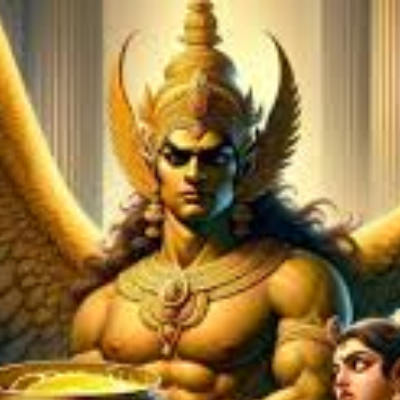
Aruna is a solar deity and the divine charioteer of Surya, the sun god, in the Hindu Puranic and epic traditions. He is the elder son of the sage Kashyapa — one of the seven primordial seers and a progenitor of numerous classes of beings — and Vinata, a daughter of Daksha the progenitor-patriarch and one of Kashyapa's principal wives. Aruna is the elder brother of Garuda, the great eagle who became the vehicle of Vishnu. His body is described as radiantly crimson, and he is identified with the reddish glow of dawn that precedes sunrise. He appears prominently in the Mahabharata, the Vishnu Purana, the Brahma Purana, the Bhagavata Purana, and several other Mahapuranas.
✦ The Name
The name Aruna derives from the Sanskrit root associated with the colour reddish-brown or tawny, the hue of the sky at dawn. It is the same root from which the word for dawn-colour is drawn across classical Sanskrit literature. The epithet Vainateya, shared with his younger brother Garuda, means "son of Vinata" and identifies him by his maternal lineage. Kashyapeya similarly means "son of Kashyapa" and places him within the patrilineal line of that great sage. The name Anuru, found in certain Puranic passages, refers to his physical condition of being without fully formed thighs or lower limbs, a consequence of his premature birth, as described below.
✦ Lineage
- Father: Kashyapa — one of the Saptarishis, the seven primordial sages; a son of Marichi and grandson of Brahma; progenitor of gods, demons, humans, birds, serpents, and other classes of beings.
- Mother: Vinata — a daughter of Daksha, the progenitor-patriarch who is himself a son of Brahma; one of the thirteen or seventeen daughters given in marriage to Kashyapa according to different Puranic lists; sister of Kadru, who is also a wife of Kashyapa.
- Maternal aunt: Kadru — another wife of Kashyapa and the mother of the Nagas, the great serpent race; Kadru and Vinata are rivals whose wager over the colour of the horse Uchchaihshravas leads directly to Vinata's enslavement and shapes Aruna's circumstances at birth.
- Younger brother: Garuda — the great eagle-deity, vehicle of Vishnu, born from the second of Vinata's two eggs; Garuda later wins the release of their mother Vinata from Kadru's bondage by bringing amrita, the nectar of immortality, to the Nagas.
- Half-siblings (selected): The Adityas, the Daityas, the Danavas, the Nagas, and numerous other classes of beings are counted among Kashyapa's offspring by his various wives, making Aruna a half-sibling of an enormous range of divine and demonic figures in the tradition.
✦ The Premature Birth and Its Consequence
According to the account given in the Adi Parva of the Mahabharata, Kashyapa granted Vinata two eggs, promising that they would each give birth to powerful sons surpassing all others. Vinata and her sister-co-wife Kadru kept their respective eggs warm for five hundred years. At the end of that period, Kadru's eggs hatched into a thousand serpents. Vinata, overcome with impatience and perhaps with competitive feeling toward her sister, broke open one of her own eggs before the full term of incubation had elapsed. The being within — Aruna — had emerged before he was fully formed. His upper body was brilliantly radiant, but his lower body, specifically his thighs, was undeveloped or altogether absent. In his anger at being forced into birth prematurely, Aruna cursed his mother Vinata, pronouncing that she would be enslaved by her sister Kadru for five hundred years, and that only the being within the second egg, if she refrained from opening it prematurely, would eventually liberate her. Aruna then ascended to the sky, where he took his place as the charioteer of the sun. This episode explains both his physical condition and his position in the celestial order.
✦ Role as Charioteer of the Sun
Across the Vishnu Purana, the Brahma Purana, the Markandeya Purana, and related Puranic sources, Aruna is firmly established as the charioteer of Surya, the sun god. He sits at the front of the sun's chariot, facing outward toward the world, while Surya rides behind him. Aruna's radiant reddish body is said to be what produces the crimson and orange light of dawn each morning before the full disc of the sun rises above the horizon. He thus functions as the herald and forerunner of the sun itself. The Vishnu Purana describes the arrangement of Surya's chariot with Aruna as the charioteer in some detail. His role is not merely functional but cosmological: the daily reddening of the dawn sky is understood as his presence illuminating the eastern horizon in advance of his master.
✦ Textual Variants and Inconsistencies
The principal Puranic and epic texts are broadly consistent regarding Aruna's parentage, his premature birth, his curse of Vinata, and his position as charioteer of the sun. Minor variations exist in the number of years assigned to incubation periods and the precise wording of the curse. The Mahabharata's Adi Parva gives the most extended narrative of the birth episode. The Vishnu Purana and Bhagavata Purana confirm his role as the sun's charioteer without always repeating the birth narrative in full. Some regional and later Puranic texts describe his body as entirely limbless below the torso rather than merely underdeveloped; others treat the condition as absence of thighs specifically. These are matters of descriptive emphasis rather than fundamental contradiction across sources.
✦ Connection to the Wider Genealogy
Aruna belongs to the line of Kashyapa, who is one of the mind-born sons of Marichi, himself a mind-born son of Brahma the creator. Through Kashyapa's multiple wives, this lineage branches into virtually every order of being in the Puranic cosmos. Aruna's place within it is as the progenitor-by-exception — he is one of only two known offspring of Vinata, yet his younger brother Garuda becomes one of the most prominent beings in the entire tradition as the vehicle of Vishnu. Aruna's own genealogical significance is primarily as a link between the avian line of Vainateyas and the solar order: his physical station at the front of the sun's chariot places the Kashyapa-Vinata bloodline at the very centre of the daily celestial cycle.
✦ References
- Mahabharata, Adi Parva, sections 14–16: Primary source for the narrative of Vinata's eggs, the premature hatching, the physical condition of Aruna at birth, and his curse upon his mother; also establishes his ascent to become the sun's charioteer.
- Vishnu Purana, Book II, Chapter 8: Describes the chariot of the sun and confirms Aruna's position as charioteer; places him in the solar cosmological order.
- Brahma Purana: Repeats and elaborates on Aruna's role in the solar chariot and his identity as dawn.
- Bhagavata Purana, Skandha VI: Lists Kashyapa's wives and their offspring, situating Aruna within the broader genealogy of Kashyapa and Vinata.
- Markandeya Purana: Refers to Aruna in the context of solar cosmology and the daily movement of the sun.
- Vettam Mani, Puranic Encyclopaedia (1975): Modern reference; provides a consolidated summary of Aruna's birth narrative, epithets, and role drawn from multiple primary sources.
- Monier-Williams Sanskrit-English Dictionary: Modern reference; gives the etymology and semantic range of the name Aruna and its association with the reddish-brown colour of dawn.