
About
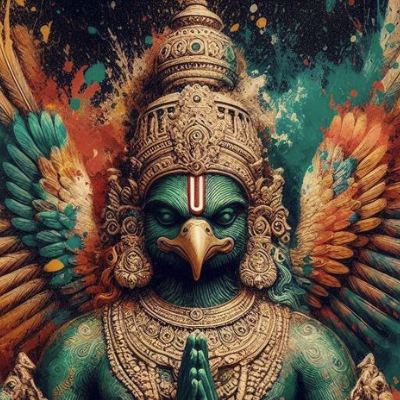
Garuda — King of Birds, Vehicle of Vishnu
Garuda · Vainateya · Garutman · Suparna · Tarkshya · Khageshvara · Nagantaka · Vishnuratha · Pannagashana · Kashyapeya · Pakshiraja · Suvarnakaya · Chirada · Gaganeshvara · Arunanuja
Garuda is one of the most celebrated divine beings in the Hindu tradition — a great eagle-deity, king of all birds, and the vahana or vehicle-mount of Vishnu, the preserver of the cosmos. He is the younger son of the sage Kashyapa, one of the seven primordial seers and the supreme progenitor of divine and cosmic races, and of Vinata, a daughter of Daksha the progenitor-patriarch and one of Kashyapa's principal wives. He is the younger brother of Aruna, the charioteer of Surya the sun god. His birth, his quest for the nectar of immortality to secure his mother Vinata's freedom from slavery to her sister Kadru and Kadru's serpent sons, his defeat of the gods and his compact with Vishnu, and his eternal enmity with the Naga race are narrated at length in the Adi Parva of the Mahabharata. He appears across virtually every stratum of the Hindu scriptural tradition — the Rigveda, the Shatapatha Brahmana, the Mahabharata, the Valmiki Ramayana, the Vishnu Purana, the Bhagavata Purana, the Garuda Purana, the Brahma Purana, the Padma Purana, the Bhagavad Gita, and the Garudopanishad — as well as in Buddhist and Jain canons, and in the royal and religious iconographies of numerous South and Southeast Asian traditions.
✦ The Names
The name Garuda is derived from a Sanskrit root associated with the act of devouring or consuming; it may also connect to the root gri, meaning to speak, and has been interpreted in philosophical literature as signifying the Vedic speech or mantra that carries divine knowledge. Garutman, the earliest Vedic designation for this being, appears in the Rigveda and means one with magnificent or resplendent wings; a hymn of the Rigveda describes Garutman as a beautiful divine being whose wings are splendid. Suparna means one of beautiful or auspicious feathers and is among the most frequent epithets across both epic and Puranic literature. Vainateya means son of Vinata, identifying him by his maternal descent. Tarkshya, associated in the Rigveda with a horse but identified with Garuda in later literature, is given in Puranic texts as an alternative name. Khageshvara means lord of sky-dwellers or lord of birds. Nagantaka means the destroyer or terminator of Nagas. Vishnuratha means the chariot or vehicle of Vishnu. Pannagashana means the eater of serpents. Arunanuja means the younger brother of Aruna. Kashyapeya means son of Kashyapa.
✦ Lineage
- Father: Kashyapa — one of the Saptarishis, the seven primordial sages; son of Marichi, himself a mind-born son of Brahma the creator; husband of numerous daughters of Daksha; progenitor of the Adityas, Daityas, Danavas, Nagas, birds, and virtually all classes of beings in the Puranic cosmos.
- Mother: Vinata — a daughter of Daksha the progenitor-patriarch; one of Kashyapa's principal wives; sister and co-wife of Kadru, the mother of the Naga race; the one whose enslavement to Kadru forms the direct cause of Garuda's great quest; her name has been interpreted as she before whom knowledge bows.
- Maternal aunt and co-wife of father: Kadru — another wife of Kashyapa and daughter of Daksha; the mother of the thousand Naga serpent-sons; her wager with Vinata over the colour of the horse Uchchaihshravas, which she won by deception, placed Vinata in her power and set in motion the entire chain of events leading to Garuda's theft of the amrita.
- Elder brother: Aruna — the charioteer of Surya the sun god; born prematurely from Vinata's first egg in an act of impatience that earned Vinata Aruna's curse of enslavement; his radiant reddish body constitutes the crimson glow of dawn preceding sunrise each day.
- Half-siblings (selected): The Adityas, born of Kashyapa and Aditi — another daughter of Daksha — are Garuda's half-brothers; they include Indra, king of the gods, with whom Garuda engages in direct combat during the theft of the amrita. The Daityas and Danavas, born of Diti and Danu respectively, are further half-sibling classes. The Nagas, born of Kadru, are Garuda's half-siblings through Kashyapa and his sworn enemies through the history of Vinata's enslavement.
- Wife (principal account): Unnati — named in Vaishnava texts as Garuda's consort; her name means progress or ascent; also referred to in some sources as Vinayaka, meaning queen of knowledge.
- Sons (per Mahabharata): Six sons — Sumukha (beautiful-faced), Suvarna (golden), Subala (of great strength), Sunaama (of beautiful name), Sunethra (beautiful-eyed), and Suvarchas (of beautiful vigour) — are named in the Mahabharata as Garuda's offspring, from whom the entire race of birds descended. The Brahma Purana and related sources add Sampati, the great vulture-king of the Ramayana, to this tradition in certain accounts, though the principal Ramayana genealogy identifies Sampati as the son of Aruna rather than Garuda.
✦ Vedic Origins
The earliest stratum of Garuda's presence in the tradition is Vedic. The Rigveda describes a celestial eagle or Shyena — the Sanskrit word for hawk or eagle — that brings the soma plant, the ritual beverage of immortality, down from heaven to earth. This bird is also called Garutman in certain Rigvedic passages and is described as a radiant divine being of magnificent wings. The Shatapatha Brahmana, embedded in the Yajurveda, identifies Garuda as the personification of courage. Later Puranic tradition and the Mahabharata explicitly connect Garutman of the Vedas with Garuda of the epics, treating them as the same being; scholars note that the Vedic feat of bringing soma from heaven is structurally parallel to the Puranic account of Garuda stealing the amrita, reinforcing this identification. The name Tarkshya, applied to Garuda in epic and Puranic literature, appears in the Rigveda as a horse-name, representing one of the few points where the textual identification requires qualification.
✦ Birth
The Mahabharata's Adi Parva, in the Astika Parva section, narrates the circumstances of Garuda's birth at length. Kashyapa had granted Vinata and Kadru boons each: Kadru asked for a thousand Naga sons of great power, and Vinata asked for two sons of surpassing strength and brilliance. Both wives laid eggs, which were incubated in heated vessels. After five hundred years, Kadru's thousand eggs hatched into the serpent race. Vinata, impatient and anxious, broke open her first egg prematurely, releasing the incompletely formed Aruna who, angered at the forced birth, cursed her to five hundred years of servitude to Kadru before ascending to the sky as the sun's charioteer. Vinata, chastened, left her second egg undisturbed. The Mahabharata records a separate tradition in which the Valakhilya sages — a group of tiny but enormously powerful ascetics who had been insulted by Indra — performed a sacrifice specifically for the birth of a being that would humiliate Indra; Kashyapa, learning of this, negotiated with the sages so that the being born would be his son. In consequence, Garuda was born from Vinata's second egg at the right term, emerging with blazing radiance that frightened the gods, who approached the fire god Agni believing a second fire had arisen. Agni reassured them that the being born was Garuda, son of Kashyapa, and as radiant as fire itself. The gods offered their praises, and Garuda reduced his luminosity on their request.
✦ Vinata's Enslavement and the Condition for Her Release
Before Garuda's birth, and during the period in which he was growing, Vinata had already fallen into slavery to Kadru through the wager over the colour of the tail of the divine horse Uchchaihshravas, which arose from the churning of the cosmic ocean. Kadru had directed her Naga sons to cling to the horse's white tail and make it appear black, thereby causing Vinata to lose. Vinata was thus bound in servitude to Kadru's household. When Garuda came of age and learned of his mother's condition, he went to the Nagas and asked what ransom would secure her freedom. The Nagas demanded the amrita, the nectar of immortality then guarded in the possession of the gods, as the price of Vinata's release. Garuda accepted this condition and set out.
✦ The Quest for the Amrita
The Mahabharata's Adi Parva narrates the quest in detail across multiple chapters. Before departing, Garuda asked his father Kashyapa what food would sustain him for such a journey. Kashyapa directed him to a lake where two brothers — former sages cursed by each other into the forms of an elephant and a tortoise — were engaged in eternal combat; consuming them would provide sufficient strength. Garuda seized both in his talons, sought a great tree on which to eat, broke a branch of that tree under his weight, and discovered it was occupied by the tiny Valakhilya sages performing austerities hanging from it upside down. Rather than dislodge them, he carried the branch carefully in his beak to a mountain summit, set it down gently, allowed the sages to depart, and then consumed the elephant and tortoise.
Garuda then advanced to the heavens where the amrita was kept. The gods had secured it with a ring of fire that filled the sky, a mechanical device of deadly rotating blades, and two enormous venomous serpents as immediate guardians. Garuda took water from numerous rivers into his mouth and quenched the fire. He reduced his body to a minute size and slipped through the rotating blades. He then killed the two serpent guardians with a storm of dust driven by his wings and took the vessel of amrita in his mouth without swallowing any of it. He fought the entire host of gods and defeated them all. Indra struck him with his thunderbolt, the vajra made from the bones of the sage Dadhichi, but Garuda, out of respect for Dadhichi's sacrifice from which the vajra was forged, voluntarily shed one of his own feathers in acknowledgement of the weapon's sanctity; from this act he received the epithet Suparna, one of beautiful feathers. Indra recognised Garuda's extraordinary power and sought friendship with him, offering the serpents as Garuda's perpetual food.
✦ The Compact with Vishnu
While returning from the heavens bearing the amrita, Garuda encountered Vishnu, the preserver of the cosmos. The Mahabharata records that the two engaged neither in combat nor in confrontation: rather, Vishnu, recognising the self-denial implicit in Garuda's carrying the amrita without consuming it, offered him two boons. The first boon was immortality without drinking the amrita — that is, independence from the nectar that was the source of divine immortality. The second was that Garuda would be placed above Vishnu as the emblem on his banner and flag. Garuda in turn offered Vishnu a reciprocal boon: he would serve as Vishnu's vehicle, the mount upon which the god traverses the cosmos. From this point forward, Garuda became inseparably identified with Vishnu, appearing on his banner, serving as his vahana in all narrative contexts, and standing as one of the nitya suris, the eternal celestial attendants of Vishnu's transcendental domain Vaikuntha.
✦ Liberation of Vinata and the Deception of the Nagas
Garuda descended to earth and placed the vessel of amrita on darbha grass before the assembled Nagas, thereby technically fulfilling the condition for Vinata's release. He then declared that before they drank, the Nagas should purify themselves through ritual bathing. As the Nagas departed to bathe, Indra — acting on the prior arrangement made with Garuda — swiftly stole the vessel of amrita back. When the Nagas returned, the amrita was gone. They found small drops of it remaining on the darbha grass and began to lick the grass in desperation; the sharpness of the grass split their tongues, which is presented in the tradition as the origin of the forked tongue of serpents. Some texts add that the act of touching the sacred darbha grass while seeking the amrita granted the Nagas the ability to shed their skin, their version of a limited immortality. Vinata was freed. From this episode derives the permanent hostility between Garuda and the Naga race: the Nagas, as the children of Kadru who had enslaved Vinata, were already Garuda's ancestral enemies through his mother's suffering, and the deception regarding the amrita perpetuated the enmity into the cosmic order.
✦ Later Narrative Appearances
Beyond the foundational birth and amrita narrative, Garuda appears in several other episodes across the epic and Puranic tradition. In the Bhagavata Purana he is associated with the rescue of Gajendra, the elephant-king who was seized by a crocodile at a lotus lake; it is on Garuda that Vishnu rides to deliver Gajendra and grant him liberation. In the episode of Narakasura's defeat narrated in Puranic and later Vaishnava literature, Vishnu rides Garuda alongside Satyabhama to destroy the demon. In the Mahabharata's Udyoga Parva, Garuda is said to have a son named Kapota. The Mahabharata also records a planned encounter between Garuda and the Naga Sumukha, in which Indra intervenes; and throughout the epic, Garuda is invoked repeatedly as a symbol of martial speed and the terror that a great predator brings upon its prey. In the Bhagavad Gita, Krishna declares among his divine manifestations: of birds I am the son of Vinata — that is, Garuda — identifying him as the supreme representative of the entire avian class.
✦ Textual Variants and Inconsistencies
The Valmiki Ramayana's Aranya Kanda gives a genealogy in which Vinata is the great-granddaughter of Tamra — herself a wife of Kashyapa — through the line Tamra, Shuki, Nata, Vinata. This would make Vinata not a direct daughter of Daksha but a descendant of Kashyapa through a collateral female line, meaning that Garuda's parentage through Vinata is more complex in the Ramayana genealogy than in the Mahabharata account, which treats Vinata simply as a daughter of Daksha and wife of Kashyapa. The two accounts are not fully reconcilable, and different primary texts adopt different genealogical positions without addressing the discrepancy.
Regarding his offspring: the Mahabharata names six sons of Garuda as the progenitors of the bird race. The World History Encyclopedia and certain iconographic sources name Sampati as a son of Garuda, whereas the Mahabharata's Adi Parva at Chapter 63 verse 71 explicitly states that Sampati and Jatayu are sons of Aruna and Shyeni; the Valmiki Ramayana's Aranya Kanda confirms this through Jatayu's own lineage declaration. The identification of Sampati as Garuda's son is therefore in conflict with the primary epic and Ramayana evidence and appears to be a secondary variant or confusion between uncle and nephew.
Garuda's wife is given as Unnati in Vaishnava texts and as Vinayaka in others; some iconographic sources name two consorts as Rudra and Sukriti or Sukeerthi. These represent variant traditions across different textual and regional streams and are not fully harmonised in the primary sources.
✦ Theological and Philosophical Significance
Within Vaishnava theology, Garuda's role as the vehicle of Vishnu is not merely narrative or functional but deeply symbolic. The Srivaishnava interpretive tradition reads Garuda as the embodiment of the three Vedas — the vehicle that carries the Lord of Sacrifice through the cosmos, just as the Vedas carry the knowledge of Vishnu through the tradition. The Vaishnava philosopher's equation of Garuda with the Vedas, and of Vishnu's riding Garuda with the Lord being carried by scriptural knowledge, gives Garuda a philosophical weight far beyond that of a mount or attendant. The Shatapatha Brahmana identifies Garuda as the personification of courage. George Williams, a modern scholar of Hinduism, analyses Garuda as a Vedic metaphor for rik, saman, yajna, and atman, noting that in the Puranic development of the tradition, Garuda becomes a literal embodiment of the idea of the individual Self that is attached to and inseparable from the Supreme Self. His enmity with the Nagas, symbolically read, represents the struggle of the spiritual aspiration against the binding forces of desire, time, and material existence — the serpents being in this framework emblems of cyclic bondage.
✦ Iconography and Worship
Garuda is depicted in two principal forms across the tradition: a fully zoomorphic form as a giant eagle or kite with wings partially open, and an anthropomorphic form with the torso and arms of a human, the beak, wings, talons, and head of an eagle, and in many representations a beak-like nose rather than a full bird's head. The Silparatna prescribes a body of four bands of colour: golden yellow from feet to knees, white from knees to the navel, scarlet from navel to neck, and black above the neck. The Sritatvanidhi recommends a kneeling figure in namaste posture wearing serpents as ornaments, with a pointed beak-like nose. In representations where he is not carrying Vishnu, he holds a pot of amrita in one rear hand and an umbrella in the other, while the front pair of hands maintain the anjali posture. When shown carrying Vishnu, his rear hands support the god's feet. He is sometimes flanked by Vishnu's consorts Sridevi and Bhudevi. His face is described as white, his wings as red, and his body as golden or emerald-green in different textual prescriptions.
Dedicated Garuda temples are rare in India relative to Vishnu temples, where Garuda figures commonly appear as devotional attendants or on columns before the main shrine. A significant Garuda kavu of approximately eighteen hundred years of age exists in Kerala. Early sculptural evidence for Garuda iconography includes the Besnagar sandstone column of at least the first century BCE, thought to have been topped by a Garuda figure, and the Badami cave temples of the sixth century CE where Garuda appears at the cave entrance. The Garudopanishad is an Upanishad dedicated specifically to Garuda. Garuda Panchami is an annual day of his worship. His image became the national emblem of both Thailand and Indonesia; Thailand's Garuda, known as Phra Khrut Pha, became the royal symbol under King Rama VI and has been a state seal from the sixteenth century. Indonesia's national emblem, Garuda Pancasila, is rendered in a heraldic style derived from the same tradition.
✦ Connection to the Wider Genealogy
Garuda stands at the intersection of the Kashyapa lineage's two most prominent avian figures. Through Kashyapa and Vinata he is the younger brother of Aruna and the nephew of Kadru's Naga sons through their shared father. His enmity with the Naga race is thus simultaneously a cosmic opposition and an intra-familial conflict within the vast progeny of Kashyapa. Through his own six sons, named in the Mahabharata as Sumukha, Suvarna, Subala, Sunaama, Sunethra, and Suvarchas, the entire bird race traces its divine genealogy back to Kashyapa through Garuda. His nephew Jatayu, son of Aruna, dies in Rama's service; and his nephew Sampati, elder brother of Jatayu, provides the intelligence that makes Sita's rescue possible. The avian lineage of Kashyapa thus participates in the cosmic events of the Ramayana's central narrative through both the Garuda branch and the Aruna branch of Vinata's two sons.
✦ References
- Rigveda, various hymns (Shyena and Garutman passages): Earliest textual stratum; describes the divine eagle Garutman with resplendent wings and the Shyena that brings soma from heaven; the Vedic foundation of the Garuda tradition.
- Shatapatha Brahmana (embedded in the Yajurveda): Identifies Garuda as the personification of courage; bridges the Vedic and epic traditions.
- Mahabharata, Adi Parva, Astika Parva section (Chapters 13–34): Primary and most extended source for Garuda's birth, the wager between Vinata and Kadru, the condition for Vinata's release, the quest for amrita, the battle with the gods, the feather episode with Indra, the compact with Vishnu, the liberation of Vinata, and the origin of the Naga enmity. Also names his six sons as progenitors of the bird race.
- Mahabharata, Udyoga Parva: Mentions Garuda's son Kapota; contributes supplementary genealogical data.
- Bhagavad Gita, Chapter 10, verse 30: Krishna identifies himself as the son of Vinata among birds; confirms Garuda's status as the supreme representative of the avian class.
- Valmiki Ramayana, Aranya Kanda, Chapter 14: Jatayu's genealogical declaration traces his own lineage through Kashyapa and Aruna; provides the Ramayana's version of the avian genealogy including the alternative account of Vinata's descent through Tamra, Shuki, and Nata.
- Vishnu Purana, Book I, Chapters 15 and 21: Confirms Garuda's parentage and places him within the genealogical order of Kashyapa's progeny; describes his role as Vishnu's vehicle.
- Bhagavata Purana, Skandha VI and VIII: Genealogical context for the Kashyapa lineage; the Gajendra rescue episode involves Garuda as Vishnu's mount.
- Garuda Purana (Mahapurana): The entire text is framed as a dialogue between Vishnu and Garuda; confirms his status as the eternal attendant and vehicle of Vishnu; the text is also known as Sauparna Purana, Tarkshya Purana, and Vainateya Purana in different manuscript traditions.
- Garudopanishad: An Upanishad dedicated specifically to Garuda; theological and devotional elaboration of his significance in the Vaishnava tradition.
- Padma Purana, Srishti Khanda, Chapter 47: Contains a birth narrative for Garuda and his visit to his father Kashyapa seeking food; contributes supplementary narrative detail.
- Suparnaakhyana (late Vedic period poem): Considered among the earliest traces of epic poetry in India; narrates the legend of Garuda and forms the basis for the expanded version in the Mahabharata.
- Silparatna (iconographic treatise): Prescribes the four-band colour scheme for Garuda's body in sculptural representation.
- Sritatvanidhi (iconographic text): Describes the kneeling Garuda in namaste posture commonly found in Vishnu temple contexts.
- Vettam Mani, Puranic Encyclopaedia (1975): Modern reference; consolidates Garuda's names, genealogy, and principal episodes across primary sources.
- George Williams, Handbook of Hindu Mythology (2003): Modern reference; analyses the Vedic roots of the Garuda tradition and the philosophical interpretation of Garuda as a metaphor for atman.
- Encyclopaedia Britannica, Garuda article: Modern reference; summarises the mythological account with attention to the Vedic and Mahabharata sources.
- World History Encyclopedia, Garuda article (Mark Cartwright, 2015): Modern reference; covers iconography across South and Southeast Asian traditions and the variant regarding Garuda's consort and offspring.
- Wikipedia, Garuda article: Modern secondary reference; comprehensive summary of names, narrative episodes, iconographic prescriptions, and pan-Asian cultural presence.