
About
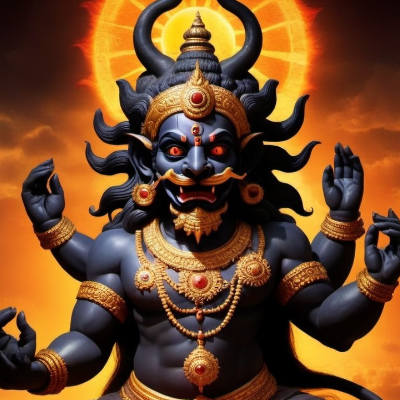
Svarbhanu — The Asura Before Dismemberment, Eldest Son of Simhika
Svarbhanu · Swarbhanu · Sainhikeya · Rahuketu (pre-division compound) · Tamasa
Svarbhanu is a powerful asura existing as a unified, whole being in the traditions preceding and independent of the Samudra Manthan episode in which he was divided into Rahu and Ketu. He is the son of the Danava king Viprachitti — eldest of the Danava race, son of Kashyapa and Danu — and of Simhika, a Daitya princess and daughter of Kashyapa and Diti. As a complete being, Svarbhanu has his own identity, his own mythology, his own actions, his own daughter, and a rebirth after his existence as an undivided asura. This profile treats him as that complete being and does not conflate him with either Rahu or Ketu, whose profiles are given separately in this series. The name Svarbhanu appears first in the Rigveda, where he is attested as an eclipse-causing asura who attacks Surya the sun god with darkness — a tradition entirely independent of the Puranic decapitation narrative. He reappears across the Yajurveda, the Brahmanas, the Mahabharata, the Harivamsha, the Vishnu Purana, the Bhagavata Purana, the Brahmanda Purana, and the Vayu Purana.
✦ The Name
The name Svarbhanu is a Sanskrit compound of svar meaning heaven, the luminous sky, or the celestial realm, and bhanu meaning radiance, brightness, or the sun itself. The compound therefore means one of heavenly radiance or celestial brilliance — a name that carries deep solar associations and an intrinsic irony, since Svarbhanu's defining act both in the Vedic and Puranic traditions is to extinguish or obscure solar light. The Monier-Williams dictionary gives the Sanskrit meaning as the radiance or brilliance of heaven and notes that in the Rigveda the name denotes an asura who attacks the sun, while in later epic literature it is explicitly applied to the being who becomes Rahu. The scholar Stella Kramrisch, in her analysis of the Rigvedic passages, considers that the Vedic figure Svarbhanu was initially portrayed as a power greater than the sun — one capable of piercing and overwhelming Surya entirely — before later tradition subordinated him to the Puranic Samudra Manthan narrative. The Wisdomlib compilation of scholarly sources notes that the Rigveda passage represents the only occurrence of the name in the Vedic family books and that no evidence in the Rigveda itself identifies Svarbhanu with the graha or planet concept; that identification belongs to the later Mahabharata and Ramayana period.
✦ Lineage
- Father: Viprachitti — eldest of the Danava race, son of Kashyapa and Danu; king of the Danavas after his brother Puloman's death; identified in the Mahabharata's Adi Parva as the previous birth of Jarasandha king of Magadha.
- Mother: Simhika — daughter of Kashyapa and Diti; sister of Hiranyakashipu and Hiranyaksha; a Daitya princess whose name means lioness; described in the Valmiki Ramayana as possessing the power to seize beings by capturing their shadow, a power she exercises against Hanuman during his flight to Lanka. The Brahmanda Purana specifies that Svarbhanu was born in the Bharani nakshatra.
- Paternal grandfather: Kashyapa — one of the seven primordial sages, son of Marichi and grandson of Brahma; also Svarbhanu's maternal grandfather, since both Danu and Diti are daughters of Daksha and wives of Kashyapa. Svarbhanu is therefore doubly a grandchild of Kashyapa.
- Maternal uncles: Hiranyakashipu — the great Daitya tyrant slain by Vishnu in the Narasimha avatar; and Hiranyaksha — slain by Vishnu in the Varaha avatar. Svarbhanu's maternal uncles are thus among the most celebrated asura antagonists of Vishnu in the entire Puranic tradition.
- Brothers (by Simhika, per Vishnu Purana): Vyamsha, Shalya, Nabha, Vatapi, Namuchi, Ilvala, Khasrima, Anjaka, Naraka, Kalanabha, and Vaktrayodhi. The Bhagavata Purana and Vayu Purana name Svarbhanu-Rahu as the eldest of all Simhika's sons. The Vayu Purana states that all these brothers were ultimately slain by Parashurama.
- Daughter: Prabha — also called Suprabha in some sources, per the Vayu Purana; married Ayus, the eldest son of Pururavas of the Chandravamsha or Lunar dynasty; mother of Nahusha and his four brothers Vriddhasharma, Rambha, Raji, and Anena, as recorded in the Harivamsha Chapter 28. Through this daughter, Svarbhanu becomes the maternal great-grandfather of Yayati and the ultimate asura progenitor in the ancestry of the Pandavas and Kauravas.
✦ Svarbhanu in the Rigveda — The Eclipse Demon
The earliest attestation of Svarbhanu in the textual tradition is in the Rigveda at hymn 5.40, attributed to the seer Atri. This passage describes Svarbhanu — called the descendant of the asuras — as piercing Surya through and through with darkness, a catastrophic event that throws all creatures into bewilderment, leaving them unable to recognise where they stand. The hymn presents this as an eclipse of total darkness, the sun concealed within the asura's power and unable to function. The passage records that Atri the sage, having pressed the soma stones and performed worship, prayed with escalating intensity and by his fourth prayer was able to perceive Surya concealed within the gloom of Svarbhanu. By the power of his sacred incantations, Atri caused Svarbhanu's magical arts to vanish, restored the eye of Surya to heaven, and set the sun back in its proper place. A further verse in the same hymn also credits Indra with striking down Svarbhanu in this rescue. This Rigvedic episode is entirely independent of the Puranic decapitation narrative: there is no mention here of Simhika, Viprachitti, the Samudra Manthan, or Vishnu. Svarbhanu in the Rigveda is simply the archaic asura of eclipse, overcome by the combined power of seer Atri's prayer and Indra's might.
The Yajurveda and the Brahmanas continue this tradition. The Brahmanas record that Svarbhanu with darkness pierced Aditya the sun, and that the gods freed the sun by means of the svara musical accents or tonal formulas — a ritual-cosmological account in which the recitation of sacred sound counteracts the power of the eclipse asura. The Shatapatha Brahmana, embedded in the Yajurveda, also engages with this eclipse mythology. The scholar's note at the Wisdomlib compilation confirms that the Rigvedic occurrence of the name Svarbhanu carries no identification with the graha or celestial node concept; this is a later development belonging to the Mahabharata period.
✦ Svarbhanu as a Complete Asura in the Puranic Genealogies
The Vishnu Purana at Chapter 21 lists a Svarbhanu among the principal Danavas born of Kashyapa and Danu, alongside Dvimurdha, Shankara, Ayomukha, Shankushiras, Kapila, Shambara, Ekachakra, Taraka, Vrishaparvan, Puloman, and Viprachitti. This listing is independent of his identification as a son of Viprachitti by Simhika, and the Vishnu Purana in this chapter also notes that this Svarbhanu had a daughter named Prabha. The Bhagavata Purana at Skandha VI, Chapter 6, verses 30 and 32, confirms him as a son of Danu and father of Suprabha or Prabha. The Vayu Purana at Chapter 68 verse 8 similarly places him in the Danava genealogy as a son of Danu and father of Prabha. The Brahmanda Purana, in contrast, identifies him specifically as a son of Simhika born in the Bharani nakshatra — the account that combines his Danava-Daitya dual descent — and gives considerable genealogical detail about his birth and his daughter's marriage to Ayus.
As a whole being before the Samudra Manthan, Svarbhanu was among the most powerful of the asuras. He was an assistant of Shukracharya, the preceptor of the asuras and the presiding deity of the planet Venus, who possessed the Mritasanjivani mantra capable of reviving the dead. The Monstropedia source, drawing on Puranic material, confirms this service relationship. The Harivamsha further records that in the cosmic administration Svarbhanu ushered the great asura Kalanemi through the galaxy — an image that presents him as a figure of significant standing in the asura cosmological hierarchy even before his transformation.
✦ The Samudra Manthan and the Decapitation
The decisive event of Svarbhanu's existence as a unified being is the Samudra Manthan, the churning of the cosmic ocean, during which he disguised himself as a deva to receive the amrita. This episode is narrated at length in the Bhagavata Purana's Skandha VIII, the Vishnu Purana, and the Mahabharata's Adi Parva. Svarbhanu, described as the most perceptive among the asuras, recognised that Vishnu in the form of Mohini was distributing the amrita exclusively to the gods. He slipped away from the asura row and seated himself between Surya and Soma among the gods. He consumed a portion of the amrita. Surya and Soma recognised him and alerted Vishnu, who hurled the Sudarshana Chakra and severed his head from his body. Because the amrita had already been swallowed and absorbed, both the head and the body became immortal. The head became Rahu; the body became Ketu. Svarbhanu as a unified, complete being ceased to exist at that moment, replaced by two immortal half-beings whose profiles are given separately in this series.
✦ The Rebirth of Svarbhanu as Ugrasena
The Mahabharata's Adi Parva at Chapter 67, in the Sambhava Parva section, contains the celebrated passage in which the births of the Mahabharata's principal characters are attributed to the reincarnations of various celestial beings. The text states plainly that the great asura who was known as Svarbhanu became on earth the monarch Ugrasena. Ugrasena is the king of Mathura, a descendant of the Yadava line, and the father of Kamsa — who is himself identified in the same passage as the reincarnation of the Danava Kalanemi. This identification creates a remarkable genealogical and karmological chain: Svarbhanu the eclipse-asura is reborn as the relatively righteous human king Ugrasena; his son Kamsa in that life is the reincarnation of Kalanemi, a ferocious Danava of Svarbhanu's own clan. Ugrasena is imprisoned by his own son Kamsa and eventually freed by Krishna, who then restores him to his throne. The tradition thus traces the asura's reincarnation into a human king who ultimately becomes a beneficiary of divine grace through the same Vishnu — now incarnated as Krishna — who decapitated Svarbhanu at the Samudra Manthan.
✦ Textual Variants and Inconsistencies in Parentage
The parentage of Svarbhanu is given differently across the primary sources, and the inconsistency is significant. The Vishnu Purana Chapter 21 list of Danavas includes him as a son of Danu, treating him as a full Danava in the same generation as Viprachitti rather than as Viprachitti's son. The Bhagavata Purana at Skandha VI and the Vayu Purana similarly place him as a son of Danu. In contrast, the Brahmanda Purana identifies him specifically as a son of Simhika born in the Bharani nakshatra, which would make him the son of Viprachitti and Simhika — the account that underlies the Vishnu Purana's later chapter listing of the Sainhikeyas and the Bhagavata Purana's identification of Rahu as the eldest son of Simhika. The resolution most consistent with the principal Puranic sources treating the Samudra Manthan is that his mother Simhika was herself a daughter of Kashyapa and Diti, making him a son of a Danava father and a Daitya mother — both lines descending from Kashyapa. The listing of a Svarbhanu among Danu's sons in the Vishnu Purana may reflect either a distinct figure bearing the same name or the same figure placed one generation earlier in a variant genealogical tradition.
The Matsya Purana lists a Svarbhanu among the sons of Bana, who is the son of Bali, placing him in the Bali-Virocana-Prahlada lineage entirely. The Brahmanda Purana in one passage also records a tradition making him a son of Soma the moon god or of Budha — the latter a further variant that, as the Grokipedia entry notes, may reflect syncretic elements in later traditions. These divergent placements across different Puranas indicate that the name Svarbhanu was applied to more than one figure across the tradition, and that the primary source materials do not present a single unified genealogy.
A further distinction must be noted: the Bhagavata Purana at Skandha 10 names a son of Krishna by his wife Satyabhama also as Svarbhanu. This figure is entirely unrelated to the asura of the eclipse traditions and bears only the name in common with the principal figure of this profile.
✦ Theological and Cosmological Significance
Svarbhanu's significance in the tradition operates across three distinct registers. In the Vedic register, he is the archaic eclipse-demon, the primordial force of cosmic darkness that can overwhelm the sun and bring all creation to a standstill — a force overcome not by brute power but by the sacred sound and austerity of the rishi Atri. In the Puranic register, he is the most perceptive of the asuras at the Samudra Manthan — intelligent enough to see through Vishnu's Mohini disguise, bold enough to sit between Surya and Soma to claim immortality, and ultimately the origin of the two shadow-planets that govern eclipse cycles for the entire duration of cosmic time. In the genealogical register, he is the maternal great-grandfather of Nahusha, Yayati, the Pandavas, and the Kauravas — the asura progenitor embedded in the very lineage of the Chandravamsha's greatest kings. His rebirth as Ugrasena adds a fourth dimension: the asura who challenged the cosmic order is reborn as a human king who is restored to dignity by the very divine power that dismembered him. Across all four registers, Svarbhanu is a figure of unusual range and genealogical consequence.
✦ Connection to the Wider Genealogy
As an undivided being, Svarbhanu concentrates in himself the asura lineage of Kashyapa doubly — through Danu on his father's side and through Diti on his mother's side. He is a half-sibling of the Adityas including Surya through Kashyapa and Aditi, which makes the eclipse mythology a conflict within the extended family of Kashyapa's progeny. Through his daughter Prabha's marriage to Ayus and the birth of Nahusha, he becomes the asura forebear of the entire main trunk of the Chandravamsha's later generations. Through his rebirth as Ugrasena, the asura presence continues in the Dvapara Yuga as a paternal figure within the Yadava lineage closely associated with Krishna's birth and life. In the this genealogical series, Svarbhanu is thus the bridge between the Danava-Daitya cosmological stratum of Kashyapa's asura progeny and the human royal lineages of India's epic age.
✦ References
- Rigveda, Hymn 5.40, verses 5–9: Primary and earliest source; describes Svarbhanu as the asura's descendant who pierces Surya with darkness and is overcome by the prayer of Atri and the action of Indra; the foundational Vedic eclipse narrative.
- Yajurveda and Shatapatha Brahmana: Continue the Vedic eclipse tradition; record that Svarbhanu pierced Aditya with darkness and that the gods freed the sun by means of the svara tonal accents.
- Mahabharata, Adi Parva, Chapter 67 (Sambhava Parva): States explicitly that the great asura known as Svarbhanu was reborn on earth as the monarch Ugrasena; the primary source for the rebirth identification connecting Svarbhanu to the Dvapara Yuga Yadava lineage.
- Bhagavata Purana, Skandha VI, Chapter 6, verses 30 and 32: Names Svarbhanu as a son of Danu and father of Suprabha-Prabha; genealogical source for his position within the Danava lineage.
- Bhagavata Purana, Skandha VIII (Samudra Manthan): Primary Puranic source for the churning narrative, Svarbhanu's disguise and decapitation; establishes the Sainhikeya identification with Rahu and Ketu.
- Vishnu Purana, Book I, Chapters 9 and 21: Chapter 9 narrates the Samudra Manthan and decapitation; Chapter 21 lists Svarbhanu among the Danavas as a son of Danu with a daughter Prabha; the footnote in the Wilson translation notes the omission of Rahu and Ketu from the named Sainhikeyas in that recension.
- Vayu Purana, Chapter 68, verse 8: Places Svarbhanu as a son of Danu and father of Prabha; confirms the genealogical thread connecting him to Ayus and Nahusha.
- Brahmanda Purana, Chapter II.24, verses 83–97 and 137; Chapter III.6, verses 8 and 23–24: Names Svarbhanu as a son of Simhika born in the Bharani nakshatra; gives the account of his daughter Prabha's marriage to Ayus; the Puranic source that most fully integrates his Danu-Diti dual descent.
- Harivamsha, Adi Parva, Chapter 28, verses 1–2 and 9: Confirms the genealogical chain through Svarbhanu's daughter Prabha to Ayus and to the five sons Nahusha, Vriddhasharma, Rambha, Raji, and Anena; the Sanskrit svarbhānu tanayāyāM at verse 1 is the controlling primary genealogical statement.
- Wisdomlib.org, Svarbhanu definition entry: Modern reference; synthesises primary source citations from the Rigveda, Mahabharata, Bhagavata Purana, Vishnu Purana, Vayu Purana, and Brahmanda Purana; notes the scholarly observation that the Rigvedic Svarbhanu is not identified with the graha concept, which belongs to the later epic period.
- Wikipedia, Svarbhanu article: Modern secondary reference; covers the Vedic, Brahmana, and Puranic attestations; notes Stella Kramrisch's scholarly characterisation of the Vedic figure.
- Monier-Williams Sanskrit-English Dictionary: Modern reference; etymology of the compound svar plus bhanu as heavenly radiance; confirms the principal Rigvedic and epic usages of the name.