
About
Sampati — Elder Son of Aruna, King of Vultures
Sampati · Sampatin · Vainateya (by descent) · Gridhrарaja
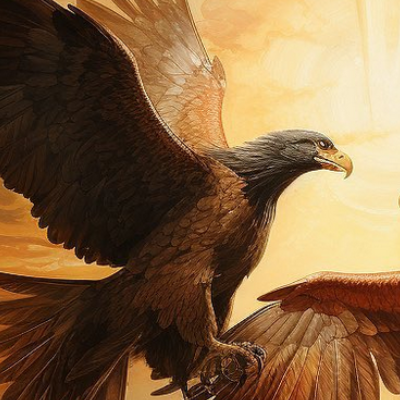
Sampati is a divine vulture-lord and the elder of the two celebrated avian brothers whose fates are woven through the Valmiki Ramayana and related Puranic literature. He is identified as the elder son of Aruna — the charioteer of Surya the sun god and himself the elder son of the sage Kashyapa and Vinata — and of Shyeni, a female being of avian nature whose identity is discussed under her own entry. Sampati is the elder brother of Jatayu, who dies defending Sita from the demon-king Ravana. His own most significant role in the Ramayana's Kishkindha Kanda is that of an aged, wingless witness who, despite his physical incapacity, provides the vanara search party with the critical intelligence that Sita is held in Lanka, thereby enabling the entire campaign for her rescue. He appears centrally in the Valmiki Ramayana, and is mentioned in the Mahabharata, the Brahma Purana, and the Vishnu Purana.
✦ The Name
The name Sampati derives from a Sanskrit root associated with flying, alighting, or coming together; it conveys the sense of one who descends or settles with speed and force, appropriate to a great bird of prey. The compound Gridhrаraja, meaning king of vultures, is applied to both Sampati and his brother Jatayu in different passages, though in the Kishkindha Kanda narrative Sampati is explicitly styled as the elder king. The epithet Vainateya, meaning a descendant of Vinata, is applicable to Sampati through his paternal line, since Aruna his father is the son of Vinata and Kashyapa.
✦ Lineage
- Father (principal account): Aruna — charioteer of Surya the sun god, elder son of Kashyapa and Vinata, elder brother of Garuda; his body radiates the crimson glow of dawn and he is associated with the daily solar passage.
- Mother (principal account): Shyeni — a divine female being of avian nature; identified in the Mahabharata Adi Parva at Chapter 63 verse 71 as the wife of Aruna and mother of Sampati and Jatayu.
- Paternal grandfather: Kashyapa — one of the seven primordial sages, son of Marichi and grandson of Brahma; the progenitor of gods, demons, birds, serpents, and virtually all classes of beings in the Puranic cosmos.
- Paternal grandmother: Vinata — daughter of Daksha the progenitor-patriarch, wife of Kashyapa, mother of Aruna and Garuda.
- Paternal uncle: Garuda — the great eagle-deity and vehicle of Vishnu, younger son of Kashyapa and Vinata; Sampati thus belongs to the same avian lineage as one of the most celebrated beings in the tradition.
- Younger brother: Jatayu — the valiant vulture-lord who dies in combat with Ravana while attempting to rescue Sita; the most celebrated figure of this lineage in the Ramayana narrative.
- Son: Suparsva (also given as Suparshva in some sources) — named in the Valmiki Ramayana's Kishkindha Kanda as the son who fed and cared for the aged wingless Sampati during the long years of his incapacity; also reported in some versions to have independently sighted Ravana carrying Sita and brought this intelligence to his father.
- Son (per Brahma Purana): Babhru — named in the Brahma Purana as a son of Sampati who was swift and widely known; not mentioned in this role in the Valmiki Ramayana.
✦ The Flight to the Sun and the Loss of Wings
The foundational episode of Sampati's biography is narrated in the Kishkindha Kanda of the Valmiki Ramayana. During their youth, Sampati and Jatayu undertook a competition to determine which of them could fly the higher. The contest is said in some versions to have been prompted by the occasion of Indra's slaying of the demon Vritra. Jatayu, the younger and more impetuous of the two, flew beyond his brother and entered the Suryamandala — the orbital sphere of the sun — at noon, when the solar heat was at its most intense. His wings began to scorch under the fierce radiance of Surya. Sampati, seeing his younger brother in danger of being destroyed, flew upward and spread his own wings wide above Jatayu, using his body as a shield against the direct heat. In consequence, Sampati's own wings were burned away entirely. He fell from the sky and descended upon the Vindhya mountains, where he came to rest in a cave or on a rocky slope. From that point onward he was unable to fly, living out a prolonged existence without the power of flight, dependent first on the care of the sage Nishakara and later on his son Suparsva for sustenance.
✦ The Sage Nishakara and the Prophecy
After Sampati fell to the Vindhya mountains, he came under the care of the sage Nishakara, who was performing austerities in that region. The Valmiki Ramayana records that Sampati lived in the sage's company for eight thousand years. Nishakara, described as one possessing foresight, informed Sampati of the forthcoming incarnation of Vishnu as Rama, and foretold that a search party of vanaras would one day arrive at his location seeking information about a woman named Sita who would have been abducted by a demon. Nishakara told Sampati that on the day he provided this information to the searchers, his wings would be miraculously restored. Nishakara subsequently passed away, having delivered this prophecy. Sampati thereafter continued his solitary existence on the Vindhya slopes, sustained by his son Suparsva, awaiting the fulfilment of what the sage had foretold.
✦ The Encounter with the Vanara Search Party
The Kishkindha Kanda of the Valmiki Ramayana narrates the pivotal episode of Sampati's encounter with the vanara search party. Hanuman, Angada — the son of Vali the vanara king — and Jambavan, the aged bear-chief, led the southern contingent of the search for Sita to the shores of the great southern ocean. There, exhausted and without any intelligence of Sita's whereabouts, despairing of returning to Sugriva the vanara king without news, and dreading the consequences, the vanaras lay down on the shore resigned to death. In this state, Angada lamented aloud and, in the course of his grief, spoke the name of Jatayu and praised the vulture's noble death in Sita's service. Sampati, aged and wingless, was approaching from his cave in the hope of feeding on what appeared to be a large group of creatures helpless on the shore. Hearing his brother's name spoken, Sampati halted and drew close. He enquired urgently of the vanaras about Jatayu. Angada, Hanuman, and Jambavan then recounted to Sampati the full account of Rama's exile, Sita's abduction, Jatayu's battle with Ravana, and Jatayu's death. Sampati mourned deeply for his brother and, having learned the circumstances, declared that he would render Rama a service through his words alone, since he no longer possessed the physical power to act. Using his supernatural long-range vision, which the Ramayana describes as a faculty belonging to the avian race of the Vainateyas, Sampati confirmed that he could perceive Sita in Lanka, a distance of one thousand yojanas across the sea, confined in the Ashoka Vatika, the grove guarded by demonesses. He further reported that his son Suparsva had independently witnessed Ravana carrying Sita and had relayed this to him. With this information conveyed, the prophecy of Nishakara was fulfilled: Sampati's wings grew back. He then performed the funeral rites for his long-dead brother Jatayu, whose death he had been unable to attend, and the vanaras, now armed with the knowledge of Sita's location, proceeded toward their objective.
✦ Textual Variants and Inconsistencies
The Dharmawiki synthesis of Puranic material records a version in which Sampati's parents are given not as Aruna and Shyeni but as Surya — the sun god himself — and a female figure named Mahasveta, and in which Sampati is styled as king of all birds with Jatayu as crown prince on account of a parental boon. This account differs fundamentally from the genealogy established in the Mahabharata and in the Valmiki Ramayana, which consistently place Sampati and Jatayu as sons of Aruna. The Surya-Mahasveta parentage appears to derive from a distinct regional or later Puranic strand and is not corroborated by the Valmiki Ramayana text or the Mahabharata's Adi Parva statement. The inconsistency is noted here but the Aruna-Shyeni parentage carries the greater weight of primary epic evidence.
The Mahabharata's Vana Parva also mentions Sampati in the context of the sage Markandeya's retelling of the Rama story to the Pandavas, confirming that the episode of his counsel to the vanaras was known to the epic tradition beyond the Ramayana itself. The name of his son is given as Suparsva in most Ramayana recensions, while the Brahma Purana names a son called Babhru; these may represent different sons or variant traditions concerning the same figure.
✦ Theological and Narrative Significance
Sampati's role in the tradition is structured around two complementary themes: sacrifice and redemption. The sacrifice is physical — he loses his wings permanently in the act of protecting his younger brother, and spends thousands of years in a condition of radical diminishment, unable to fulfil the most essential capacity of his nature. The redemption arrives not through his own heroic deed but through knowledge and witness: in old age and incapacity, the one thing he can offer — his long-range sight and his testimony — turns out to be precisely what is needed at the critical juncture of Rama's campaign. The tradition thus presents Sampati as a figure whose usefulness to cosmic order is restored through his willingness to serve with what remains to him. The restoration of his wings at the moment of disclosure is the tradition's narrative confirmation that this service was both the fulfilment of a divine design and the completion of the sacrifice he made in youth.
✦ Connection to the Wider Genealogy
Sampati stands at the intersection of three significant genealogical threads. Through his father Aruna he is a grandson of Kashyapa and Vinata and a nephew of Garuda, connecting him to the deepest stratum of the avian divine lineage. Through his mother Shyeni, if the Puranic account of her parentage through Tamra is accepted, he is doubly a descendant of Kashyapa through a separate line, concentrating the Kashyapa ancestry in his person. Through his brother Jatayu his lineage enters the central narrative of the Ramayana at its most consequential moment. His son Suparsva extends this lineage into the next generation, and through Suparsva's independent sighting of Ravana and Sita, the avian lineage of Kashyapa contributes to the Ramayana's plot across two generations.
✦ References
- Valmiki Ramayana, Kishkindha Kanda, Chapters 57–62: Primary source for the full narrative of Sampati's encounter with the vanara search party, his account of the flight to the sun and its consequences, his revelation of Sita's location, the prophecy of Nishakara, and the restoration of his wings.
- Valmiki Ramayana, Aranya Kanda, Chapter 14: Background genealogical source; Jatayu's self-identification to Rama establishes the lineage of Aruna as father of both brothers.
- Mahabharata, Adi Parva, Chapter 63, verse 71: States that Aruna's wife Shyeni gave birth to Sampati and Jatayu; the primary epic confirmation of the parental lineage.
- Mahabharata, Vana Parva: Markandeya's retelling of the Rama story to the Pandavas references Sampati's role in providing intelligence of Sita's location, confirming the episode's standing within the broader epic tradition.
- Brahma Purana: Names Babhru as a son of Sampati and places Sampati within the avian genealogies descending from Aruna.
- Vishnu Purana, Book I, Chapter 21: Genealogical reference placing the avian lineages of Kashyapa; background context for Sampati's descent.
- Vettam Mani, Puranic Encyclopaedia (1975): Modern reference; consolidates references to Sampati across Ramayana and Puranic sources.
- Wisdomlib.org, Animal Kingdom in Epics study: Modern secondary reference; provides analysis of Sampati's narrative role within the bird lineages of the Ramayana.