
About
Jatayu — Younger Son of Aruna, the Martyred Vulture-King
Jatayu · Jatayus · Gridhrаraja · Pakshiraja · Vainateya (by descent)
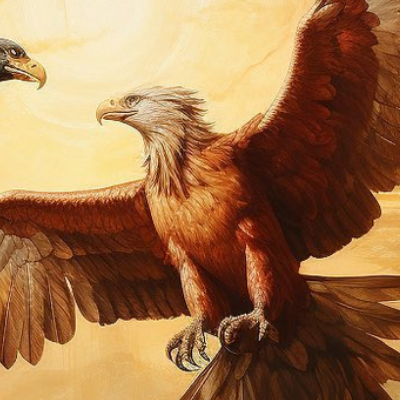
Jatayu is a divine vulture-lord and one of the most celebrated figures of sacrifice and loyalty in the Valmiki Ramayana. He is the younger son of Aruna — the charioteer of Surya the sun god, himself the elder son of the sage Kashyapa and Vinata — and of Shyeni, a divine avian female. He is the younger brother of Sampati, the elder vulture-king. Jatayu is distinguished in the tradition both as the long-standing friend of Dasharatha, the king of Ayodhya and father of Rama, and as the being who sacrifices his life in an attempt to rescue Sita from the demon-king Ravana at the moment of her abduction. His death in this cause, and the funeral rites performed over him by Rama himself, give Jatayu a unique devotional and theological standing in the Ramayana tradition that extends well beyond his narrative function. He appears centrally in the Valmiki Ramayana's Aranya Kanda, is referenced in the Mahabharata, and his genealogy and role are confirmed across several Puranic texts.
✦ The Name
The name Jatayu is of Sanskrit derivation, associated with the matted or tangled plumage characteristic of a large bird of prey; some interpretations connect it to the root for swift movement or striking descent. Gridhrаraja means king of vultures. Pakshiraja means king of birds. In the Aranya Kanda of the Valmiki Ramayana, Jatayu identifies himself as a descendant of Shyeni — a phrase carrying genealogical specificity within the avian lineage associated with hawks and eagles. The same passage records his name and states that Sampati is his elder brother and Aruna their common father.
✦ Lineage
- Father: Aruna — charioteer of Surya the sun god, elder son of Kashyapa and Vinata, whose luminous reddish body constitutes the dawn; elder brother of Garuda.
- Mother: Shyeni — divine avian female, identified in the Mahabharata Adi Parva as wife of Aruna and mother of Sampati and Jatayu.
- Paternal grandfather: Kashyapa — one of the seven primordial sages, son of Marichi and grandson of Brahma; the supreme progenitor of the Puranic cosmos.
- Paternal grandmother: Vinata — daughter of Daksha, wife of Kashyapa, mother of Aruna and Garuda.
- Paternal uncle: Garuda — the great eagle-deity and vehicle of Vishnu, younger son of Kashyapa and Vinata; Jatayu's lineage thus connects directly to the avian divine order at its highest level.
- Elder brother: Sampati — the wingless vulture-king of the Vindhya mountains whose long-range vision reveals Sita's location in Lanka to the vanara search party; elder by birth and in some accounts by royal rank.
✦ The Flight to the Sun
The episode that defines the relationship between Jatayu and his elder brother Sampati is narrated in the Kishkindha Kanda of the Valmiki Ramayana, in the account Sampati gives the vanara search party. During their youth, the two brothers undertook a contest to determine who could fly the higher. Jatayu, younger and less restrained in his exuberance, outflew Sampati and entered the Suryamandala, the orbital sphere of the sun, at noon. The full force of solar heat began to scorch his wings. Sampati, seeing his brother in peril, flew above him and spread his own wings to shield Jatayu from the direct heat. Sampati's wings were consequently burned away entirely, and he fell to earth on the Vindhya mountains, where he remained wingless for thousands of years. Jatayu survived the incident with his wings intact. This episode establishes the two brothers as bound to each other by a debt of sacrifice — Sampati permanently maimed in the act of preserving Jatayu — which gives additional weight to Jatayu's eventual sacrifice in Sita's cause.
✦ Friendship with Dasharatha
The Valmiki Ramayana records that Jatayu was an old and close friend of Dasharatha, the king of Ayodhya of the Ikshvaku solar dynasty and the father of Rama. The nature and occasion of their friendship is not fully elaborated in the Valmiki text itself, which simply presents their bond as already established when Jatayu introduces himself to Rama in the Aranya Kanda. Regional and later recensions — notably the Bengali Ramayana associated with Krittibas — elaborate on this friendship in episodes involving Dasharatha and the planet Shani, but these are later additions not present in the Valmiki text. What the primary source confirms is that Jatayu describes Dasharatha as venerable and honourable to him in the same degree as Dasharatha's own most respected allies, and that when Rama recognises Jatayu as his father's friend, he embraces and venerates him accordingly. At the time of the Ramayana's action, Dasharatha has already died, and Jatayu belongs to that generation of beings whose loyalty extends from father to son.
✦ The Encounter with Rama and the Guardian Role
When Rama, accompanied by Lakshmana and Sita, is travelling through the Dandaka forest toward Pancavati during his exile, he encounters a massive and powerful vulture. Rama and Lakshmana initially suspect the creature to be a demon in disguise. Jatayu addresses them in gentle tones, declares himself a friend of their father, and proceeds to give a full account of his lineage tracing from the primordial Prajapatis through Kashyapa to Aruna and himself. Rama, having heard of this friendship from Dasharatha, embraces Jatayu with affection and treats him with the deference due to an elder. Jatayu then takes up residence near Pancavati and accepts the charge of keeping watch over Sita during the times when Rama and Lakshmana must be absent. The Aranya Kanda notes that no demon or demoness could approach Rama's hermitage while Jatayu was present.
✦ The Battle with Ravana and the Death of Jatayu
The central episode of Jatayu's life is narrated in detail in the Aranya Kanda of the Valmiki Ramayana. When Ravana, the ten-headed demon-king of Lanka and son of the sage Vishravasa, abducted Sita from the hermitage during the absence of Rama and Lakshmana and bore her away in his aerial chariot, Sita's cries reached Jatayu. Although very old at this time, Jatayu immediately confronted Ravana, called upon him to release Sita, and warned him of the certain destruction that would follow this act of adharma. Ravana disregarded the warning. A fierce battle ensued in the air and on the ground. Jatayu struck Ravana's chariot, blinded or disabled the horses drawing it, destroyed Ravana's bow, and wounded Ravana himself, forcing him at one point to fight on foot. The Valmiki Ramayana compares Jatayu's speed and ferocity in this battle to that of Garuda, the supreme eagle. However, Jatayu was of very great age, and Ravana eventually overcame him. Ravana severed Jatayu's wings with his sword, referred to in some passages as the Chandrahas, and Jatayu fell mortally wounded to the earth of the Dandaka forest. Ravana then seized Sita again and resumed his flight to Lanka. Jatayu lay dying on the forest floor.
When Rama and Lakshmana returned and found the hermitage empty and the forest disturbed, they searched for Sita and discovered Jatayu dying on the ground. The Aranya Kanda records Rama's grief and his explicit statement that he regards Jatayu as equal in veneration to Dasharatha himself. Jatayu, with his remaining strength, identified Ravana as the abductor and confirmed the direction of his flight toward Lanka before dying. Rama, in an act of singular honour for a non-human being, cremated Jatayu with full funeral rites, offering the water-oblations proper to the death of a close kinsman at the River Godavari. The tradition regards this act of Rama's as conferring upon Jatayu a state of liberation and auspicious passage beyond death.
✦ Textual Variants and Inconsistencies
The parentage of Jatayu is consistently given as Aruna and Shyeni across the Mahabharata and the Valmiki Ramayana. One Puranic strand recorded in Dharmawiki material gives his father as Surya the sun god and his mother as Mahasveta, a variant that conflicts with the primary epic evidence and is not corroborated by the Valmiki text. This minority account is noted but does not displace the principal genealogy.
Regional versions of the Ramayana, including those associated with later Bengali, Tamil, and Telugu literary traditions, expand considerably on the episode of Jatayu's friendship with Dasharatha and on the circumstances of his final battle with Ravana. These elaborations are additional rather than contradictory in most cases. The Jain version of the Ramayana, the Paumachariyam of Vimalasuri, includes Jatayu as a character but within a substantially different cosmological and genealogical framework not directly comparable to the Valmiki account.
✦ Theological and Devotional Significance
Jatayu occupies a position of unusual theological distinction in the Ramayana tradition. He is not a human being, a sage, a god, or a demon, but a bird of advanced age and impaired capacity who nonetheless undertakes combat with one of the most powerful beings in creation in the sole service of dharma and loyalty. The tradition emphasises that he could not have been unaware of the disparity between his own age and Ravana's power. His action is therefore understood not as a calculation of success but as an expression of duty without regard for outcome — a form of nishkama karma, desireless action, that the tradition holds in the highest regard. The fact that Rama performs his funeral rites in person, treating a vulture as a kinsman deserving the rites due to a father, is read in devotional commentary as Rama's recognition of Jatayu's supreme righteousness. In later Vaishnava devotional literature and temple traditions, Jatayu's death and Rama's funeral rites for him became a paradigmatic episode illustrating the accessibility of liberation to any being, regardless of species or form, that acts in sincere service of the divine.
✦ Connection to the Wider Genealogy
Jatayu belongs to the avian lineage of Kashyapa through Aruna and Vinata, placing him genealogically within the same broad family as Garuda. His lineage thus connects the Ramayana's pivotal episode of Sita's abduction directly to the foundational avian line of the Puranic tradition. Through his brother Sampati, and through Sampati's son Suparsva, this lineage remains active and consequential across multiple generations of the Ramayana narrative. Jatayu's friendship with Dasharatha links the Vainateya avian lineage to the Ikshvaku solar dynasty of Ayodhya, drawing the bird-race into the human royal genealogy at its most significant point. His death at Ravana's hands, and the intelligence he provides Rama before dying, make him the direct link in the chain of cause and consequence that leads from Sita's abduction to Rama's knowledge of its direction — without which the entire campaign for Lanka could not have been oriented.
✦ References
- Valmiki Ramayana, Aranya Kanda, Chapters 14 and 67–68: Primary source for Jatayu's self-identification and genealogical declaration to Rama; the full narrative of the battle with Ravana; Jatayu's dying testimony; Rama's cremation of Jatayu and the water oblations at Godavari.
- Valmiki Ramayana, Kishkindha Kanda, Chapters 57–62: Sampati's account of the youth episode of the flight to the sun, which establishes the shared history of the two brothers and the circumstances of Sampati's loss of wings.
- Mahabharata, Adi Parva, Chapter 63, verse 71: States that Aruna's wife Shyeni gave birth to Sampati and Jatayu; confirms the paternal and maternal lineage in the epic tradition.
- Mahabharata, Vana Parva: Markandeya's retelling of the Rama story references Jatayu's death and Sampati's role, confirming these episodes in the broader Mahabharata context.
- Vishnu Purana, Book I, Chapter 21: Genealogical background for the avian lineages of Kashyapa; places Jatayu's ancestry within the Puranic cosmological order.
- Brahma Purana: References the avian lineage of Aruna and the Vainateya descent, providing supplementary genealogical context.
- Vettam Mani, Puranic Encyclopaedia (1975): Modern reference; provides a consolidated account of Jatayu's parentage, principal episodes, and Puranic references.
- Wikipedia, Jatayu article: Modern secondary reference; summarises the primary narrative and notes the parentage from Aruna and Shyeni with reference to the Valmiki Ramayana and Mahabharata.