
About
Shesha — King of the Nagas, Cosmic Support of the Universe, and Servant of Vishnu
Shesha · Ananta · Adishesha · Sheshanaga · Ananta Shesha · Sankarshana · Nagaraja · Virupaksha
Shesha is the king of all nagas, one of the primal beings of creation, and the eternal cosmic serpent on whose coiled body the god Vishnu reclines upon the ocean of milk between cycles of creation. He is the eldest son of the sage Kashyapa and his wife Kadru, a daughter of the Prajapati Daksha, and the elder brother of Vasuki, Airavata, and Takshaka among the thousand nagas born of Kadru. He appears in the Mahabharata, the Valmiki Ramayana, the Bhagavata Purana, the Vishnu Purana, the Brahma Purana, and numerous other texts, and is one of the most cosmologically significant beings in the Hindu tradition. His primary roles are as the support of the earth and the planets upon his thousand hoods, as the bed of Vishnu in the cosmic ocean, as the destroyer of the universe through fire at the end of each kalpa, and as the principal servant and companion of Vishnu across all ages. He is identified in the Bhagavata Purana as Sankarshana, one of the four vyuha manifestations of Vishnu himself, making him simultaneously a devotee of and a manifestation of the supreme deity. He is said to have incarnated in human form as Lakshmana, the devoted younger brother of Rama, in the Treta Yuga, and as Balarama, the elder brother of Krishna, in the Dvapara Yuga.
✦ The Names
The name Shesha is Sanskrit, meaning remainder or that which remains. The Circle of the Dragon secondary source articulates this precisely: the name refers to Shesha's function as that which endures even after the dissolution of the universe at the end of each kalpa, when all else ceases. The Nathas.org commentary on the Vishnu Purana elaborates that Shesha remains even during the night of Brahma, the period of divine rest when all creation is reabsorbed. The name Ananta means endless or infinite and was conferred upon Shesha by Brahma in recognition of his eternal nature and the impossibility of comprehending his full extent. The compound Ananta Shesha, rendered as the Endless Remainder or the Infinite One, combines both meanings. Adishesha means the first Shesha or the primordial Shesha, designating his status as the original among the serpent beings. Sheshanaga combines his personal name with the class designation naga. Sankarshana is the name given to him in the Bhagavata Purana as one of Vishnu's four vyuha forms, meaning he who draws together or he who plows — a name also associated with Balarama's implement, the plough. Nagaraja means king of the nagas. The Bhagavad Gita's declaration by Krishna that among nagas he is Ananta marks the name as one of the supreme designations in the entire tradition.
✦ Lineage
- Father: Kashyapa — the great sage, son of Marici and grandson of Brahma, regarded as the progenitor of all living beings through his multiple wives, daughters of Daksha. Kashyapa is the progenitor of the devas through Aditi, the asuras through Diti, and the nagas through Kadru, among many other classes of beings.
- Mother: Kadru — a daughter of the Prajapati Daksha and one of Kashyapa's wives, described in the tradition as the mother of all nagas. She bore a thousand serpents, of whom Shesha was the eldest. Kadru is also notable as the opponent of Kashyapa's other wife Vinata in the famous rivalry that resulted in the enslavement of Vinata and her son Garuda. Kadru and Vinata were sisters, both daughters of Daksha.
- Brothers (among the principal nagas): Vasuki — the second born after Shesha, who serves as the rope in the churning of the ocean of milk and is associated with Shiva as an ornament on his body; Airavata — a naga of great power; Takshaka — a formidable naga who plays a significant role in the Mahabharata, ultimately responsible for the death of King Parikshit and the subsequent Sarpa Satra of Janamejaya. The total number of Kadru's sons is stated across texts as a thousand.
- Half-brother: Garuda — the great eagle, son of Kashyapa by Vinata, and the vehicle of Vishnu. Garuda and the nagas stood in hereditary enmity owing to the rivalry between their mothers Kadru and Vinata. Shesha alone among the nagas is exempted from this enmity through his piety and his service to Vishnu, whom Garuda also serves.
- Wife: Nagalakshmi — identified in the Garga Samhita, according to the HandWiki Shesha article, as the personification of the divine cosmic ocean, the Kshira Sagara. She is said to have incarnated as Urmila, sister of Sita, when Shesha took the form of Lakshmana in the Treta Yuga.
✦ Origins: Disgust with His Brothers and the Penance
The Mahabharata Adi Parva, Chapter 105, Verse 41, provides the primary narrative of Shesha's early life. Among the thousand nagas born of Kadru, the majority were cruel in nature and took pleasure in causing harm to others. They were unkind not only to other beings but also to their own half-brother Garuda, whom they tormented on account of his mother Vinata's subjugation by their mother. A central incident involves Kadru and Vinata's famous dispute over the colour of the horse Uchaishravas, which arose from the churning of the ocean of milk. Kadru instructed her serpent sons to hang from the tail of the horse to make it appear black, thereby winning the bet and ensuring Vinata's enslavement. The Wisdomlib Ashtanaga essay records that Shesha refused to participate in this deception — a detail that establishes his moral distinctiveness from birth. Disgusted by the cruelty and deceitfulness of his brothers, Shesha left his mother and kin and embarked on severe austerities.
He subsisted on air alone and meditated in succession at Gandhamadana, Badrikashrama, Gokarna, Pushkara, and the Himalayas. The Mahabharata describes his penances as so severe that his flesh, skin, and muscles dried up and merged with his frame. Brahma, convinced of the quality and sincerity of Shesha's spiritual discipline, appeared before him and invited him to request a boon. Shesha asked that his mind remain under perfect control so that he could continue his penances, and that he be enabled to practice non-injury and righteousness. Brahma granted this and then made a further request of Shesha — that he descend into the earth and support it steadily. Brahma told him that the earth trembled and required one of sufficient power and virtue to bear it. Shesha agreed and entered the earth through a fissure at its base, proceeding to Patalaloka and there taking the entire weight of the world upon his hoods. From this moment his cosmic function as the support of the earth was established.
✦ Cosmic Functions
The Puranas enumerate several cosmic functions for Shesha. As the bearer of the earth, he resides deep within Patalaloka with the entire weight of the universe's planets upon his thousand hoods, which are adorned with jewels whose light illuminates all directions. The Brahma Purana passage quoted in the Wikipedia article describes his appearance: he has a thousand hoods marked with the svastika symbol, wears a single earring, is clad in blue or purple garments, adorned with white garlands, and shines like a white mountain crowned with flame. When he shifts the earth from one hood to another, the resulting movement causes earthquakes in the upper world.
As Ananta Shayana — he on whom Vishnu sleeps — Shesha forms the divine couch upon which the Narayana form of Vishnu reclines in the cosmic ocean between cycles of creation. In this form he floats upon the primordial waters, his coiled body providing the bed of the supreme deity and his thousand hoods spreading as a canopy over Vishnu's head. When Adishesha uncoils, the tradition holds, time moves forward and creation commences; when he coils back, the universe returns to its unmanifest state. He thus embodies the very substrate of time itself.
At the end of each kalpa — a cycle of 4.32 billion solar years — Shesha is said to emit fire from his thousand mouths and destroy all creation. The Dollsofindia secondary account records that toward the end of each epoch he creates eleven Rudras from himself for this purpose. He is one of the very few cosmic beings in the tradition described as surviving the pralaya, the universal dissolution, intact. His name Shesha — remainder — specifically encodes this function: he is what remains.
He is also counted among the divine beings who participated in the churning of the ocean of milk by loosening Mount Mandara to enable its use as the churning rod, according to the Puranas. The HandWiki article attributes this act specifically to Shesha, while the Religion Wiki cites his brother Vasuki as the rope used for churning — the two brothers thus contribute to the same cosmic event in complementary roles.
✦ Identity as Sankarshana and Relationship to Vishnu
The Bhagavata Purana introduces a theological dimension that transcends the genealogical account of Shesha's birth from Kashyapa and Kadru. In this text he is identified as Sankarshana, one of the four vyuha manifestations of Vishnu: Vasudeva, Sankarshana, Pradyumna, and Aniruddha. As Sankarshana he is described as the tamasic energy of Narayana — the aspect of the supreme deity associated with the power of dissolution and the quality of darkness or inertia. The Dollsofindia summary of this tradition states that Sankarshana is the first expansion of Vasudeva, that the limits of time and space do not apply to him, and that he narrated the Bhagavata to the Four Kumaras, who passed it to Maitreya, who passed it to Vidura. The Vaishnava theological tradition thus places Shesha not merely as a devoted servant of Vishnu but as a primary manifestation of the divine itself.
The Bhagavad Gita's statement by Krishna — that among nagas he is Ananta — marks Shesha as the supreme representative of the naga order in the context of Krishna's enumeration of his own divine manifestations in the phenomenal world. In the Vishnu Purana the form of Vishnu that resides beneath the seven Patalas in endless darkness is called Shesha, and his nature is described as luminous and beyond the capacity of either Daityas or Danavas to fully enumerate.
✦ Human Incarnations
The tradition records six incarnations of Shesha on earth. The most widely accepted are two. In the Treta Yuga, Shesha descended as Lakshmana, the younger brother of Rama — Vishnu's avatar — remaining at his lord's side throughout the fourteen-year forest exile, the Lanka war, and every hardship of the Ramayana narrative. His wife Nagalakshmi incarnated as Urmila, sister of Sita, who remained in Ayodhya during the exile. In the Dvapara Yuga, Shesha incarnated as Balarama, the elder brother and constant companion of Krishna — Vishnu's avatar — whose weapon is the plough, cognate with Sankarshana's association with drawing or plowing, and who is also linked to the serpent form through multiple iconographic and narrative associations. This identification is stated clearly in the Brahma Purana passage quoted in the Shesha Wikipedia article.
In the Kali Yuga, the Sri Vaishnava tradition identifies Shesha as having incarnated as Patanjali — the sage who codified the Yoga Sutras and is iconographically depicted with a naga canopy — as Ramanuja, the eleventh-century philosopher-saint who founded Vishishtadvaita Vedanta, and as Manavala Mamunigal, a later Sri Vaishnava acharya. The Satya Yuga incarnation is identified as forming the divine seat for the Narasimha avatar of Vishnu at the time of the destruction of Hiranyakashipu.
✦ Textual Variants on Origin
The Mahabharata Adi Parva provides the genealogical account of Shesha as born to Kashyapa and Kadru. However, the Wikipedia Shesha article notes that in other accounts he is usually presented as a primordial being created directly by Vishnu, without an earthly parentage. The Valmiki Ramayana's Aranya Kanda 14.7 records, in a different context, that Brahma came from Vishnu and the Prajapatis from Brahma — from which some commentators deduce that Ananta is a Prajapati himself, suggesting a status closer to a primordial creative principle than to a born being. The Navanaga tradition as summarised in the Ananta-shesha.org article identifies Ananta as a holy man and founder of the Naga dynasty rather than primarily as a cosmic serpent, an euhemeristic reading that treats the mythological tradition as preserving historical memory of an actual tribal founder. These variant framings reflect the different priorities of the genealogical, cosmological, and theological strands of the tradition. For the purposes of this genealogical profile, the Mahabharata Adi Parva account of birth from Kashyapa and Kadru is treated as the primary textual statement, with the other framings noted as coexisting traditions.
✦ Iconography and Worship
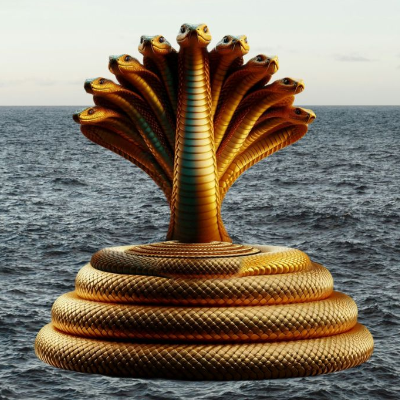
Shesha's iconographic form appears in three principal configurations across temple art and sculpture. In the Ananta Shayana form he is depicted as a vast multi-hooded serpent coiled upon the cosmic ocean, with Vishnu reclining upon his coils and Lakshmi seated at Vishnu's feet — images found across South and Southeast Asia, from the Anantapadmanabhaswamy Temple in Thiruvananthapuram, whose very city name means city of the Lord Ananta, to the temples of Angkor Wat in Cambodia. As a canopy he appears with five, seven, or a thousand heads spread in a fan formation above Vishnu, Narasimha, or other divine figures. In standalone form he is depicted as an immense serpent within the lower realms bearing the earth upon his hoods. The Brahma Purana's description of him as wearing a single earring, a crown and garland, blue garments and white necklace, and shining like a white mountain aflame with fire, is the canonical textual basis for his temple iconography. The festival of Ananta Chaturdashi is dedicated to his worship.
✦ Theological Significance
In the Vaishnavite philosophical tradition, Shesha represents several interlocking concepts. As Ananta he embodies infinity and eternity — the quality of that which has no end and which persists beyond all cycles of creation and dissolution. As the bearer of the earth he represents the cosmic principle of stability and foundation, the ground upon which all existence rests. As the bed of Vishnu he symbolises the primordial substrate of consciousness upon which divine awareness reposes. In the Bhagavata Purana's identification of Shesha as Sankarshana, the tamasic energy of Narayana, he represents the power of dissolution and rest as an aspect of the supreme divine, not as its opposite. The theological implication is that the cosmic dissolution he enacts at the end of each kalpa is itself a divine act continuous with the act of creation rather than opposed to it. The Kundalini interpretation noted in secondary sources draws a further connection between Shesha's thousand-hooded serpentine form and the spiritual energy said to lie coiled at the base of the spine in yogic physiology, his thousand heads being compared to the thousand-petaled Sahasrara chakra at the crown.
✦ References
Primary Sources
- Mahabharata, Adi Parva, Chapter 105, Verse 41 — the primary genealogical source; records Shesha as the eldest son of Kashyapa and Kadru, his disgust with his brothers' cruelty, his austerities, Brahma's boon, and his assumption of the role of earth-bearer.
- Valmiki Ramayana, Aranya Kanda, 14.7 — records the cosmogonical statement from which Ananta's status as a Prajapati is inferred in some readings.
- Bhagavata Purana, Skandha 5 — describes Shesha bearing the earth in Patalaloka, his thousand jewelled hoods illuminating all directions; identifies him as Sankarshana.
- Bhagavata Purana, Skandha 10 — the Garga Samhita identification of Nagalakshmi as Shesha's wife and the personification of the Kshira Sagara.
- Vishnu Purana, I.2.64–65 — describes Ananta resting the supreme god who has absorbed all beings; presents Shesha as the form of Vishnu beneath the seven Patalas.
- Brahma Purana — provides the detailed physical description of Ananta: thousand hoods, svastika markings, single earring, blue garments, white necklace, mountain-like radiance.
- Bhagavad Gita, Chapter 10, Verse 29 — records Krishna's declaration that among nagas he is Ananta.
- Brahma Purana — records Shesha's participation in loosening Mount Mandara for the churning of the ocean.
Modern Reference Works
- Wikipedia, "Shesha" — the most comprehensive secondary survey; covers genealogy, penance, earth-bearing, Vishnu-bed role, incarnations, Puranic descriptions, Sri Vaishnava tradition, and iconography.
- Wisdomlib, "Ashtanaga — Eight Important Nagas", Chapter 5.2 — records the Mahabharata and Valmiki Ramayana passages on Ananta's birth and role; notes the variant in which the Ramayana implies Ananta's status as a Prajapati.
- Isvara.org, "Sesa (Shesha) 2" — detailed secondary treatment of Shesha's birth, penance, Brahma's boon, earth-bearing role, and Sankarshana identity.
- Dollsofindia.com, "Ananta Shesha: The Infinite One" — provides the Bhagavata Purana account of Sankarshana and the vyuha theology; notes his role as narrator of the Bhagavata to the Four Kumaras.
- Circle of the Dragon, "Ananta Sesha" — surveys variant accounts of Shesha's rank relative to Vasuki and Takshaka and his fiery end-of-kalpa role.
- Nathas.org, "Ananta-Shesha" — provides direct quotation from Vishnu Purana I.2.64–65 on Ananta as Vishnu's resting form in the primordial ocean.
- HandWiki, "Religion: Shesha" — records Nagalakshmi as Shesha's wife per the Garga Samhita and surveys the six-incarnation tradition.
- Rudraksha-Ratna.com, "Shesha Naga" — provides the most concise synthesis of the cosmological, iconographic, and theological dimensions of Shesha's significance.