
About
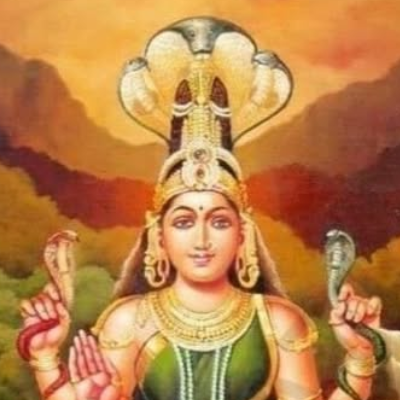
Nagalakshmi — Consort of Shesha, Personification of the Cosmic Ocean
Nagalakshmi · Naga Lakshmi · Kshira Sagara Devi
Nagalakshmi is the divine consort of Shesha, also known as Adishesha or Ananta, the primordial cosmic serpent who serves as the eternal couch and canopy of the preserver deity Vishnu. She is identified in the Vaishnava tradition as a personification of the Kshira Sagara — the celestial Ocean of Milk upon which Vishnu reclines in his cosmic form, supported by Shesha. In the Treta Yuga, when Shesha took birth as Lakshmana, the younger brother and devoted companion of Rama, the seventh avatar of Vishnu, Nagalakshmi is said to have incarnated alongside him as Urmila, the younger sister of Sita and daughter of King Janaka of Mithila, thereby entering the human order in a form consonant with her divine station. Her textual attestation is limited primarily to one Vaishnava Upapurana, and her profile is accordingly brief.
✦ The Name
The name Nagalakshmi is a compound of two Sanskrit elements. Naga refers to the class of divine serpent beings prominent throughout Puranic and epic literature, and more specifically here denotes her identity as the consort of the foremost of all Nagas, Shesha. Lakshmi is the name of the goddess of fortune, prosperity, and divine beauty, the eternal consort of Vishnu. The compound thus signifies a figure who embodies the qualities of Lakshmi within the sphere of the Naga world — a serpent goddess of auspiciousness and divine grace. The epithet Kshira Sagara Devi, meaning goddess of the Ocean of Milk, reflects her identification with the Kshira Sagara itself, the cosmic waters that are the primordial substrate upon which Shesha floats and Vishnu reposes.
✦ Lineage
- Spouse: Shesha (also Adishesha, Ananta) — the primordial thousand-hooded cosmic serpent, eldest of the Nagas, who serves as the eternal couch and canopy of Vishnu and is regarded as a partial manifestation of Vishnu himself. In the Treta Yuga he incarnated as Lakshmana, devoted younger brother of Rama.
✦ Identity as the Cosmic Ocean
In the Vaishnava cosmological framework, the Kshira Sagara — the Ocean of Milk — is the outermost and most sacred of the seven concentric oceans that surround the seven island-continents of the universe. It is upon these primordial waters that the great serpent Shesha floats, forming the bed upon which Vishnu reclines in his cosmic sleep between cycles of creation. Nagalakshmi's identification with this ocean establishes her not merely as a consort figure but as a cosmic entity in her own right — the very medium within which the divine repose of Vishnu and Shesha is eternally sustained. This identification places her in a cosmological role parallel to that of Lakshmi, who similarly arises from and is associated with the cosmic waters in Puranic tradition, having emerged at the churning of the Ocean of Milk during the Samudra Manthan episode described in the Vishnu Purana and the Bhagavata Purana.
✦ Incarnation as Urmila
The Garga Samhita, a Vaishnava Upapurana attributed to the sage Garga, records the tradition that when Shesha took birth in the Treta Yuga as Lakshmana, Nagalakshmi incarnated alongside him as Urmila. Urmila is the second daughter of King Janaka of Mithila — the same king whose elder daughter Sita became the consort of Rama, the seventh avatar of Vishnu — and the younger sister of Sita. Urmila became the wife of Lakshmana upon the occasion of the great wedding ceremony at Mithila in which Rama wed Sita, Bharata wed Mandavi, and Shatrughna wed Shrutakirti, all daughters of the Janaka lineage. The incarnation of Nagalakshmi as Urmila thus mirrors precisely the incarnation of Shesha as Lakshmana, maintaining the divine conjugal pairing across the transition from the eternal cosmic order into the human biographical frame of the Ramayana.
Urmila's role in the Ramayana tradition is most prominently her acceptance of fourteen years of separation from Lakshmana, who accompanied Rama and Sita into forest exile. In several later Ramayana retellings and commentarial traditions, Urmila's patient endurance of this separation is treated as a form of supreme devotion and self-abnegation, a virtue presented as consonant with the divine nature underlying her mortal form.
✦ Textual Variants and Scope of Attestation
Nagalakshmi as a named figure with an independent biographical identity is attested in the Garga Samhita, which belongs to the category of Upapuranas — secondary Puranic texts composed later than and subordinate in canonical standing to the eighteen Mahapuranas. She does not appear as a named consort of Shesha in the Vishnu Purana, the Bhagavata Purana, the Harivamsha, the Mahabharata, or the Valmiki Ramayana. The attribution of her identification to the Garga Samhita is known through secondary scholarly sources; the specific verse reference within that text has not been independently verified for this profile. The incarnation tradition linking Shesha to Lakshmana is, by contrast, well attested across multiple primary Vaishnava texts; it is specifically the extension of that tradition to identify Nagalakshmi as the divine prototype of Urmila that rests on the Garga Samhita attestation.
✦ References
- Primary Sources
- Garga Samhita — A Vaishnava Upapurana attributed to the sage Garga; the primary source for Nagalakshmi's identification as the consort of Shesha, her nature as a personification of the Kshira Sagara, and her incarnation as Urmila in the Treta Yuga. Specific chapter and verse reference not independently verified.
- Vishnu Purana — Establishes Shesha's cosmological role as the cosmic serpent and bed of Vishnu, and records the tradition of Vishnu's avatars and their divine associates across yugas.
- Bhagavata Purana — Contains accounts of Shesha as Ananta and of the Samudra Manthan from which Lakshmi arises; provides cosmological context for the Ocean of Milk and the divine hierarchy within which Nagalakshmi's identity is situated.
- Valmiki Ramayana — The primary epic source for Urmila as the daughter of Janaka and wife of Lakshmana, establishing the biographical frame into which Nagalakshmi's incarnation tradition is placed.
- Secondary Sources
- HandWiki, article on Shesha — Secondary reference attributing the identification of Nagalakshmi as Shesha's consort and her cosmic ocean personification to the Garga Samhita; used as the intermediary source for the Garga Samhita claim in the absence of direct primary text access.