
About
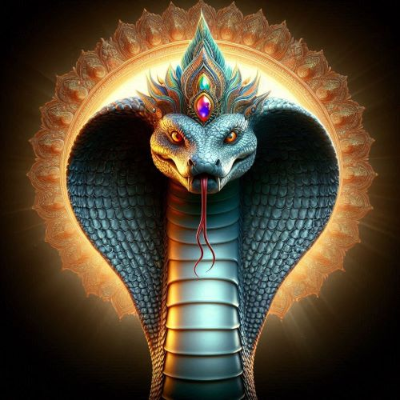
Vasuki — King of the Nagas, Rope of the Ocean's Churning, and Ornament of Shiva
Vasuki · Vasuka · Nagaraja · Sarpeshvara · lord of serpents
Vasuki is the king of the nagas and one of the most prominent serpent deities in the Hindu tradition, appearing across the Mahabharata, the Puranas, the Valmiki Ramayana, and numerous regional and Shaiva texts. He is the second son of the sage Kashyapa and his wife Kadru, born after his elder brother Shesha and before his siblings Airavata, Takshaka, and the remaining nagas among Kadru's thousand sons. While Shesha renounced his family to pursue solitary austerities and became the cosmic support of Vishnu, Vasuki remained with the naga community and assumed the role of their king and protector. His most celebrated episodes are his service as the churning rope in the Samudra Manthana — the churning of the ocean of milk — and his role as the ornament of Shiva, who wears Vasuki coiled around his neck. He is also the brother of Manasa, the serpent goddess, whose marriage to the sage Jaratkaru was engineered by Vasuki to produce Astika, the child who would eventually stop the Sarpa Satra — the great snake sacrifice of King Janamejaya — and save the naga race from annihilation. He is closely associated with Shiva in the Shaiva tradition, serves as Shiva's bowstring in the destruction of the three cities, and is described in the Mahabharata as residing in the palace of Varuna. The Wikipedia article identifies him among the eight great dragon kings in Chinese and Japanese Buddhist tradition as well.
✦ The Name
The name Vasuki is derived from the Sanskrit root vasu, meaning good, bright, excellent, or diamond-like, and the suffix ki forming a patronymic or personal designation. The Wisdomlib Ashtanaga essay notes the specific derivation: vasu means diamond and the one with a diamond on the head is Vasuka — that is, Kashyapa — making the one born of Vasuka Vasuki. This patronymic reading thus embeds within his very name an identification with his father Kashyapa and his luminous lineage. He is described as possessing the Nagamani — the serpent's ornament gem — on his head, which serves as both a personal emblem and a source of supernatural power. His colour is described as white, like the lustre of diamonds.
✦ Lineage
- Father: Kashyapa — the great sage, son of Marici and grandson of Brahma, progenitor of all living beings through his many wives.
- Mother: Kadru — daughter of Daksha and one of Kashyapa's wives, mother of all nagas. Kadru gave birth to a thousand serpent sons, of whom Vasuki was the second born. She is also identified as having cursed her own sons to perish in Janamejaya's snake sacrifice after several of them refused to assist her in deceiving Vinata in the Uchaishravas wager.
- Elder brother: Shesha — also called Ananta and Adishesha, the eldest naga, king of all serpents, who abandoned the family in disgust at his brothers' cruelty, performed austerities, obtained Brahma's boon, and descended to Patalaloka to bear the earth upon his thousand hoods. Shesha is the cosmic bed of Vishnu and is identified in the Bhagavata Purana as Sankarshana, one of the vyuha forms of Vishnu himself.
- Sister: Manasa — the serpent goddess, known as Vishahari (destroyer of poison), worshipped primarily in Bengal, Bihar, and northeastern India as the goddess of snakes. She is the wife of the sage Jaratkaru and the mother of Astika. Her relationship to Vasuki is attested in the Wikipedia Vasuki and Manasa Religion Wiki articles. Vasuki was instrumental in arranging her marriage to Jaratkaru as part of the plan to produce Astika, who would save the naga race.
- Brothers (among the principal nagas): Airavata — a powerful naga; Takshaka — a formidable naga chief who killed King Parikshit of the Kuru dynasty and was the principal target of Janamejaya's Sarpa Satra; and many others among Kadru's thousand sons.
- Half-brother: Garuda — the great eagle, son of Kashyapa by Vinata, vehicle of Vishnu, and hereditary enemy of the nagas owing to the rivalry between his mother and Kadru.
- Nephew: Astika — son of Vasuki's sister Manasa and the sage Jaratkaru, who stopped the Sarpa Satra and thereby saved the naga race from destruction. Astika was raised in Vasuki's home after his father departed and was taught by the sage Chyavana.
✦ The Curse of Kadru and the Background to the Sarpa Satra
The Mahabharata Adi Parva records the episode that set in motion the chain of events culminating in the Sarpa Satra. Kadru and her sister Vinata, both wives of Kashyapa, wagered on the colour of the tail of the divine horse Uchaishravas, which had arisen from the churning of the ocean. Kadru asserted the tail was black and Vinata that it was white, the loser to become the other's slave. Kadru, intending to cheat, instructed her thousand naga sons to coil around the horse's tail to make it appear black. The Wikipedia Vasuki article states that Vasuki refused to assist his mother in this scheme of deception, as did a number of his brothers. Those who refused were cursed by Kadru, who prophesied that they would be consumed in the fire of Janamejaya's snake sacrifice. Other sons complied, the tail appeared black, and Vinata became Kadru's slave.
The Sarpa Satra Wikipedia article records the further context: Brahma himself had willed that this curse was necessary, since the nagas had multiplied dangerously and caused immense suffering to living beings through their unchecked venom. The noble among the nagas, however, would be saved. The naga Elapatra, who had heard the deliberations of the gods before Brahma, informed Vasuki and the other serpents of this divine decree and of the prophecy that Jaratkaru the sage would marry a sister of Vasuki bearing the same name as himself, and their son Astika would halt the sacrifice.
✦ The Samudra Manthana: Churning Rope of the Ocean
Vasuki's most celebrated cosmic role is as the churning rope in the Samudra Manthana, the churning of the ocean of milk, described in the Vishnu Purana, Bhagavata Purana, and Mahabharata. The devas and asuras, following Vishnu's instruction, resolved to churn the cosmic ocean to extract the amrita, the nectar of immortality. Mount Mandara was to serve as the churning rod, and a rope of sufficient size to coil around the mountain was required. Vasuki agreed to serve as this rope. The asuras held his head end and the devas his tail, and the two groups pulled in alternation, spinning the mountain and churning the ocean. The process produced fourteen jewels and substances from the ocean — including the moon, Lakshmi, Dhanvantari bearing the amrita, and the poison Halahala.
The Halahala was of such destructive potency that it threatened to consume all creation. Shiva intervened and consumed the poison, which lodged in his throat and turned it blue, giving Shiva the epithet Nilakantha. Some accounts record that Vasuki also consumed a portion of the Halahala at this time, an act that earned him Shiva's particular regard and was among the reasons for the close bond between Vasuki and Shiva thereafter. The Hindu Blog account includes a detail regarding Garuda being sent to invite Vasuki to participate: despite their hereditary enmity, when Garuda is said to have been disrespectful in his invitation, Vasuki still consented to serve, demonstrating an equanimity that the tradition marks as characteristic of him.
✦ Association with Shiva
Vasuki's relationship with Shiva is one of the defining features of his presence in the tradition. He is depicted in standard Shaiva iconography coiled three times around Shiva's neck, the three coils representing in symbolic commentary the past, present, and future — the cycle of time over which Shiva presides. The Wisdomlib Ashtanaga essay states that Vasuki is said to dwell in the body of Shiva and is thought to be the ring on Shiva's finger, reflecting his profound integration with Shiva's own person. The Hindu Blog account records a story in which the snake species sought refuge from Garuda with Shiva, who offered them a home on Mount Kailash; on account of Kailash's extreme cold the snakes required warmth close to Shiva's body and were accordingly draped upon him.
In the Tripuradahana episode — Shiva's destruction of the three demon cities built of gold, silver, and iron by the sons of Taraka — the Puranas record that Vasuki served as the bowstring of Shiva's divine bow, an act of intimate cooperative service in the most momentous military feat of Shaiva mythology. The Wisdomlib Ashtanaga essay additionally records that Vasuki gave two parshadas — attendants — to the god Subrahmanya, Shiva's son.
✦ Arranging Manasa's Marriage and the Strategy to Save the Nagas
Knowing through Elapatra's report that Brahma had decreed that a son born of his sister and the sage Jaratkaru would save the nagas, Vasuki took it upon himself to find the sage and effect the marriage. The Jaratkaru Wikipedia article records that Vasuki stationed nagas to watch the movements of the wandering ascetic and report to him when the sage showed any inclination toward marriage. When the sage Jaratkaru eventually announced that he would marry a woman of the same name as himself who came to him offering herself, Vasuki emerged with his sister and offered her to the sage, also promising to support her. Jaratkaru accepted the match. Vasuki took care of his sister throughout the troubled marriage and the period following Jaratkaru's eventual abandonment of Manasa, raising the child Astika in his own home after his birth.
When the Sarpa Satra commenced under Janamejaya and naga after naga was drawn into the sacrificial fire, Vasuki watched his race being destroyed with mounting dread. The Sarpa Satra Wikipedia article records that he feared being drawn into the fire himself and appealed to his sister Manasa to dispatch Astika to halt the sacrifice. Astika, eloquent and learned, arrived at Janamejaya's court, praised the sacrifice in terms that won the king's admiration, and was offered a boon. He requested the immediate cessation of the sacrifice. Janamejaya, bound by his word, complied. Takshaka, who had taken refuge under Indra himself, was released. The naga race survived.
✦ Episode with Bhima in the Underwater Kingdom
The Mahabharata records an episode in which the young Pandava prince Bhima, son of Pandu and the wind god Vayu, was poisoned by his cousin Duryodhana, bound with vines, and thrown into the Ganga. Bhima sank to the realm of the nagas, where countless snakes bit him. The venom of the nagas, mixing with the poison Duryodhana had administered and with the power of Bhima's own nature as the son of Vayu, neutralised the poison and revived him. Vasuki's court received Bhima, and Vasuki gave him a powerful nectar to drink that multiplied his already formidable strength enormously, making him the equal of ten thousand elephants. The Deustoday and Mythlok accounts record that Vasuki gifted Bhima this strengthening elixir directly, an act of generosity that aligned the naga king with the Pandava cause.
✦ Other Episodes and Associations
The Wisdomlib Ashtanaga essay records that Vasuki, as one of the seven nagas who support the earth, descended to the underworld to receive Balarama — the elder brother of Krishna and an incarnation of Shesha — when Balarama departed the mortal world at the end of his life. The Hindu Blog account preserves a regional tradition in which the Iron Pillar of Delhi is said to have rested upon Vasuki's head, and that a king who attempted to dig up the pillar found only blood, the implication being that disturbing Vasuki's support caused the kingdom's instability. The Mahabharata Sabha Parva records that Vasuki resides in the palace of Varuna, the god of the waters, a detail that reflects his status as a cosmic lord of the aquatic and chthonic realms. In Buddhist tradition he is recognised as one of the eight great Naga Kings and features in the audiences of several of the Buddha's sermons. The Kukke Subramanya temple in Karnataka preserves a regional tradition in which Kartikeya offered Vasuki protection from Garuda, explaining Vasuki's presence and worship at that sacred site.
✦ Textual Variants
Several secondary sources identify Vasuki as the eldest son of Kashyapa and Kadru rather than the second born after Shesha. The Hindu Blog, Vedicfeed, and the 99pandit.com account all describe him as the eldest, while the Wikipedia Vasuki and Shesha articles, the Wisdomlib Ashtanaga essay, the Kadru Wikipedia article, and the Amar Chitra Katha account consistently place Shesha first and Vasuki second. The Mahabharata Adi Parva Chapter 105 primary text as cited in the Shesha profile is explicit that Shesha was the eldest, followed by Vasuki, Airavata, and Takshaka in order. The secondary sources that call Vasuki the eldest appear to be following a simplified popular tradition rather than the primary text. This profile treats the Mahabharata's order as authoritative.
A further variant concerns whether Vasuki or Shesha loosened Mount Mandara for the churning of the ocean. The HandWiki Shesha article attributes the loosening to Shesha, while the mainstream account of the churning focuses on Vasuki as the rope. These are not mutually exclusive roles — Shesha may have loosened the mountain and Vasuki served as the rope — but the sources do not always distinguish these acts clearly. A third variant appears in the name of Vasuki's sister: the Mahabharata refers to her by the same name as the sage Jaratkaru, while later regional traditions call her Manasa or Jagadgauri. The Wikipedia Manasa article records that in the original Mahabharata text the sister is simply called by the name Jaratkaru, while the identity of Vasuki's sister with the goddess Manasa is a later Puranic and regional development.
✦ Iconography and Worship
Vasuki is depicted with multiple heads in most iconographic forms, described in texts as thousand-headed though temple images most commonly show five heads. His most characteristic iconographic form is coiled three times around Shiva's neck, where he serves simultaneously as ornament and emblem of Shiva's dominion over death, time, and the chthonic realm. He wears the Nagamani gem on his head. He is worshipped during Nag Panchami, the principal naga festival of the Hindu calendar, alongside other naga deities. Temples dedicated to or prominently featuring Vasuki include the Vasuka temple near Haripad in Kerala at Mannarasala Illom and the Vishakha district in Andhra Pradesh. The Kukke Subramanya temple in Karnataka also maintains a specific tradition of Vasuki's worship in connection with Kartikeya's protection of him from Garuda.
✦ References
Primary Sources
- Mahabharata, Adi Parva, Chapter 105 — the primary genealogical source; records Vasuki as the second son of Kashyapa and Kadru; establishes the context of Kadru's curse and the Uchaishravas episode.
- Mahabharata, Adi Parva, Astika Parva — the primary narrative source for the entire Sarpa Satra complex: Kadru's curse, Elapatra's revelation, Vasuki's arrangement of Manasa's marriage to Jaratkaru, the birth and raising of Astika, and the halting of the sacrifice.
- Mahabharata, Sabha Parva — records Vasuki's residence in the palace of Varuna.
- Bhagavata Purana, Skandha 8 — records Vasuki's role in the Samudra Manthana as churning rope.
- Vishnu Purana — records the Samudra Manthana with Vasuki as rope and the fourteen treasures that emerged.
- Shiva Purana — records Vasuki as Shiva's ornament and bowstring in the Tripuradahana.
- Varaha Purana — names Vasuki, Ananta, Kambal, Karkotak, Padma, Mahapadma, Shankha, and Kulik as the most notable among Kadru's progeny.
Modern Reference Works
- Wikipedia, "Vasuki" — comprehensive secondary survey; covers genealogy, Samudra Manthana role, Shiva association, Buddhist tradition, Sarpa Satra context, temples, and iconography.
- Wikipedia, "Sarpa Satra" — the primary secondary account of Vasuki's role in the naga-saving strategy; records Elapatra's disclosure, Vasuki's arrangement of Manasa's marriage, and his appeal to Astika during the sacrifice.
- Wikipedia, "Jaratkaru" — records Vasuki's role in arranging his sister's marriage and his promise to support her.
- Wikipedia, "Manasa (goddess)" — records Manasa as Vasuki's sister and the later Puranic and regional traditions identifying her with the goddess of snakes.
- Wikipedia, "Kadru" — records the Uchaishravas episode, the birth order of the naga sons, and Kadru's curse.
- Wisdomlib, "Ashtanaga — Eight Important Nagas", Chapter 5.2 — provides detailed treatment of Vasuki's birth, his devotion to Shiva, his role in the Tripuradahana, and his welcome of Balarama at death.
- Deustoday.com, "Vasuki: The Powerful Serpent King" — covers the Samudra Manthana, Tripuradahana, and Bhima episode with secondary detail.
- Vedicfeed.com, "Vasuki: The Serpent King" — the most detailed modern secondary treatment of Vasuki's character and principal episodes.
- Amar Chitra Katha, "Kashyapa and Nagas" — confirms the birth order placing Shesha first and Vasuki second.
- Apam Napat, "Astika — Brahmana Who Saved the Serpents" — records Vasuki's role in the Sarpa Satra narrative from the perspective of his motivations as the serpent king.