
About
Manasa — Serpent Goddess, Daughter of Kashyapa, Sister of Vasuki, and Mother of Astika
Manasa · Jaratkaru (Mahabharata name) · Vishahara · Padmavati · Nitya · Jagadgauri · Nagini
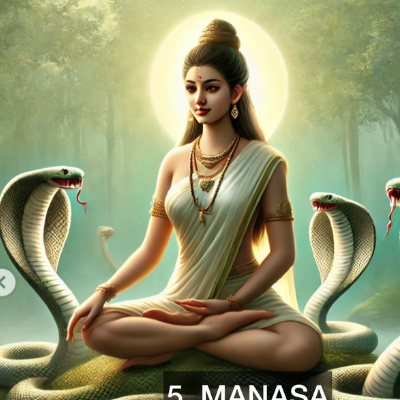
Manasa is the serpent goddess of Hinduism, worshipped as the deity of snakes, protector against snakebite, and bestower of fertility and prosperity. She is identified in the Puranic tradition as a daughter of the sage Kashyapa, making her a daughter of Kashyapa and a sister of Vasuki, the naga king — and thus a daughter of Kashyapa and Kadru within the naga genealogy. She is the wife of the sage Jaratkaru and the mother of Astika, the learned young Brahmin whose eloquence halted the Sarpa Satra, the great snake sacrifice of King Janamejaya, and thereby saved the naga race from annihilation. Manasa's textual history is complex: in the Mahabharata she is referred to only as the sister of Vasuki, bearing the same name Jaratkaru as her sage husband — a naming convention that connects both parties in the prophecy — while she does not acquire independent divine status or the name Manasa until the Puranas and later regional devotional texts. The Wikipedia Manasa article notes that scholars trace her origins to a non-Brahmanical, possibly tribal, goddess who was integrated into mainstream Hinduism by the fourteenth century. Her popular worship is concentrated in Bengal, Bihar, Jharkhand, Assam, and other parts of northeastern and eastern India.
✦ The Names
The name Manasa is Sanskrit, derived from manas, meaning mind. Her birth is described in the Devi Bhagavata Purana and associated accounts as occurring from the mind of Kashyapa — specifically, she emerged from his concentrated thought when he was composing a mantra at Brahma's instruction to protect human beings from snakes. Her name thus directly encodes this mind-born origin. She is accordingly also called Kamrupa in the Devi Bhagavata Purana tradition. The name Vishahara means destroyer of poison, one who removes or neutralises venom — her primary protective attribute. Padmavati reflects the lotus, both as a symbol of purity and because she is said in the Mangalkavya tradition to have been born on or associated with a lotus leaf. Nitya means eternal. Jagadgauri means golden one of the world or fair one of the universe. As a serpentine deity she is called Nagini.
In the Mahabharata she has no independent personal name: she is identified solely as the sister of Vasuki who shares the same name as the sage Jaratkaru, fulfilling the prophecy that the sage would marry a woman bearing the same name as himself. The Wikipedia Manasa article explicitly notes that scholar Bhattacharya holds that the Jaratkaru of the Mahabharata is not the same figure as the Manasa popular in Bengal, and that this later identification was a developmental process across several centuries.
✦ Lineage
- Father (Puranic tradition): Kashyapa — the great sage, progenitor of all living beings, from whose mind Manasa was born according to the Devi Bhagavata Purana and related accounts. The Mahabharata and Brahma Vaivarta Purana also identify Kashyapa as her father. Her mother in the naga genealogy is accordingly Kadru, the mother of the serpents, making her a full sister of Shesha and Vasuki within this framing.
- Father (Mangalkavya and later Bengali regional tradition): Shiva — the Mangalkavya texts of medieval Bengal, including the Manasa Mangalkavya of Bijay Gupta and the Manasa Vijaya of 1495 by Bipradas Pipilai, identify Manasa as a mind-born daughter of Shiva or as born when a statue sculpted by Vasuki's mother was touched by Shiva's consciousness. The Wikipedia Manasa article treats this as a later development arising from Manasa's integration into the Shaiva pantheon after her cult grew powerful enough to rival Shaivism itself. The Puranic identification with Kashyapa is treated in this profile as the primary textual tradition.
- Brothers: Shesha — the eldest naga, cosmic bed of Vishnu; Vasuki — the naga king who arranged her marriage as part of the plan to save the naga race.
- Husband: Jaratkaru — a renowned ascetic Brahmin of the Yayavara lineage, the only surviving member of his clan, who had vowed celibacy but was persuaded by the vision of his ancestors hanging upside down in a pit — doomed to fall to hell without a male heir to perform their last rites — to marry. He agreed to wed only a woman who bore the same name as himself and who promised to obey him at all times. Vasuki presented his sister, who fulfilled both conditions. The marriage was marked from the beginning by the sage's austere detachment, and ended when he abandoned Manasa after she woke him in the evening — an act he interpreted as disobedience, though she did so to prevent him missing his obligatory evening worship and losing his spiritual merit.
- Son: Astika — the learned Brahmin who stopped the Sarpa Satra. After Jaratkaru's departure, Manasa gave birth to Astika, who was raised in Vasuki's home under the teachings of the sage Chyavana. Astika's name is explained in the Sarpa Satra Wikipedia account as meaning whoever is, derived from his father's words in the womb — a confirmation of existence at the moment of his spiritual conception.
✦ The Troubled Marriage and Birth of Astika
The marriage narrative is preserved in the Mahabharata Astika Parva and expanded considerably in the Puranas. Vasuki, having positioned nagas to watch Jaratkaru's movements for years, finally emerged with his sister when the sage signalled willingness to marry. Vasuki promised to support his sister throughout the marriage. The couple lived in the abode of the serpents, and Manasa served her eccentric husband with unfailing care. The Jaratkaru Wikipedia article records that the marriage had almost no emotional bond — the sage remained fixated on his spiritual disciplines and the necessity of producing an heir for his ancestors rather than on the relationship itself.
The crisis came when Manasa observed her husband sleeping near sunset. Knowing that he would lose his spiritual merit if he missed the evening Sandhya worship, but also knowing his warning that she must never disturb him, she faced an acute dilemma. She chose to wake him gently. He awoke, perceived that the sun had already set before his prayers, and declared she had disobeyed him — in his view, she had woken him too late. Despite her explanation that she had acted to protect his merit, Jaratkaru was implacable. He stated his seed was already within her and that she would bear a learned son, then departed to resume his austerities. Some versions record that the gods intervened to persuade Jaratkaru to return briefly before his final departure, ensuring conception was complete. Manasa gave birth to Astika in Vasuki's home.
✦ Episodes in the Regional and Puranic Tradition
In the regional Puranic traditions beyond the Mahabharata core narrative, Manasa's biography is elaborated into an extensive mythological cycle focused on her quest to establish herself as a goddess deserving of worship. The Religion Wiki Manasa article summarises the primary themes of this tradition. Manasa was rejected by her father Shiva, who did not accept her as his daughter despite her parentage. When she came to Kailash, Shiva's wife Chandi — identified with Parvati — scooped out one of her eyes, leaving Manasa half-blind. This rejection gave Manasa the foul temper and quality of harsh vengeance toward those who refused to worship her that defines her character in the regional tradition. She became devoted to Krishna, who blessed her with the boon that she would always be worshipped. Despite the Devi Bhagavata Purana's identification of Kashyapa as her father, the emotional and cultic narrative in Bengal centres on her half-blinded state and her struggle against Chandi's hatred.
The most famous episode in the Mangalkavya devotional literature is her encounter with the merchant Chand Saudagar, a devoted Shaiva who refused to worship Manasa out of loyalty to Shiva. In the ensuing conflict she destroyed much of what Chand valued, including his ships and sons, before eventually compelling his worship — in many versions through the death and miraculous resurrection of his son Lakhindar and daughter-in-law Behula. This narrative, which forms the Manasamangal Kavya cycle, is one of the great devotional literature traditions of Bengal.
✦ Attributes, Iconography, and Worship
Manasa is depicted in standard iconographic forms as a two-armed or four-armed figure seated upon a lotus, with seven serpent hoods forming a crown above her head — the crown of the Ashtanaga Manasa form includes all eight principal nagas. The Banglapedia article records that many images show her flanked by her husband Jaratkaru and her brother Vasuki, with her son Astika on her lap. The Banglapedia account records that her vehicle in some traditions is the goose, shared with Brahma and Sarasvati. She is typically shown holding serpents and conveying the promise of protection from their venom. Worship of Manasa is concentrated in the monsoon season when snakes are most active — on Ashari Panchami in the Bengali month of Ashar and on Shravan Sankranti. She is also worshipped at Nag Panchami alongside Vasuki and the other naga deities.
✦ Textual History and Scholarly Notes
The Wikipedia Manasa article records a structured scholarly account of this figure's textual development. The Mahabharata knows her only as the sister of Vasuki bearing the name Jaratkaru; independent divine identity as Manasa comes with the Puranas. By the fourteenth century she had been integrated into the Shaiva pantheon and was associated with Shiva as his daughter in the Bengali regional tradition. The Mangalkavya texts of the thirteenth to eighteenth centuries are the primary literary vehicles for the Manasa cult. Scholar D. C. Sen traced fifty-one versions of her narrative across the Bengali tradition, reflecting the extraordinary diversity within which her myth was transmitted and elaborated. The possibility of a non-Sanskrit, originally tribal or Adivasi origin for the Manasa cult — before its absorption into the Brahmanical tradition — is noted by scholars and reflected in the Wikipedia article's observation that she was considered a non-Aryan deity who appeared in Bengal before being integrated into mainstream Hinduism.
✦ References
Primary Sources
- Mahabharata, Adi Parva, Astika Parva — the primary source; refers to Vasuki's sister bearing the name Jaratkaru; records her marriage to the sage Jaratkaru and the birth of Astika.
- Devi Bhagavata Purana — identifies Manasa as the mind-born daughter of Kashyapa; records her devotion to Krishna and the boon of perpetual worship.
- Brahma Vaivarta Purana — identifies Kashyapa and Kadru as her parents; records her marriage narrative.
- Manasa Mangalkavya (Bijay Gupta, late 15th century) and Manasa Vijaya (Bipradas Pipilai, 1495) — the primary Bengali literary sources for the expanded Manasa narrative including the Chand Saudagar episode and the Shiva-parentage tradition.
Modern Reference Works
- Wikipedia, "Manasa" — the most comprehensive secondary account; covers both the Puranic-Mahabharata tradition and the Bengali Mangalkavya tradition; addresses the scholarly debate over her origins and the distinction between the Mahabharata's Jaratkaru and the later Manasa.
- Wikipedia, "Jaratkaru" — detailed account of the marriage between Jaratkaru and Vasuki's sister; records the dilemma of the evening waking and the sage's departure.
- Banglapedia, "Manasa" — provides the Bengali cultural and iconographic dimension of the Manasa tradition; records the Devi Bhagavata Purana birth account.
- Rudraksha-Ratna.com, "Goddess Manasa" — synthesises the Puranic genealogy and the role of Astika.
- Religion Wiki Fandom, "Manasa" — records the Shaiva assimilation traditions, the Chandi episode, and Vasuki's acceptance of Manasa as his sister.
- Utsavapp.in, "Who Is the Father of Goddess Manasa" — articulates the Kashyapa vs Shiva duality across regional traditions.