
About
Astika — Brahmin Sage, Saviour of the Naga Race, and Stopper of the Sarpa Satra
Astika · Āstīka · saviour of serpents · son of Jaratkaru and Jaratkaru
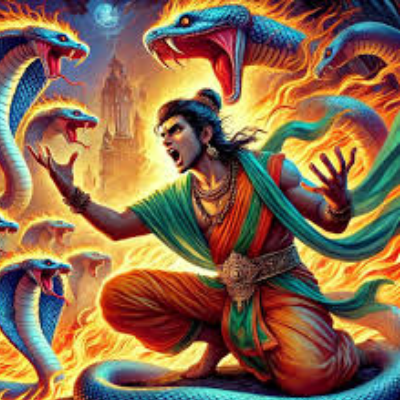
Astika is a Brahmin sage of the Mahabharata who occupies a singular and precisely defined narrative role: he is the figure born and destined to stop the Sarpa Satra — the great snake sacrifice of King Janamejaya of the Kuru dynasty — and thereby save the naga race from annihilation. His narrative forms the Astika Parva, the opening sub-book of the Adi Parva of the Mahabharata, and the tale of his birth, childhood, and intervention at the sacrifice is the framing story within which the Mahabharata was first publicly recited. He is the son of the sage Jaratkaru and Vasuki's sister — also called Jaratkaru in the Mahabharata — who is identified in later Puranic and regional traditions with the goddess Manasa. He is raised by his maternal uncle Vasuki, taught by the sage Chyavana, and fulfils his destiny as a young boy by approaching Janamejaya's court and persuading the king — through eloquence, praise, and the formal grant of a boon — to halt the sacrifice and spare the surviving nagas. The Mahabharata tradition holds that whoever hears the story of Astika is protected from the harm of serpents, and that serpents who hear his name uttered in a pledge will not harm the speaker.
✦ The Name
The name Astika is derived from the Sanskrit affirmative particle asti, meaning he is or there is, with the nominal suffix forming a personal name meaning one who affirms existence, he who is, or believer. The Sarpa Satra Wikipedia account explains the naming directly: when the infant was in the womb, his father the sage Jaratkaru uttered the words there is upon perceiving his presence through inner knowledge, and the child was accordingly named Astika — he who is, or he who exists. The name is thus a declaration of existence and affirmation, contrasting with the potential annihilation of the naga race that his birth was prophesied to prevent.
✦ Lineage
- Father: Jaratkaru — a renowned Brahmin ascetic of the Yayavara lineage, one of the most learned and disciplined sages of his age, who had devoted himself entirely to austerities and celibacy. He married Vasuki's sister only because his ancestors appeared to him in a vision hanging upside down in a pit, facing the prospect of falling to hell without a male heir. He departed from the marriage after his wife woke him at sunset, and he blessed her with the assurance that his seed was within her before he left.
- Mother: Vasuki's sister, named Jaratkaru in the Mahabharata primary text and identified in later Puranic and regional traditions with the goddess Manasa. She gave birth to Astika in Vasuki's home and raised him there. When the Sarpa Satra began consuming the nagas, it was she who sent Astika to the sacrifice to fulfil his destiny.
- Maternal uncle: Vasuki — the king of the nagas, who raised Astika in his home, arranged the marriage of his sister and the sage to produce Astika as a strategic act to save the naga race, and when the Sarpa Satra began consuming his kin appealed directly to Astika to intervene.
- Maternal grandmother: Kadru — the mother of the nagas, whose curse pronounced against her disobedient sons set in motion the entire chain of events leading to the Sarpa Satra, and whose curse Astika's intervention partially fulfilled and partially checked.
- Maternal grandfather: Kashyapa — the progenitor sage, father of all nagas through Kadru and of Garuda through Vinata.
- Teacher: Chyavana — son of the sage Maharishi Bhrigu, who taught the young Astika the Vedas and their branches in Vasuki's household. The Sarpa Satra Wikipedia article records that Astika became proficient in the Vedic scriptures under Chyavana's instruction and was saintly and rigid in his habits from an early age.
✦ The Background: Prophecy and the Sarpa Satra
Astika's existence is the fulfilment of a cosmic plan established long before his birth. When Kadru cursed her serpent sons to perish in Janamejaya's snake sacrifice — because several of them had refused to participate in her scheme to deceive Vinata over the colour of the horse Uchaishravas — the gods brought the matter before Brahma. Brahma declined to interfere, as he saw the curse as a necessary corrective to the unchecked proliferation of venomous serpents causing suffering to living beings. However, he disclosed through the naga Elapatra that the noble serpents would be saved: the sage Jaratkaru would marry a woman of the same name as himself from the naga lineage, and their son, to be called Astika, would stop the sacrifice. This was the prophetic framework within which every subsequent event — Vasuki's patient vigil over the wandering sage, the arranged marriage, the troubled household, Jaratkaru's departure, and Astika's birth and upbringing — unfolded as predetermined steps toward a destined conclusion.
The proximate cause of the Sarpa Satra was the death of King Parikshit of the Kuru dynasty — grandson of Arjuna, last survivor of the house of Pandu — who had been cursed to die by snakebite by the young sage Sringi, whose father Parikshit had inadvertently insulted. The snake Takshaka carried out the curse, biting and killing Parikshit. Parikshit's son and successor Janamejaya, consumed with grief and rage, resolved to exterminate the entire naga race by performing the Sarpa Satra — a sacrifice of such terrible power that serpents from across the three worlds were drawn into its fire by the force of the mantras. The powercutonline account records that even Takshaka, the direct killer of Parikshit, took refuge under Indra himself, and when the priests began to summon Indra along with Takshaka to the fire, the cosmic stakes of the sacrifice had escalated to a confrontation with the king of the devas.
✦ The Intervention at the Sarpa Satra
As the sacrifice consumed naga after naga and Vasuki saw his kin being destroyed, he appealed in desperate urgency to his sister and then directly to Astika. Astika's mother confirmed to him the background of the curse, the prophecy, and his own destiny. Astika vowed to stop the sacrifice and set out for Janamejaya's court.
He was initially refused entry at the gate of the sacrifice ground. He persuaded the gatekeepers to allow him in. Once inside, the young Brahmin — described across sources as appearing as a boy or young man radiating an extraordinary aura of learning and spiritual authority — began to extol Janamejaya, praising his strength, lineage, righteousness, and the qualities of his ancestors. He also praised the officiating priests (Ritwiks) and the assembled sages (Sadasyas). Janamejaya, deeply pleased by the eloquence and erudition of this remarkable youth, offered him a boon — any boon of his choosing, with the assurance that even the ungrantable would be granted to a Brahmin. The chief priest cautioned the king that the sacrifice was not yet complete, that Takshaka was still alive, and that the boon should not be given until the principal target had fallen. Janamejaya commanded the priests to intensify the mantra-work to draw Takshaka into the fire.
According to the Mahabharataonline primary translation account, Astika cried out at the critical moment — Stay! Let Takshaka's fall be arrested! — and by the force of his utterance and spiritual power held Takshaka suspended above the flames even as the priests continued chanting. He then turned to Janamejaya and stated his lineage — his father Jaratkaru the Brahmin, his mother the sister of Vasuki — and declared that his boon was the cessation of the sacrifice. Janamejaya was deeply reluctant. He offered Astika gold, silver, cattle, and other gifts, urging him to ask for anything else. Astika refused: he would have the sacrifice end and his maternal relations saved, or nothing. The assembled learned priests unanimously advised Janamejaya to honour his word. The sage Vyasa, who was present, added his counsel. Janamejaya, as a man of dharma, bound by the honour of his own boon, gave the order to stop. The fires died. The chants ceased. Takshaka was released.
✦ The Mantra and the Significance for the Mahabharata's Transmission
The Drifter Adwait account records the declaration of Vasuki upon Astika's success: that whoever remembers Astika's name shall never be harmed by any serpent. The Mahabharata preserves an associated protective mantra that invokes Astika's name as a ward against snakebite. The mahabharataonline account records that the tradition holds anyone who hears the story of the Sarpa Satra will have nothing to fear from snakes.
Critically, the stopping of the Sarpa Satra by Astika is the narrative occasion for the first complete public telling of the Mahabharata itself. With the sacrifice ended and the court still assembled, the sage Vaishampayana — a disciple of Vyasa — narrated the entire Mahabharata to King Janamejaya and the gathered sages and kings at Vyasa's instruction. The powercutonline account states this explicitly: the Astika Parv forms the framing device within which the retelling of the Mahabharata was initiated, and without the occasion of Janamejaya's sacrifice and Astika's intervention, the conditions for the first public recitation of India's greatest epic would not have existed. Astika is thus not merely the saviour of the nagas but the inadvertent patron of the transmission of the Mahabharata to posterity.
✦ Theological and Narrative Significance
The story of Astika illustrates several principles that the Mahabharata returns to repeatedly. The fulfillment of a cosmic purpose through an ordinary individual who does not seek power but acts from compassion and duty is one of the tradition's most characteristic themes. Astika is not a warrior, a king, or a god — he is a young Brahmin boy of mixed human-naga parentage whose entire significance lies in his eloquence and in the honour of a king's given word. The Swarajya Mag analysis of the Sarpa Satra notes that the sacrifice was fated to fail through multiple converging factors — Sarama's curse, the appointment of a priest born of a snake mother, Janamejaya's own hospitality to Brahmins — creating a structural pattern in which the universe itself conspired toward the outcome that Brahma had decreed: the preservation of the noble nagas and the extermination only of the harmful ones. Astika is the instrument through which this decree was realised.
The Apam Napat account emphasises Astika's role as a bridge between sages and nagas — through his dual parentage he embodies both Brahmin learning and naga kinship, and it is precisely this combination that enables him to speak with authority in the sacrificial court and to invoke both his Brahmin father and his naga mother as the grounds for his plea. His request appeals simultaneously to the king's duty to honour Brahmins and to Brahma's own desire that only the truly evil nagas perish.
✦ References
Primary Sources
- Mahabharata, Adi Parva, Astika Parva — the primary and most detailed source for Astika's birth, upbringing, mission, and intervention at the Sarpa Satra; contains the complete narrative in two versions (a shorter and longer telling).
- Srimad Devi Bhagavatam, Skandha 2, Chapter 12 — records the birth of Astika as protector of the nagas.
Modern Reference Works
- Wikipedia, "Sarpa Satra" — the most comprehensive secondary account of the Sarpa Satra; records all key episodes of Astika's role from Elapatra's disclosure through to the halting of the sacrifice and the subsequent narration of the Mahabharata.
- Wikipedia, "Jaratkaru" — records Astika's conception, birth, and the context of his parents' troubled marriage.
- Mahabharataonline.com, "Janamejaya's Sarpa Satra" — provides direct quotation from the primary text of Astika's speech to Janamejaya identifying his parentage and his request.
- Apam Napat, "Astika — Brahmana Who Saved the Serpents" — detailed secondary narrative of Astika's role; analyses his symbolic position as bridge between the sage and naga worlds.
- Drifter Adwait, "The Legend of Astika" — records Vasuki's declaration that whoever remembers Astika's name will not be harmed by any serpent, and the textual basis for the protective mantra.
- Powercutonline.com, "What Happened After the Mahabharata War" — records the connection between the stopping of the Sarpa Satra and the first public narration of the Mahabharata by Vaishampayana.
- Swarajya Mag, "Fated to Fail: The Sarpa Satra" — provides the structural analysis of the sacrifice's multiple pre-ordained failure points and Astika's position within the cosmic design.
- VenuPayyanur.com, "Story of Astika and Snake Sacrifice" — records Astika's refusal of all alternatives and his insistence on the boon of the sacrifice's cessation.