
About
Takshaka — King of the Nagas, Friend of Indra, and Slayer of Parikshit
Takshaka · Takṣaka · Nagaraja · king of the Nagas
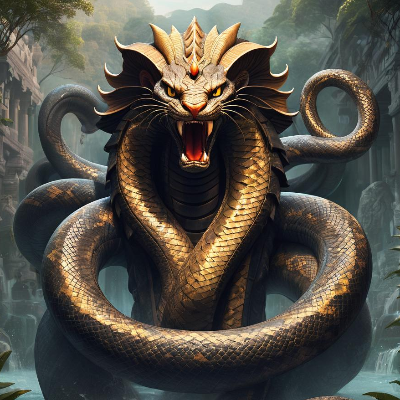
Takshaka is a king of the nagas in the Mahabharata, the Bhagavata Purana, and associated Puranic traditions — one of the most consequential serpent figures in the Hindu epic cycle and a driving force behind the chain of events that led from the burning of the Khandava forest through the death of King Parikshit to the Sarpa Satra of Janamejaya. He is the third principal naga son of Kashyapa and Kadru, born after Shesha and Vasuki, and is described as the most venomous of all serpents, possessed of deadly poison and a terrifying form. His colour is red. He is a king of the nagas, specifically associated with the city of Takshasila — later the ancient city of Taxila — and is the special friend of Indra, king of the devas. The entire arc of his narrative is organised around two interlocking cycles of revenge: the enmity between his race and the Pandava line arising from the burning of the Khandava forest, in which his wife was killed; and the eventual fulfilment of that enmity through his killing of Parikshit, Arjuna's grandson. His survival of the Sarpa Satra through the intervention of Astika and the shelter of Indra forms the resolution of his narrative arc. He is also known in Chinese and Japanese Buddhist tradition as one of the eight great dragon kings.
✦ The Name
The name Takshaka is Sanskrit, from the root taksh, meaning to cut, carve, or fashion by cutting. The nominal form Takshaka thus denotes a cutter or carver — a name with possible associations with the sudden, cutting nature of a snakebite, or with the shaping of destiny through decisive and destructive action. In later tradition the name is associated with the historical city of Takshasila (Taxila), which the Mahabharata identifies as Takshaka's domain and which the Wikipedia Takshaka article records as his new territory after the nagas were expelled from the Khandava forest and Kurukshetra by the Pandavas. The brother of Takshaka is named Srutasena in the Mahabharata, which identifies him as residing at the holy place called Mahadyumna with the aim of obtaining the chiefship of the serpents.
✦ Lineage and Nature
- Father: Kashyapa — the great sage, progenitor of all living beings.
- Mother: Kadru — mother of all nagas, whose curse upon her disobedient sons set in motion the prophecy of the Sarpa Satra.
- Elder brothers: Shesha — the cosmic bearer of the earth and bed of Vishnu; Vasuki — the naga king, churning rope of the Samudra Manthana, and ornament of Shiva.
- Brother: Srutasena — mentioned at Mahabharata 1.3 as Takshaka's younger brother, residing at Mahadyumna.
- Wife: Unnamed — slain in the burning of the Khandava forest by Arjuna. Her death is the root cause of Takshaka's vendetta against the Pandava lineage.
- Son: Ashvasena — who survived the Khandava burning because his mother shielded him before dying. Ashvasena later attempted to avenge his mother's death during the Kurukshetra War by disguising himself as an arrow in Karna's quiver during Karna's battle with Arjuna. When Karna fired the arrow, Krishna pressed down the chariot with his feet, causing the arrow to strike and shatter only Arjuna's crown rather than killing him. The Wikipedia Takshaka article records that the Mahabharata mentions a king named Riksha of the Puru lineage marrying a daughter of a naga of Takshaka's race, indicating the continuation of the Takshaka lineage beyond the immediate family.
- Ally: Indra — the king of the devas and a long-standing personal friend of Takshaka. The Khandava forest was under Indra's protection precisely because Takshaka lived there, and Indra had previously sent rains to prevent Agni from burning it. During the Sarpa Satra, Indra sheltered Takshaka under his own throne when all other serpents were being drawn into the fire.
✦ The Khandava Forest and the Root of the Vendetta
The burning of the Khandava forest, narrated in the Adi Parva of the Mahabharata as the Khandava Daha Parva, is the foundational episode of Takshaka's antagonism toward the Pandava line. The god Agni, afflicted by a digestive ailment, required the consumption of the vast Khandava forest to recover his strength. Agni approached Krishna and Arjuna and requested their assistance. They agreed, and while Agni burned the forest, Arjuna and Krishna prevented every bird, beast, and living being from escaping — a fifteen-day destruction of extraordinary scale. The forest was the home of Takshaka and his family, as well as of many nagas, pisachas, rakshasas, daityas, and danavas.
At the time of the burning, Takshaka was absent from the forest, having gone to Kurukshetra. His wife, however, was present and was killed in the conflagration. Their son Ashvasena was saved only because Takshaka's wife, in her dying act, swallowed the infant and shielded him before perishing. Ashvasena later emerged and escaped. The Scroll.in analysis of the Khandava burning notes that Takshaka's particular personal enmity for the Pandavas — and Arjuna specifically — stems from this killing of his wife, and that the chain connecting the Khandava burning to Parikshit's death to the Sarpa Satra forms one of the Mahabharata's most coherent sub-themes of karmic consequence across generations. The Wisdomlib Ashtanaga account states that Takshaka was one of the nagas cursed by Kadru who went to live in the Khandava forest.
✦ The Attempt on Arjuna During the Kurukshetra War
Before Takshaka could exact his revenge on Arjuna directly, his son Ashvasena attempted the deed during the Kurukshetra War. The WordPress Mahabharata account records that during the battle between Karna and Arjuna in the Karna Parva, Ashvasena, dwelling in the underworld since the Khandava burning and waiting for an opportunity, entered Karna's quiver disguised as an arrow. When Karna deployed this weapon against Arjuna, Krishna — who was Arjuna's charioteer and had already identified the danger — pressed his feet hard against the chariot floor, causing the vehicle to sink under his divine weight so that the horses knelt and the chariot lowered. As a result, the arrow — Ashvasena in disguise — struck Arjuna's crown rather than his throat or head, shattering it without killing him. Ashvasena died in the attempt. Karna had not known the arrow's true nature; the Mahabharata text notes at 8.90 that Ashvasena was described as born in the race of Airavata. Takshaka himself is also said in the Boloji literary analysis to have attempted to slay Arjuna during the war by disguising himself on Ashvatthama's arrow, though this is treated as a variant of the Ashvasena episode rather than a separate event.
✦ The Stealing of Uttanka's Earrings
An episode recorded in the Mahabharata Adi Parva connects Takshaka to the sage Uttanka, which ultimately became one of the catalysts for the Sarpa Satra. Uttanka, a disciple of a Brahmin sage, had been sent to obtain the earrings of a queen as part of his guru dakshina. He successfully obtained them but on his way back Takshaka, disguised as a beggar, stole the earrings from him. Uttanka eventually recovered the earrings through supernatural assistance and delivered them to his teacher, but the incident left him with a profound grievance against Takshaka. Years later, when Janamejaya became king after his father Parikshit's death — itself caused by Takshaka — Uttanka came to the court of Janamejaya and reminded him of the circumstances of his father's death. It was this visit by Uttanka that formally informed Janamejaya of Takshaka's role and provided the impetus for the Sarpa Satra.
✦ The Killing of Parikshit
Parikshit, grandson of Arjuna and sole surviving heir of the Pandava line, was cursed by the young ascetic Sringi — son of the meditating sage Shamika — to die by snakebite within seven days. The curse arose when Parikshit, exhausted and thirsty during a hunt, came to Shamika's hermitage. When the sage, lost in deep meditation, did not respond to his request for water, Parikshit in a moment of uncharacteristic irritation picked up a dead snake with his bow and draped it around the sage's neck. Sringi, returning and finding the insult, cursed him immediately. Shamika, on emerging from meditation, regretted his son's rashness and sent warning to Parikshit, but the curse was irrevocable.
Takshaka, learning of the curse, set out to fulfil it on the seventh day. On the road he encountered a Brahmin named Kashyapa — not the primordial sage Kashyapa but a human Brahmin of the Kashyapa clan — who possessed the mantras to cure snakebite and was travelling to the king's palace intending to cure Parikshit and earn a reward. Takshaka, to test Kashyapa's claim, struck a nearby tree with his venom, reducing it to ash instantly. Kashyapa then recited the appropriate mantras and sprinkled water on the ash, causing the tree to regrow entirely — demonstrating his ability to reverse even Takshaka's bite. Confronted with this proof, Takshaka acknowledged the ability but argued that Parikshit's time of death had come and that no merit would accrue to Kashyapa from reviving one whose karma was exhausted. He then offered the Brahmin a sum of wealth exceeding what the king could provide. Kashyapa, by his divine vision, confirmed that the king's allotted time was indeed over and accepted the bribe, turning back.
With Kashyapa neutralised, Takshaka devised his final approach to the heavily guarded king. Parikshit had retreated to a palace constructed on a single pillar, surrounded by Brahmin priests expert in poison-cures. Takshaka sent his companion nagas disguised as Brahmin ascetics bearing offerings of fruit to the king. Within one of the fruits Takshaka concealed himself as a tiny worm. The guards permitted only the fruit to enter; the disguised nagas were stopped at the gate but the fruit was allowed through. When Parikshit bit into the fruit, the tiny worm emerged and transformed instantaneously into Takshaka in full serpent form, who bit the king. The Bhagavata Purana version records that the king died immediately, consumed by fire generated by the potency of Takshaka's poison — a detail with symbolic resonance, since it was fire that had killed Takshaka's wife in the Khandava burning.
✦ The Sarpa Satra and the Refuge with Indra
Parikshit's death provoked his son Janamejaya into initiating the Sarpa Satra, the snake sacrifice designed to exterminate all serpents. As the sacrifice began and nagas fell into the fire by the thousands, Takshaka — the primary target of Janamejaya's wrath — fled to his friend Indra and sought his protection. Indra sheltered Takshaka under his own throne in Svarga. When the priests' mantras grew powerful enough to pull Indra himself toward the fire along with Takshaka, Janamejaya commanded the priests to summon both Indra and Takshaka together. The power of the sacrifice was such that even the king of the devas began to be drawn toward the flames. At this most critical moment, Astika intervened, and the sacrifice was halted at Janamejaya's order. Takshaka was released and survived. The Parikshit Wikipedia article records that this day — when Takshaka was spared — was the Shukla Paksha Panchami in the month of Shravana, which has been celebrated since as the festival of Nag Panchami.
✦ Textual Variants
The Wikipedia Takshaka article includes an unusual variant in parentage: it states that according to the Shrimad Bhagavatam, Takshaka belonged to the Ikshvaku dynasty and was a descendant of Rama. This is directly at odds with the mainstream naga genealogy that identifies him as a son of Kashyapa and Kadru. The Ikshvaku dynasty identification appears to be an isolated tradition without corroboration in the principal Mahabharata or Puranic sources consulted. It is noted here without endorsement. The same article mentions a Brihadbala — said to be the son of Takshaka — who was killed in battle by Abhimanyu; however, the well-attested Brihadbala of the Mahabharata is a king of the solar Ikshvaku line descended from Rama, making this attribution almost certainly a confusion between two distinct figures of the same name.
✦ Narrative Significance
Takshaka occupies a structurally unique position in the Mahabharata as the figure through whom the karma of the Khandava burning — an act of the Pandava heroes, enabled by Krishna, celebrated as a triumph of human power — returns to collect its debt across generations. The Scroll.in and Boloji.com literary analyses emphasise this structural function: the death of Takshaka's wife in the Khandava fire was an act of indiscriminate destruction by the heroes of the epic, and its consequence — the killing of their descendant Parikshit — arrives not as divine punishment but as the working of an inexorable chain of cause and effect. Takshaka acts from grief and the logic of revenge, not from demonic malice; the Isha Sadhguru account places this explicitly in Astika's own words to Janamejaya at the Sarpa Satra, urging that the cycle of revenge be ended rather than perpetuated. Takshaka's survival at the end of the Sarpa Satra thus represents not his triumph but the resolution of a cycle that had been turning since the burning of the Khandava forest.
✦ References
Primary Sources
- Mahabharata, Adi Parva, 1.3 — establishes Takshaka as a king of the nagas, identifies him as the friend of Indra, and records his former dwelling at Kurukshetra and the Khandava forest.
- Mahabharata, Adi Parva, Khandava Daha Parva (1.225–1.230) — records the burning of the Khandava forest; the absence of Takshaka; the killing of his wife; the escape of Ashvasena; and the survival of Mayasura.
- Mahabharata, Adi Parva, Astika Parva (1.40–1.56) — the principal source for Takshaka's killing of Parikshit, his encounter with and bribery of Kashyapa, his disguise as a worm in a fruit, and his shelter under Indra during the Sarpa Satra.
- Mahabharata, Karna Parva (8.90) — records Ashvasena's attempt to kill Arjuna by entering Karna's quiver as an arrow, and Krishna's intervention.
- Bhagavata Purana, Skandha 12 — the Bhagavata Purana account of Takshaka's killing of Parikshit; includes the demonstration of poison on the tree, the bribery of Kashyapa, and the king's death by fire generated from Takshaka's venom.
Modern Reference Works
- Wikipedia, "Takshaka" — comprehensive secondary survey with direct Mahabharata sarga references; covers all principal episodes and notes the Ikshvaku-dynasty variant.
- Vyasaonline.com, "Takshaka" — encyclopaedic summary of Takshaka's narrative arc from the Khandava forest to the Sarpa Satra.
- Wisdomlib, "Ashtanaga — Eight Important Nagas", Chapter 5.2 — records Takshaka's birth from Kashyapa and Kadru, his red colour, his terrible form and powerful venom, and his survival of the Sarpa Satra.
- Jayarama.wordpress.com, "The Revenge of Takshaka and Aswasena on Arjuna" — the clearest secondary account of the multi-generational revenge chain from the Khandava burning through Ashvasena's battle-arrow attempt to Takshaka's killing of Parikshit; cites Mahabharata sarga references directly.
- Scroll.in, "As the Amazon Burns…" — literary analysis of the Khandava burning as the origin of Takshaka's vendetta and as a structural hinge of the Mahabharata's extended narrative.
- Boloji.com, "Khandava in Flames" — the most rigorous literary treatment of Takshaka's role as the connecting thread between the Khandava burning and the Sarpa Satra; notes the parallel significance of Indra's consistent protection of Takshaka in both episodes.
- INDIASPIRITUALITY blog (Bhagavata Purana 12.6) — provides the full Bhagavata Purana account of the poison-demonstration-on-tree episode and Kashyapa's bribery.
- Parikshit Wikipedia article — records the Nag Panchami tradition connecting the festival to the day of Takshaka's survival at the Sarpa Satra.
- Isha Sadhguru, "Mahabharata Episode 73" — preserves Astika's speech to Janamejaya identifying the full cycle from the Khandava burning through to Takshaka's revenge, and the case for ending the cycle of retribution.