
About
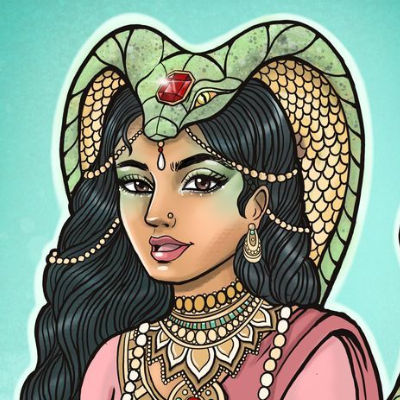
Nagakanya — Wife of Takshaka, Queen of the Naga Realm
Nagakanya · Nagapatni · Takshaka-patni
Nagakanya is the wife of Takshaka, one of the foremost Naga kings in the Mahabharata tradition, and the mother of his children including the Naga princess Ivalana, who is given in marriage to Richeyu, a king of the lunar dynasty. The name Nagakanya is not a personal name in the strict sense but rather a descriptive designation meaning maiden of the Nagas or daughter of the serpent race, applicable in principle to any female being of the Naga order. It is the name by which this figure is identified in the relevant passages of the primary sources, and no alternative personal name for Takshaka's wife is recorded in the surviving textual tradition. She is known principally through the episode of the burning of the Khandava forest, in which she perishes, and through her role as the mother of Takshaka's lineage. The textual base for this figure is narrow, and this profile reflects that limitation honestly.
✦ The Name
The designation Nagakanya is a Sanskrit compound formed from naga, meaning serpent or serpent being, and kanya, meaning maiden, girl, or daughter. As a compound it denotes a female of the Naga race and is used as both a general descriptive term and, in this instance, as the identifying name by which Takshaka's wife is known in the primary sources. The related epithet Nagapatni, meaning wife of a Naga or queen of the Naga world, is a parallel construction applicable to her role as the consort of Takshaka. The designation Takshaka-patni, meaning wife of Takshaka, is a relational identifier rather than a name. None of the primary sources consulted for this profile supply a personal name for this figure distinct from these descriptive designations, and the absence of a personal name in the surviving record is itself a fact worth noting rather than a gap to be filled.
✦ Lineage
- Husband: Takshaka — one of the foremost Naga kings in the Mahabharata, counted among the greatest of all serpent chiefs alongside Shesha, also known as Ananta, the cosmic serpent upon whom Vishnu rests, and Vasuki, the Naga used as the churning rope at the churning of the cosmic ocean. Takshaka dwells at Kurukshetra and at the city of Takshasila, which bears his name. He is the Naga who delivers the fatal bite to Parikshit, the grandson of Arjuna and son of the hero Abhimanyu, an act that precipitates the great serpent sacrifice of Janamejaya and provides the narrative occasion for the Mahabharata itself to be recited. All Nagas trace their cosmological ancestry to Kashyapa, one of the seven primordial sages, and Kadru, a daughter of the progenitor Daksha, who is regarded as the mother of all serpent beings.
- Daughter: Ivalana — a Naga princess, daughter of Takshaka and Nagakanya, who is given in marriage to Richeyu, a king of the lunar dynasty descended from the primordial ancestor Manu. Through this union, the lineage of Takshaka enters the human royal genealogical world of the Mahabharata.
✦ The Burning of the Khandava Forest
The sole narrative episode in the Mahabharata in which Nagakanya, the wife of Takshaka, is directly implicated is the burning of the Khandava forest, narrated in the Adi Parva. The Khandava forest was a vast and ancient woodland that the fire god Agni wished to consume but had been repeatedly frustrated in his attempts to do so, because Indra, the king of the gods, intervened each time with rain to protect the forest, which sheltered Takshaka and was under Indra's protection. Agni eventually sought the assistance of Arjuna and Krishna to prevent Indra's intervention while he burned the forest. Arjuna, the third Pandava and one of the greatest archers of the age, and Krishna, the Yadava prince who is regarded in the Bhagavata tradition as an avatar of Vishnu, agreed to assist Agni and sealed off the forest so that no creature could escape while it burned.
Takshaka himself was absent from the forest at the time of the burning, having gone to Kurukshetra, and thus escaped destruction. His wife Nagakanya, however, was present in the Khandava forest when it was set ablaze and perished in the fire. The Mahabharata records her death in this conflagration as a fact of the episode. Her death in the Khandava burning is subsequently cited in later portions of the text as a source of Takshaka's grief and as context for the enmity and actions that define his later role in the narrative, most notably his killing of Parikshit. The burning of Khandava is thus the episode through which Nagakanya acquires her only direct narrative significance: she is the wife whose death in the fire shapes, at least in part, the motivation and character of one of the epic's most consequential antagonists.
✦ Nagakanya's Death and Takshaka's Grief
The Mahabharata makes reference to the grief of Takshaka over the loss of his wife in the Khandava fire in connection with the larger narrative of the enmity between the Nagas and the Pandava line, and between Takshaka and those associated with the burning. The destruction of Khandava is presented in the text not merely as an incident in the early life of Arjuna and Krishna but as an event with lasting consequences for the relationships between gods, Nagas, and humans. The loss of Nagakanya is one of those consequences: it bereaves the most powerful of Naga kings and contributes to the chain of events — Takshaka's later killing of Parikshit, Janamejaya's serpent sacrifice in response, and the framing narrative of the entire Mahabharata — that give the epic its outer structural shape. In this sense, although Nagakanya is a figure with almost no direct textual presence of her own, her death is an event of genuine narrative consequence within the architecture of the epic.
✦ Textual Variants and Inconsistencies
The primary sources do not provide variant accounts of Nagakanya's identity or of her death in the Khandava burning that would constitute a significant textual inconsistency. Her treatment across recensions of the Mahabharata is consistent in its brevity: she is named or identified as Takshaka's wife who perished in the fire, without elaboration or variant tradition attaching to her individual story. No Puranic source provides a substantially different account of this figure. The absence of a personal name for her in the surviving record is consistent across the textual tradition, suggesting that the primary sources did not preserve or perhaps did not possess a personal name for this figure independent of her relational and descriptive designations.
✦ Connection to the Wider Genealogy
Through her husband Takshaka, Nagakanya is connected to one of the most prominent lineages in the Naga world, itself tracing its cosmological origin to Kashyapa and Kadru, the progenitors of all serpent beings. Takshaka is counted among the supreme Naga chiefs, a peer of Shesha and Vasuki in the hierarchy of the serpent world. Through her daughter Ivalana's marriage to Richeyu, a king of the lunar dynasty, Nagakanya becomes a maternal grandmother whose lineage enters the human royal world of the Mahabharata. The lunar dynasty to which Richeyu belongs traces its descent from Manu, the progenitor of humanity, through Soma the moon god and his son Budha, and encompasses the Kuru, Pandava, and Yadava royal lines among its many branches. Nagakanya thus stands, through her daughter, at one of the points of intersection between the Naga world and the human royal genealogies that the Mahabharata constructs across its genealogical books.
✦ References
- Primary Sources:
- Mahabharata, Adi Parva, Khandava-daha sub-parva — The principal source for the burning of the Khandava forest, the role of Arjuna and Krishna in sealing the forest, and the death of Nagakanya, wife of Takshaka, in the conflagration.
- Mahabharata, Adi Parva, Astika sub-parva — Provides the broader account of Takshaka's lineage, his standing among the Naga chiefs, and the cosmological genealogy of the Nagas descending from Kashyapa and Kadru.
- Mahabharata, Adi Parva, Sambhava sub-parva — Contains genealogical material identifying Ivalana as the daughter of Takshaka and the wife of Richeyu, establishing the lineage that Nagakanya helped produce.
- Secondary Sources:
- Puranic Encyclopaedia by Vettam Mani — Provides entries for Takshaka and the Khandava burning episode that allow the narrative context of Nagakanya's death to be situated within the wider framework of Mahabharata events.
- The Mahabharata, critical edition published by the Bhandarkar Oriental Research Institute — The authoritative critical text against which the details of the Khandava burning and the identification of Takshaka's wife have been verified.