
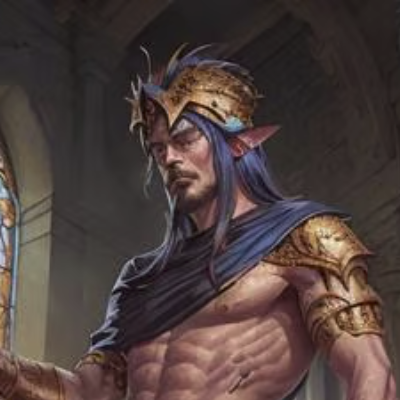
About
Ashvasena — Naga Prince, Son of Takshaka, Antagonist of Arjuna
Ashvasena · Asvасena · Ashwasena · Ashva-sena
Ashvasena is a Naga prince recorded in the Mahabharata as the son of Takshaka, the powerful king of the serpent race. He is one of the most narratively distinct serpent figures in the epic, distinguished by a personal vendetta against the Pandava archer Arjuna that persists from the burning of the Khandava forest in the Adi Parva to the seventeenth day of the Kurukshetra war described in the Karna Parva. His story encompasses his near-death in the Khandava fire, the killing of his mother by Arjuna, his miraculous escape, the curse laid upon him, his attempt at revenge through Karna's arrow, and his ultimate death at Arjuna's hands. The Puranic Encyclopedia records that before his death he became acquainted with Krishna. Ashvasena appears primarily in the Adi Parva and the Karna Parva of the Mahabharata.
✦ The Name
The name Ashvasena is a Sanskrit compound formed from ashva, meaning horse, and sena, meaning army or force. The compound thus carries the sense of one who possesses the strength or force of horses — a name befitting a prince of the serpent race renowned for power. In the Sanskrit lexicographical tradition, the name is recorded simply as a proper designation for a Naga and does not appear to carry a mythological etymology beyond its compositional meaning. The Monier-Williams Sanskrit dictionary records Ashvasena as the name of a Naga with references to the Mahabharata at I.803 and I.8237 in the critical text.
✦ Lineage
- Father: Takshaka — the king of the Naga race, one of the most powerful and feared serpent rulers in the Puranic and epic tradition. Takshaka is the serpent who eventually brings about the death of the Pandava king Parikshit, son of Abhimanyu, as recounted in the Bhagavata Purana and the Adi Parva.
- Mother: A Naga queen, wife of Takshaka, who sacrificed her life during the burning of the Khandava forest in an act of self-immolation intended to save the infant Ashvasena by swallowing him; she was slain by Arjuna before she could carry him to safety.
- Race: The Naga race, serpent beings of the Puranic cosmos descended from the sage Kashyapa and his wife Kadru; the Nagas inhabit the subterranean realm of Patala and are among the most prominent non-human races in both the epics and the Puranas.
✦ The Burning of the Khandava Forest and the Death of Ashvasena's Mother
The foundational episode in Ashvasena's narrative occurs during the burning of the Khandava forest, described in the Khandavadaha Parva of the Adi Parva. The fire god Agni, seeking to consume the Khandava forest to recover his full power, approached Krishna and Arjuna on the banks of the Yamuna and requested their assistance. Arjuna agreed to hold back Indra's rains, which Indra would send in defence of the forest, while Krishna drove the chariot and aided in preventing any creature from escaping the flames. Agni then set the forest ablaze.
Ashvasena, still a young serpent, was trapped within the burning forest. His mother, unwilling to let him perish, devised a desperate means of rescue: she swallowed him headfirst, enclosing him within her body, and attempted to fly free of the conflagration. Arjuna, stationed to prevent the escape of all creatures from the fire, intercepted her flight and severed her head with a sharp arrow, killing her instantly. With his mother decapitated in mid-air, Ashvasena fell.
✦ Escape, Indra's Intervention, and Arjuna's Curse
At this critical moment, Indra — king of the gods and a figure connected to Takshaka in the epic tradition — intervened on Ashvasena's behalf. He unleashed a powerful cyclone that shattered the canopy of arrows Arjuna had erected and caused Arjuna to fall momentarily insensible. In this brief window of confusion, Ashvasena managed to slip away from the burning forest and escape.
When Arjuna recovered consciousness, he discovered that Ashvasena had vanished. Understanding that Indra's intervention had allowed the Naga to flee, Arjuna pronounced a curse upon the serpent: that Ashvasena would never find refuge or shelter anywhere. This curse, which appears in Chapter 226 of the Adi Parva in the traditional recension, established the terms of enmity between archer and serpent that would not be resolved until the Kurukshetra war.
✦ The Nagastra Episode and the Duel of the Seventeenth Day
The second major episode in Ashvasena's narrative takes place on the seventeenth day of the Kurukshetra war, when Karna and Arjuna met in direct combat. Carrying his vendetta across the years since the Khandava fire, Ashvasena concealed himself within a serpent-missile loosed by Karna against Arjuna. His aim was to use the encounter between the two warriors as an opportunity to reach and destroy the man who had killed his mother.
Krishna, serving as Arjuna's charioteer, perceived the supernatural nature of the incoming missile. In a celebrated act of divine foresight and physical intervention, Krishna stamped his feet down with extraordinary force, pressing the chariot wheels into the earth and thereby lowering the entire chariot by one cubit at the precise moment the weapon arrived. The adjustment caused the missile to strike Arjuna's celestial crown — the divine diadem gifted to him by his father Indra — rather than his neck. The crown was shattered and destroyed, but Arjuna survived unharmed.
The missile fell short of its target and returned. Ashvasena revealed himself to Karna and urged him to fire the arrow a second time, promising that this time the shot would not fail. Karna, adhering to the warrior code of the Kshatriya, refused to fire the same arrow twice and also declined to pursue victory through what he regarded as a serpent's act of concealment and deception. He turned down Ashvasena's offer.
Finding himself without Karna's aid, Ashvasena attacked Arjuna directly in an open assault. Arjuna, directed by Krishna, struck the attacking serpent with his arrows and killed him. The Puranic Encyclopedia records that before his death Ashvasena became acquainted with Krishna — a detail that implies a final moment of recognition or encounter with the divine before the end, though the nature of this meeting is not elaborated in the available summary sources. The Karna Parva references for this episode appear at Chapter 90 in some traditional recensions and at Chapter 96 in others, reflecting the variation in sectional numbering across manuscript traditions of the Mahabharata.
✦ Textual Variants and Inconsistencies
The chapter numbering for Ashvasena's appearances in the Mahabharata varies across recensions. The Khandavadaha episode is referenced variously as Chapter 221, 226, or 239 of the Adi Parva depending on the recension consulted. The Karna Parva episode is placed at Chapter 90 in some traditional enumerations and at Chapter 96 in the Puranic Encyclopedia. These discrepancies are characteristic of the manuscript tradition of the Mahabharata and do not reflect contradictions in the narrative content itself.
A separate and entirely distinct figure named Ashvasena appears in the Bhagavata Purana at the tenth skandha, chapter 61, verse 13, where he is listed as a son of Krishna and his wife Satya, also known as Nagnajiti. This figure has no connection to the Naga Ashvasena of the Mahabharata. The shared name creates potential confusion in secondary literature and Sanskrit lexical sources, which list both figures under the same entry. Care must be taken to distinguish the two: the Mahabharata Ashvasena is a Naga, son of Takshaka; the Bhagavata Purana Ashvasena is a human prince, son of Krishna.
Additionally, a third figure named Ashvasena appears in Jain literature as the father of Parshvanatha, the twenty-third Tirthankara, and as a king of Varanasi. This figure belongs to an entirely separate tradition and shares only the name with the epic Naga.
✦ Theological and Narrative Significance
Ashvasena's story functions on several levels within the Mahabharata's moral and theological framework. His narrative is one of the most developed examples of personal vendetta in the epic — a grudge formed in the Adi Parva that crosses the entire chronological arc of the text and erupts again in the Karna Parva. The episode illustrates the Mahabharata's sustained engagement with the question of how personal grief and desire for revenge interact with dharma and with the operations of divine providence.
Karna's refusal to use Ashvasena a second time is one of the most discussed passages in the analysis of Karna's character, as it demonstrates that Karna's warrior code constrains him even in circumstances of extreme need. His refusal to pursue advantage through what he considers a dishonorable means becomes, in hindsight, a factor in his ultimate defeat. Ashvasena's intervention thus becomes a pivot point in the epic's exploration of the tension between tactical advantage and ethical conduct.
Krishna's intervention — sinking the chariot at the critical moment — is among the many passages in the Karna Parva that present Krishna not merely as charioteer but as the active, omniscient protector of Arjuna, subtly altering the physical conditions of the battle to preserve his companion. The destruction of Arjuna's crown rather than his life also carries symbolic weight: the gift of Indra — the same Indra who had once aided Ashvasena's escape — is now the unwitting shield that absorbs the serpent's final blow.
✦ Connection to the Wider Genealogy
Ashvasena belongs to the Naga lineage, which in Puranic cosmology descends from the sage Kashyapa and his wife Kadru. Takshaka, his father, is one of the most prominent Naga kings of the epics and Puranas, appearing across a wide range of episodes including the death of Parikshit, the snake sacrifice of Janamejaya described in the Adi Parva, and various Puranic narratives. The enmity between Takshaka's lineage and the Kuru-Pandava succession is thus a thread that weaves through multiple generations: Takshaka kills Parikshit, and Ashvasena wages his own war against Parikshit's grandfather Arjuna. The Naga race as a whole occupies a complex position in the epic and Puranic universe — feared, revered, capable of both malice and nobility, and frequently intersecting with the human and divine worlds through curse, boon, and marriage.
✦ References
- Mahabharata, Adi Parva, Khandavadaha Parva, Chapter 239 (Verse 5) / Chapter 226 (various recensions): Primary source. Records Ashvasena as the son of Takshaka, his entrapment in the Khandava fire, his mother's act of swallowing him, Arjuna's slaying of his mother, Indra's cyclone, Ashvasena's escape, and Arjuna's curse.
- Mahabharata, Karna Parva, Chapter 90 / Chapter 96 (recension-dependent): Primary source. Records the Nagastra episode on the seventeenth day of the war: Ashvasena concealing himself in Karna's missile, Krishna sinking the chariot, the destruction of Arjuna's crown, Karna's refusal to use the arrow again, Ashvasena's independent attack, and his killing by Arjuna. Also records Ashvasena's acquaintance with Krishna before his death.
- Bhagavata Purana, Skandha X, Chapter 61, Verse 13: Records a separate and distinct figure named Ashvasena as a son of Krishna and Satya (Nagnajiti), establishing the need to distinguish this figure from the Mahabharata Naga of the same name.
- Vettam Mani, Puranic Encyclopaedia (1975): Modern reference. The entries for Ashvasena and Khandavadaha provide a synthesised summary of both episodes from the Mahabharata, including the detail of Ashvasena's acquaintance with Krishna before death and the chapter references for the Karna Parva narrative.
- Wisdomlib.org — Definition page for Ashvasena: Modern reference. Aggregates Sanskrit dictionary entries (Monier-Williams, Cappeller, Apte, Shabda-Sagara), Puranic Encyclopedia summaries, and Cologne Digital Sanskrit Dictionary citations; confirms the Mahabharata textual references at I.803 and I.8237 and notes the Bhagavata Purana reference for the separate Krishna-son named Ashvasena.
- Cologne Digital Sanskrit Dictionaries (Monier-Williams, Cappeller): Modern reference. Confirm Ashvasena as the name of a Naga in the Mahabharata and separately as the name of a son of Krishna in the Bhagavata Purana, with precise textual citations.